Inspiration
Owed tells you who still has to fix your broken thing for free and gives you the words to say when you ask. It could be the maker, the shop, your card, a settlement or the law. For Earth Forward, the idea is simple: a broken thing that gets fixed stays out of the bin.
Here is how it usually goes. Something stops working a few months after the printed warranty ends. A replacement is one click away, and the old one goes straight in the bin. But the printed warranty is rarely the only cover:
The card you paid with may add a year. A class action settlement may have money set aside for that exact fault. The maker may run a quiet free-repair programme. The law where you live can outlast the paper warranty, or stop a company from voiding it. In the US, 15 U.S.C. 2302(c) makes it illegal to void a warranty simply because you used someone else's parts or repair shop. None of this is secret. It's published, just somewhere nobody reads while standing over something that just broke.
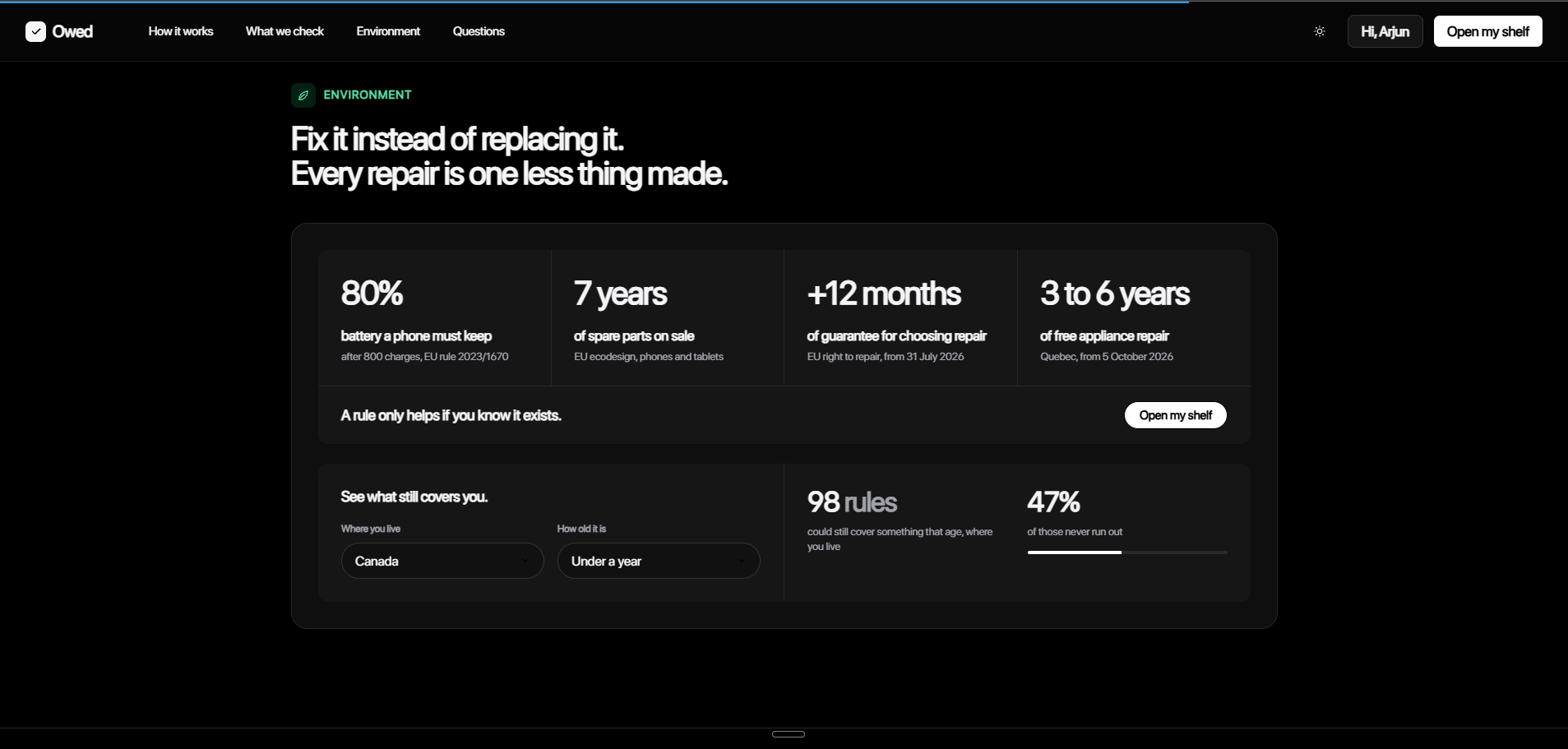
That gap matters for the planet. A record 62 million tonnes of e-waste was produced in 2022, and only 22.3% of it was documented as properly collected and recycled. E-waste is growing five times faster than documented recycling (Global E-waste Monitor 2024). Some of those things died with a fault that someone was already obliged to fix for free, and nobody knew. The greenest repair is the one somebody else already agreed to pay for.
What it does
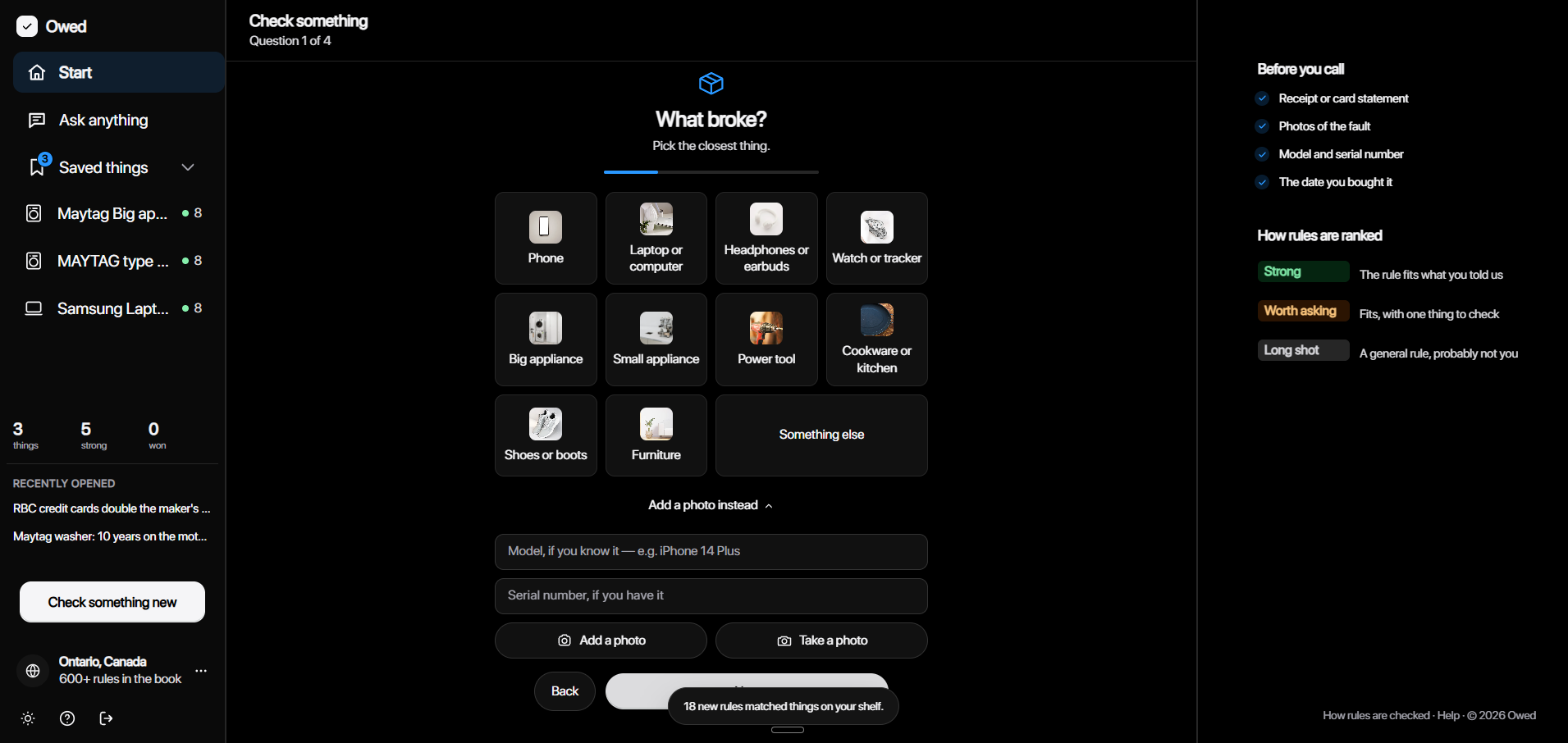
You answer four questions: what broke, the brand, roughly when you bought it, and how you paid. "Can't remember" works for the last two. Owed checks your answers against a rulebook of 672 real coverage rules across 276 brands, and every rule links to the page it came from. Coverage hides in five places, + the shop that sold it:
The maker's warranty, including lifetime warranties people forget (325 rules) Consumer law where you live (162)
The shop that sold it (121)
The card you paid with (46)
Open class-action settlements (15)
Quiet free-repair programmes (3)
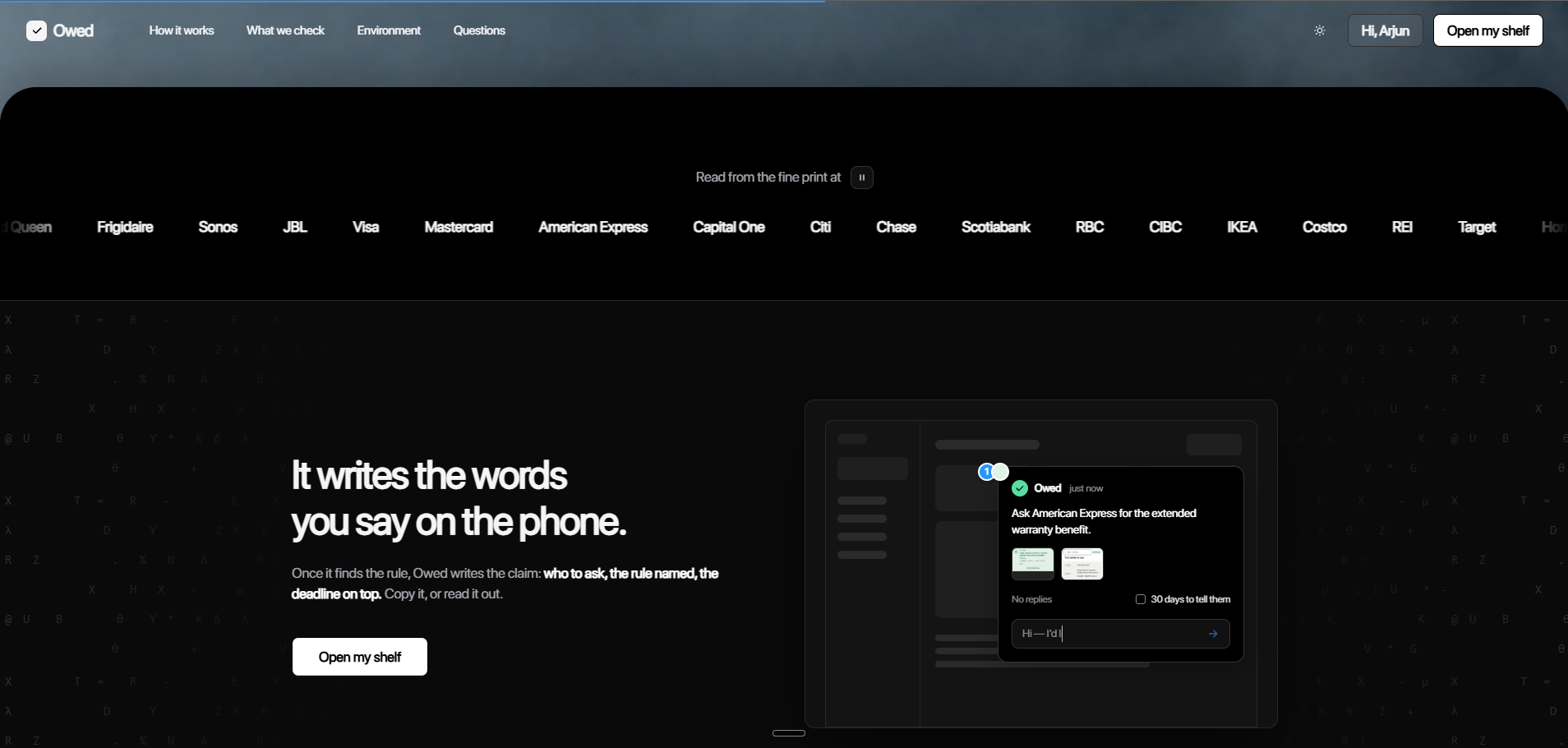
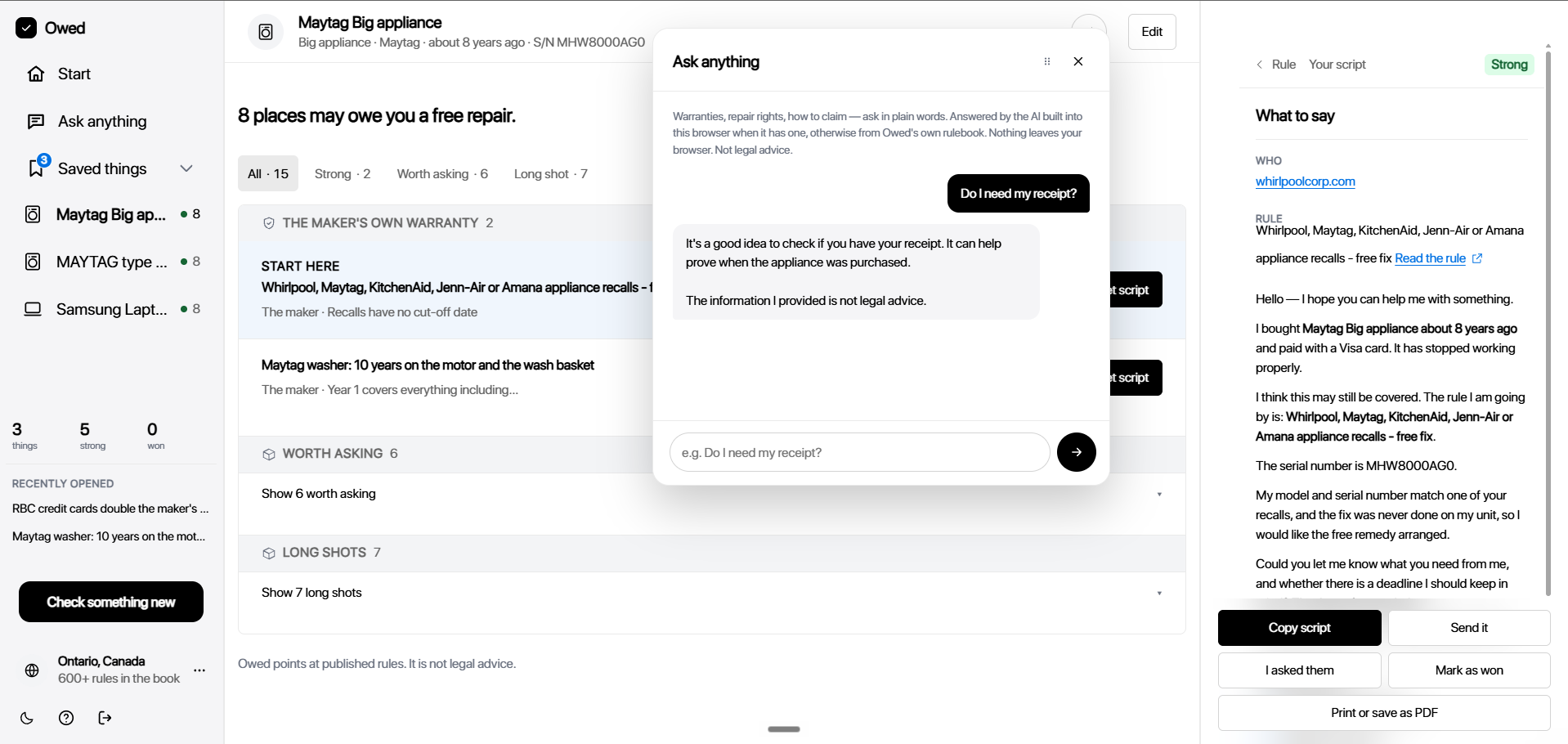
Each match is ranked Strong, Worth asking, or Long shot, with a plain reason. Tap one for a short script you can read out loud on the phone. It names the specific rule, so the person on the other end has something concrete to check instead of an easy no. You also get the contact, the deadline, and the source. You can copy the script, send it by email or phone, print a claim sheet, and mark the claim as asked or won. Marking it as won says: "Counted. That is one thing that stays out of the bin."
How we built it
I built Owed solo, with a lot of AI help, and I want to be upfront about the split. Claude Code wrote the code: 141 of the 143 commits carry its co-author tag, and I don't write JavaScript or CSS myself. My part was the decisions: choosing the problem, what to build next, the design direction, what counted as done, the testing, and the presentation.
The engine hard-filters first, then scores what's left. It drops a rule for the wrong category, place, payment, bank, or brand; an expired deadline; a store-only rule when you shopped elsewhere; or a closed window. Among the survivors, confidence counts 3, 2, or 1, and an exact brand, the right store, your own state's law, and the right card each add points. A score of 5 or more is Strong, and 3.2 or more is Worth asking. The sentence is built from the same facts, so it never cites something the score ignored.
The rules. AI research agents read the primary sources: warranty pages, card benefit guides, settlement sites, and statutes. A second agent re-read each source before a rule went in. When the first 445 rules had overlaps, another agent was told to refute every proposed merge. It blocked 8; a later re-audit undid 4 more, and the book settled at 318. On September 18, every original rule was re-read against its source as it stands today: 191 were corrected and 12 removed. The book then grew to 672, and 553 rules now carry a quote copied word for word from their source. Design. Every screen started from real shipped products. Claude pulled reference screens from Mobbin, and I picked and approved a storyboard before the redesign was built. Each landing section adapts one site's layout with Owed's own words and product, and every reference is listed in DESIGN-REFERENCES.md. I compared each result with its reference side by side and sent back what didn't match. Video. I made the video in After Effects using Blender 3D scenes. The sign-in page's background loop was generated on my own GPU with LTX-Video.
Challenges we ran into
Real rules are prose, not data. "Lifetime" isn't several months; some store policies count only if you bought it there, and some laws apply only in one province. AI research needed a checker too. Every merge of duplicate rules went to a second agent whose job was to prove it wrong, and a September re-check still found 191 of the original 317 rules needed a correction. That's why every rule keeps its source link.
The hardest part was getting anyone to listen. A lot of the repair and consumer groups I emailed said no, or that it was too early to endorse anything. But the Repair Association's director kept writing back and asked to see how one rule is written up. While writing that sample, I found my own New York rule was wrong, so I fixed it and told her. She pointed me to CanRepair, whose board invited me to their October meeting. Neither group endorses Owed, but one person taking it seriously did more for it than a logo would have.
Accomplishments that we're proud of
Every one of the 672 rules links to its source. If Owed is wrong, you can catch it in one click. There are no fake strong leads. When only general law applies, Owed says so instead of dressing up a lead.
Scripts are short enough to say out loud, naming the rule so there's something specific to check.
Private by design: no account server, no tracking, and the AI features run on the device.
Honest impact numbers. The only outcomes Owed records are the claims you mark as asked or won. An invented CO2 figure would have looked better and meant nothing.
A complete, live product: four questions, ranked results, scripts, claim tracking, and a public site anyone can use today.
What we learned
Directing AI, not just prompting it. I split the source reading across agents and gave a second agent the job of proving the first one wrong. It works, and it still misses things: the September re-check found 191 of the original 317 rules needed fixing. So every claim keeps a link a person can check.
Ranking was new to me. This had to answer "how likely," rank the answers, and be honest about the ranking. The shape is: filter out the impossible, score what survives, and turn the score into words a person understands.
What's next for Owed
French and Spanish. The translation groundwork is in and waiting to be finished.
State law for the rest of the US. Only 12 states and DC have their own rules so far.
Cars as their own question. The vehicle category exists. Next, it gets its own tile, since car rules cover the most expensive repairs in the book, like a free engine or hybrid battery.
A model field, so model-specific programmes stop matching every phone.
Freshness. Every rule stores its source URL, so the next build re-checks those pages automatically and flags anything that changed.
A "they said no" path that suggests the next strongest rule to say when the first claim is refused.
Built With
- blender
- claude
- css
- javascript


Log in or sign up for Devpost to join the conversation.