-
-
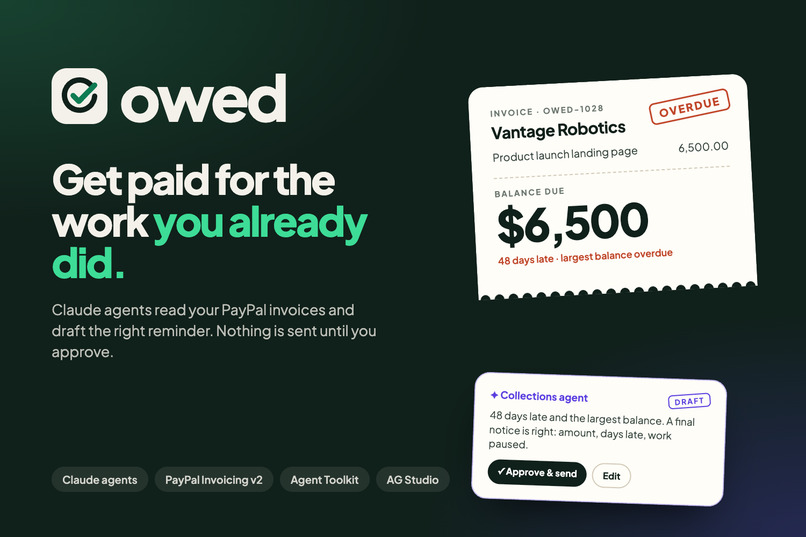
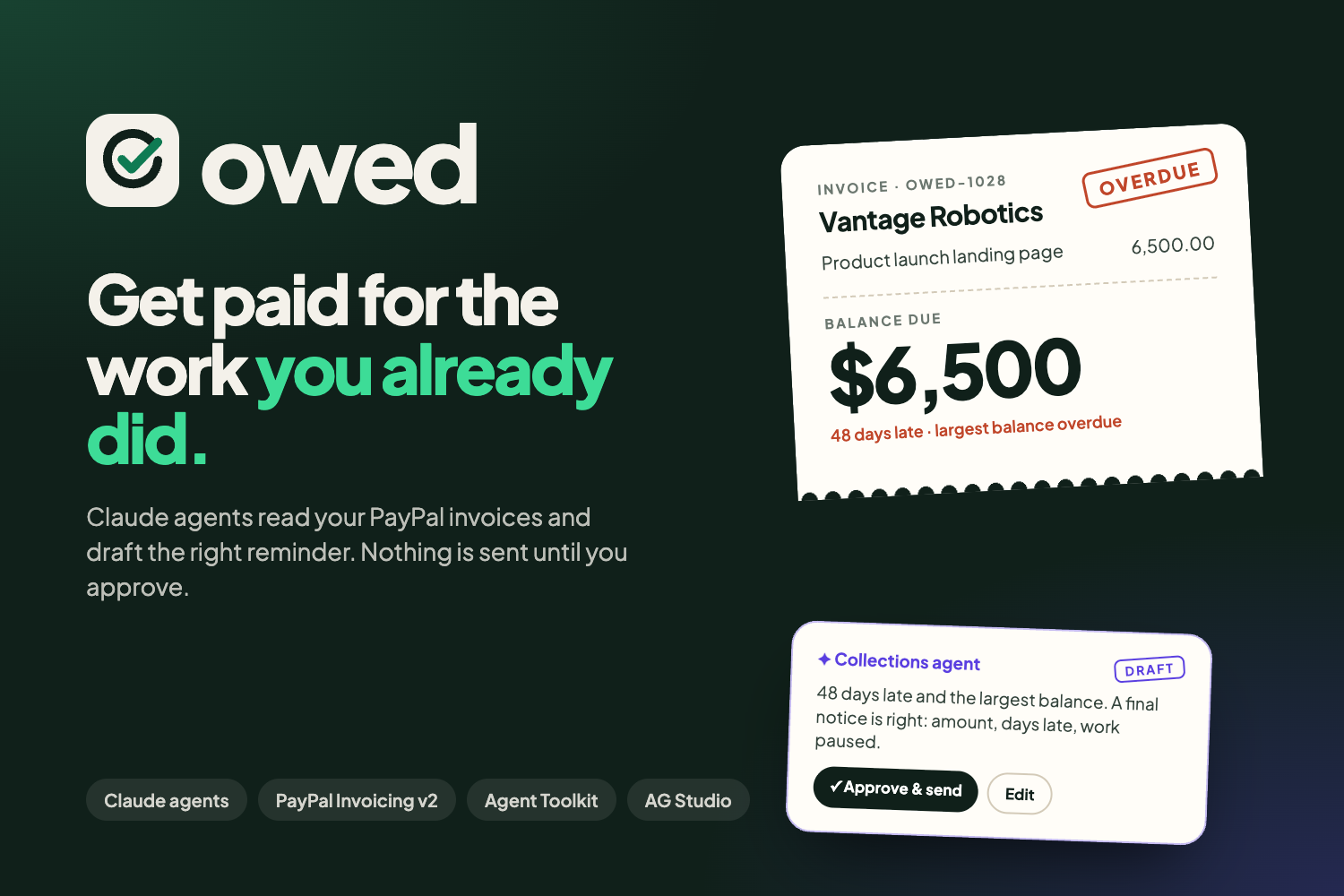
the cover (logo, headline, overdue slip, agent draft)
-
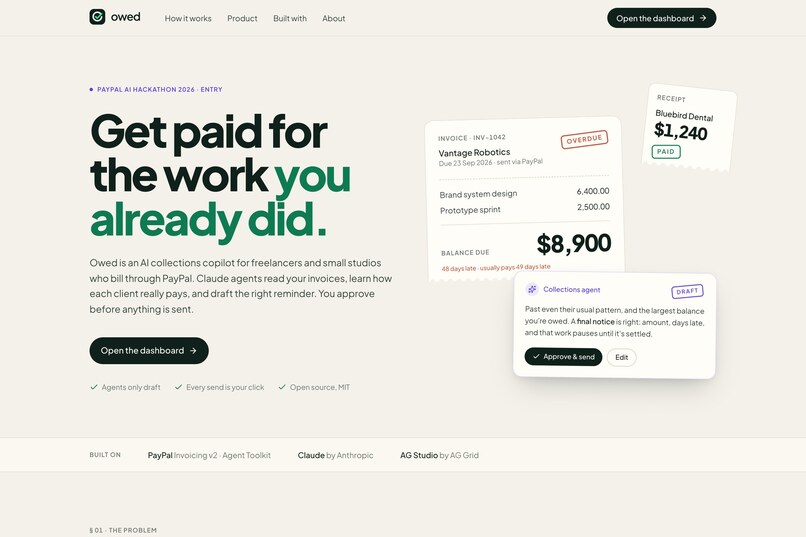
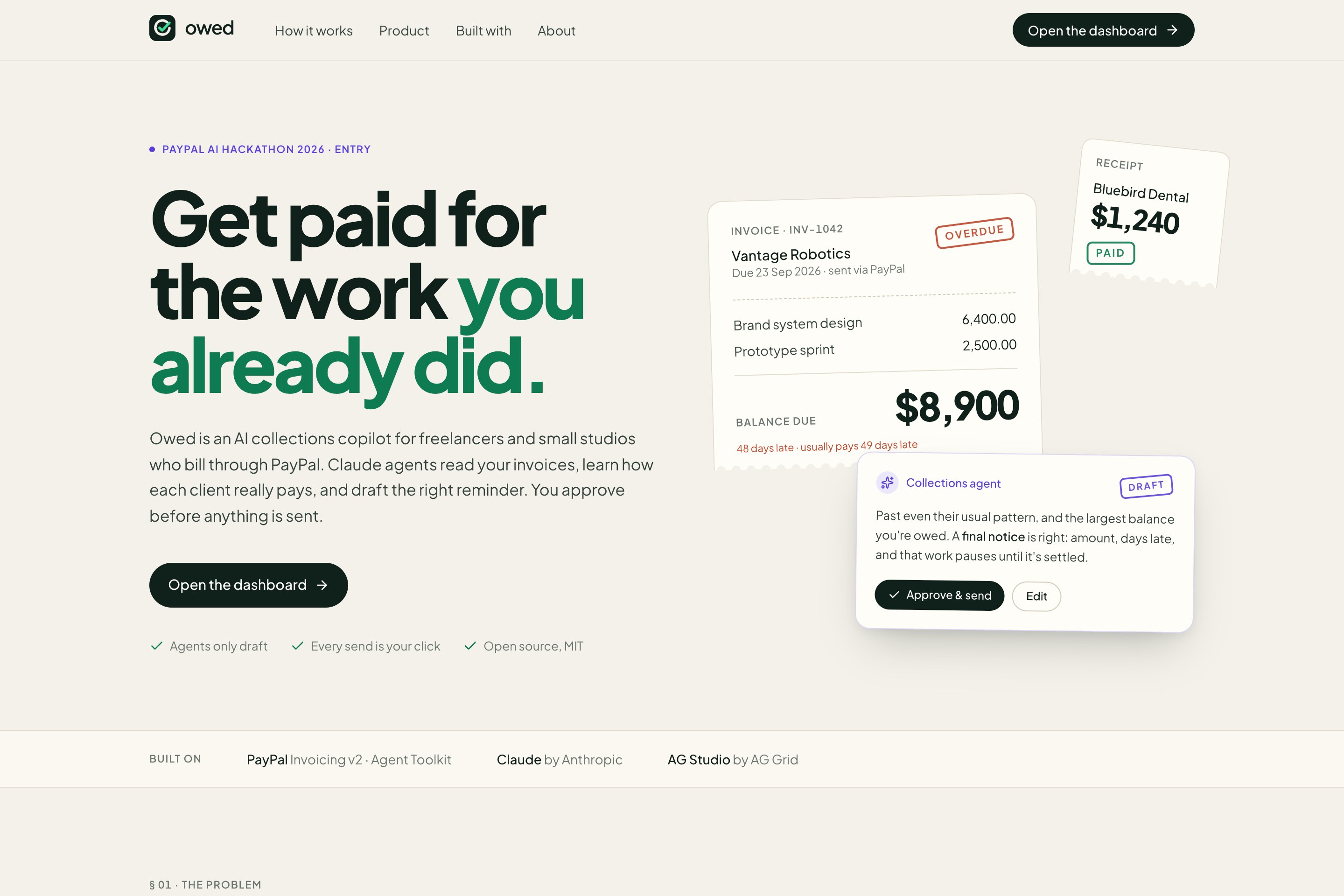
the landing page hero
-
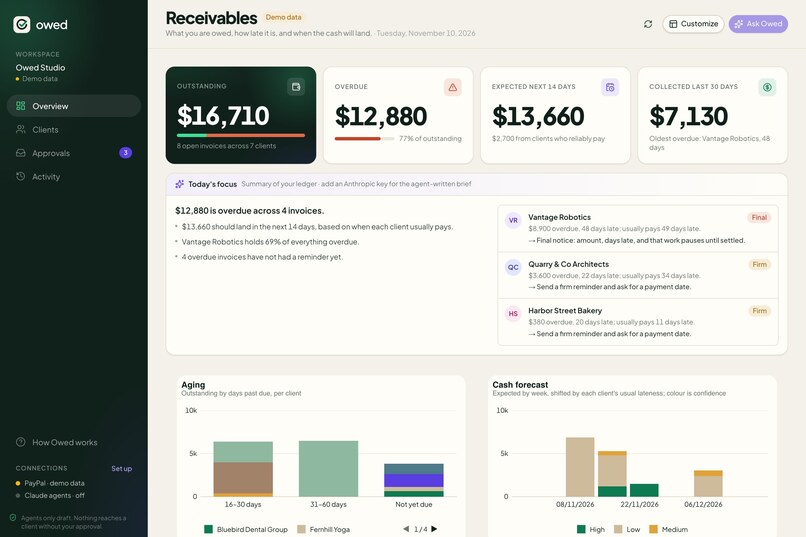
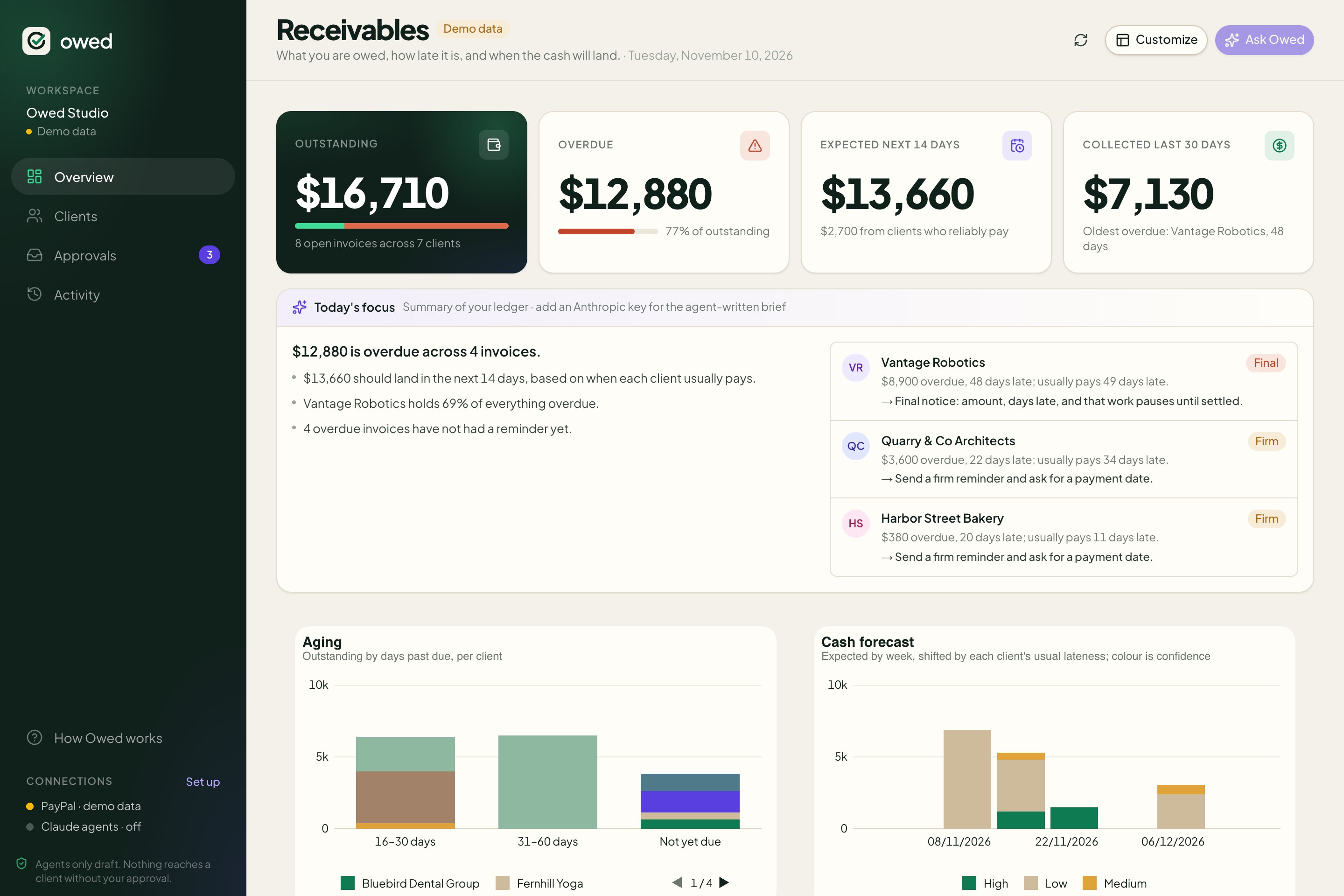
the receivables dashboard
-
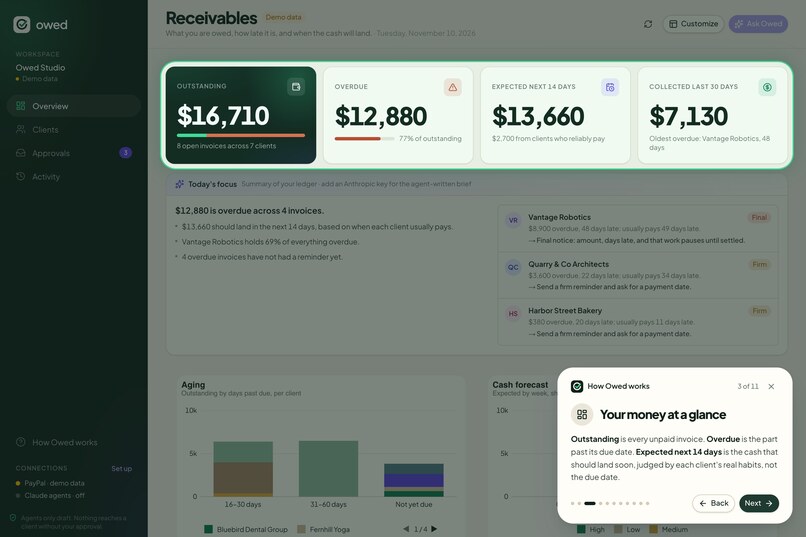
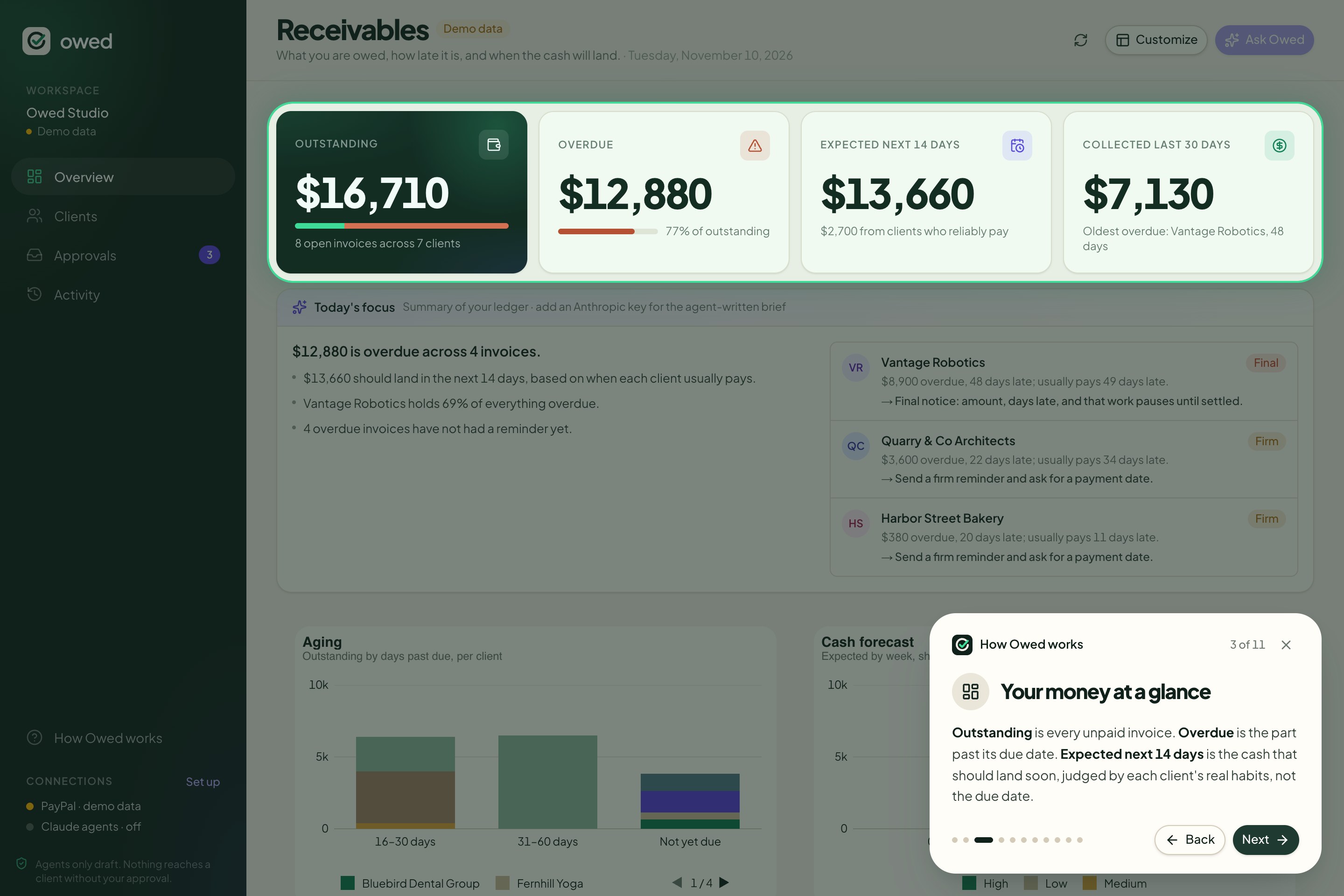
the first-visit walkthrough, spotlighting the numbers
-
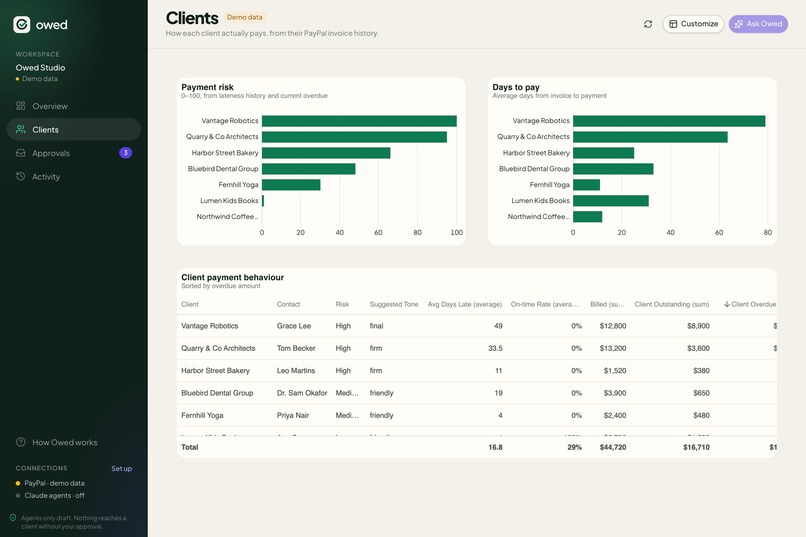
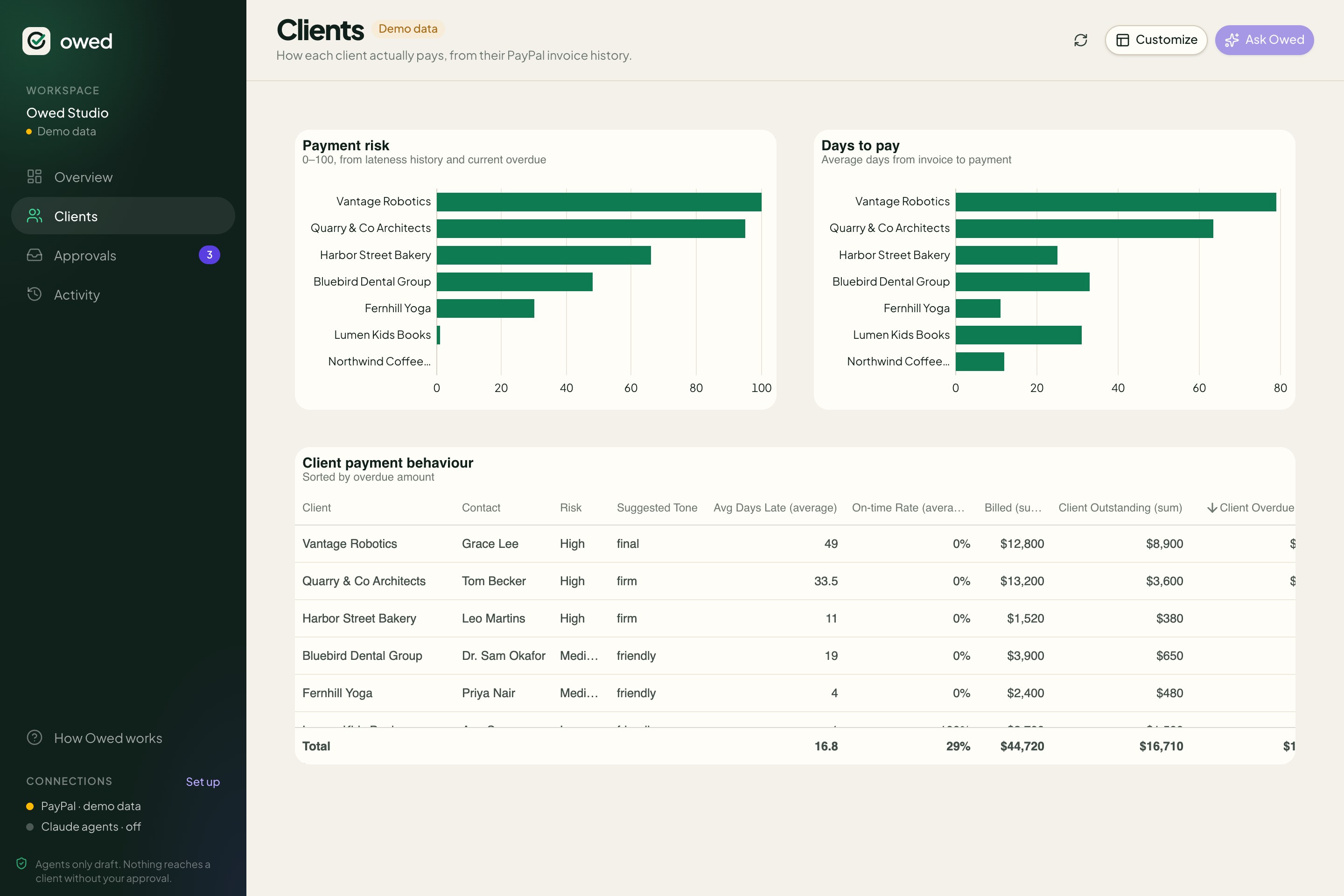
client payment profiles and risk
-
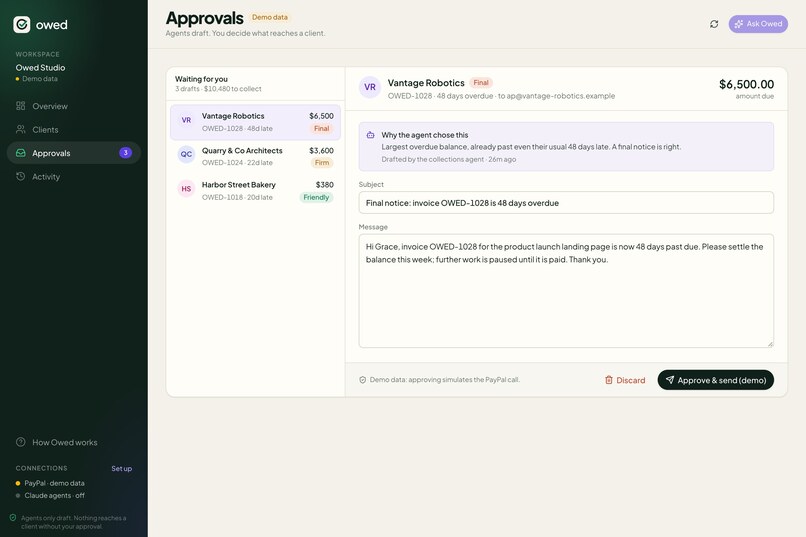
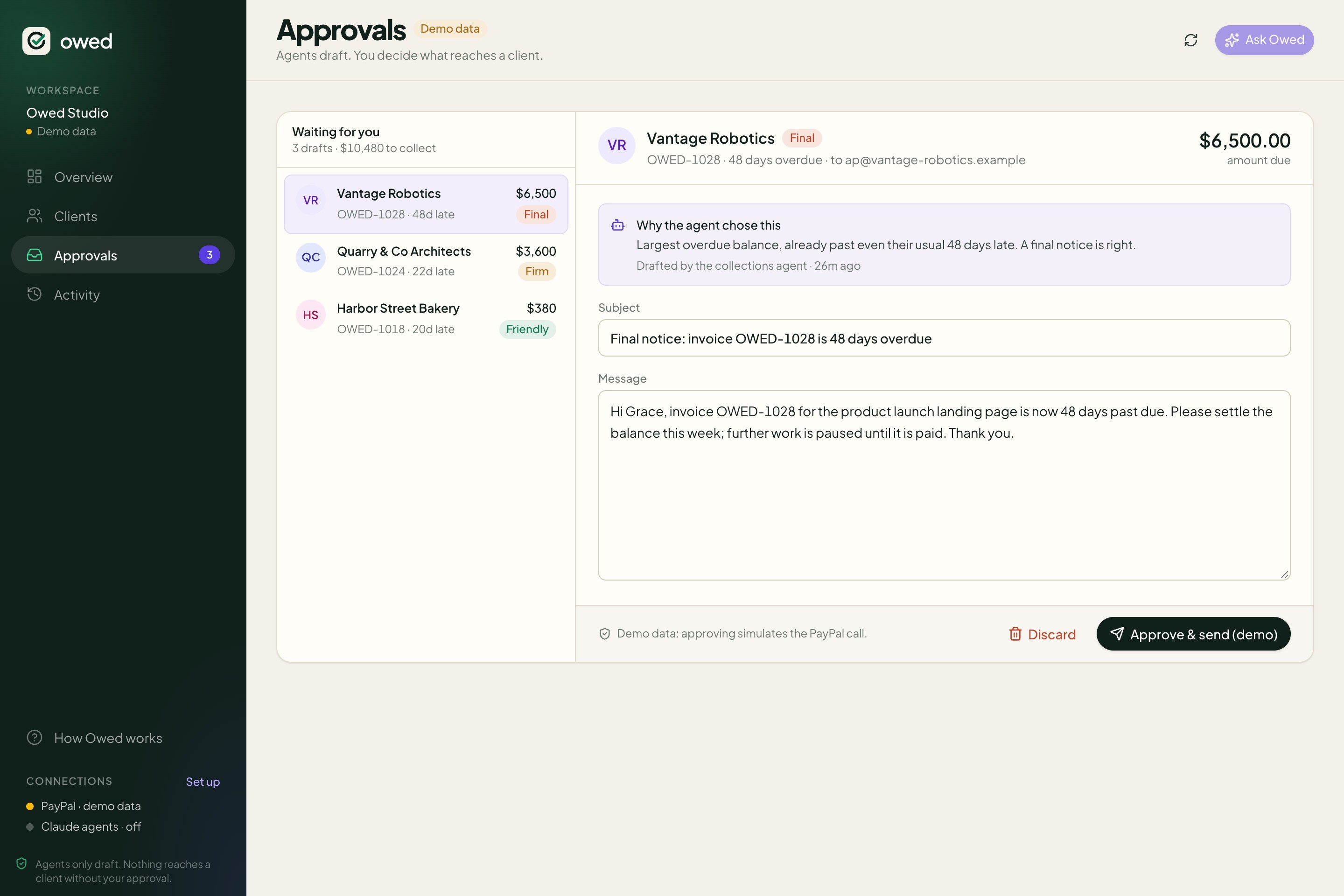
a Vantage final-notice draft with the agent's reasoning
-
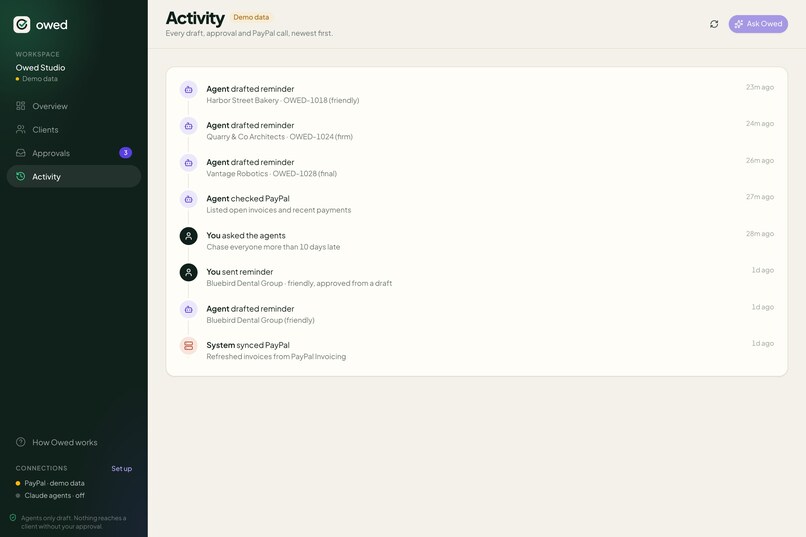
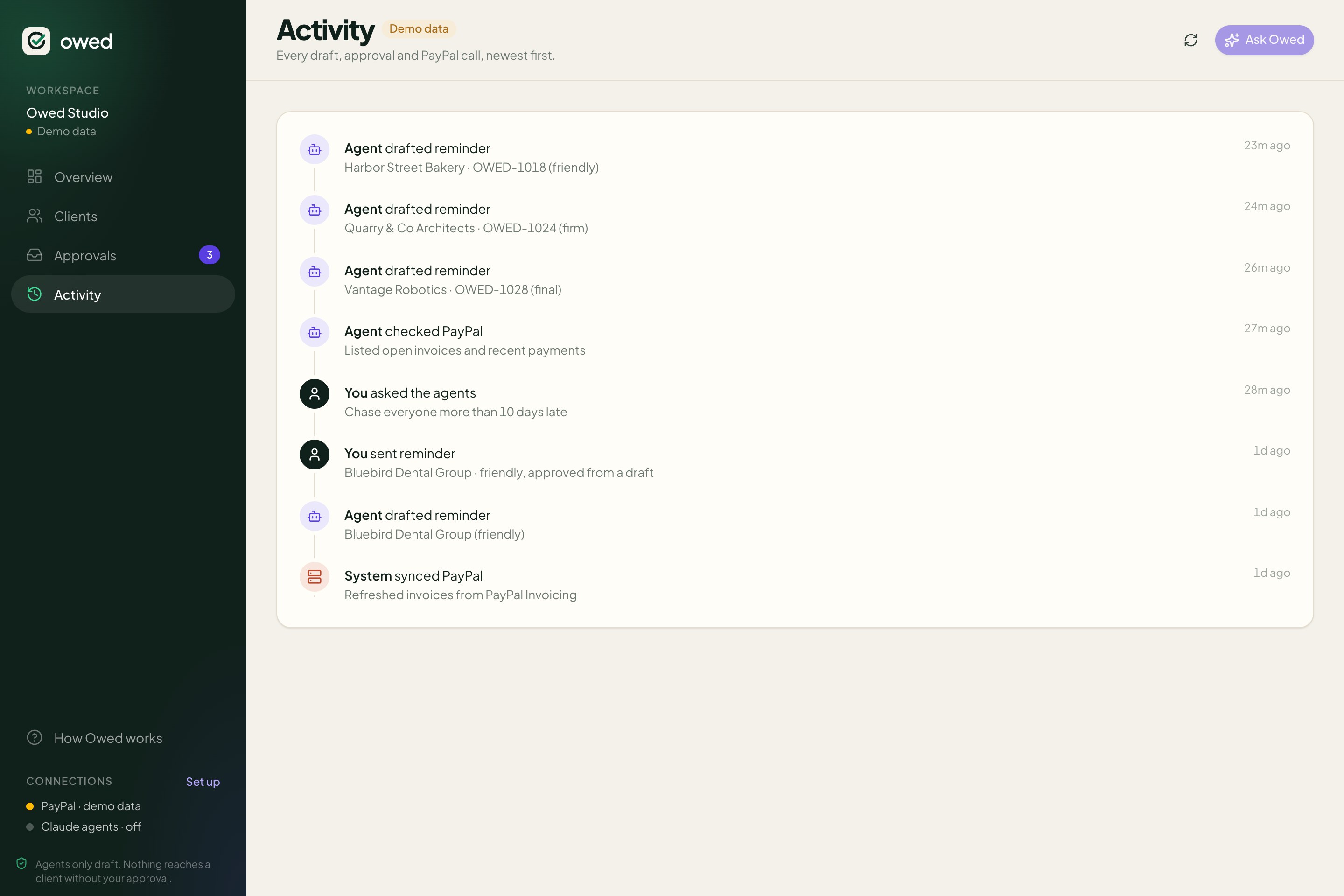
the audit trail (agent, you, system)
-
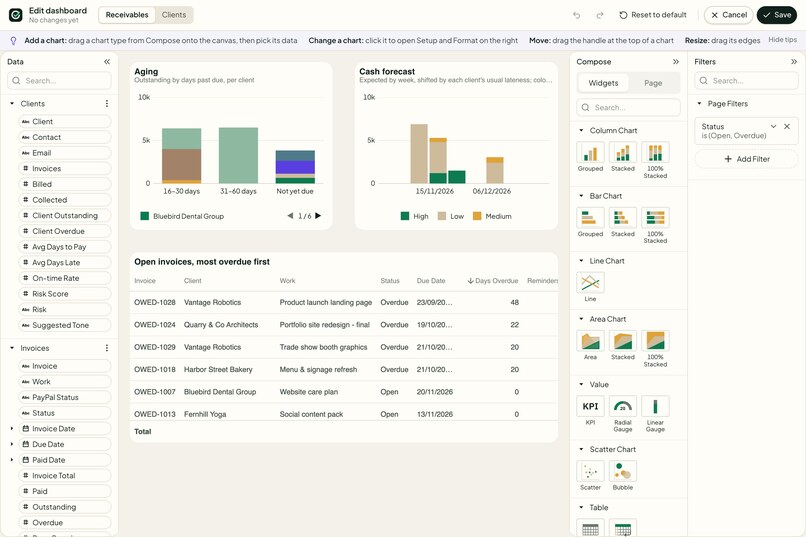
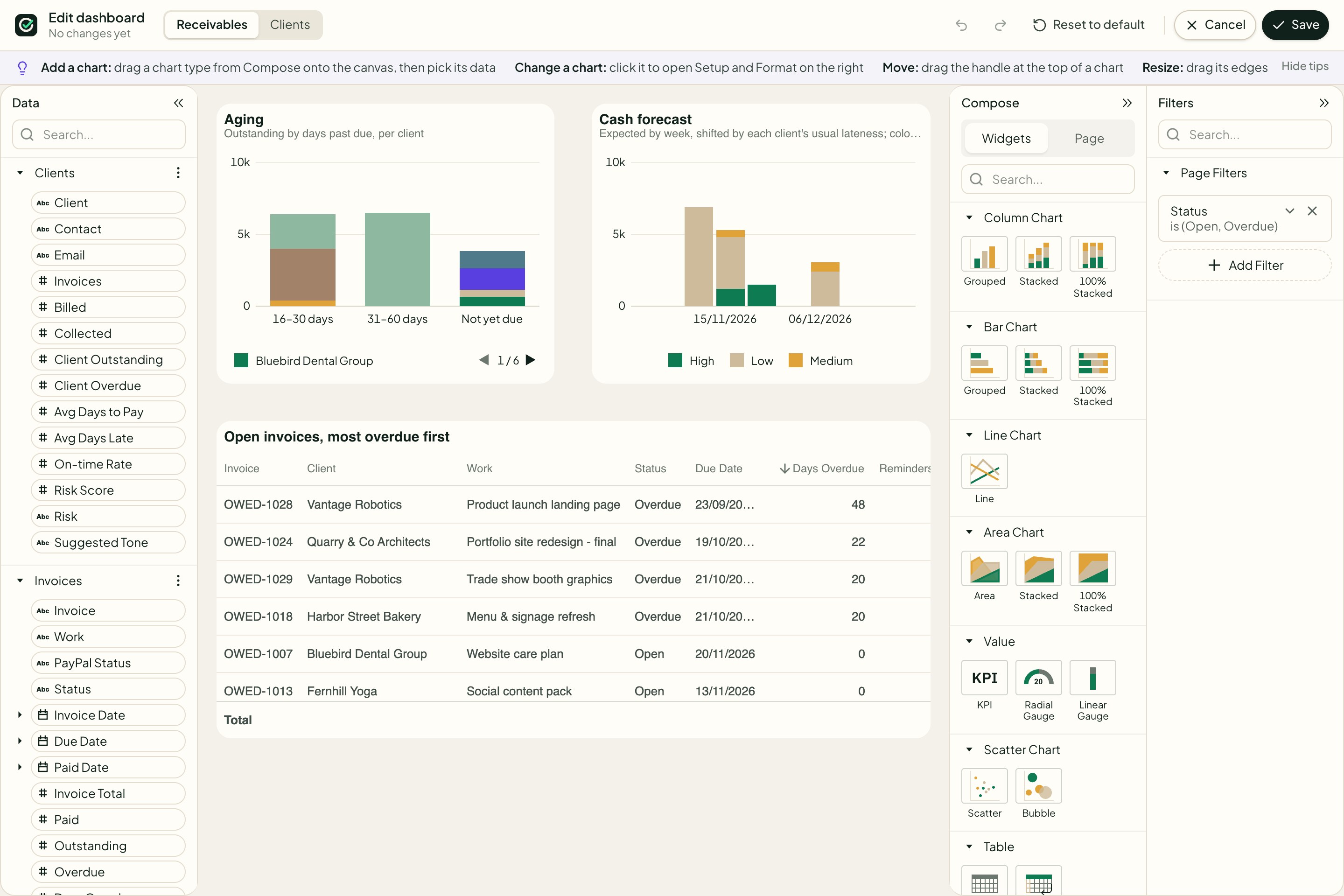
the full-screen dashboard editor
-
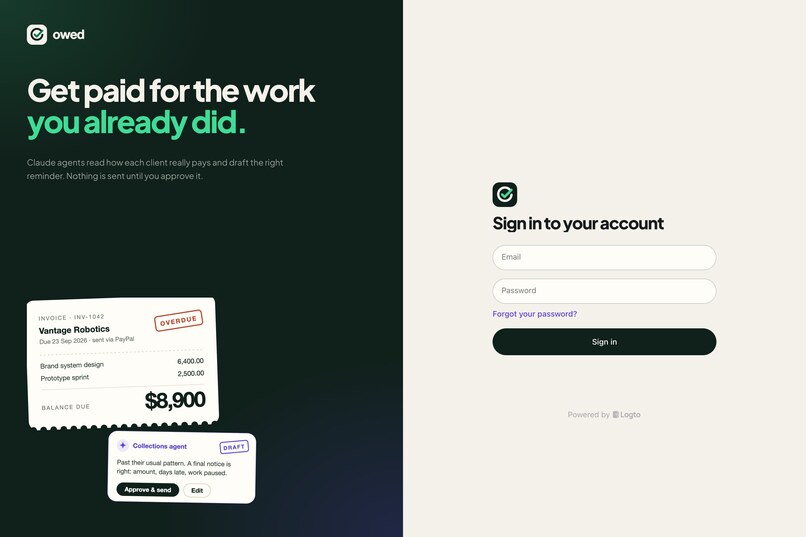
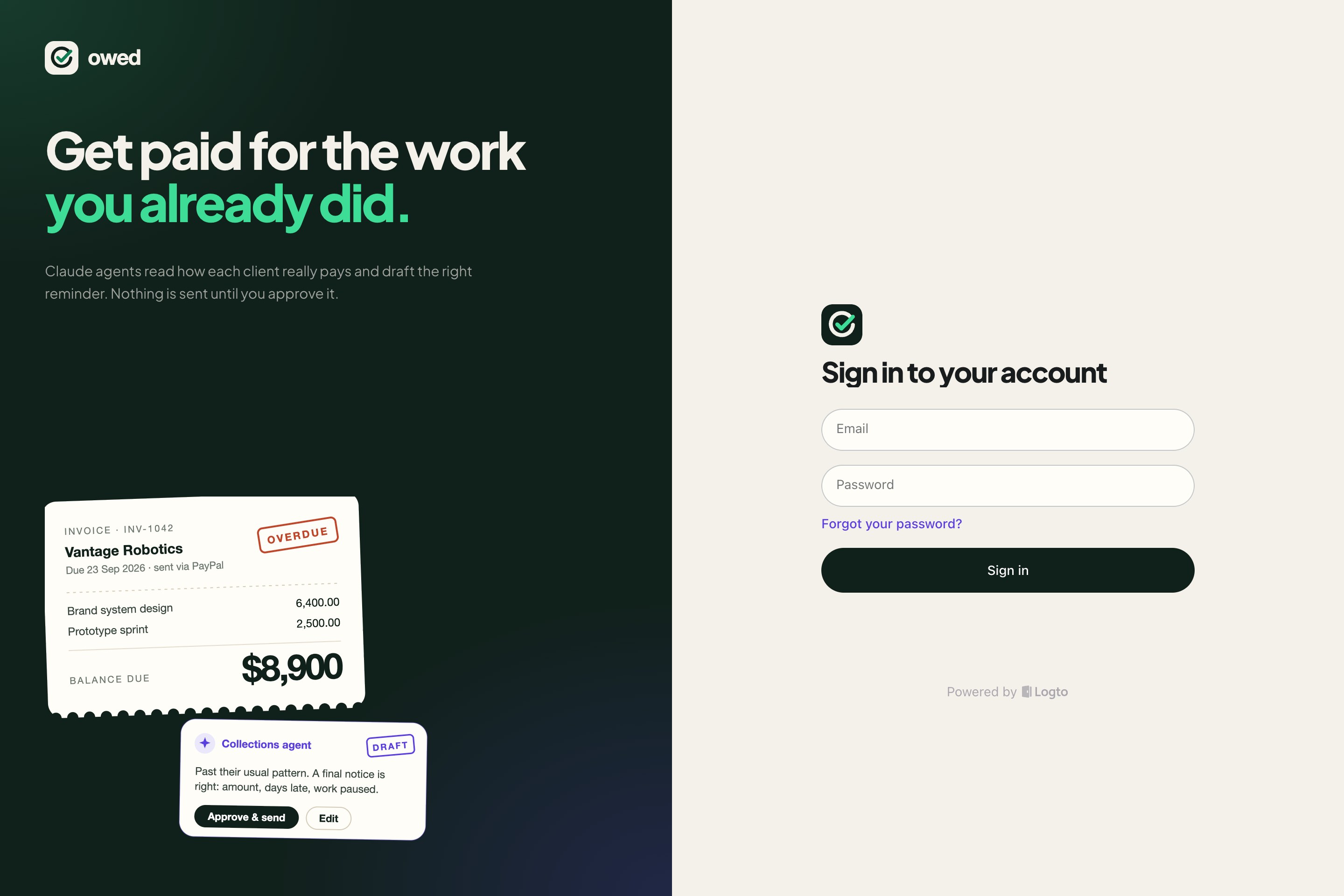
the custom Owed sign-in page
Inspiration
Every freelancer I know has the same awkward moment: the work is delivered, the invoice went out through PayPal, and three weeks later it is still unpaid. Then come the questions. Do I nudge? How hard? Will a firm email cost me the client?
Chasing money is not hard work, but it is draining, and most of us either put it off or send the same polite note to everyone. Yet clients are not all the same. One always pays two days early; another pays seven weeks late, every time. I wanted a tool that knows the difference and does the chasing for me, without ever sending anything on my behalf without my say-so.
That became Owed: an AI collections copilot for freelancers and small studios who bill through PayPal.
What it does
- Reads your PayPal invoices (Invoicing v2 and Transaction Search) and turns them into a live receivables dashboard: what is outstanding, what is overdue, how old it is, and when the cash should actually land.
- Builds a payment profile for every client from their real history: average days late, on-time rate and a risk score.
- Writes a morning brief. A Claude agent investigates the account with the PayPal Agent Toolkit (read-only tools) and names the one thing that matters today.
- Lets you chat with a team of agents. AG Studio's built-in agents and Owed's own collections agent all run on Claude. Ask "chase everyone more than 30 days late" and they draft a reminder for each client, in the right tone.
- Approval queue. Every draft lands in Approvals with its tone (friendly, firm or final) and a one-line reason. You edit, approve, and Owed sends a real PayPal reminder with a pay button.
- Audit trail. Activity records every draft, approval and PayPal call, and who did it: you, an agent, or the system.
- First-visit walkthrough. It opens each page in turn and spotlights what it explains.
How we built it
| Layer | What I used |
|---|---|
| App | Next.js 16 (App Router), React, Tailwind CSS v4 |
| Dashboard | AG Studio embedded dashboards, themed to the brand, with a full-screen Customize editor |
| Agents | AG Studio Agent Framework with a custom Claude adapter, plus a custom collections agent the built-in lead agent can delegate to |
| AI model | Claude (Anthropic API) for the chat agents, the collections agent and the morning brief |
| PayPal | Invoicing v2 (list, get, create, send, remind), Transaction Search, PayPal Agent Toolkit (list_invoices, search_invoices, list_transactions, get_merchant_insights …) |
| Auth | Logto (OIDC + PKCE), with an owed-admin role gating the admin page |
| Hosting | Docker on my own VPS, deployed on every push to main |
Approval is structural, not a prompt
The most important design decision: agents cannot send anything. Their tools can only queue drafts. The only code path that calls PayPal's remind or send endpoints is the approval button, which needs a signed-in human. A prompt can be talked out of a rule; a missing tool cannot be.
The payment-behaviour model
For each client $c$ with settled invoices $S_c$, the average lateness is
$$ \bar{L}c = \frac{1}{|S_c|} \sum{i \in S_c} \left( t^{\text{paid}}_i - t^{\text{due}}_i \right) $$
and the on-time rate counts invoices paid within two days of the due date:
$$ r_c = \frac{\left|{\, i \in S_c : t^{\text{paid}}_i - t^{\text{due}}_i \le 2 \,}\right|}{|S_c|} $$
The risk score blends habit, the worst open invoice ($W_c$ days overdue) and reliability:
$$ \text{risk}_c = \min!\Big(100,\; 1.2\,\bar{L}_c + 0.9\,W_c + 25\,(1 - r_c) + 10\cdot\mathbb{1}[\text{overdue}_c > 0]\Big) $$
The cash forecast does not trust due dates. An open invoice is expected on
$$ \hat{t}i = \max!\left( t^{\text{due}}_i + \bar{L}_c,\; t{\text{today}} + 3 \right) $$
with confidence falling as risk rises. The tone of each reminder follows the worst overdue invoice: final beyond 45 days, firm beyond 20 days (or for high-risk clients), otherwise friendly. The agent explains its choice in plain words on every draft.
Challenges we ran into
- Making agents useful but harmless. Getting the built-in AG Studio lead agent to hand collections work to my custom agent, while making sure no agent could ever reach a "send" path, took several iterations of the tool design.
- A custom Claude adapter for AG Studio. The Agent Framework expects its own model interface, so I wrote an adapter that maps its messages and tool calls onto Claude's tool use, including streaming.
- PayPal's real-world edges. Transaction Search only covers 31 days per call and must be enabled per app, and sandbox invoices need seeding with believable payment histories. I built a seed script and a full demo scenario, so the app works out of the box even without keys.
- Running behind a reverse proxy. Sign-in first redirected to
localhostand then to0.0.0.0:3000, the container's own address. I fixed it by building every redirect from the public base URL. - Design. I rebuilt the visual language several times, from a generic SaaS look to "paper and ink" invoice slips, rubber stamps and perforated receipts, so the product feels like the thing it manages.
- The demo video. It is recorded by a script: Playwright drives the real app through the walkthrough while a local neural voice reads each line, and ffmpeg stitches the shots. Keeping the voice and the screen in step, with no silent gaps, took more care than expected.
Accomplishments that we're proud of
- A complete product, not a proof of concept: sign-in, dashboard, client profiles, agent chat, approval queue, audit trail, an admin page and a guided first-visit walkthrough, all live at owed.edilsonsantos.co.za.
- Safety by construction. Agents can draft but never send; the approval button is the only path to PayPal's send and remind endpoints.
- Agents that work as a team. My custom collections agent plugs into AG Studio's own agents through a Claude adapter I wrote for the Agent Framework, so the built-in lead can hand it work.
- Works out of the box. A realistic demo scenario (seven clients, each with their own payment habits) means anyone can try Owed in a minute, with no keys.
- A design language that fits the job: invoice slips, rubber stamps and perforated receipts, in a paper-and-ink palette.
- A reproducible demo video, recorded by script from the real app, so it can be re-shot whenever the product changes.
- Open source under the MIT licence.
What we learned
- Human-in-the-loop is a product feature, not a disclaimer. Freelancers trust Owed because it cannot act alone, and showing the agent's reasoning on every draft builds that trust.
- Small, explainable models beat clever ones. A transparent lateness average, which a user can check against their own memory, is more convincing than a black-box prediction.
- Agent frameworks shine when agents specialise. A narrow collections agent with three or four tools behaved far better than one big agent with everything.
- The PayPal Agent Toolkit made the read-only investigation agent almost trivial; the work was in choosing which tools to expose.
What's next for Owed
- Scheduled reminders using PayPal's reminder settings, so approved cadences run themselves.
- Dispute awareness: pause chasing when a client opens a dispute.
- Multi-currency forecasting and a weekly digest email.
The voice-over and parts of the video were generated with AI tools.
Built With
- ag-grid
- ag-studio
- ag-studio-agent-framework
- anthropic-api
- claude
- docker
- ffmpeg
- github-actions
- kokoro-tts
- logto
- next.js
- node.js
- oauth2-oidc
- paypal-agent-toolkit
- paypal-invoicing-api
- paypal-transaction-search
- playwright
- react
- tailwind-css
- typescript
- zod
