Inspiration
Every minute of a production outage can mean lost revenue, broken customer trust, and exhausted on-call engineers. While modern observability tools generate massive amounts of logs, metrics, and alerts, the hardest part is still connecting the dots and deciding on the safest recovery action under pressure.
We wanted to explore a simple question:
What if an AI team could investigate incidents the way an experienced SRE team does—working in parallel, learning from past outages, explaining every decision, and keeping humans in control of risky operations?
That idea became Overwatch—an autonomous incident-response copilot that combines multi-agent collaboration, persistent memory, and human-in-the-loop safety to help engineers resolve production incidents faster and more confidently.
What it does
Overwatch automates the complete incident-response workflow for Site Reliability Engineering (SRE) teams.
When a production incident occurs, Overwatch:
- Receives and triages the incident.
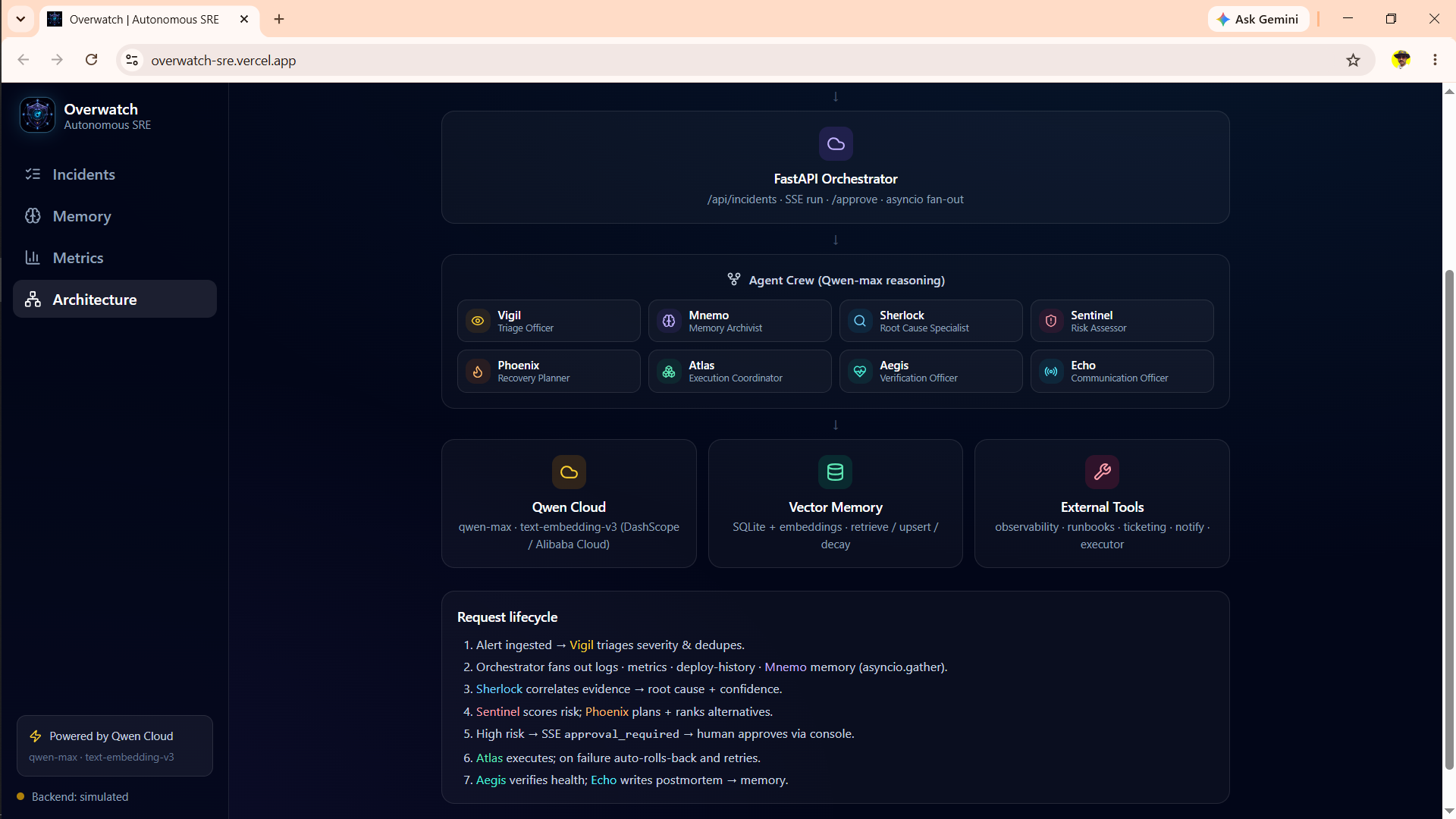
- Launches multiple specialized AI agents that investigate logs, metrics, deployment history, and historical incidents in parallel.
- Retrieves similar past incidents from persistent memory using semantic search.
- Identifies the most likely root cause with supporting evidence and confidence scores.
- Evaluates multiple remediation strategies and explains why one solution is recommended while others are rejected.
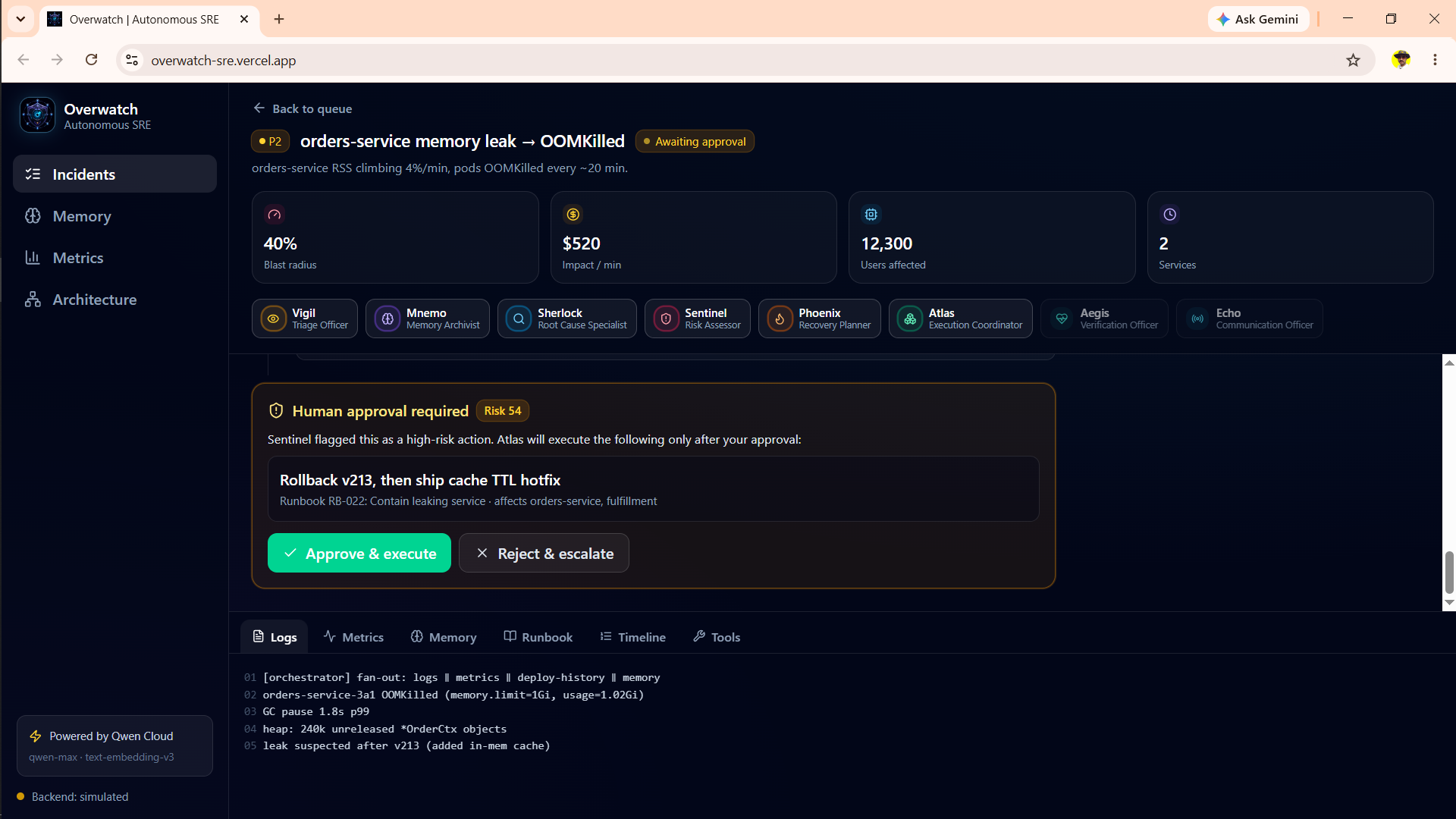
- Requires explicit human approval before executing high-risk actions.
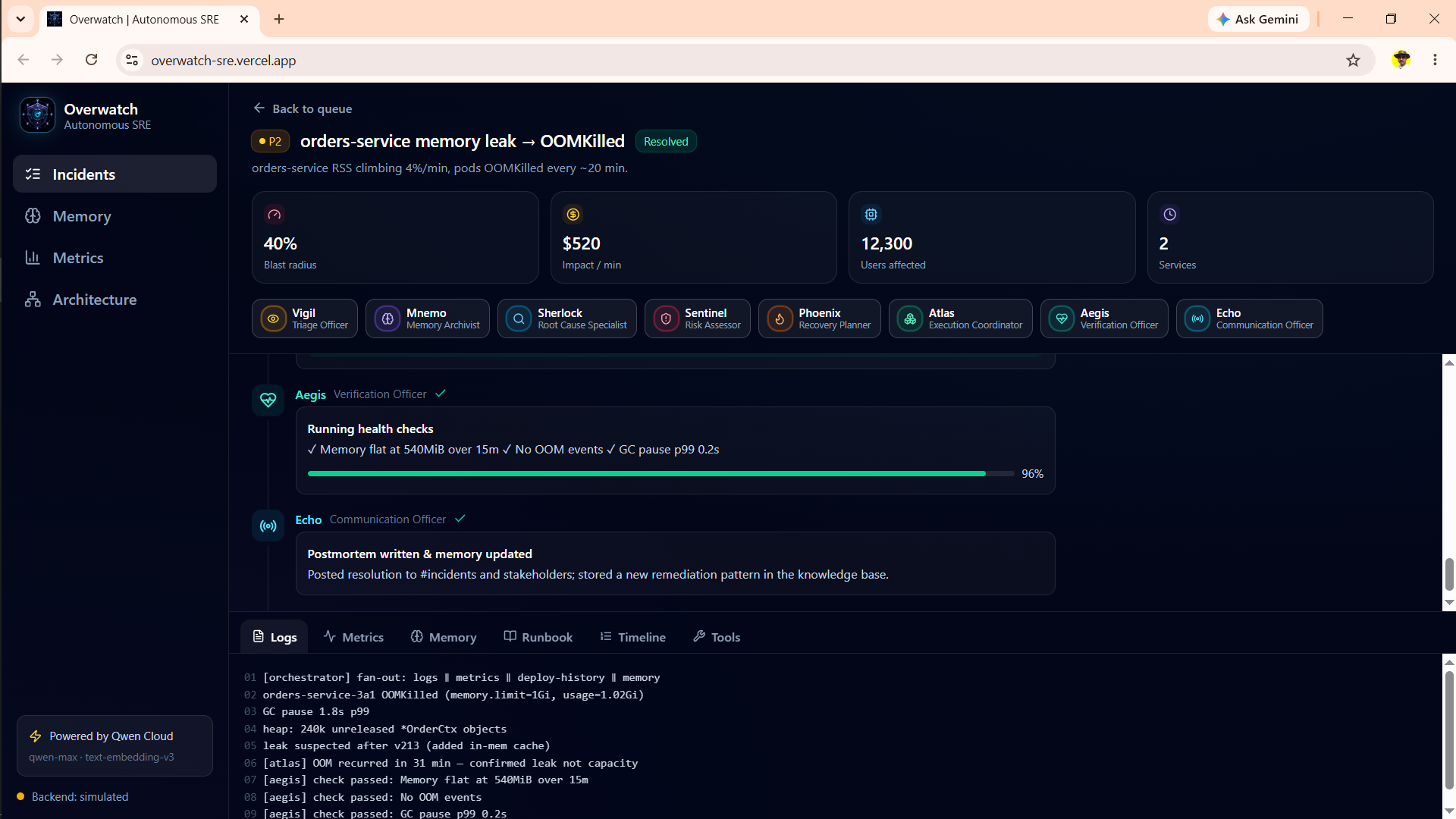
- Executes remediation, automatically rolls back if necessary, verifies system health, and generates a postmortem.
- Stores the successful resolution as reusable knowledge so future incidents become faster and more accurate.
Instead of replacing operators, Overwatch augments them with transparent AI reasoning and safe automation.
How we built it
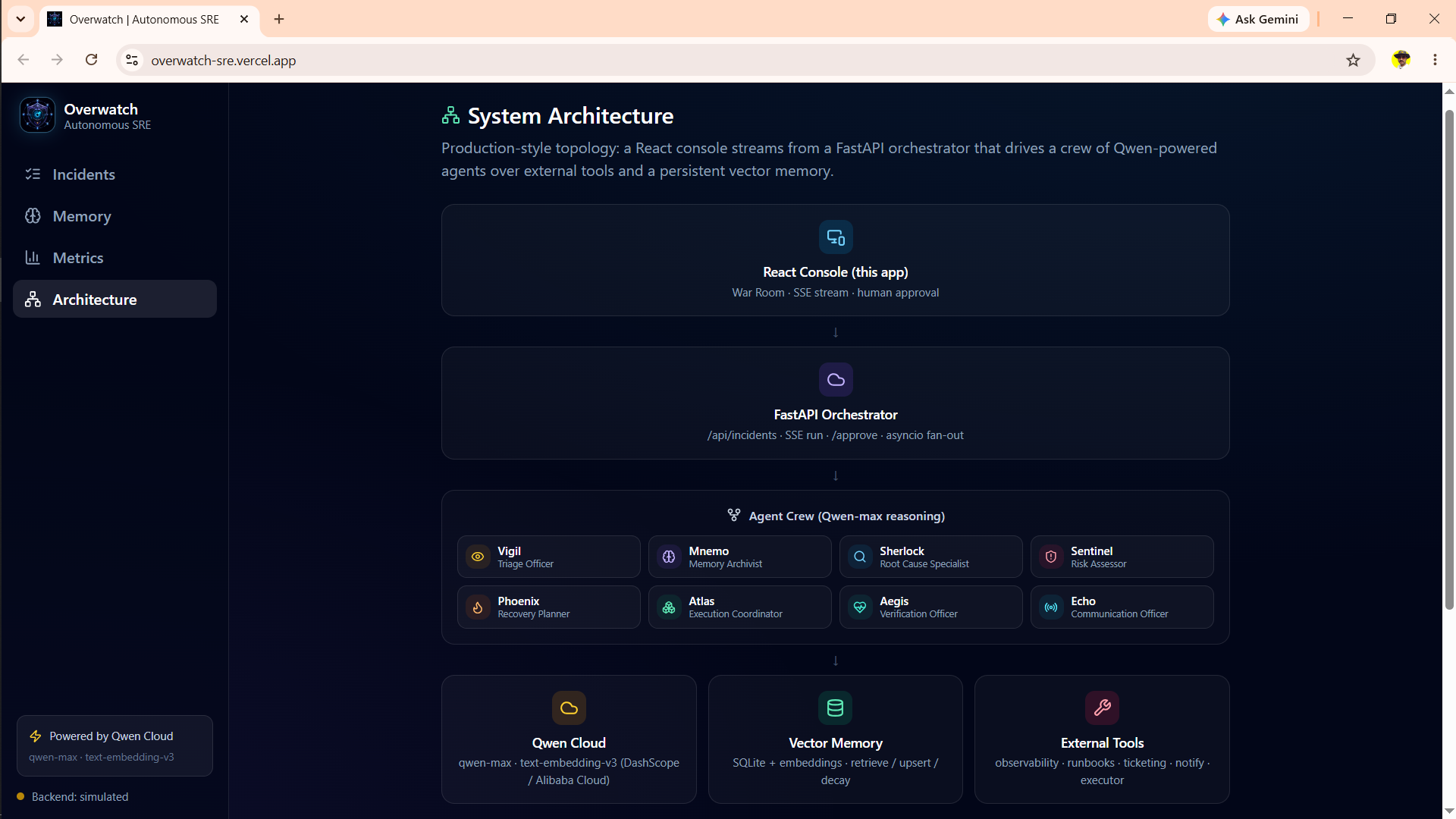
Overwatch is built as a production-inspired multi-agent system.
The frontend is built with React, TypeScript, and Vite, presenting an interactive "Incident War Room" where operators can follow every stage of the investigation in real time.
The backend uses FastAPI with Server-Sent Events (SSE) to stream the entire incident lifecycle to the UI.
Our orchestration layer coordinates eight specialized Qwen-powered agents, each responsible for a distinct stage of incident response—from triage and diagnosis to planning, execution, verification, and communication.
For intelligence, we integrated Qwen Cloud through Alibaba Cloud DashScope using:
- qwen-max for reasoning and agent collaboration
- text-embedding-v3 for semantic memory retrieval
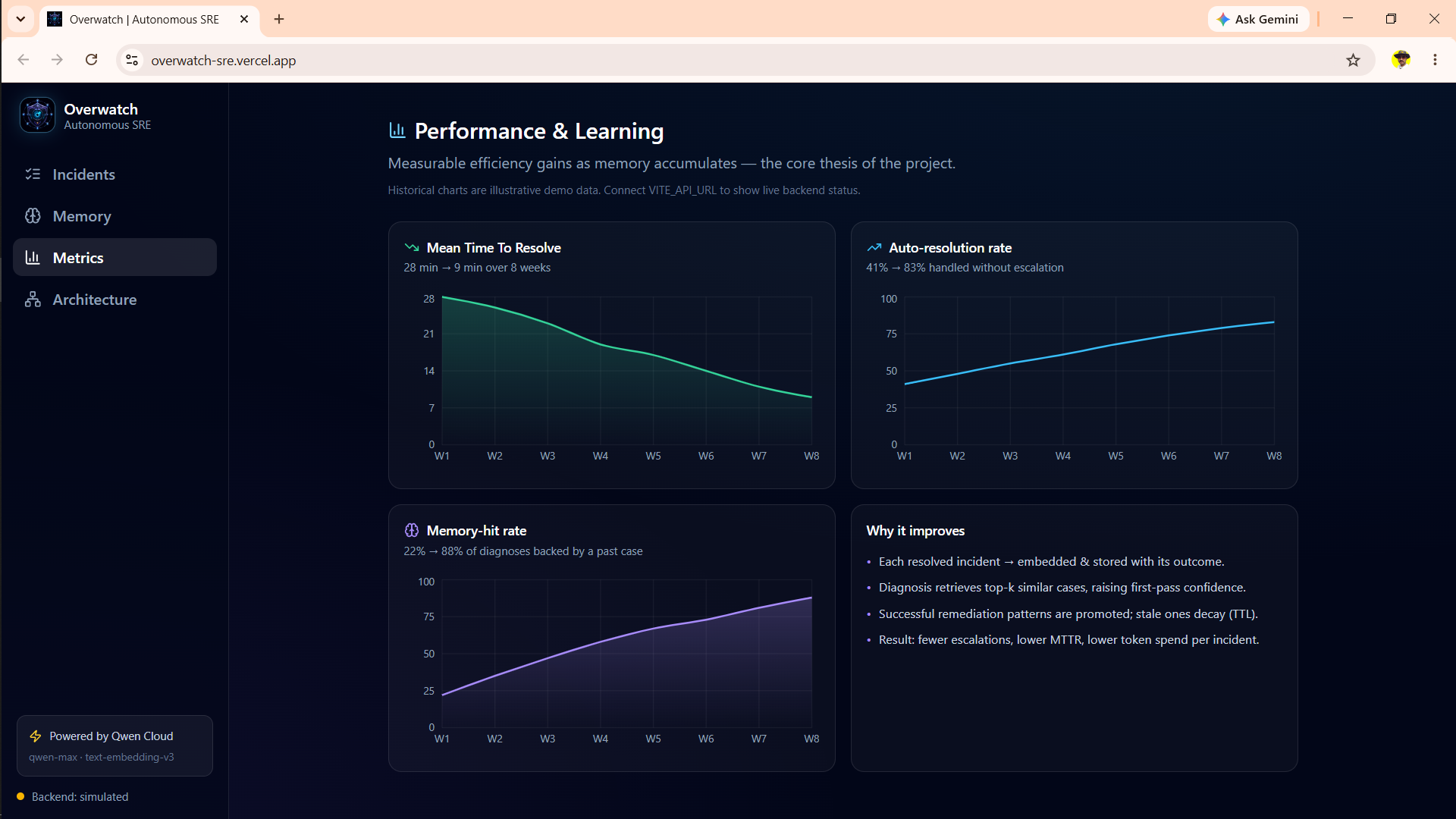
To enable continuous learning, resolved incidents are embedded and stored in SQLite, where cosine similarity retrieves relevant historical cases during future incidents. A lightweight memory-decay strategy removes stale, low-value knowledge to keep the memory relevant over time.
The system also demonstrates:
- Parallel evidence collection
- Multi-agent collaboration
- Human approval gates
- Safe rollback and recovery
- Continuous learning from resolved incidents
The entire workflow can run in both live mode using Qwen Cloud and an offline demonstration mode for reproducible testing.
Challenges we ran into
Designing autonomous incident response required balancing automation with safety.
One of our biggest challenges was orchestrating multiple agents without making their reasoning appear like a black box. We solved this by giving every agent a clearly defined responsibility and exposing their decisions through a transparent "War Room" interface.
Another challenge was implementing persistent memory that remains useful over time. Simply storing every incident eventually pollutes retrieval quality, so we designed a memory lifecycle that both remembers valuable experiences and forgets stale, rarely reused cases.
We also wanted the demo to showcase resilience rather than a perfect "happy path." To demonstrate recovery behavior, the first remediation intentionally fails, forcing the orchestrator to roll back, select an alternative strategy, and verify successful recovery.
Finally, building a realistic production workflow while keeping the project hackathon-friendly required careful abstraction. External integrations are represented through well-defined tool adapters that can later connect to real infrastructure such as Prometheus, Loki, PagerDuty, Kubernetes, cloud APIs, and enterprise runbooks.
Accomplishments that we're proud of
We are especially proud that Overwatch demonstrates much more than a chatbot.
Some highlights include:
- A complete end-to-end autonomous incident-response workflow.
- Eight specialized AI agents collaborating with distinct responsibilities.
- Persistent semantic memory with intelligent retrieval and memory decay.
- Human-in-the-loop approval for high-risk remediation.
- Automatic rollback and recovery after failed execution.
- Transparent reasoning through confidence scores, evidence, and alternative solutions.
- Production-inspired architecture using FastAPI, SSE, SQLite, and Qwen Cloud.
- A realistic interactive "War Room" experience that makes every AI decision visible and understandable.
Most importantly, we built a system that emphasizes trust, explainability, and operational safety, not just automation.
What we learned
This project reinforced that effective AI systems are built through orchestration rather than a single powerful model.
We learned that specialized agents collaborating on focused tasks consistently produce more structured and explainable results than one monolithic assistant.
We also gained practical experience designing persistent memory systems, semantic retrieval pipelines, human approval workflows, streaming architectures, and resilient AI-driven automation.
Perhaps our biggest takeaway is that enterprise AI must earn user trust. Transparent reasoning, confidence estimation, safe execution, and clear human oversight are just as important as model intelligence.
What's next for Overwatch
Overwatch is designed as a foundation for a production-ready autonomous SRE platform.
Our roadmap includes:
- Integrating directly with production observability platforms such as Prometheus, Grafana, Loki, OpenTelemetry, and Elastic.
- Supporting Kubernetes, cloud providers, CI/CD pipelines, and enterprise runbooks for real remediation.
- Replacing demonstration tool adapters with authenticated production integrations.
- Expanding memory into a scalable vector database with richer long-term learning.
- Introducing adaptive agent collaboration based on incident complexity.
- Adding policy engines, audit trails, RBAC, and compliance features for enterprise deployments.
- Supporting multimodal incident analysis using dashboards, screenshots, diagrams, and architecture documents.
- Building predictive incident prevention capabilities that proactively detect and mitigate failures before customer impact.
Our long-term vision is for Overwatch to become an AI-powered reliability engineer that helps organizations resolve incidents faster, safer, and with continuously improving operational knowledge.
Built With
- agentic-ai
- alibaba-cloud
- artificial-intelligence
- asyncio
- dashscope
- docker
- fastapi
- incident-response
- kubernetes
- llm
- machine-learning
- multi-agent-systems
- openai-compatible-api
- python
- qwen
- rag
- react
- semantic-search
- server-sent-events
- site-reliability-engineering
- sqlite
- tailwind-css
- typescript
- vector-embeddings
- vite


Log in or sign up for Devpost to join the conversation.