-
-
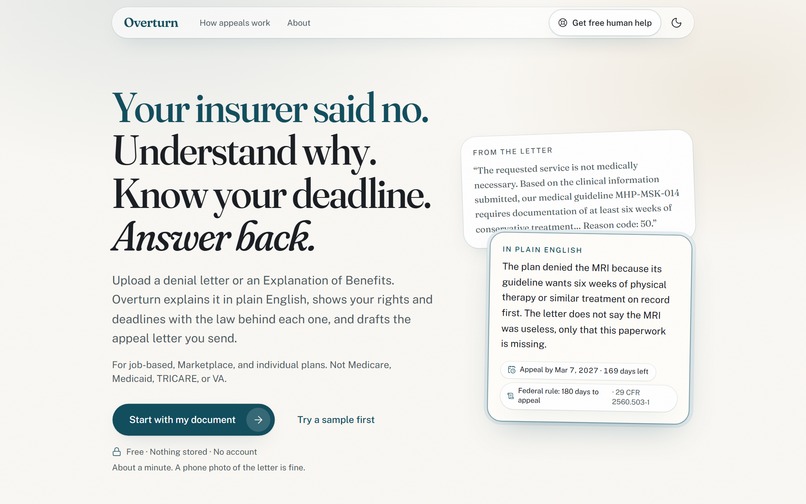
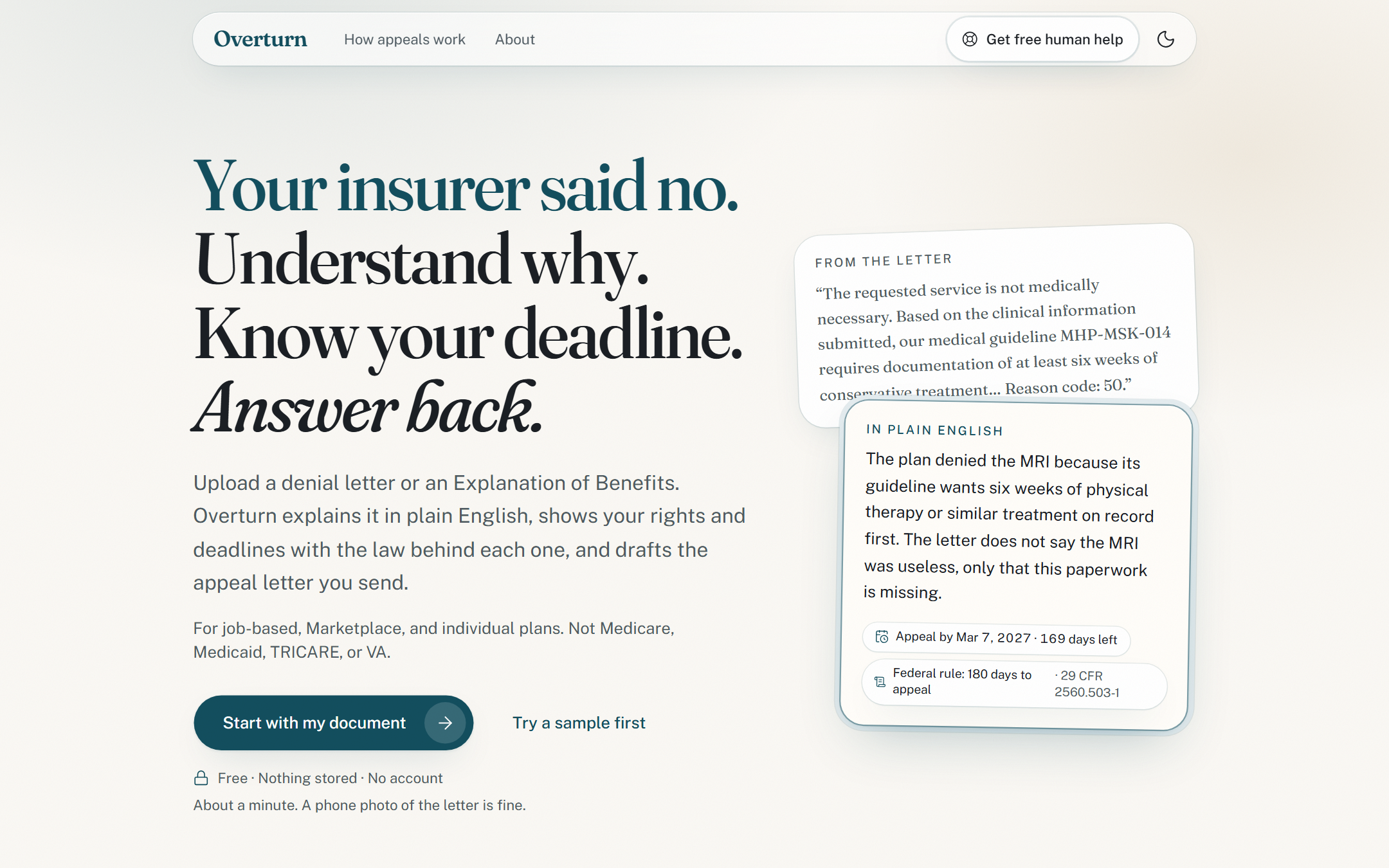
The insurer's sentence and what it actually means: the whole product in one glance.
-
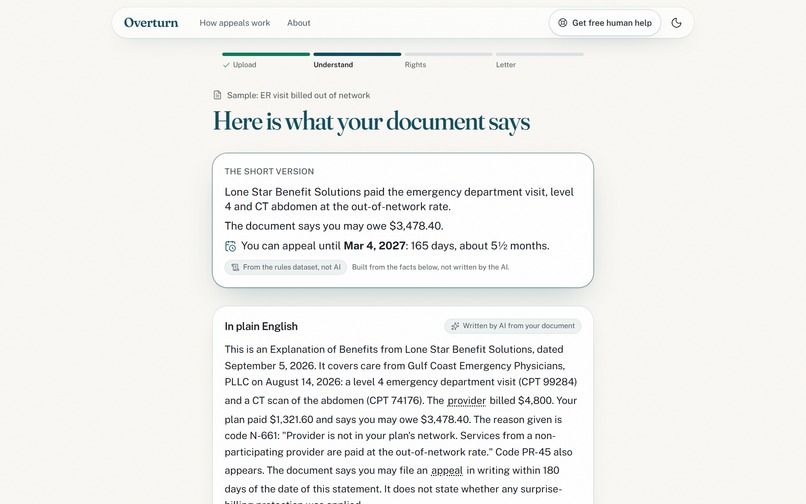
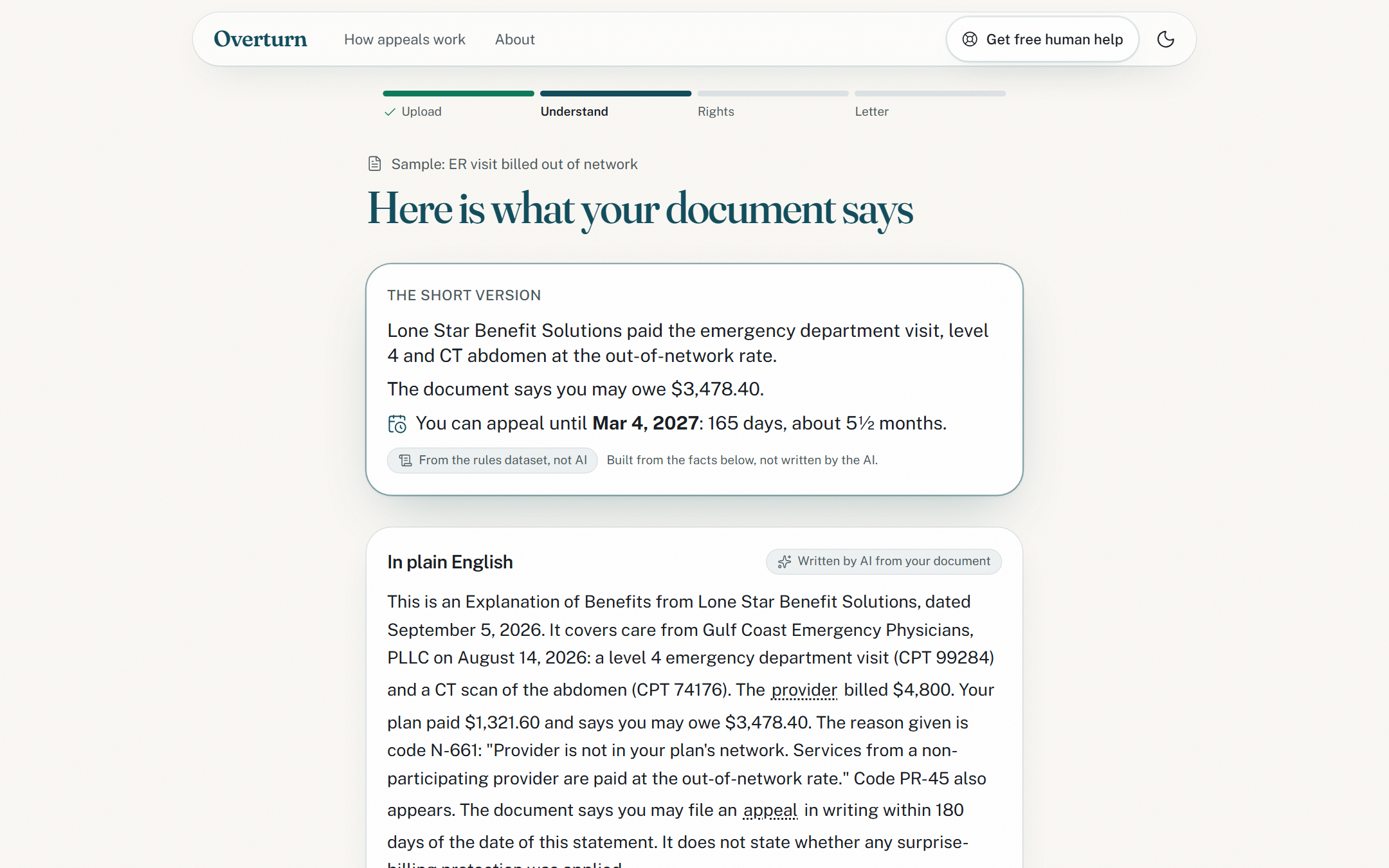
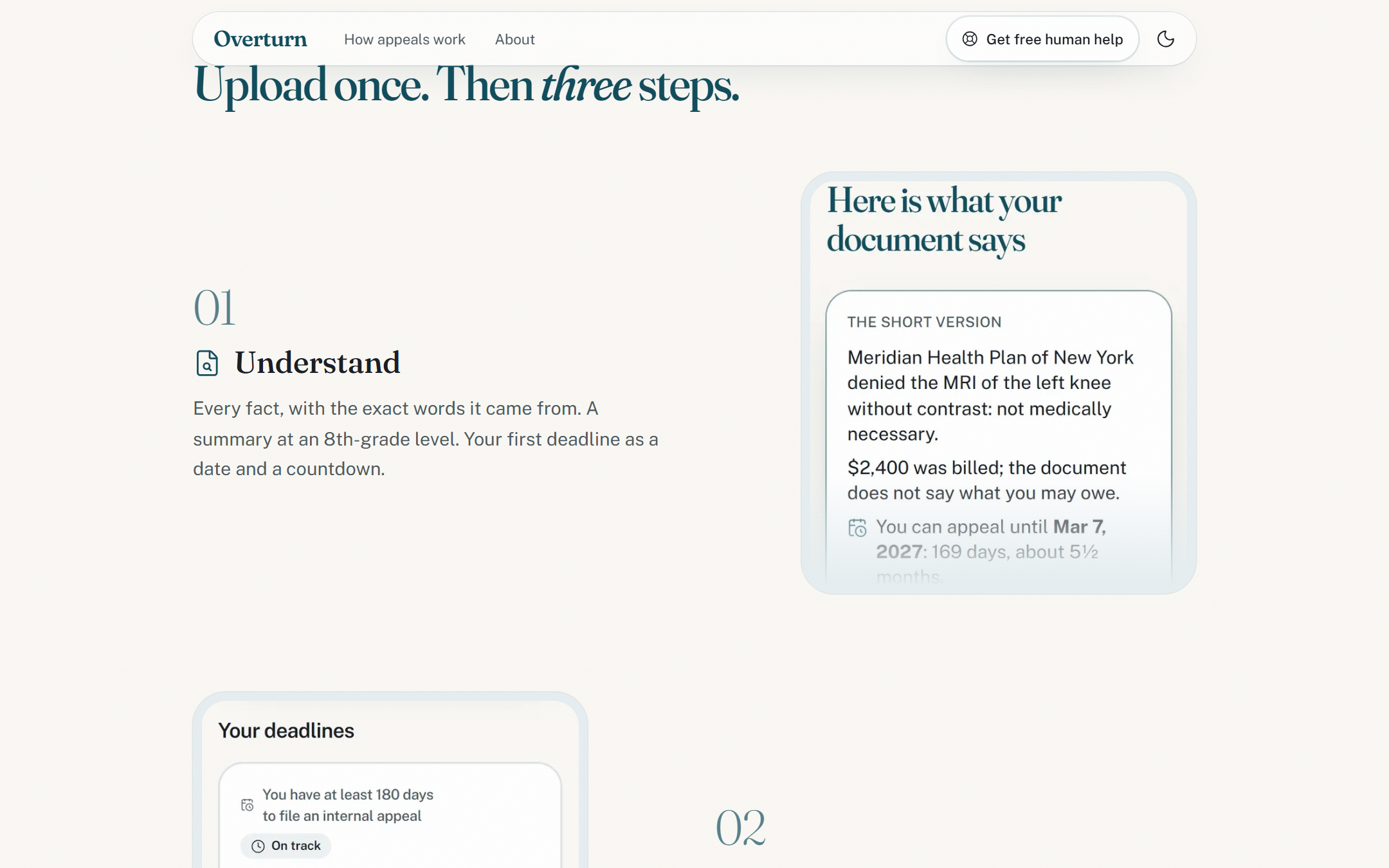
Understand: the short version (what, how much, until when), then the document in plain English.
-
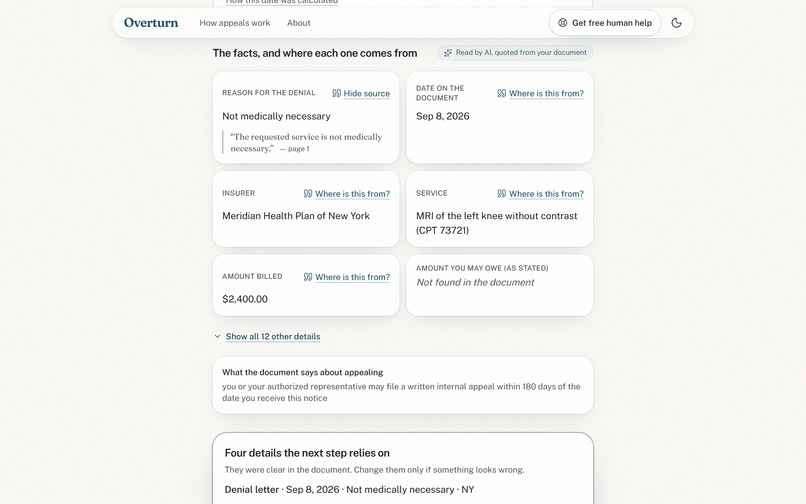
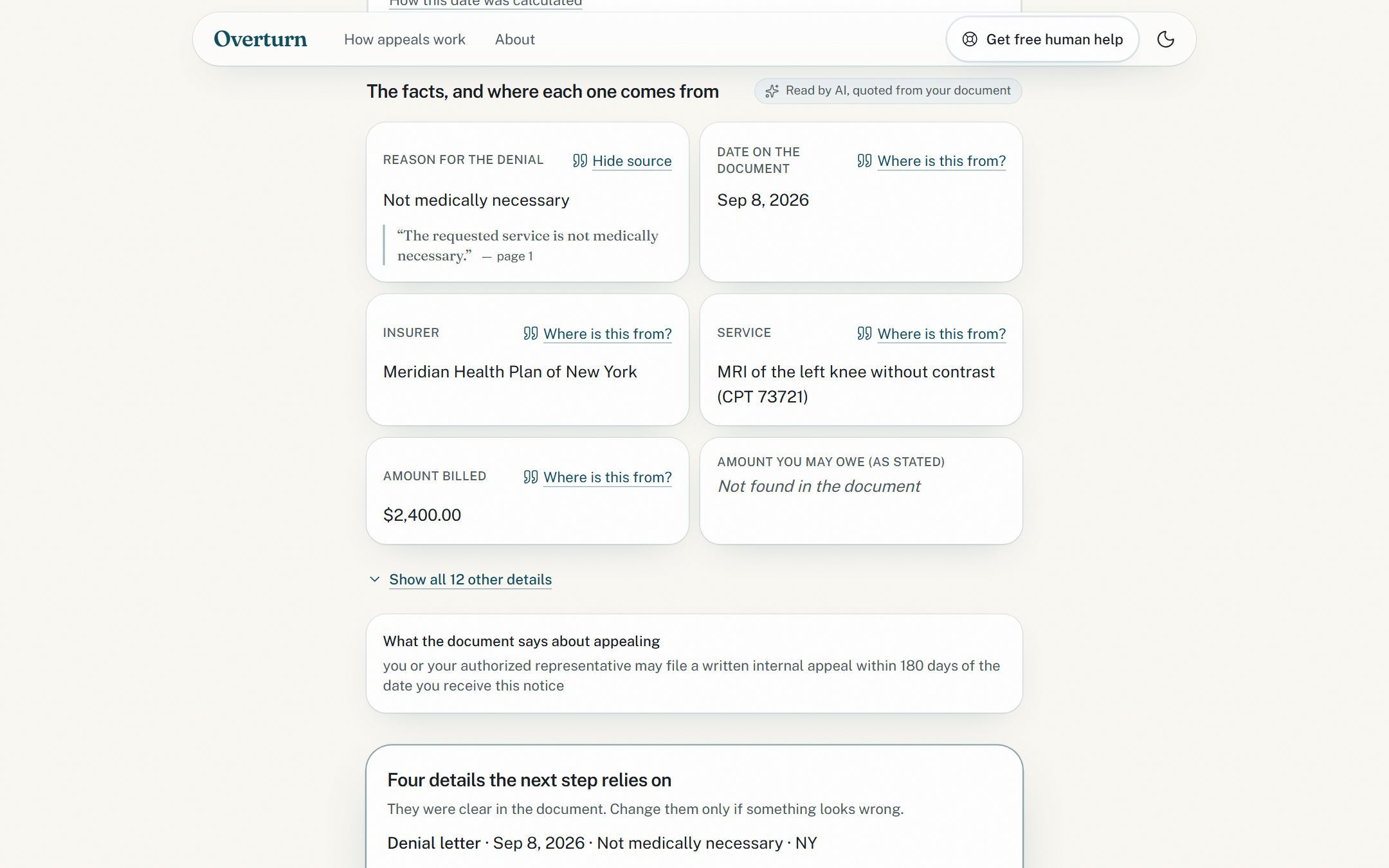
Every fact has a receipt: tap "Where is this from?" to see the exact sentence and page.
-
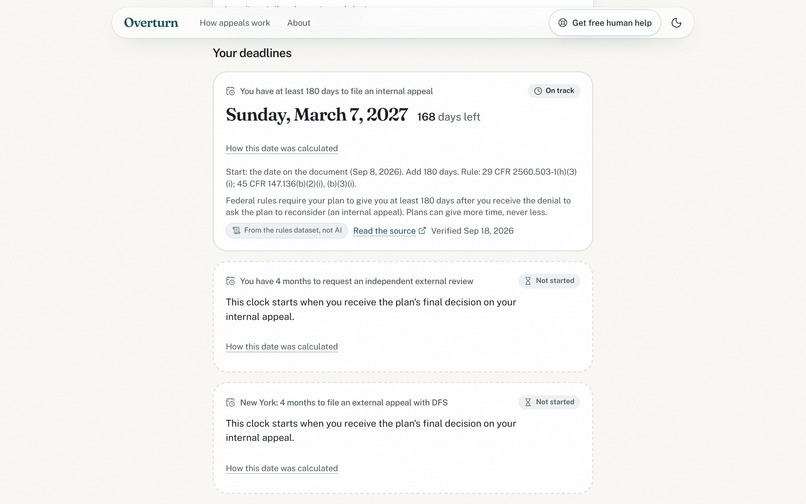
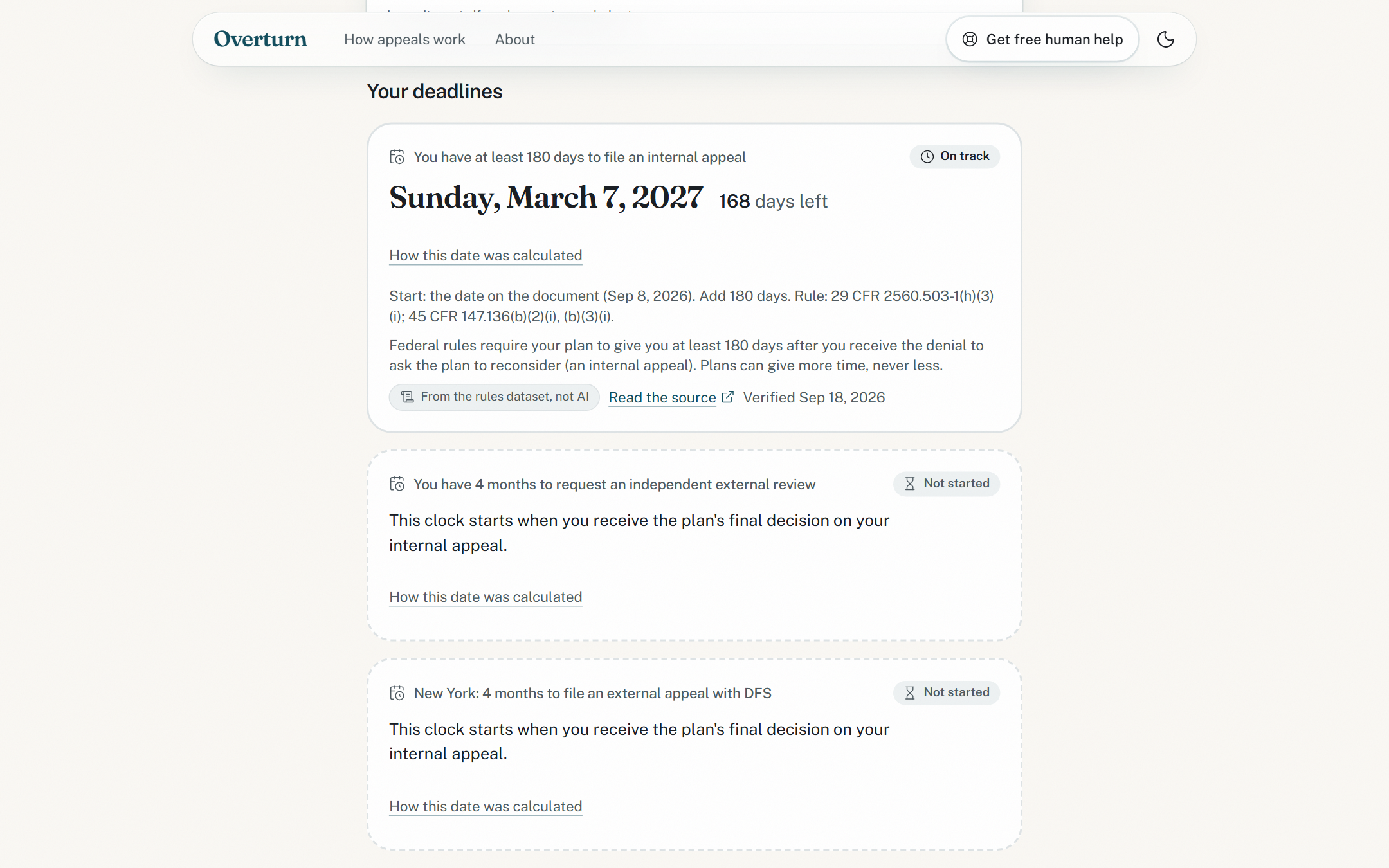
Every deadline shows its math: start date, rule, result, and the primary source.
-
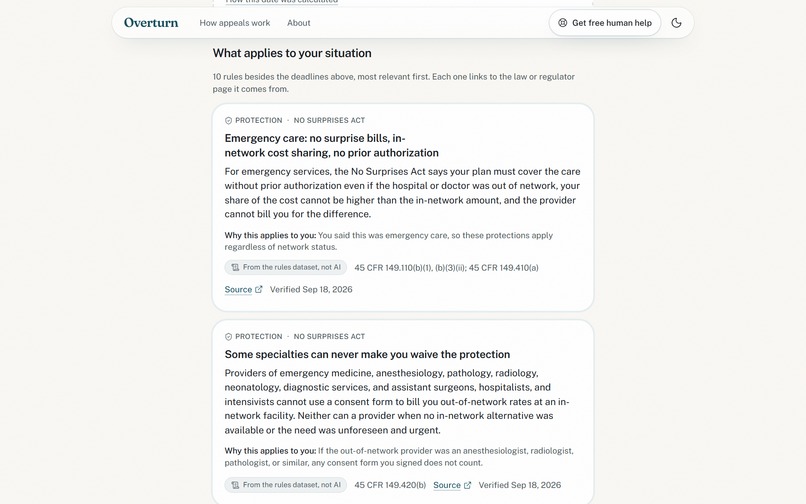
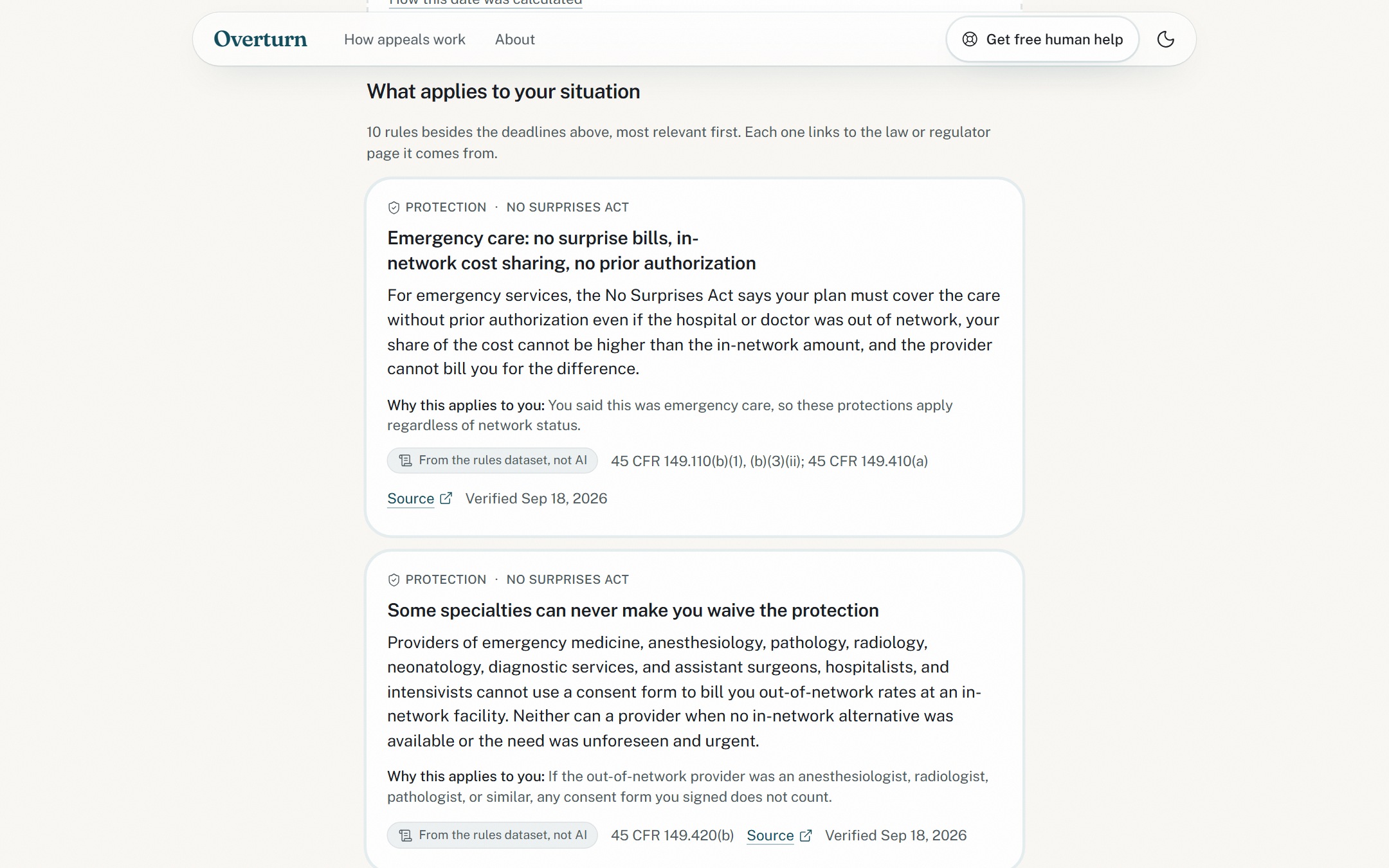
Rights computed by code, not written by the AI: citation, source link, and the date a human verified it.
-
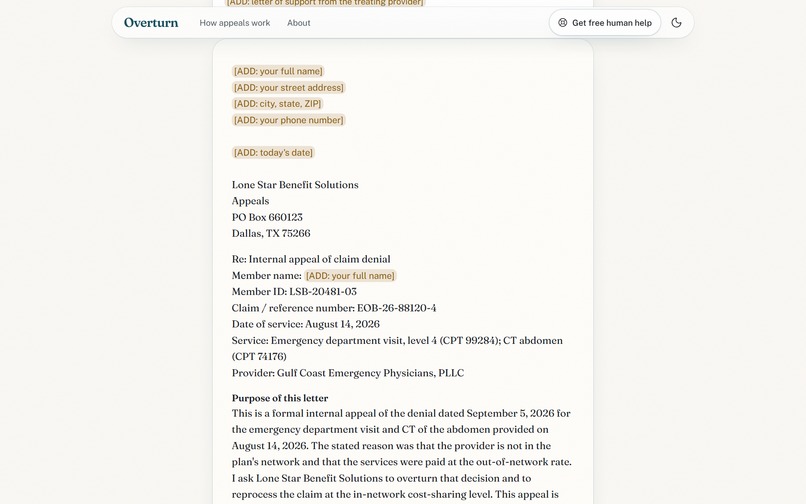
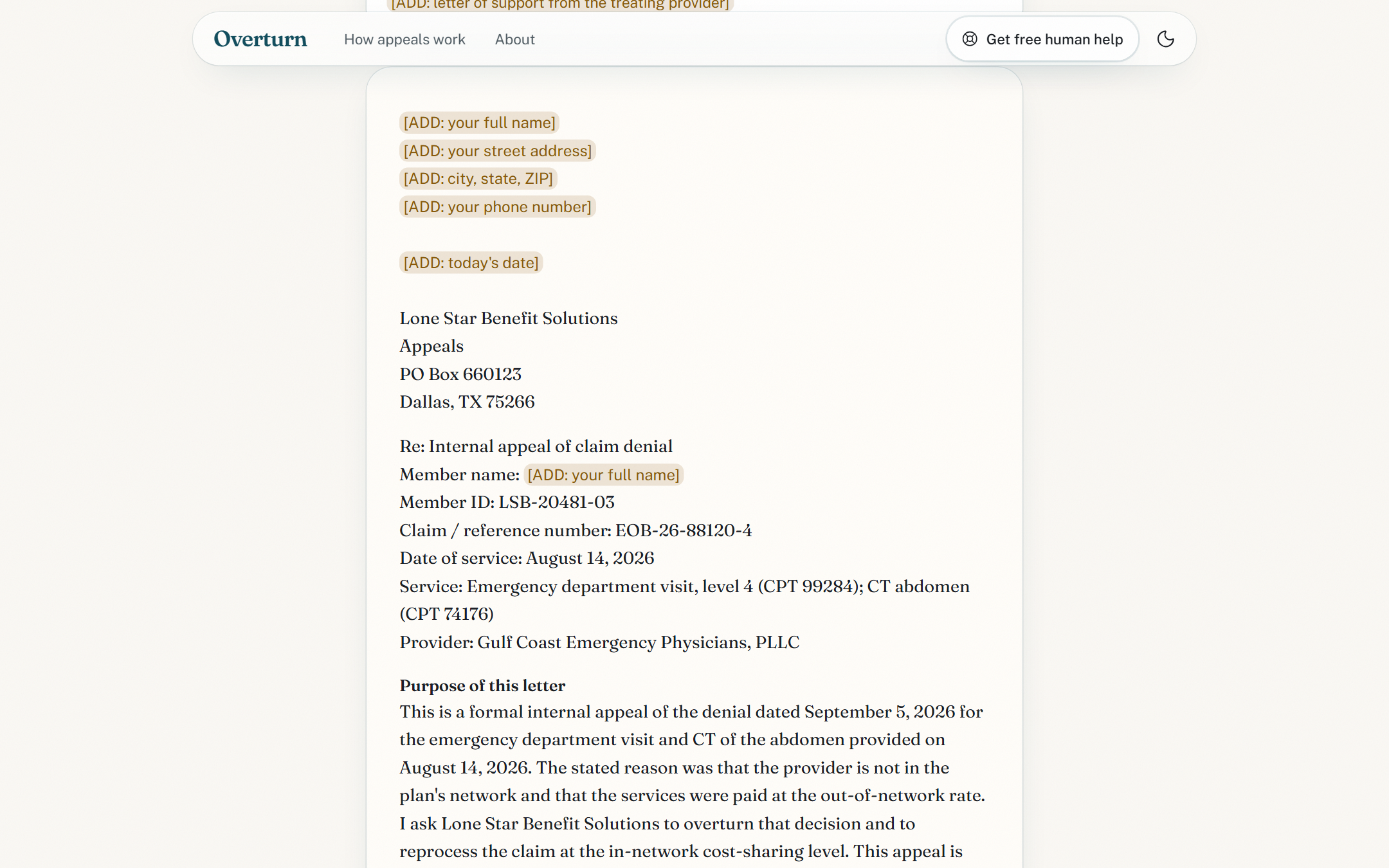
The appeal letter, drafted only from your facts and those rules. Blanks for what only you know.
-
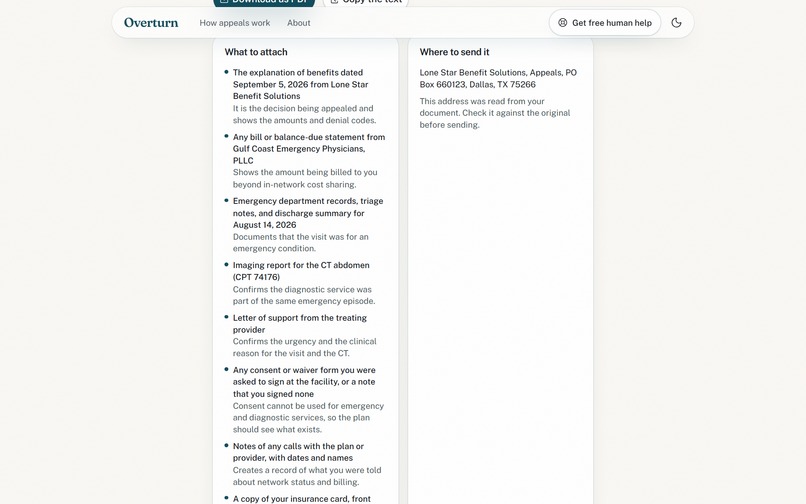
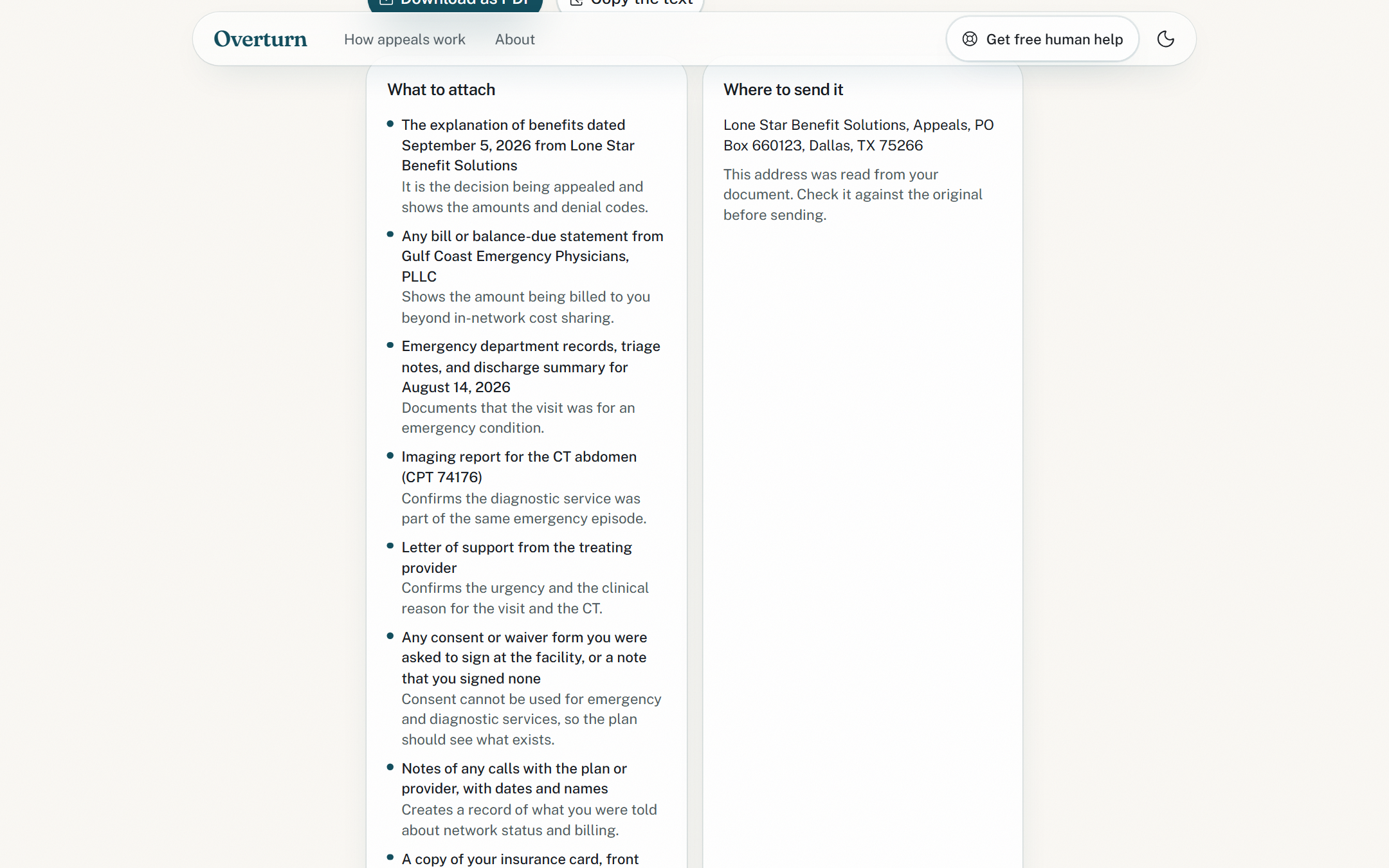
What to attach, where to send it, and a checklist before you send.
-
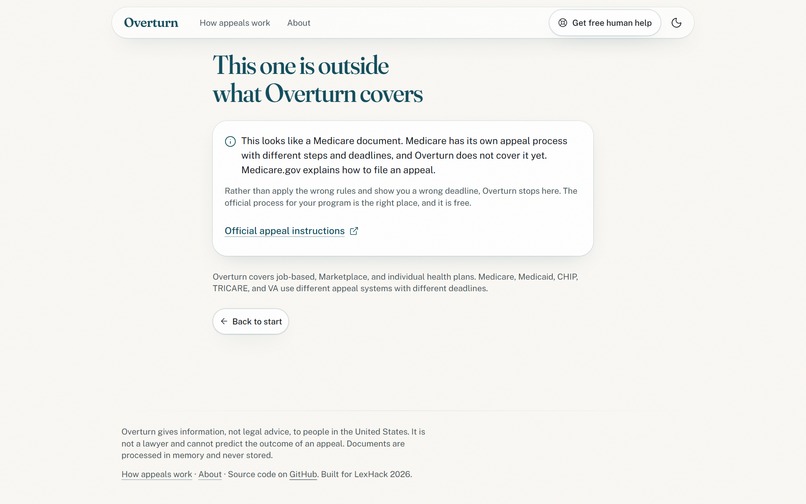
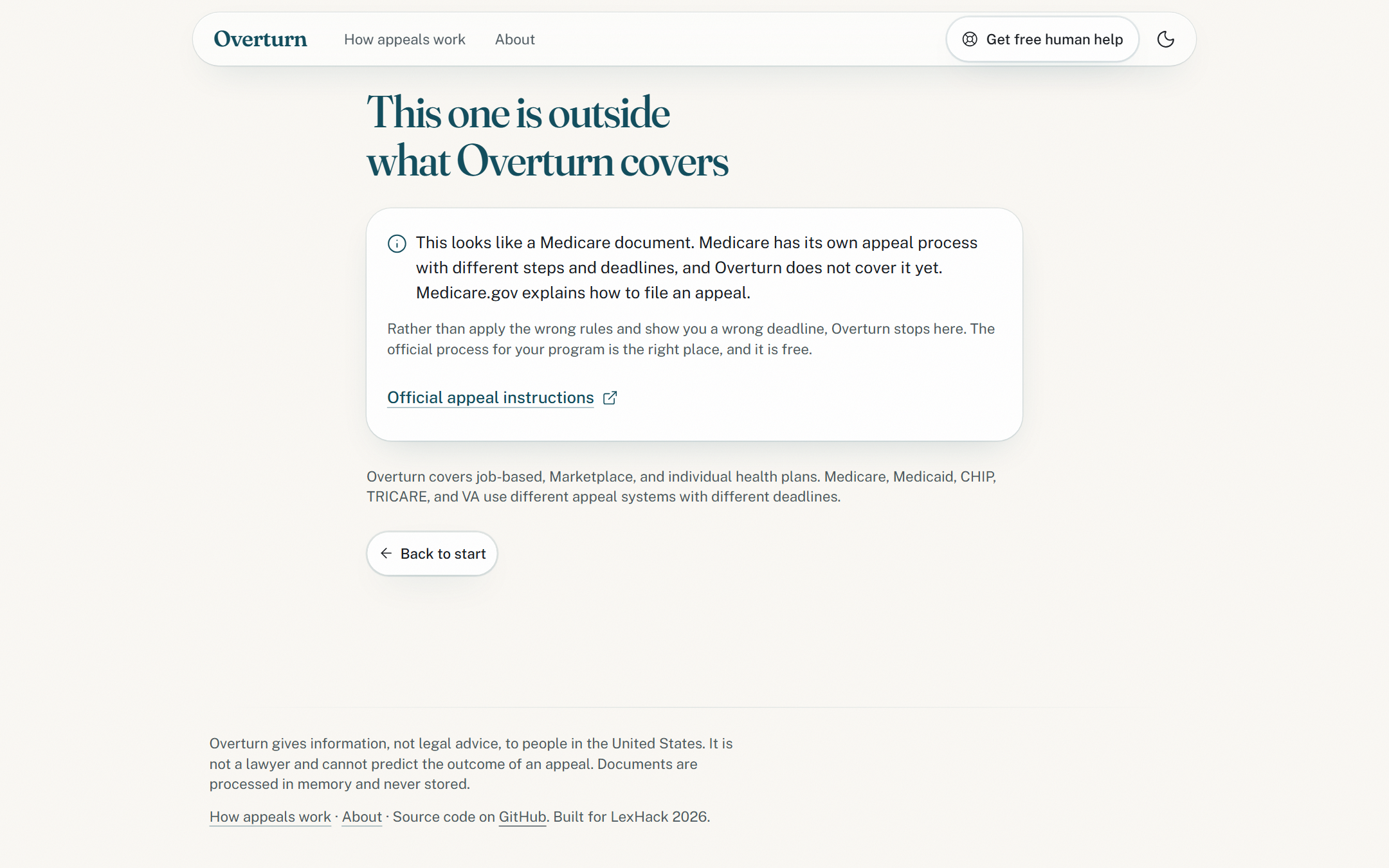
An honest stop: Medicare, Medicaid, and TRICARE follow other rules, so Overturn points you to the right place instead of guessing.
-
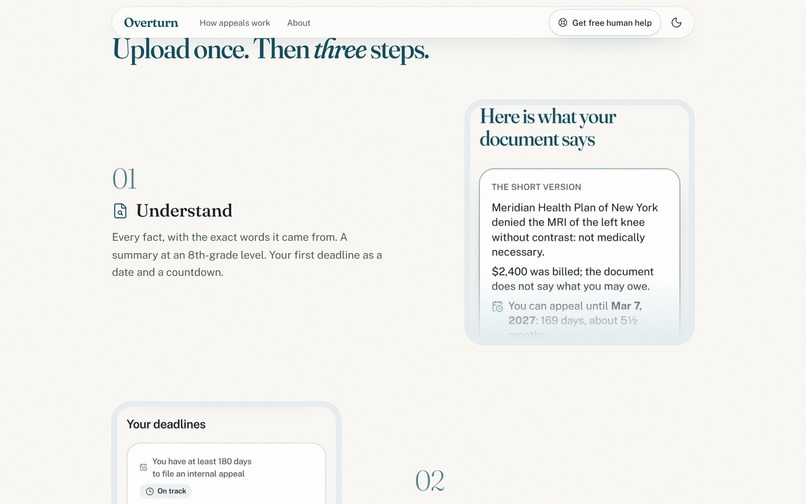
Upload once, then three steps: understand, know your rights, draft your appeal.
-
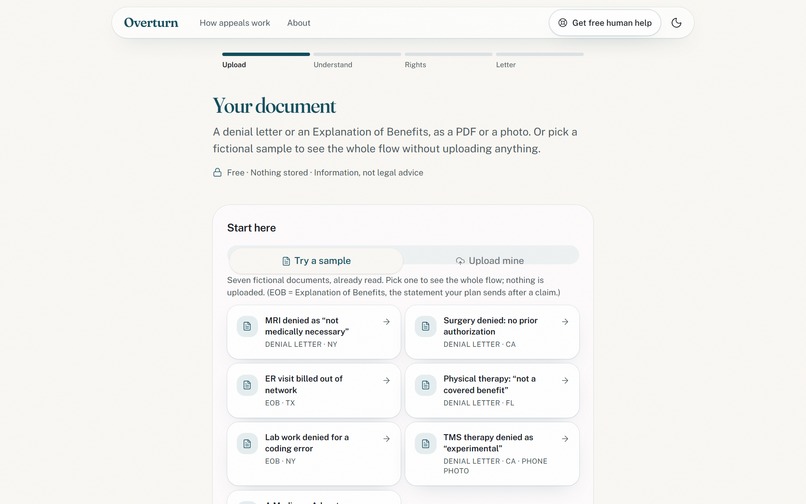
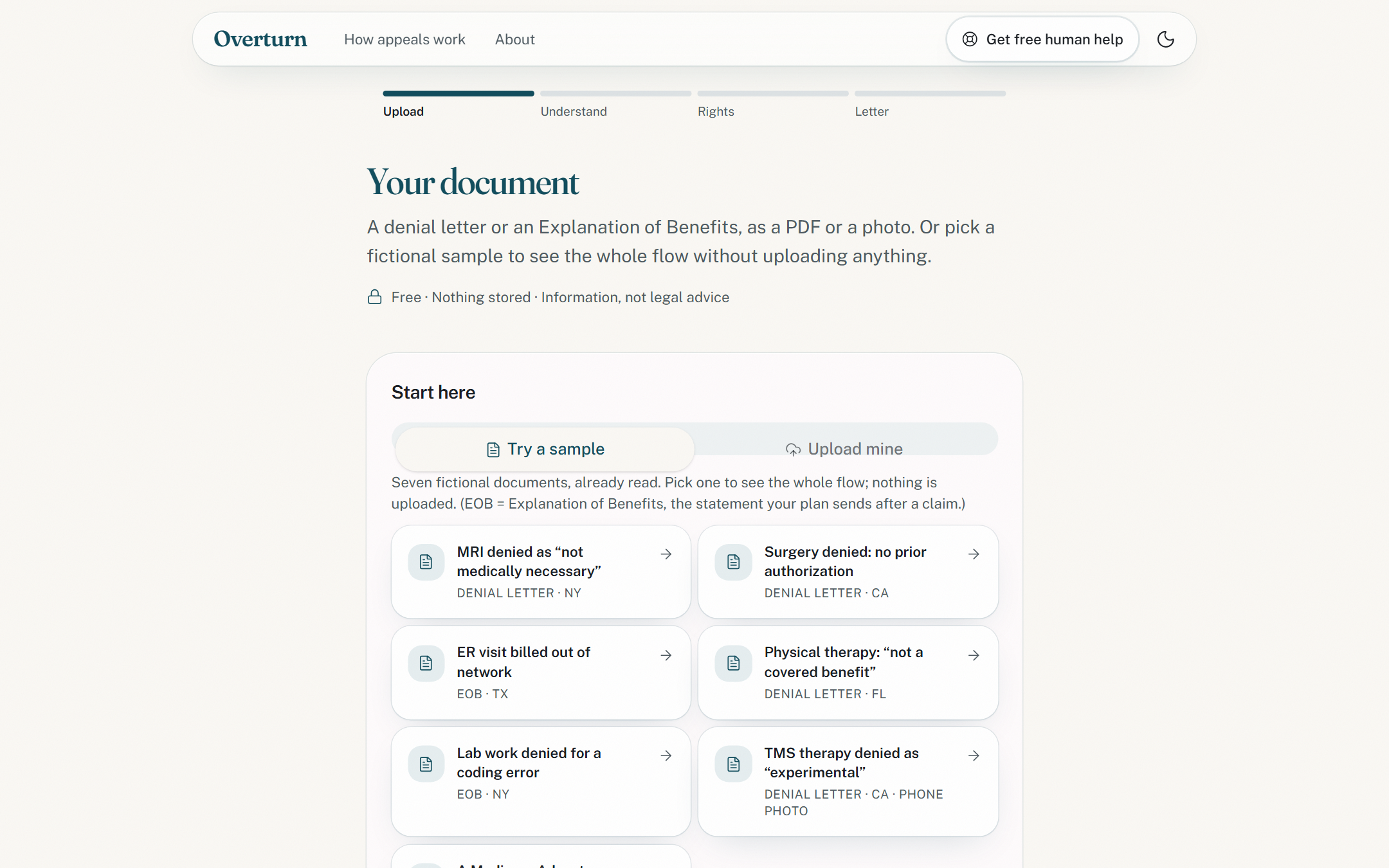
Start with your own document or one of seven fictional samples. Nothing is stored.
-
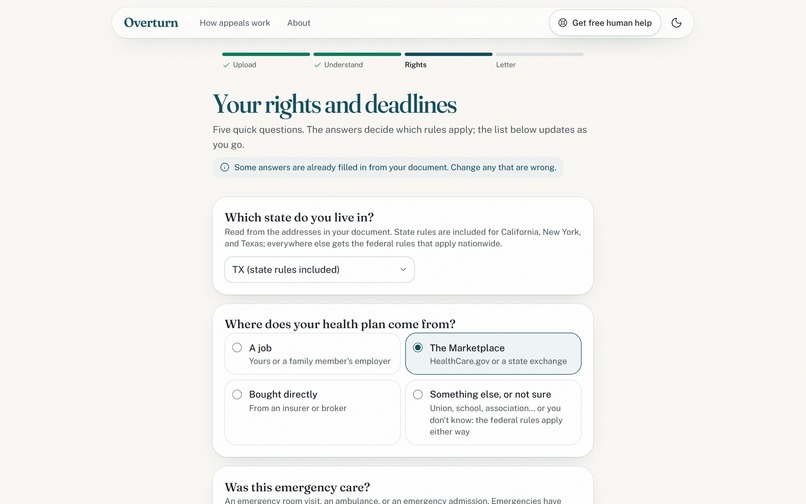
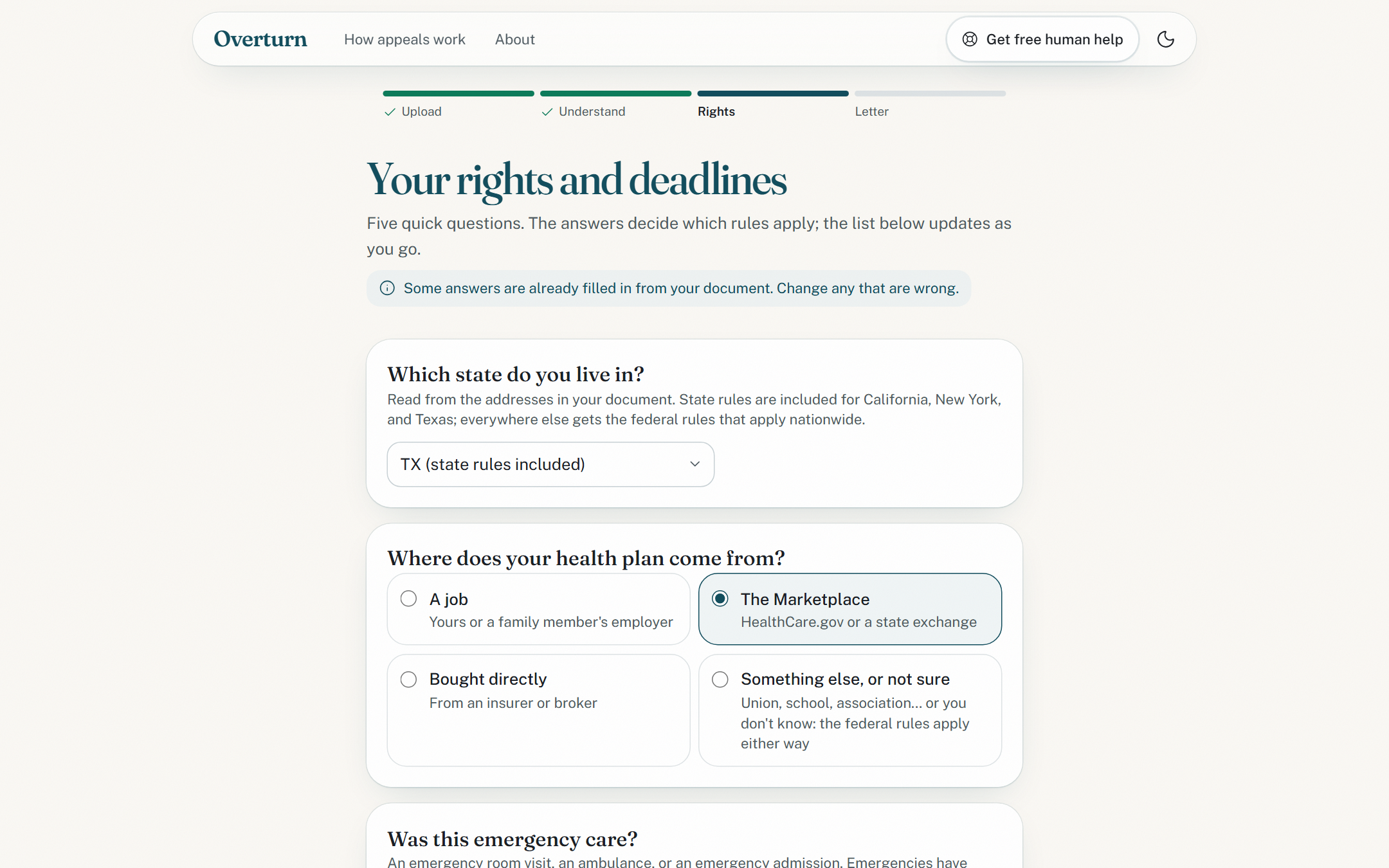
Five questions, pre-filled from the document, decide which protections apply.
-
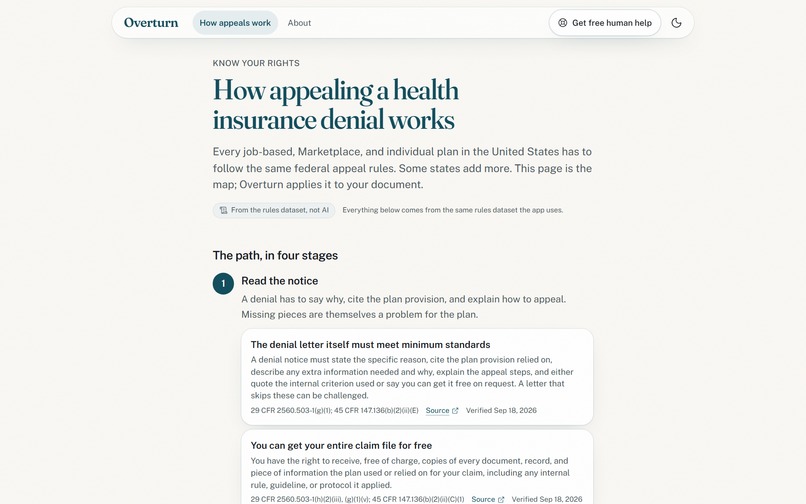
How appeals work: the four stages of a US appeal, rendered from the same rules dataset as the app.

Inspiration
In 2024, insurers on HealthCare.gov denied 19% of in-network claims. Consumers appealed fewer than 1% of them, and a third of those appeals succeeded (KFF). The gap is not motivation. It is that the denial letter is unreadable, the rights are unknown, and the deadline is invisible. The people most affected are the least likely to have someone who can read the letter for them. I wanted a tool that does what a good consumer-assistance counselor does in the first twenty minutes: read the letter with you, tell you what it means, tell you what generally applies and by when, and help you write the first appeal. Without pretending to be a lawyer.
What it does
Four screens, one task each, designed for a stressed person on a phone:
- Upload a denial letter or Explanation of Benefits (PDF or photo), or open one of seven synthetic samples.
- Understand: every fact with the exact words it came from, a plain-English summary at an 8th-grade level, and the first deadline as a date with a countdown and the rule behind it.
- Rights: five questions, then the protections and deadlines that apply to that situation, federal baseline plus state rules for California, New York, and Texas, each with a legal citation, a primary source, and a last-verified date.
- Letter: an appeal letter drafted only from those facts and those rights, with visible
[ADD: …]blanks for everything the tool does not know. Edit, download as PDF, or copy. Then a "before you send" checklist.
A "Get free human help" button on every screen lists the state Consumer Assistance Program and regulator. A How appeals work page explains the four stages of a US appeal and what each covered state adds, rendered from the same rules dataset the app uses; an About page states the problem, the information-vs-advice line, and what happens to your document.
How we built it
The model reads, the code decides, the human sends.
- Reading: Claude reads the PDF or image directly (no OCR pipeline) and returns structured facts through a JSON-schema output. Each fact carries a verbatim quote and a page. Absent means
null; the prompt forbids inference. A readability gate rewrites the explanation until it reads at grade 8 or below, and a banned-phrase scan rejects advice-style wording. - Deciding: which rights and deadlines apply is computed by a deterministic TypeScript engine over a versioned rules dataset (33 rules: ACA/ERISA claims procedure, No Surprises Act, CA, NY, TX). Every rule has
legal_ref,source_url, andlast_verified; a test fails the build if one is missing or older than 45 days. The engine handles "I don't know whether my plan is self-funded" by showing both routes with a caveat, and flags a letter that states a shorter deadline than the legal minimum. - Writing: the letter prompt receives only the extracted facts, the user's answers, and the computed rights, and cites them with
[[cite:rule_id]]markers. The server strips any citation the engine did not produce and re-checks the text for advice language. - Stack: Next.js 16, React 19, TypeScript, Tailwind 4, shadcn/ui, Zod 4,
@anthropic-ai/sdk,@react-pdf/renderer, Vitest + Playwright with axe-core, Vercel. - Process: spec-driven with GitHub's Spec Kit (constitution → spec → plan → tasks), coded solo with Claude Code. All legal content was read from primary sources (eCFR, state statutes, regulator pages) and recorded with the date read.
Challenges we ran into
Inspiration
In 2024, insurers on HealthCare.gov denied 19% of in-network claims. Consumers appealed fewer than 1% of them, and a third of those appeals succeeded (KFF). The gap is not motivation. It is that the denial letter is unreadable, the rights are unknown, and the deadline is invisible. The people most affected are the least likely to have someone who can read the letter for them.
I wanted a tool that does what a good consumer-assistance counselor does in the first twenty minutes: read the letter with you, tell you what it means, tell you what generally applies and by when, and help you write the first appeal. Without pretending to be a lawyer.
What it does
Four screens, one task each, designed for a stressed person on a phone:
- Upload a denial letter or Explanation of Benefits (PDF or photo), or open one of seven synthetic samples.
- Understand: every fact with the exact words it came from, a plain-English summary at an 8th-grade level, and the first deadline as a date with a countdown and the rule behind it.
- Rights: five questions, then the protections and deadlines that apply to that situation, federal baseline plus state rules for California, New York, and Texas, each with a legal citation, a primary source, and a last-verified date.
- Letter: an appeal letter drafted only from those facts and those rights, with visible
[ADD: …]blanks for everything the tool does not know. Edit, download as PDF, or copy. Then a "before you send" checklist.
A "Get free human help" button on every screen lists the state Consumer Assistance Program and regulator. A How appeals work page explains the four stages of a US appeal and what each covered state adds, rendered from the same rules dataset the app uses; an About page states the problem, the information-vs-advice line, and what happens to your document.
How I built it
The model reads, the code decides, the human sends.
- Reading: Claude reads the PDF or image directly (no OCR pipeline) and returns structured facts through a JSON-schema output. Each fact carries a verbatim quote and a page. Absent means
null; the prompt forbids inference. A readability gate rewrites the explanation until it reads at grade 8 or below, and a banned-phrase scan rejects advice-style wording. - Deciding: which rights and deadlines apply is computed by a deterministic TypeScript engine over a versioned rules dataset (33 rules: ACA/ERISA claims procedure, No Surprises Act, CA, NY, TX). Every rule has
legal_ref,source_url, andlast_verified; a test fails the build if one is missing or older than 45 days. The engine handles "I don't know whether my plan is self-funded" by showing both routes with a caveat, and flags a letter that states a shorter deadline than the legal minimum. - Writing: the letter prompt receives only the extracted facts, the user's answers, and the computed rights, and cites them with
[[cite:rule_id]]markers. The server strips any citation the engine did not produce and re-checks the text for advice language. - Stack: Next.js 16, React 19, TypeScript, Tailwind 4, shadcn/ui, Zod 4,
@anthropic-ai/sdk,@react-pdf/renderer, Vitest + Playwright with axe-core, Vercel. - Process: spec-driven with GitHub's Spec Kit (constitution → spec → plan → tasks), coded solo with Claude Code. All legal content was read from primary sources (eCFR, state statutes, regulator pages) and recorded with the date read.
Challenges I ran into
- Structured outputs have a grammar budget. The first extraction schema (24 fields × value/quote/page/confidence, all nullable) was rejected twice. I flattened it to sentinel values plus a single
evidencelist, and rebuilt the strict shape in code. - The model wanted to be helpful. Early drafts asserted things the patient "did not do" ("I did not sign any waiver"). One rule in the prompt, one regeneration, and that class of fabrication became a placeholder instead. Every such case is treated as a design bug, not a prompt quirk.
- Regulator websites block automated readers. For California and Texas the statute is cited on the legislature's site and the regulator page is used for the human-help entry. Where a number could not be confirmed from a primary source, it is not in the dataset.
- A five-dollar API budget. Every model output for the samples is cached and committed, so the demo costs nothing to run and the whole build cost under $2 in API calls (logged in
docs/api-spend.md). - Production is not development. Playwright against the production build caught a Content Security Policy that blocked the PDF engine's WebAssembly. Fixed before anyone saw it.
Accomplishments that we're proud of
- The information-vs-advice line is enforced in code at three layers (prompt, product, copy), and the argument is written down in one page (
LEGAL_DESIGN.md). - Every deadline on screen shows its formula and its source. Every fact shows its quote. Every citation in the letter is one the code produced.
- WCAG 2.2 AA with zero axe violations, light and dark, phone and desktop, keyboard-only flow, verified in CI on every push and against production. Lighthouse: accessibility 100.
- An honest stop for Medicare, Medicaid, and TRICARE documents instead of a wrong answer.
- A rules dataset another state can be added to in half a day, with a test that refuses unsourced rules.
What we learned
- Separating reading from deciding is what makes an AI legal-information tool defensible. It also makes it testable: the engine has a golden table; the model has fixtures.
- "I don't know" has to be a first-class answer in a legal tool, because it is the honest common case.
- Plain language is a measurable requirement, not a tone. Grade level and word count are in the tests.
What's next for Overturn
- More states, in order of population and regulator clarity (Florida next, as the federal-process counter-example).
- Spanish, which the architecture makes cheap: rules are data, prose comes from the model.
- A letter for the external review step, and reminders the user opts into (without storing the document).
- Partnering with a Consumer Assistance Program to test with real counselors.
Built With
- anthropic-sdk
- axe-core
- claude
- next.js
- playwright
- react
- react-pdf
- shadcn
- spec-kit
- tailwind
- typescript
- vercel
- vitest
- zod

Log in or sign up for Devpost to join the conversation.