Inspiration
Modern teams usually have to choose between two imperfect options: real-time chat that moves quickly but loses important context, or traditional forums that preserve knowledge but feel too slow and rigid for everyday collaboration.
We built Overpass Community to bridge that gap. Our goal was to create a space where teams and communities can communicate quickly, hold deeper asynchronous discussions, and turn useful conversations into lasting, searchable knowledge.
What it does
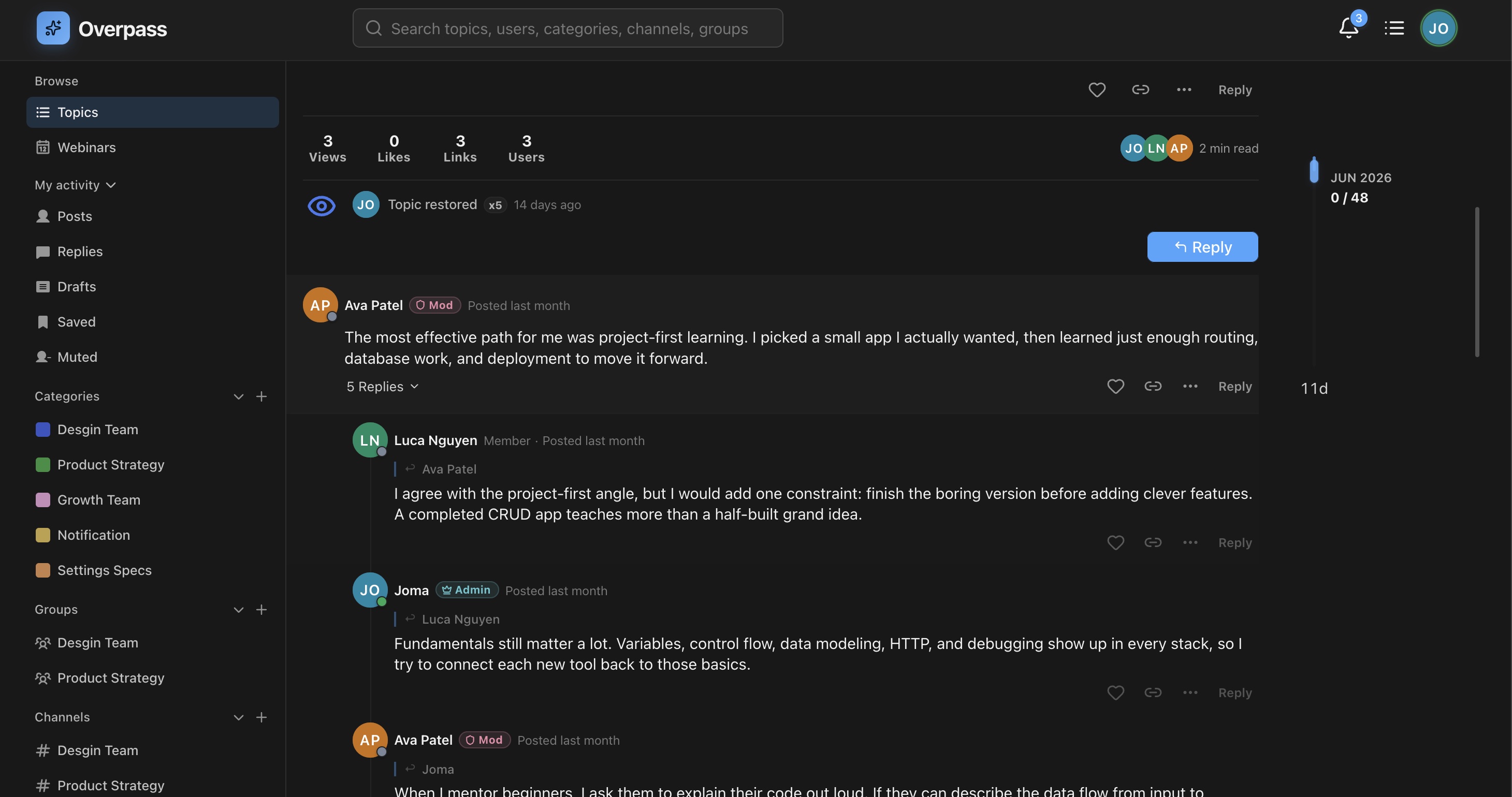
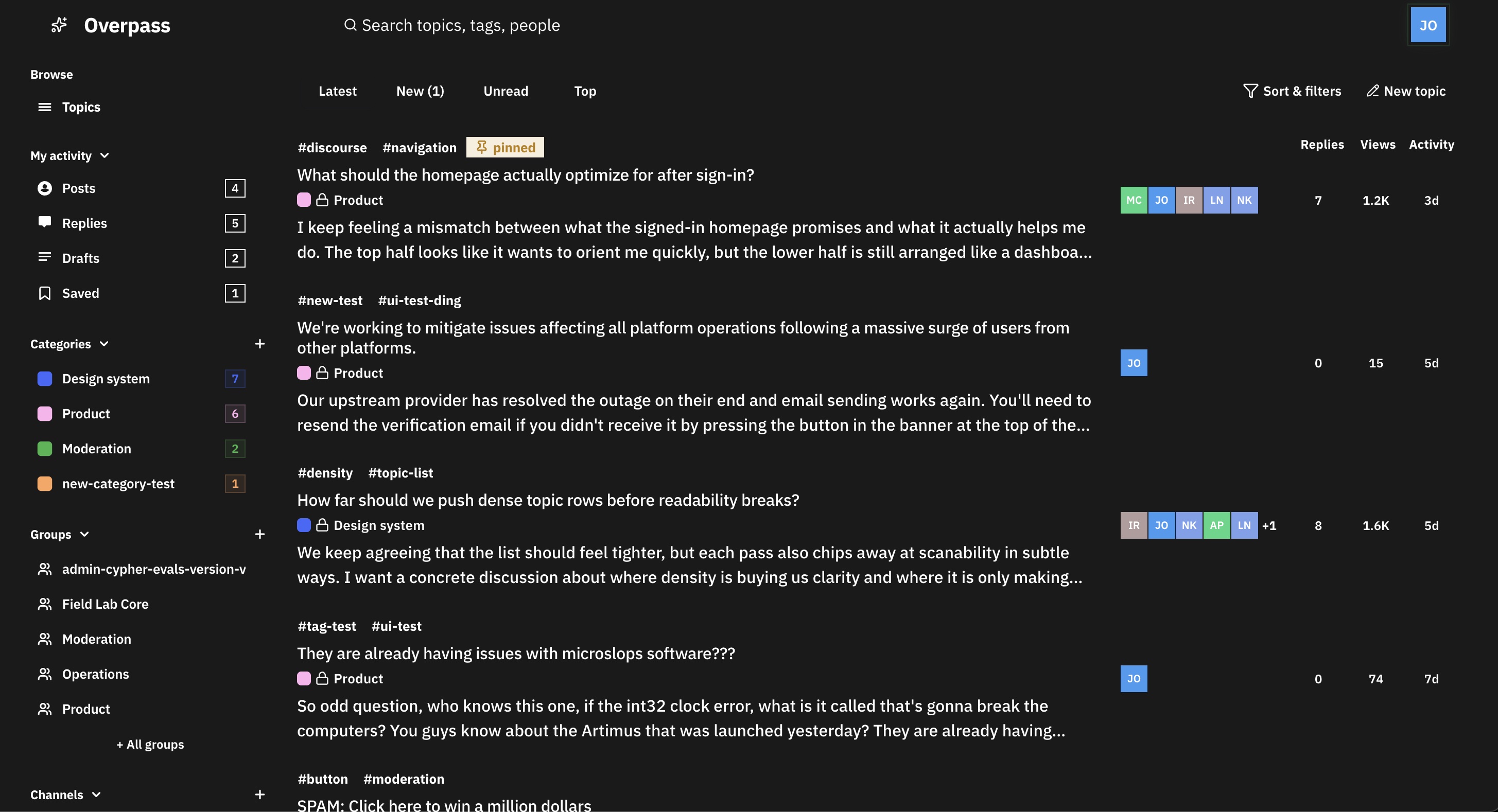
Overpass Community combines real-time communication with structured community discussions in one workspace.
Users can:
- Chat instantly in real-time channels
- Create categorized topics for deeper discussions
- Reply in structured conversation threads
- Track unread activity and return to the right place
- Save and sync drafts across sessions
- Upload images, videos, and files
- Search past discussions and documented solutions
- Control access through groups, roles, and category permissions
- Manage notifications without being overwhelmed by noise
- Build a long-term knowledge base from everyday collaboration
Instead of letting important decisions disappear into chat history, Overpass helps communities preserve context and make useful information easier to discover.
How we built it
Overpass Community is built as a modular, multi-service platform.
The frontend is developed with React and TypeScript, with reusable components for topics, replies, messaging, media, notifications, moderation, and administration.
The backend separates responsibilities across several services:
- PostgreSQL stores users, permissions, categories, topics, notifications, and other structured data
- Cassandra / ScyllaDB supports high-volume chat messages and timelines
- Redis / Valkey handles caching, presence, and real-time coordination
- RabbitMQ provides durable communication between services
- Meilisearch powers fast content discovery
- LiveKit supports real-time audio and video capabilities
We also designed Overpass to support self-hosted deployments using containers, making it suitable for organizations that need greater control over their infrastructure and data.
Challenges we ran into
One of the biggest challenges was combining two very different interaction models.
Real-time chat is optimized for speed, while forum-style discussions are optimized for structure and long-term readability. We had to make both experiences feel connected without making topics feel like slow chat rooms or making channels feel like unstructured forums.
Media presentation was another difficult problem. Images and files need to behave differently depending on whether they are part of a detailed explanation, a reply, or a group of attachments. We had to preserve the author's intended content order while still supporting responsive galleries, previews, uploads, and full-screen viewing.
Other challenges included:
- Keeping unread and read-state information accurate
- Designing permissions across sites, groups, categories, topics, and channels
- Supporting real-time updates without unnecessary UI rerenders
- Keeping drafts safe while users move between pages
- Creating a responsive interface for both desktop and mobile
- Maintaining consistent behavior across chat, topics, replies, and media
- Designing an architecture that can scale without becoming tightly coupled
Accomplishments that we're proud of
We are proud that Overpass has become more than a simple chat application or forum prototype.
We built:
- A unified experience for real-time and asynchronous collaboration
- Structured topics with nested replies and discussion tools
- Real-time channels with presence and messaging support
- Granular roles and permission controls
- Draft synchronization and read-state tracking
- Responsive image, video, and file presentation
- Searchable discussions and community knowledge
- A reusable design system across major product surfaces
- A modular architecture designed for self-hosting and future growth
Most importantly, the product now has a clear identity: quick conversations can happen naturally, while important ideas can become organized, durable knowledge.
What we learned
We learned that combining chat and forums is not simply a matter of putting both features in the same application.
The difficult part is deciding how information moves between fast communication and structured discussion. Users need to understand where a conversation belongs, what deserves to be preserved, and how to find it again later.
We also learned that small presentation details can have a major effect on trust. Read markers, media dimensions, loading states, notification behavior, and stable layouts all influence whether the product feels calm and reliable.
On the engineering side, we learned the importance of:
- Defining clear boundaries between services
- Treating permissions as a core domain rather than a UI feature
- Preserving authored content semantics
- Testing dynamic interface states, not only static output
- Designing reusable components before product complexity grows
- Building real-time features with failure and reconnection in mind
What's next for Overpass Community
Our next goal is to make the connection between real-time chat and structured knowledge even stronger.
Planned improvements include:
- Turning important channel conversations into structured topics
- Better summaries for long discussions
- Improved search and knowledge discovery
- Smarter notification and noise-filtering controls
- Richer moderation and administration tools
- More polished mobile experiences
- Improved integrations with external collaboration tools
- Expanded audio, video, and live-event capabilities
- Easier self-hosting, backups, and deployment management
- More ways for communities to customize their workspace
We want Overpass Community to become the place where teams can move quickly without losing clarity, context, or the knowledge they create along the way.

Log in or sign up for Devpost to join the conversation.