Inspiration
We live in a world grappling with a quiet mental health and lifestyle crisis. Under UN Sustainable Development Goal 3 (Good Health and Well-Being), preventative healthcare has never been more critical. The medical consensus is clear: the foundation of mental resilience and physical longevity lies in consistent daily habits—mindfulness, restorative sleep, hydration, movement, and intentional reflection.
Yet, modern digital health tools often exacerbate the very anxiety they claim to cure.
Most commercial habit trackers are engineered for digital addiction: aggressive push notifications, toxic streak-shaming mechanics, and intrusive gamification that make you feel guilty for simply having an off day. Worse, almost every wellness platform uploads deeply personal reflections, behavioral records, and emotional vulnerabilities to centralized cloud servers.
Me and my team built Overman to challenge this paradigm.
We were inspired to create a tool grounded in lifestyle medicine and behavioral psychology: an app that requires less than 10 seconds of screen time a day, operates with 100% local-first privacy, and leverages empathetic AI not as a gimmick, but as a grounded cognitive companion that helps users navigate behavioral slumps with compassion rather than shame.
What It Does
Overman is a private, local-first habit engineering and cognitive wellness application:
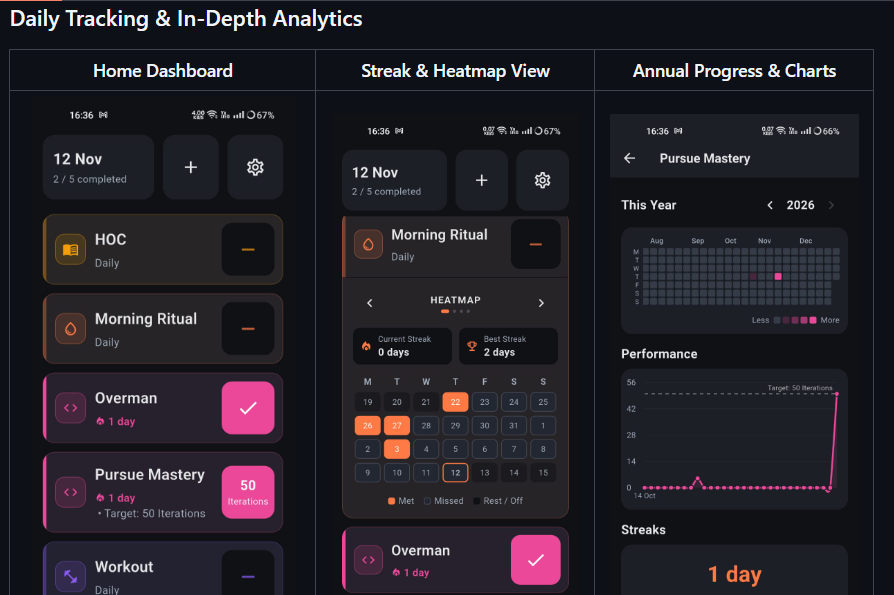
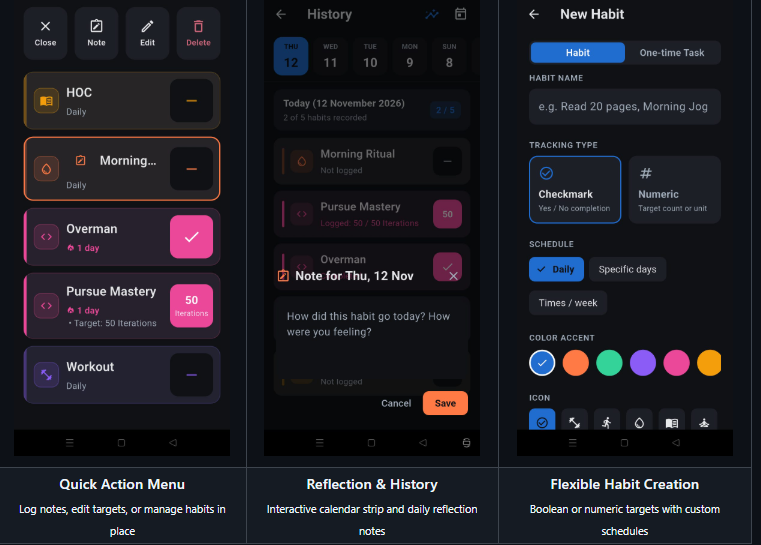
- Low-Friction Habit Tracking: Supports boolean completions and quantifiable metrics (e.g., glasses of water, meditation minutes, pages read) with custom scheduling (daily, specific weekdays, or weekly frequency targets).
- Cognitive Reflection Journaling: Users can attach contextual day notes to any habit to document mood, energy levels, mental resistance, or triggers.
- Longitudinal Behavioral Analytics: GitHub-style calendar heatmaps, annual consistency grids, and streak analytics visualize behavioral patterns and help identify burnout trends before relapse occurs.
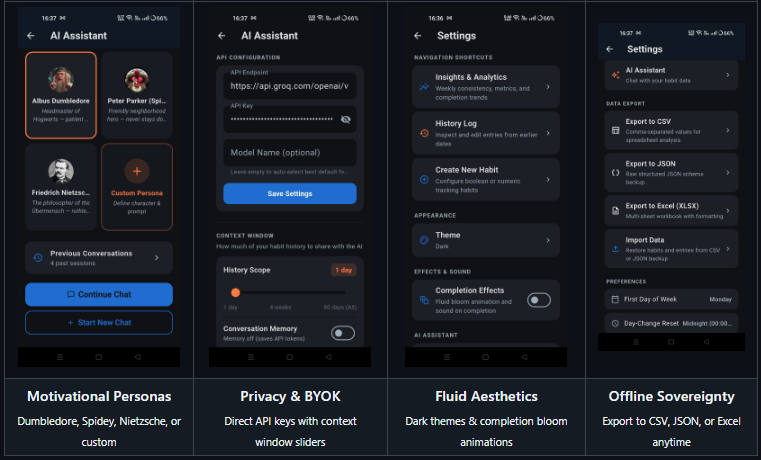
- Context-Aware AI Companion & Personas: Translates raw habit telemetry into personalized psychological feedback. Users can select motivational personas (e.g., an empathetic coach, a stoic mentor, or custom characters) to receive grounded encouragement tailored to their actual history.
- 100% Local Data Sovereignty & BYOK: Built on an embedded on-device database with zero telemetry, zero analytics tracking, and direct Bring-Your-Own-Key (BYOK) support for Google Gemini Native, Anthropic Claude, and OpenAI endpoints.
How We Built It
Overman was developed from the ground up using a modern, scalable, and resilient technical stack:
- Frontend & Architecture: Built with Flutter 3.41 / Dart following strict Clean Architecture principles. Domain entities and business logic are completely decoupled from UI widgets, with reactive state management powered by Riverpod.
- Embedded Local Storage: Instead of traditional slow SQLite or remote Firebase databases, Overman uses ObjectBox—a lightning-fast NoSQL embedded database with native C-bindings. Queries execute in sub-milliseconds on-device, ensuring instantaneous response times and zero offline friction.
- AI Orchestration Layer (
AiClientService): Engineered a multi-provider client abstraction capable of communicating directly with Google Gemini's native REST API, Anthropic Claude, and OpenAI-compatible gateways (including Groq, OpenRouter, and Ollama). - Context Serialization Engine (
AiDataFormatter): Built a specialized pipeline that dynamically scans recent habit entries, completion thresholds, streak records, and daily journal notes, formatting them into structured, token-efficient prompt context with user-adjustable memory windows. - Data Portability: Implemented a full data export pipeline (
DataExportService) enabling one-tap exports to JSON, CSV, and Excel so users can share behavioral tracking logs with therapists or healthcare providers.
Challenges We Ran Into
Decoupling Complex Streak & Schedule Mathematics:
Calculating streaks across non-standard schedules (e.g., "3 days per week" or "every Tuesday and Thursday") is notoriously difficult without introducing performance bottlenecks. Embedding this logic into UI widgets caused re-render lag. We resolved this by extracting calculation rules into a dedicated domain service (StreakCalculator) with thorough unit tests.Privacy-Preserving Context Engineering:
Feeding an LLM enough context to deliver deeply personal, empathetic wellness advice without leaking unnecessary private details or exhausting context windows was a major design challenge. We engineered an on-device serializer that strips extraneous data, normalizes timestamps, and gives the user full slider control over how many days of history are shared with the model.Cross-Platform Native C-Bindings:
Leveraging ObjectBox required managing native dynamic libraries (libobjectbox.soon Android andobjectbox.dllon Windows). Ensuring smooth compilation, ABI compatibility, and graceful error handling across different device architectures without bloating the APK took meticulous tuning.Designing for Zero Cognitive Burden:
Striking the balance between in-depth longitudinal health analytics and minimal UI friction was tough. We went through multiple interface iterations to ensure the primary check-in loop takes fewer than 3 taps, complete with subtle haptic-style bloom animations that provide psychological closure.
Accomplishments That We're Proud Of
- Zero-Telemetry Health Tool: Successfully engineered an application where sensitive mental wellness records and personal habits never touch a remote server without explicit user intent.
- Empathetic, Non-Trivial AI Integration: The AI companion doesn't just recite generic productivity quotes; it reads actual longitudinal trends (e.g., "You've been consistent with meditation for 5 days, but skipped hydration on stressful workdays") and provides supportive, actionable guidance.
- Production-Grade Architecture: Maintained strict Clean Architecture with over 15 feature modules, modular providers, and native desktop/mobile compatibility.
- A Product That Respects the User: Created a tool that prioritizes real-world human well-being over app engagement metrics.
What We Learned
- Preventative Healthcare Requires Empathy in Code: Designing health software taught us that high engagement metrics often correlate with user anxiety. True healthcare technology should aim to empower patients and get them back to living their lives, not keep them glued to a screen.
- The Power of Local-First Architecture: Building offline-first software with embedded databases is vastly superior for user trust, latency, and privacy compliance in healthcare applications.
- LLMs as Cognitive Mirrors: When supplied with structured behavioral telemetry, AI models excel as objective, non-judgmental mirrors that help users recognize subconscious patterns and overcome executive dysfunction.
What's Next for Overman
- On-Device Small Language Models (SLMs): Integrating quantized local models (such as Gemma or Llama via on-device NPU) so the AI companion can run 100% offline without needing any external API keys or internet connection.
- Biometric & Wearable Integration: Integrating with Health Connect to correlate habit consistency with objective physiological markers like resting heart rate, sleep duration, and HRV.
- Clinical Health Reports: Providing a dedicated, formatted PDF export specifically designed for clinical check-ins with psychiatrists, cognitive behavioral therapists (CBT), or lifestyle medicine practitioners.
Built With
- dart
- flutter
