-
-
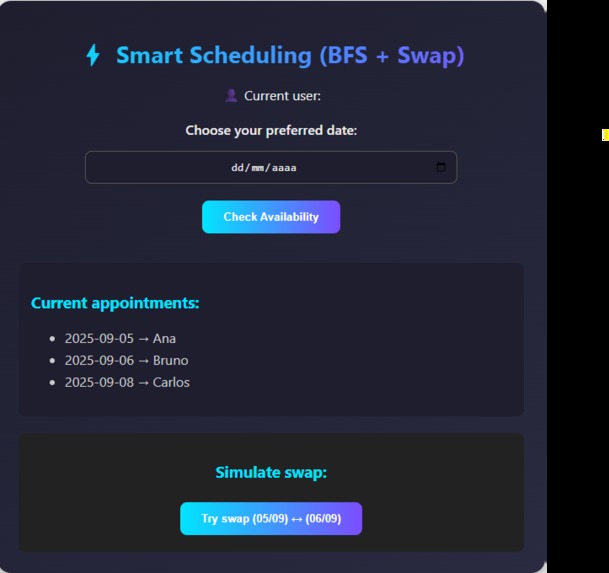
Main screen
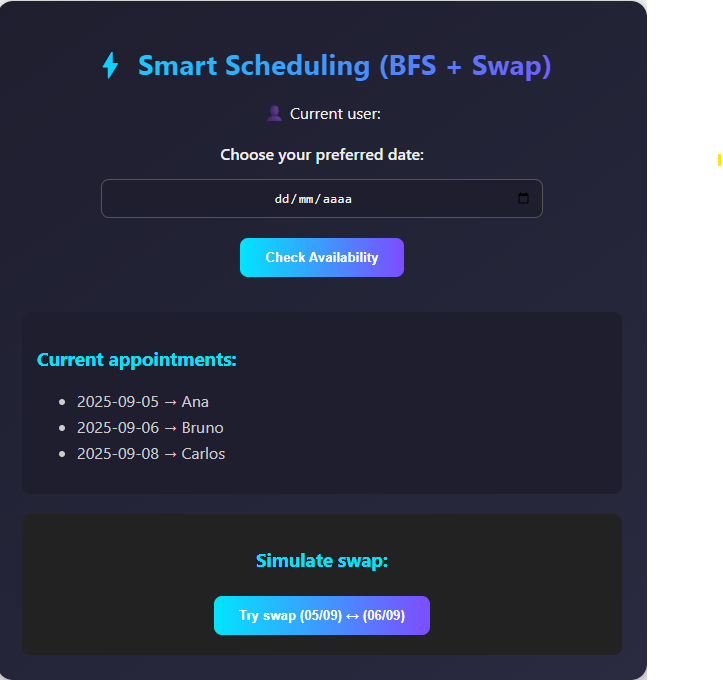
About the Project
Inspiration
The idea for this project came from the everyday struggle of managing overlapping appointments and scheduling conflicts. I wanted to build a tool that not only finds available dates quickly but also allows users to swap appointments easily, making scheduling a stress-free experience.
What I Learned
Through this project, I learned to:
- Work with React hooks (
useState,useEffect) for dynamic state management. - Persist data locally using localStorage, simulating a simple login system.
- Implement BFS (Breadth-First Search) for finding the nearest available date.
- Handle user interactions such as confirmations, swaps, and notifications.
- Write clean, maintainable code with dynamic styling in React.
I also got hands-on experience dealing with edge cases, like handling users cancelling a prompt, swapping appointments without being involved, and keeping localStorage data consistent.
How I Built It
The project was built using React with JavaScript. The main components include:
- Date selection form – users pick a date, and the system checks availability.
- Appointment management – confirmed appointments are stored in
localStorageto persist across sessions. - BFS algorithm – finds the closest free date automatically when the preferred date is taken.
- Swap feature – users can swap appointments if they are involved, simulating real-world scheduling flexibility.
- Dynamic UI – messages, modals, and lists update in real-time for better user experience.
Challenges Faced
Some of the main challenges I encountered were:
- Preventing
nullvalues fromprompt()when users canceled, which required input validation. - Managing state updates correctly during swaps, ensuring that messages reflect the current user’s involvement.
- Designing a friendly UI that is informative, colorful, and intuitive without being cluttered.
- Implementing BFS efficiently to explore past and future dates in a controlled way, avoiding infinite loops.
Fun Fact
Even though this is a scheduling app, under the hood it’s kind of like graph traversal! Each date is a node, and BFS searches the calendar graph for free slots. Mathematically, you could represent the calendar as a graph ( G = (V, E) ) where ( V ) is the set of dates and ( E ) connects consecutive days. BFS ensures we find the closest available node efficiently.
This project is a playful but practical way to explore algorithms, state management, and user experience all at once!

Log in or sign up for Devpost to join the conversation.