About the Project
💡 Inspiration
Hackathons are full of ambitious ideas — and overengineered ones.
We’ve all seen simple problems wrapped in Kubernetes, microservices, message queues, and buzzwords before a single user exists.
While preparing for Hack&Roll, we noticed something ironic:
AI is often added where it’s least needed — just because it’s available.
So we asked a simple question:
What if we built a project for “Most Overengineered use of AI”… that proves you don’t need AI?
That idea became Overengineering Detector.
🧠 What We Learned
- Overengineering follows clear, repeatable patterns.
- Many architectural decisions can be flagged deterministically, without AI.
- AI is most useful as an explanation layer, not a decision-maker.
- Clear constraints and fast feedback are more valuable than “future-proof” designs.
- Good tools should help teams delete complexity, not add more.
🛠️ How We Built It
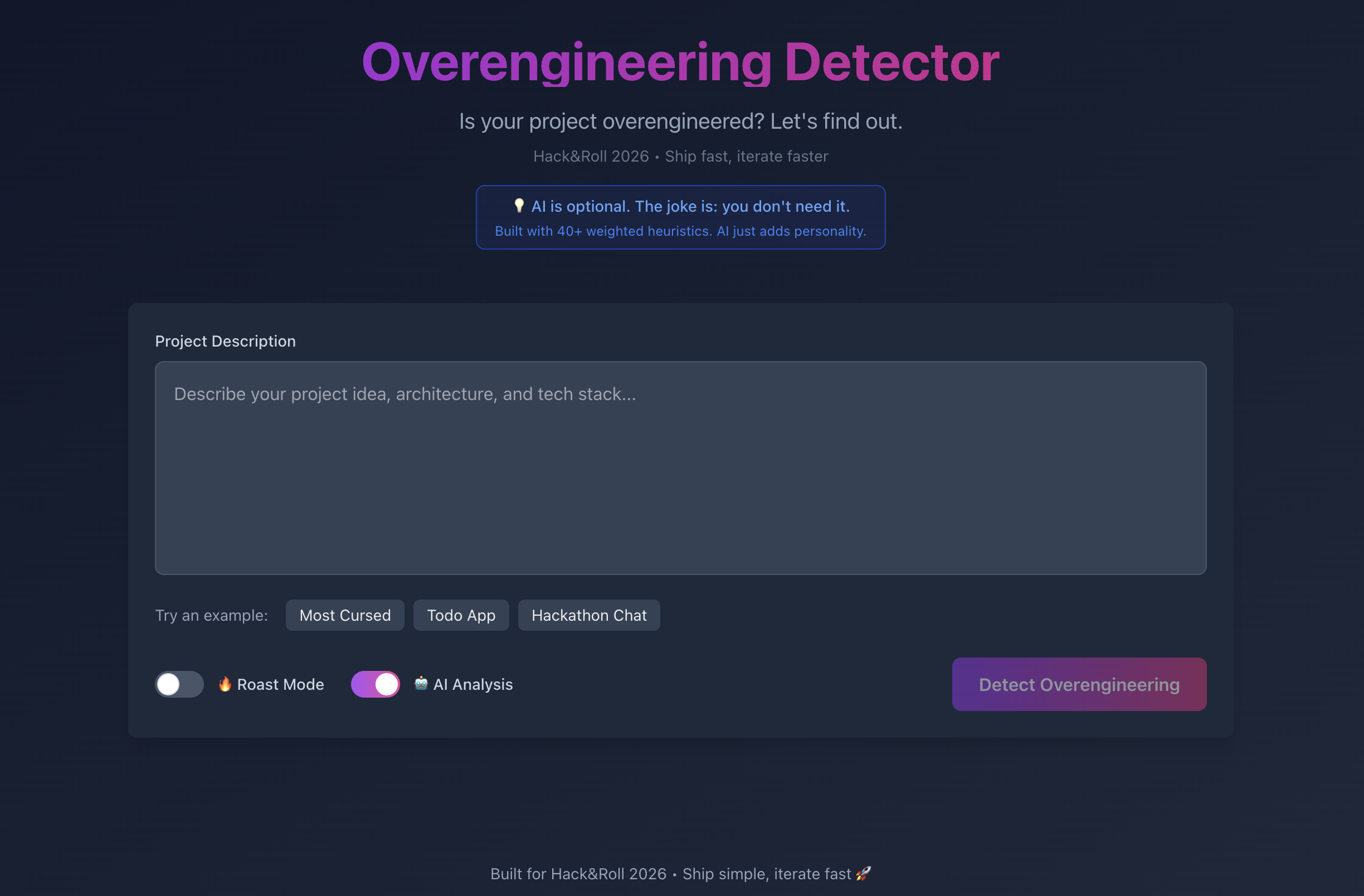
The core of the project is a rule-based heuristic engine that analyzes project descriptions using 40+ weighted engineering signals (e.g. Kubernetes, blockchain, microservices, event sourcing).
Each signal contributes to an overengineering score capped at 100, and is mapped into higher-level architectural anti-patterns such as:
- Premature scaling
- Buzzword-driven development
- Distributed systems without need
- Operational complexity exceeding scope
This engine runs fully offline and returns results in ~95ms.
On top of that, we added an optional AI layer:
- When enabled, AI rewrites the same heuristic diagnosis into human-friendly (or sarcastic) language.
- When disabled, the system behaves identically — proving AI is not required for the core logic.
The frontend is a single-page, demo-first interface designed for fast judging:
- One input
- One button
- Immediate, visual results
- Optional roast mode for fun
⚠️ Challenges We Faced
- Avoiding the “LLM wrapper” trap while still using AI meaningfully
- Designing roast-style feedback that is funny but not offensive
- Keeping explanations short enough for 3-minute judging
- Ensuring the demo never breaks, even if the AI API fails
- Balancing humor with technical credibility
✅ Final Takeaway
Most teams don’t need better infrastructure.
They need clearer thinking.
Final verdict:
Stop building infrastructure. Build a product.
Built With
- next.js

Log in or sign up for Devpost to join the conversation.