
Inspiration
Parkinson's disease is a brain disorder that leads to shaking, stiffness, and difficulty with walking, balance, and coordination. Parkinson's symptoms usually begin gradually and get worse over time. As the disease progresses, people may have difficulty walking and talking. And we are in the COVID-19 time when people can't go to the hospitals because it is almost full and they are afraid of getting COVID-19 without mentioning how much they can be afraid if they doubt that they have Parkinson's disease.
What it does
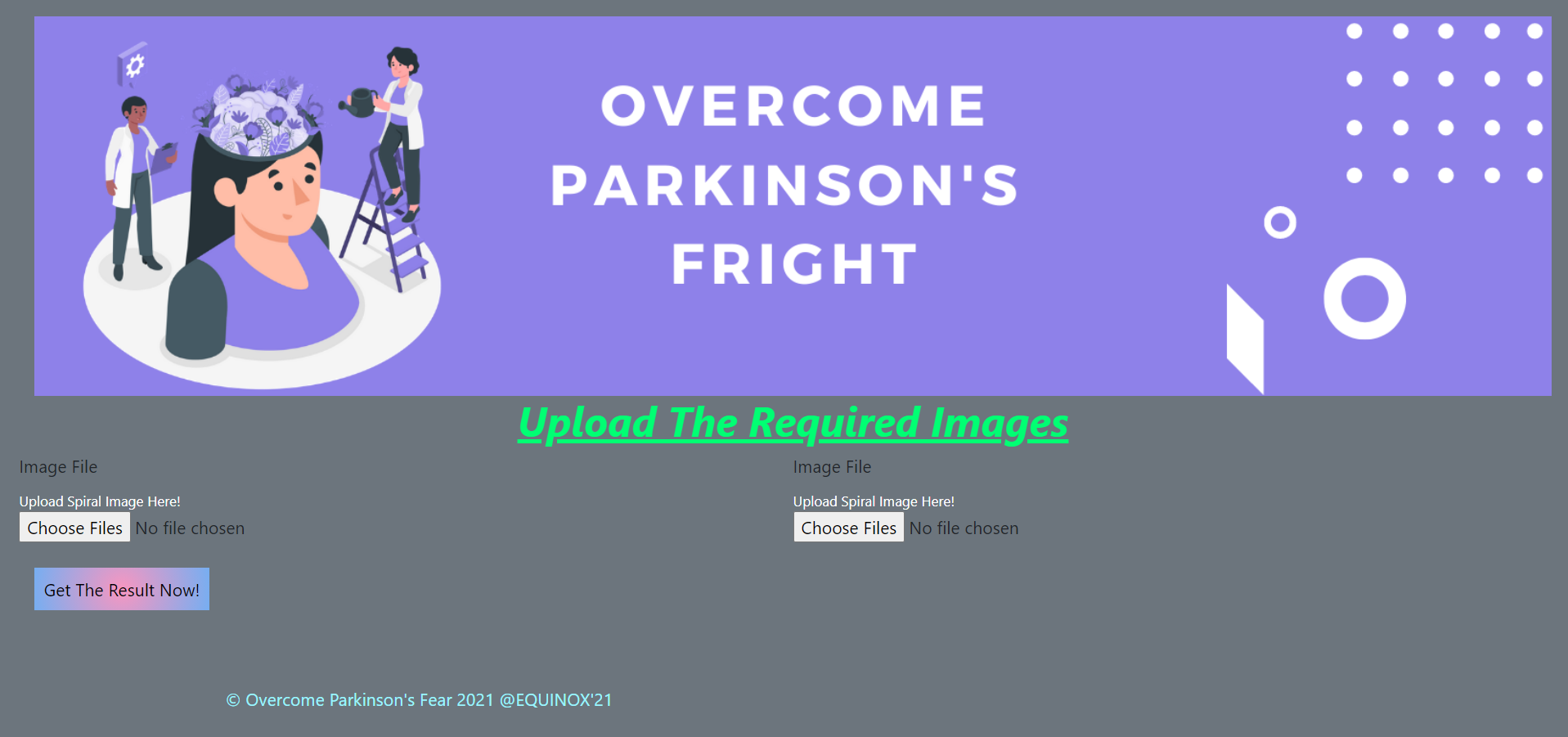
Our website will help people overcome Parkinson's fright! They just need to draw a spiral and/or a wave on paper, then take a photo, upload it to our app, and our machine learning model will predict whether they have it or not!
What was the approach?
Considering the COVID scenario we wanted to make the diagnosis simple, where to detect the presence of Parkinson's disease, the person is supposed to upload two images where he or she had drawn a wave and a spiral based on which the detection occurs. These are some of the example images on which the model is being trained and tested.
Spiral-Healthy

Spiral-Parkinson Affected

Waves-Healthy

Waves-Parkinson Affected

Tree structure

CNN model
For the detection we had used CNN architecture, which can be summarised as:


Accuracy
The following was the accuracy vs epoch graph obtained for spiral, and wave respectively:


Why do you need to use this application?
Considering the pandemic situation, it is necessary to maintain social distancing and also avoid unnecessary visits to the hospital. The perk of this application is you ask the person to draw just two images where one is spiral and the other one is a wave, and based on this the output is combined from their respective neural network. This is easy to use and access.
How we built it
- For the Machine Learning model, we used CNN, we modified it a lot, but finally, we are happy with the accuracy we got!
- We used HTML CSS JS for the website.
- And finally, Flask API to connect the website with our model
Challenges we ran into
We tried our best to train the model, it was tough to gain high accuracy. For the website image previewing was kind of new to us Challenges are always the best way to learn : )).
What we learned
We learned teamwork, working remotely with great individuals we have never met before, starting from the ideation stage where we had to agree and disagree as a team over the idea to work on. And later on, learning a lot of new things about the technologies we used.
What's next for Overcome Parkinson's Fear
- We want to improve our model accuracy and achieve the best result we can.
- Maybe we will work with other diseases and make it an online diagnosis for multiple diseases.
Built With
- canva
- css
- google-colab
- html
- javascript
- jupyter-notebook
- keras
- matplotlib
- python
- tensor-flow





Log in or sign up for Devpost to join the conversation.