-
-
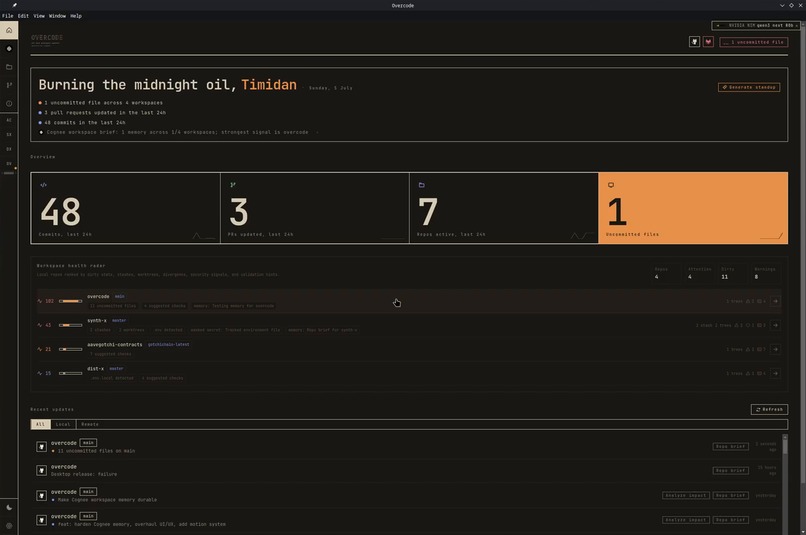
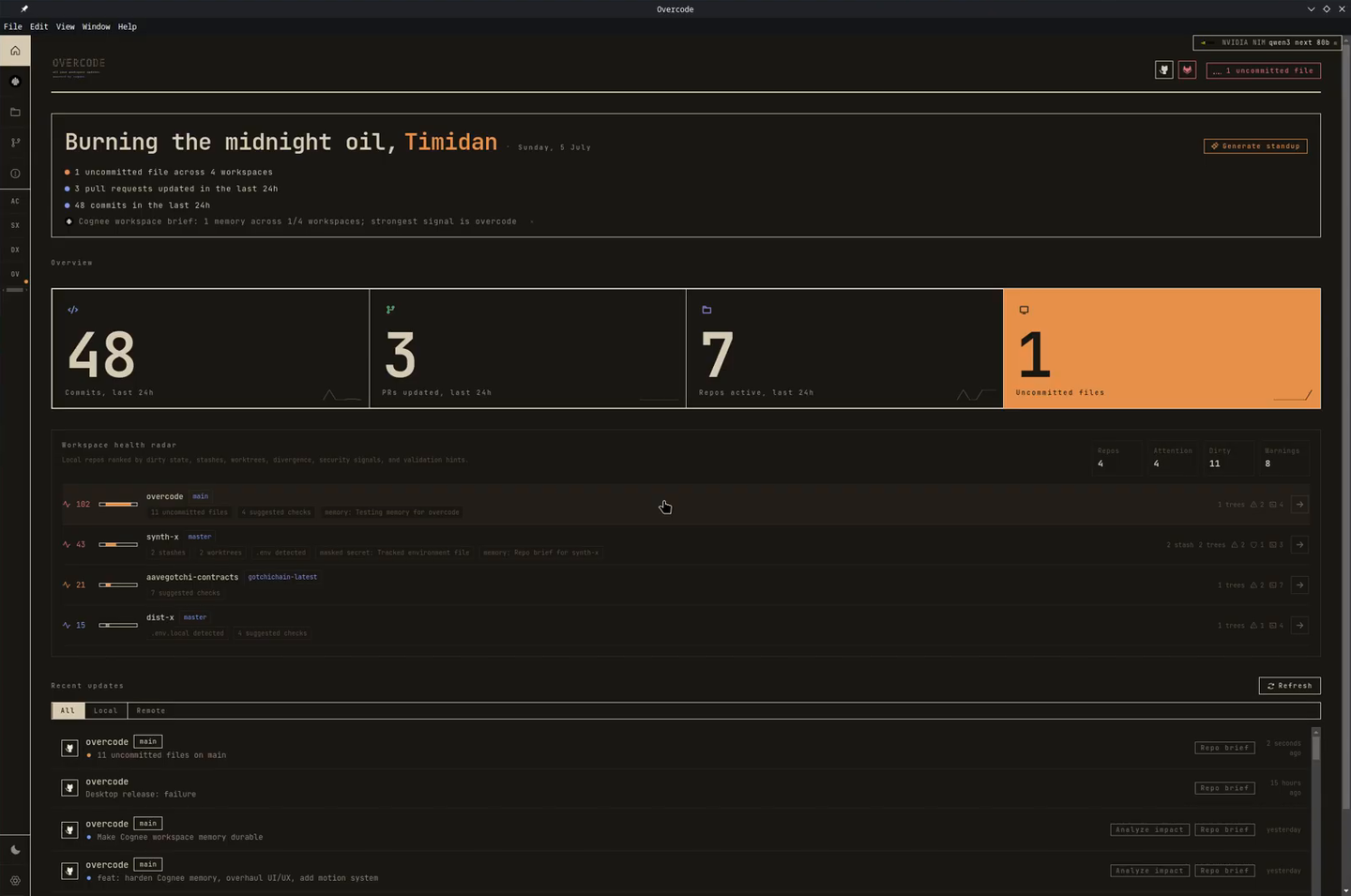
A single native dashboard for commits, pull requests, repository health, and local changes.
-
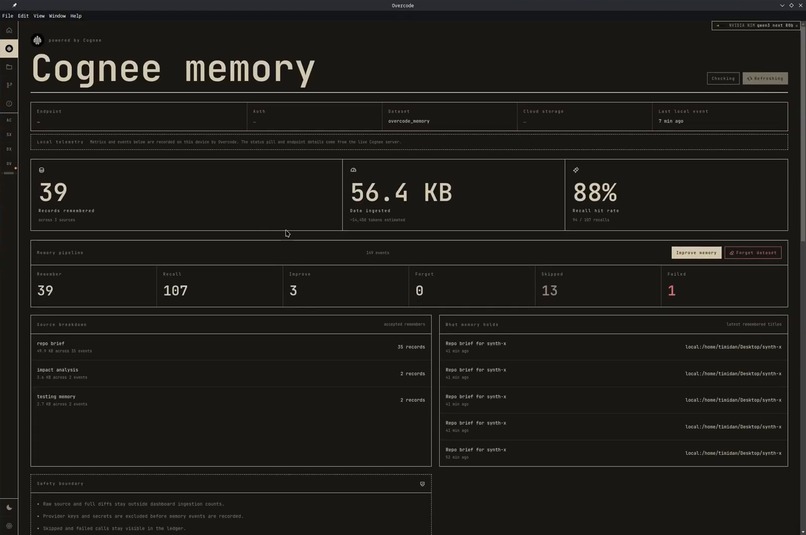
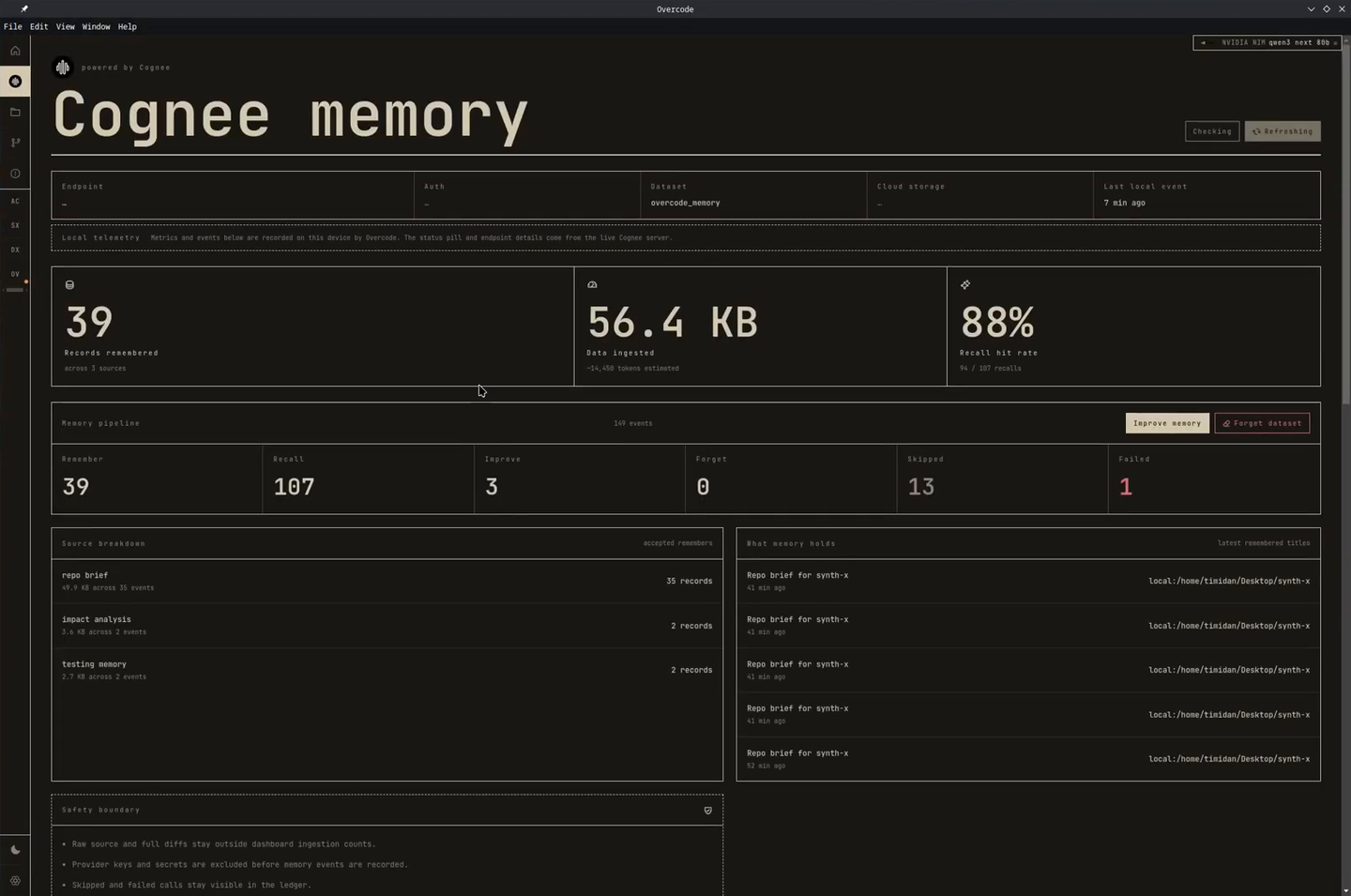
Inspectable repository memory with explicit recall, improve, and forget controls.
-
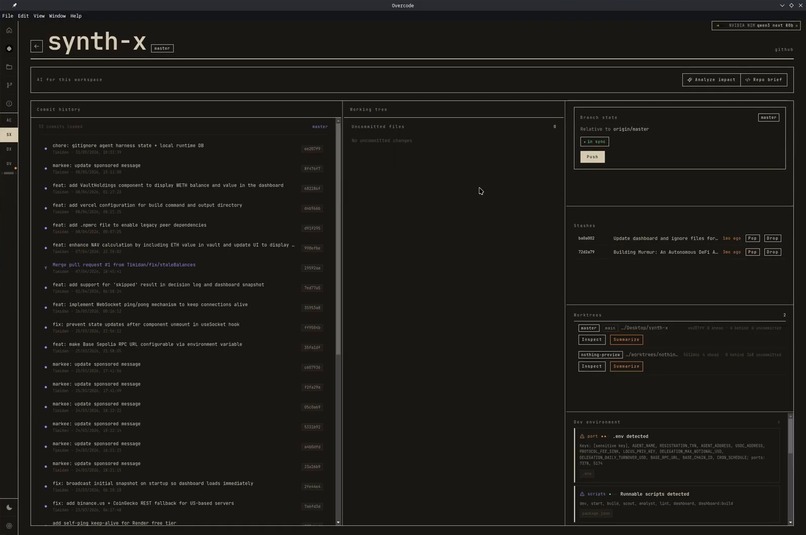
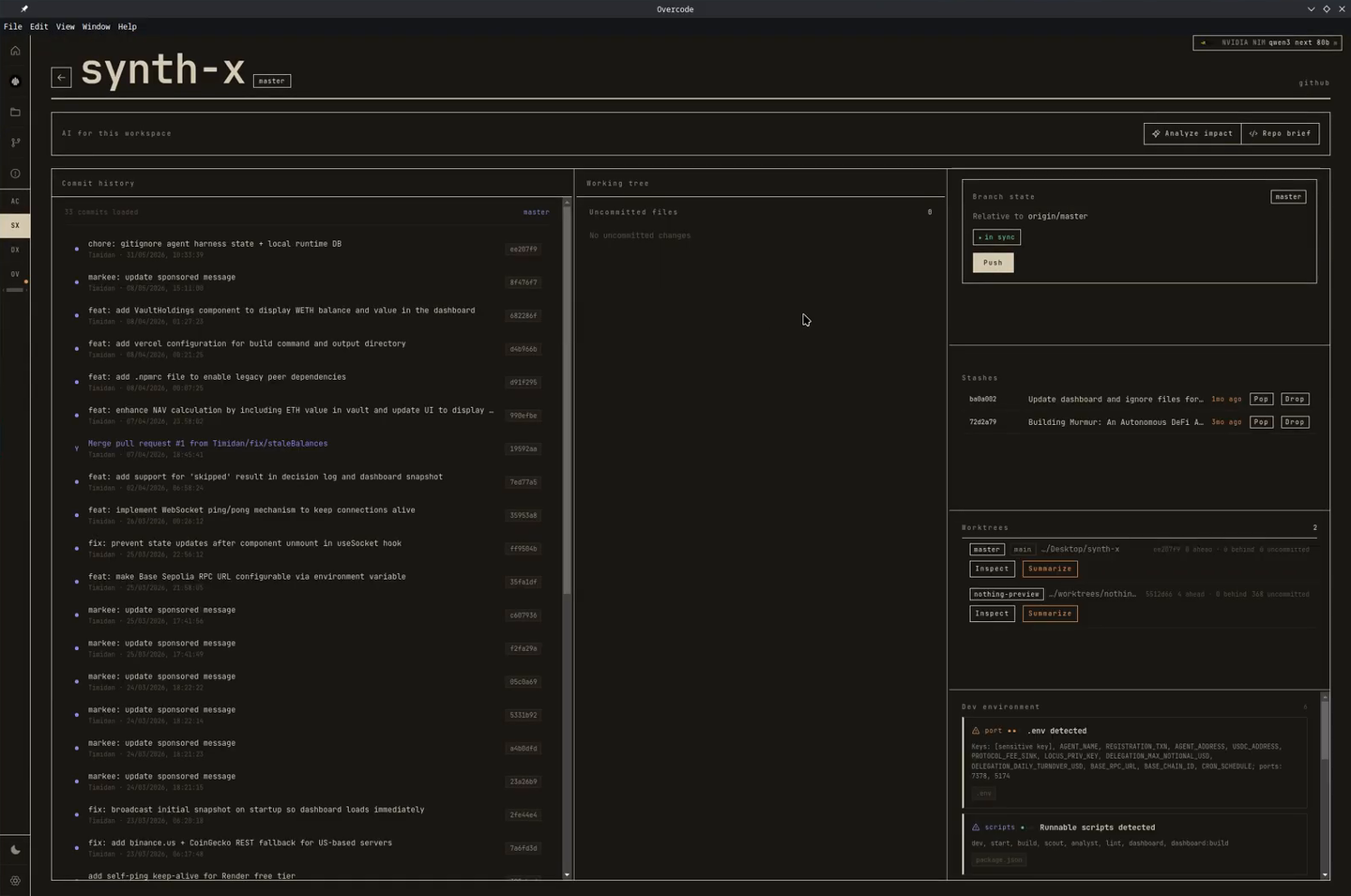
Repository history, worktrees, stashes, warnings, and AI actions in one local view.
Inspiration
I work across many repositories, and the expensive part is rarely opening Git. It is reconstructing context: which workspace needs attention, what changed locally, which pull request moved, what I was trying to do, and which details an AI assistant should remember.
Most Git clients show one repository at a time. Most AI tools start from a blank conversation or retain context in ways that are difficult to inspect and forget. I wanted one calm, local-first control plane that could show the state of all my workspaces and give AI a bounded memory lifecycle instead of an opaque transcript.
What it does
Overcode is a native desktop workspace for developers managing multiple Git repositories. It brings together:
- local repositories, branches, worktrees, stashes, diffs, and environment warnings;
- GitHub and GitLab activity, issues, and pull requests;
- workspace-health signals and an automatically generated standup view;
- bring-your-own-key AI workflows for repository briefs, impact analysis, commit assistance, issue triage, and pull-request review;
- optional Cognee-backed repository memory with explicit recall, collect, deduplicate, improve, and forget operations.
The filesystem and Git data plane remain on the developer's machine. Overcode has no hosted backend. External calls happen only for configured providers and approved memory operations.
What I added during Build Week
Overcode existed before OpenAI Build Week. The pre-existing product already had its Electron shell, local Git workspace discovery, GitHub/GitLab connections, AI surfaces, and an initial Cognee integration.
The submission is specifically the meaningful extension I built during the event with Codex and GPT-5.6:
- I replaced duplicated memory workflow logic with one tested repository-memory architecture covering recall, fact collection, stable deduplication, remembering, improvement, and forgetting.
- I migrated repository briefs, impact analysis, commit assistance, issue triage, standups, worktree comparison, pull requests, repository views, the dashboard, and settings onto that shared boundary.
- I added memory-lifecycle tests and failure-path coverage.
- I refined motion and accessibility so keyboard actions remain immediate, pointer motion preserves spatial causality, and reduced-motion preferences remove decorative delay without hiding state feedback.
- I reviewed the model-generated implementation and narrowed an ARIA live region so an interactive Forget action is not nested inside a status announcement.
The repository's dated commits, Build Week pull request, README, and Codex session make the prior/new boundary auditable.
How I used Codex and GPT-5.6
I used Codex with gpt-5.6-sol at xhigh reasoning for the central Build Week implementation. GPT-5.6 traced the existing memory callers, proposed the consolidation boundary, implemented the shared lifecycle, migrated the product surfaces, expanded the tests, and reviewed the motion/accessibility behavior.
I made the product decisions: keep memory limited to approved repository summaries and facts, keep keyboard interactions immediate, retain spatial feedback for pointer-triggered actions, and correct the live-region boundary after implementation.
The primary build thread is session 019f7679-b2ee-7961-bdac-6ec8a426ca31; /feedback was submitted and confirmed for that session.
How I built it
Overcode uses Electron, React, TypeScript, Vite, simple-git, Octokit, Zustand, and an isolated Git worker. The renderer communicates through a typed preload API instead of receiving unrestricted Node access. AI provider credentials stay behind that narrow desktop boundary.
The new cognee-repository-memory module is the single lifecycle boundary for repository memory. Callers request a repository-scoped operation, the module validates and normalizes the result, stable facts are deduplicated, and the UI exposes clear remember/improve/forget feedback.
Challenges
The hardest architectural problem was avoiding a second memory abstraction that merely wrapped the first. GPT-5.6 helped trace the complete caller graph so I could remove the duplicate runtime instead of layering another service on top.
The other challenge was motion. Entrance animation looked polished but made command-driven workflows feel slower. I separated decorative motion from meaningful state feedback, preserved immediate keyboard behavior, and kept reduced-motion paths fully usable.
Accomplishments
- One repository-memory lifecycle now serves the full product instead of duplicated workflow paths.
- The final suite passes 145 tests across 20 files, TypeScript checks, zero-warning ESLint, CI-mode packaging, and an Electron smoke test.
- GitHub Actions now builds and uploads Linux AppImage, macOS DMG, and Windows NSIS artifacts from clean runners.
- Judges can download a public Linux or Windows build without cloning or rebuilding the repository.
- The project is public and MIT-licensed.
What I learned
The best use of a high-reasoning coding agent was not generating isolated components. It was giving the model enough repository context to find a coherent boundary, then applying human review where product semantics mattered: what may be remembered, when motion is helpful, and which accessibility behavior is acceptable.
I also learned that local success can hide release failures. Existing node_modules masked an invalid lockfile, and Electron Builder's automatic CI publishing competed with the workflow's explicit release job. Clean-run verification exposed both issues.
What's next
- Signed and notarized macOS distribution.
- Broader repository-memory provider support behind the same lifecycle boundary.
- More workspace-health explainability and remediation previews.
- Performance work for very large monorepos and hundreds of repositories.
- A shorter public demo focused entirely on the Build Week extension.

Log in or sign up for Devpost to join the conversation.