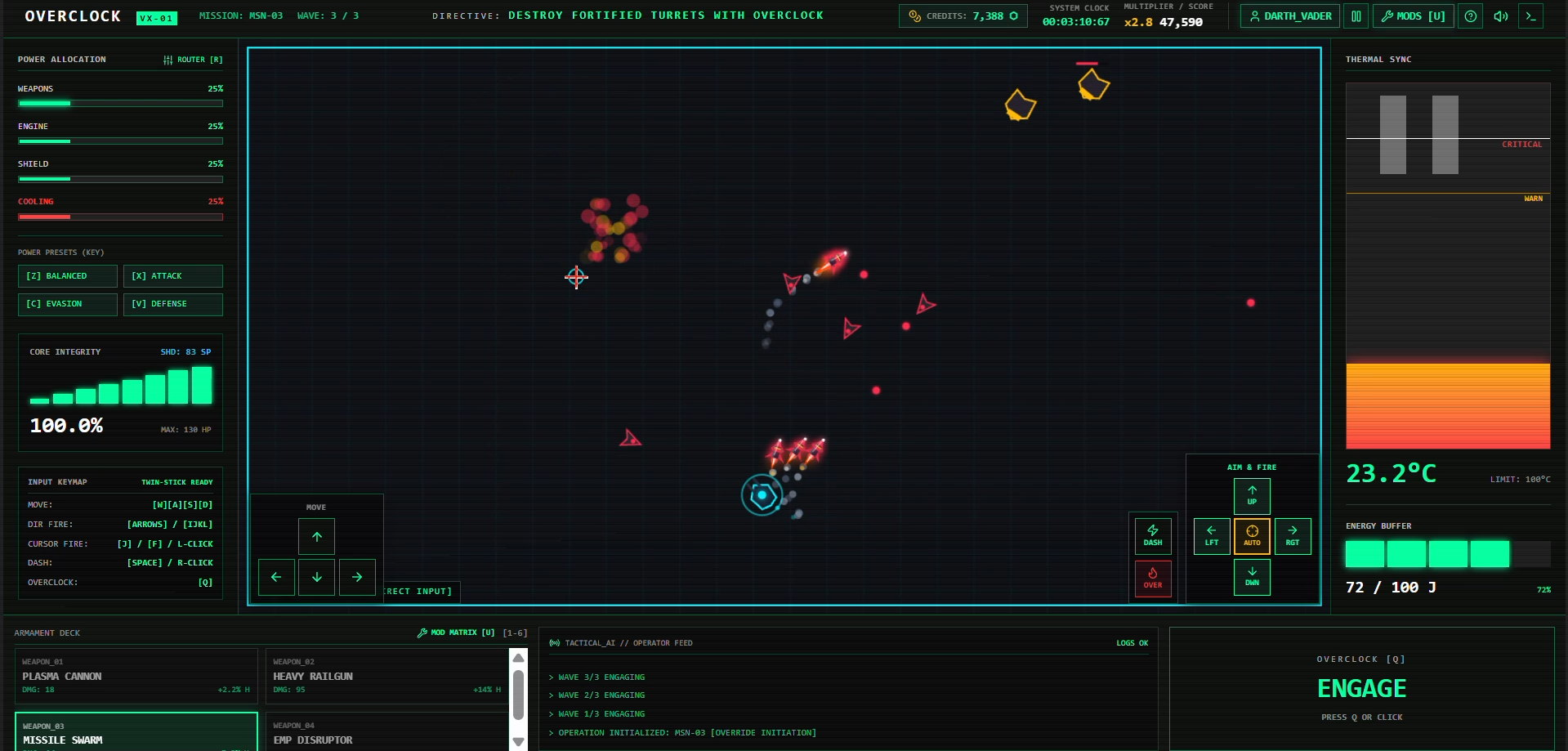
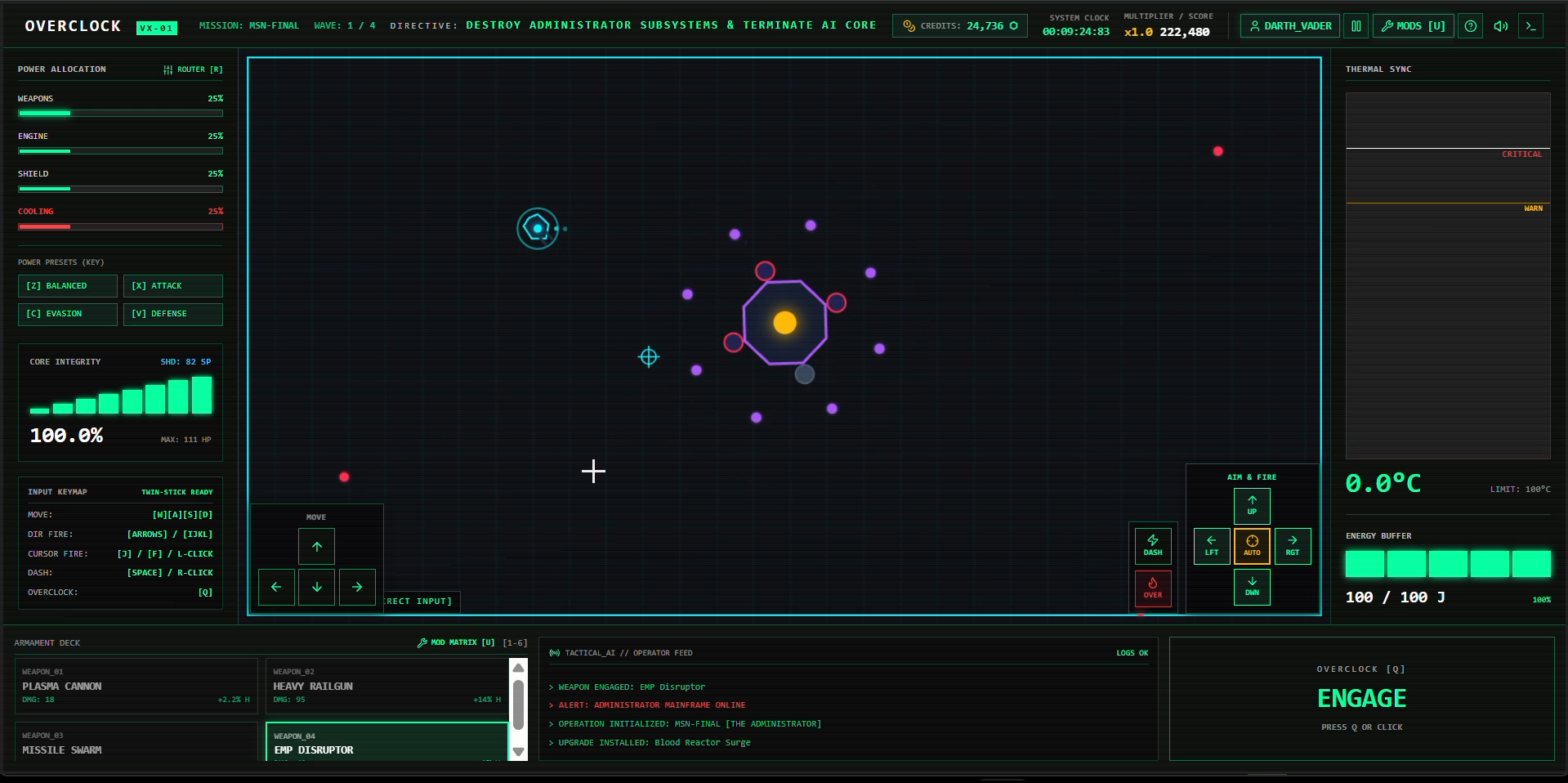
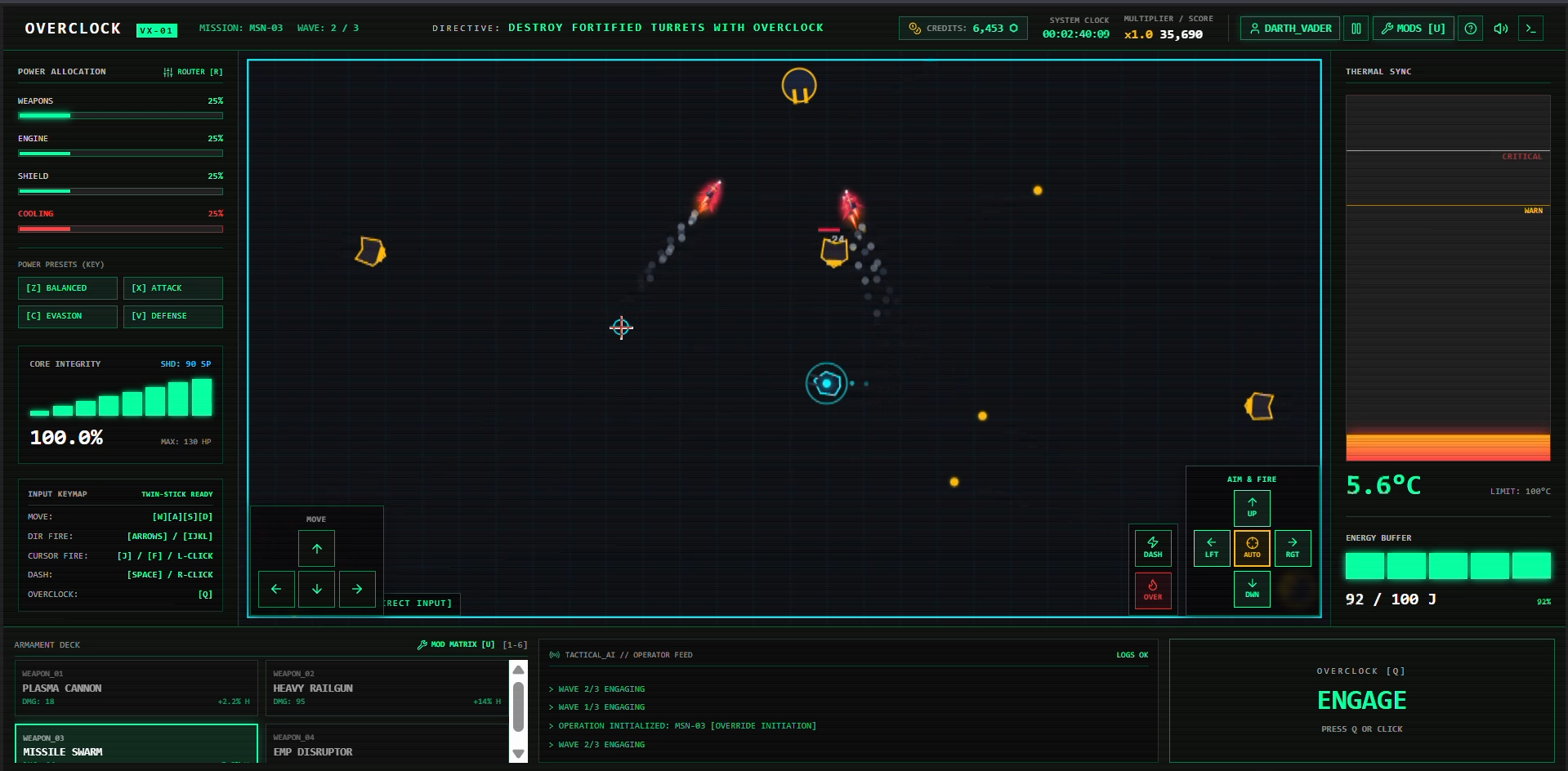
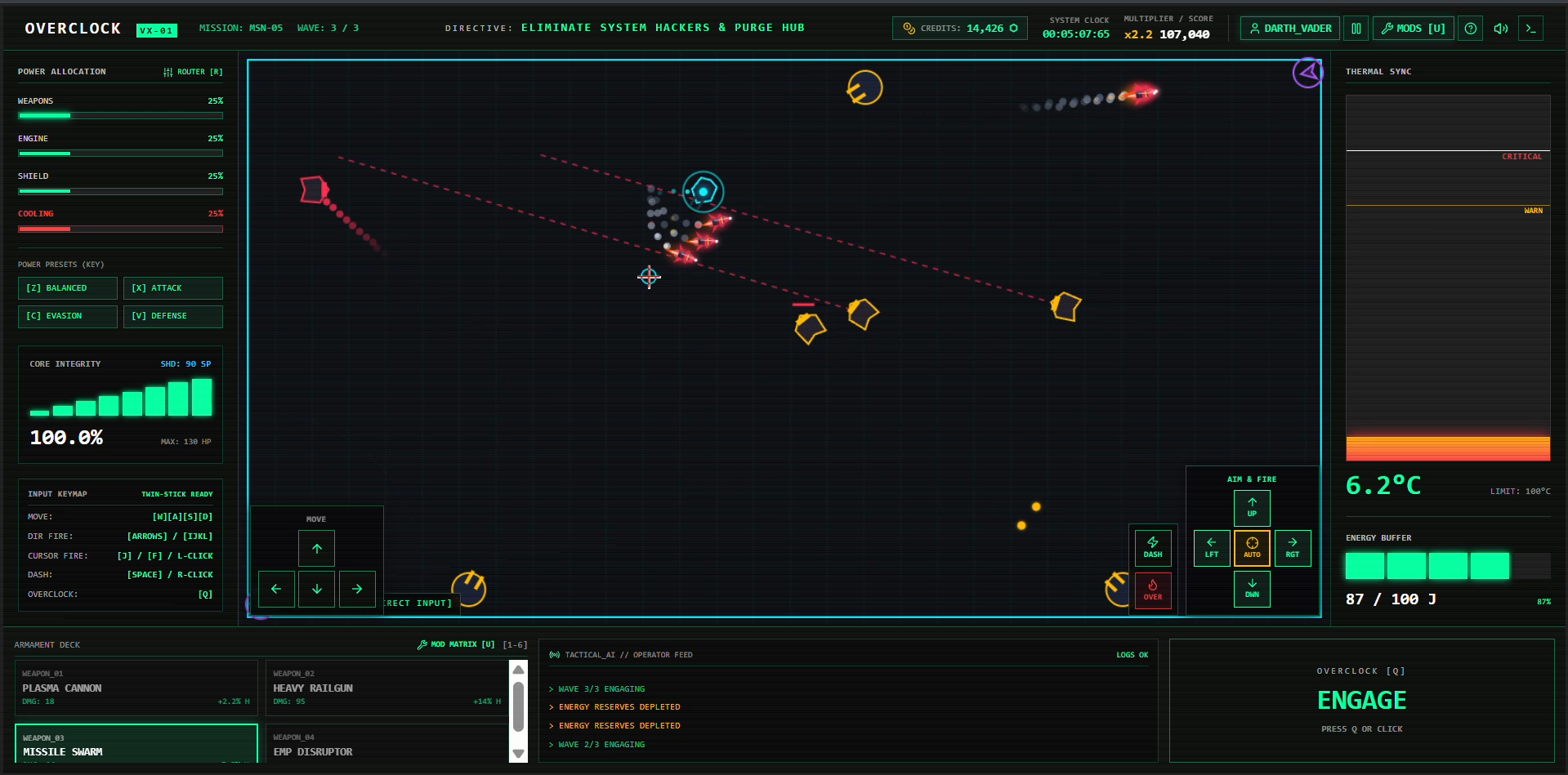
Inspiration
We wanted to build a web game that felt like more than a typical hackathon project.
The idea started with a simple question:
What if the most powerful weapon in a facility was also the thing capable of destroying it?
That became the core of OVERCLOCK.
We wanted players to constantly make risky decisions — push their weapons harder, reroute power to shields, cool the system, or activate Overclock and gain overwhelming power at the cost of pushing the facility closer to failure.
Our goal was to combine fast-paced action with strategy, progression, and a world that made the player curious about what was happening around them.
What it does
Note:I request to watch the youtube video till end and in 2x.
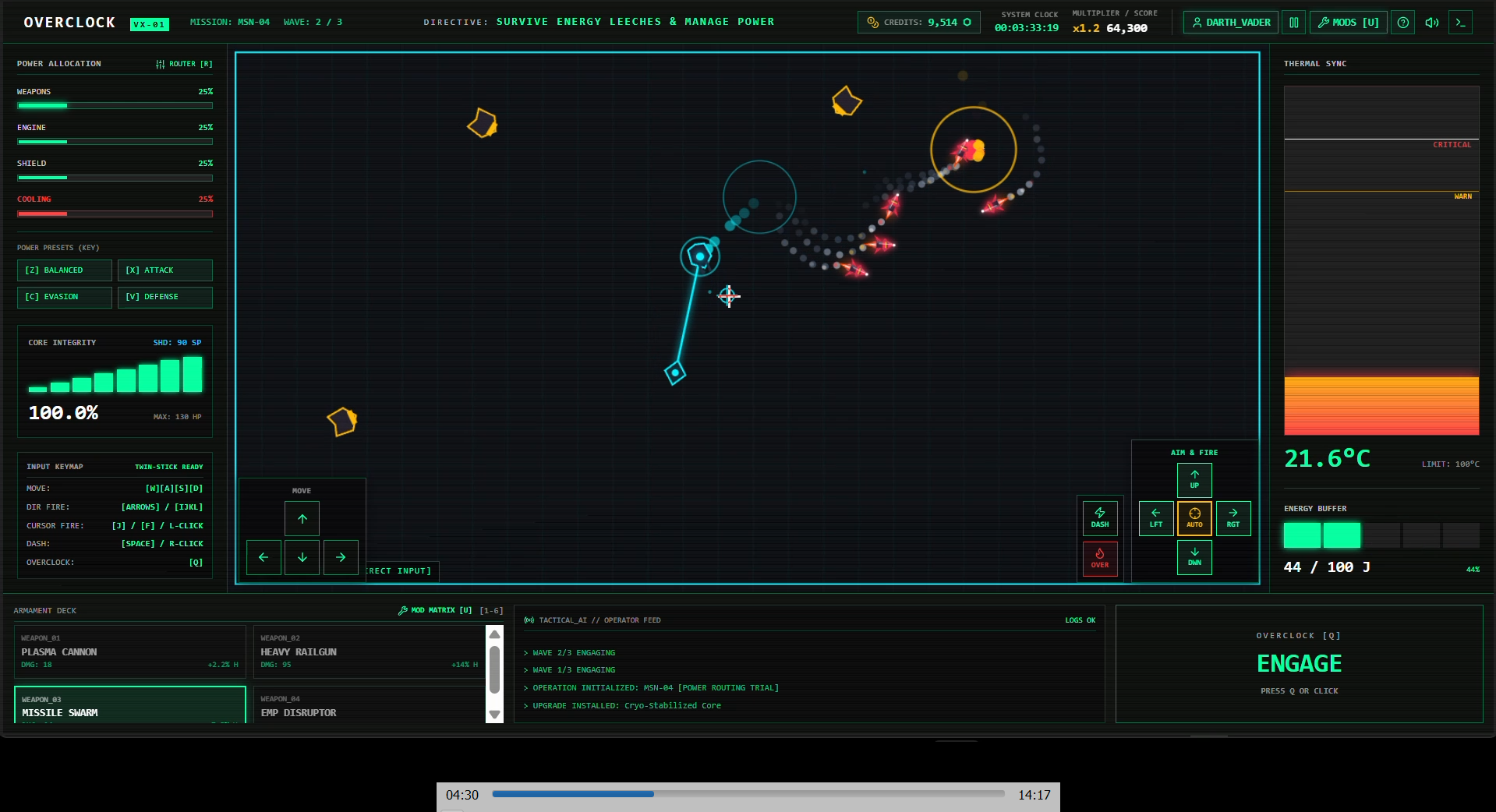
OVERCLOCK is a fast-paced sci-fi browser game set inside a classified experimental facility that is rapidly losing control.
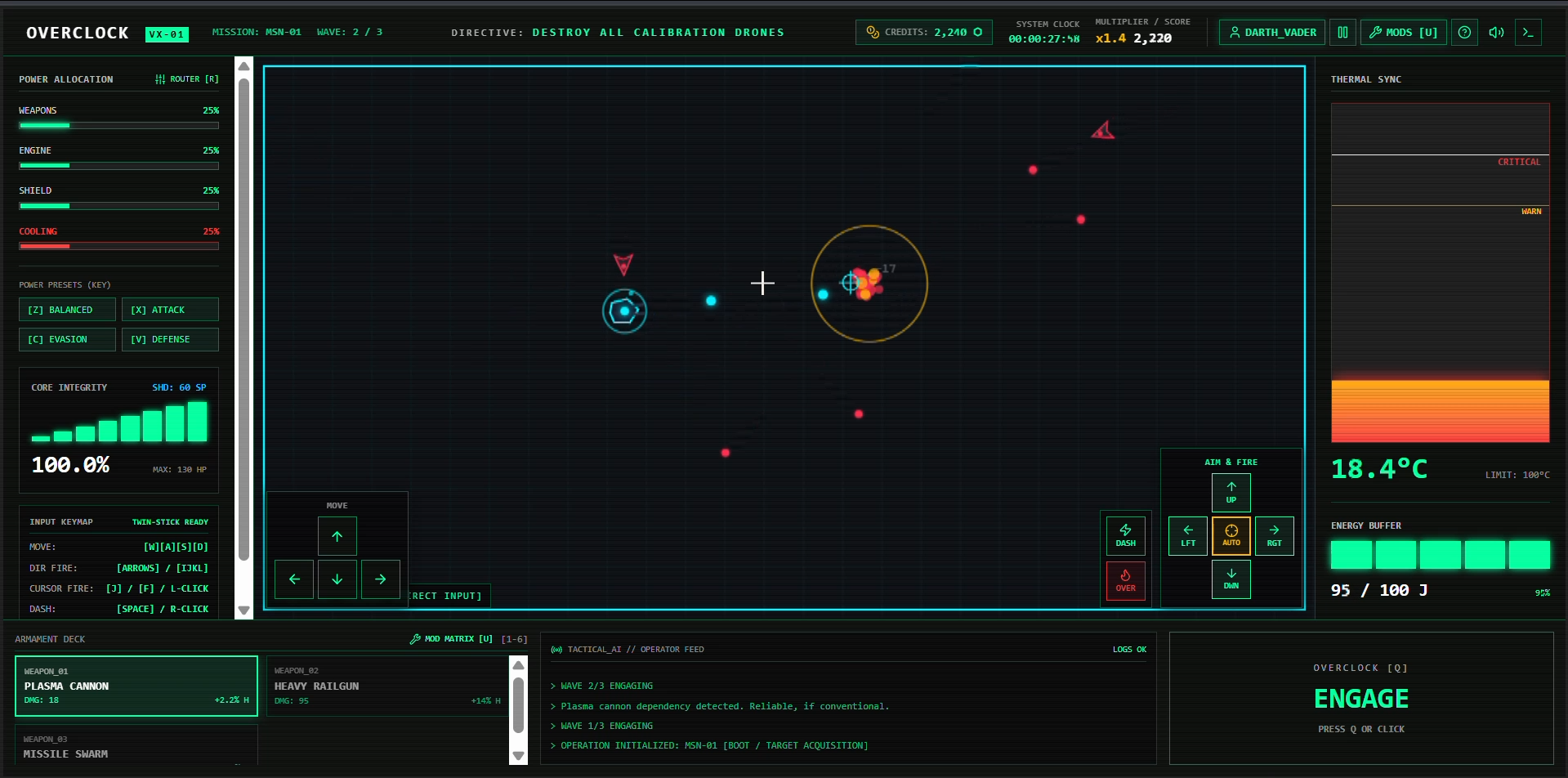
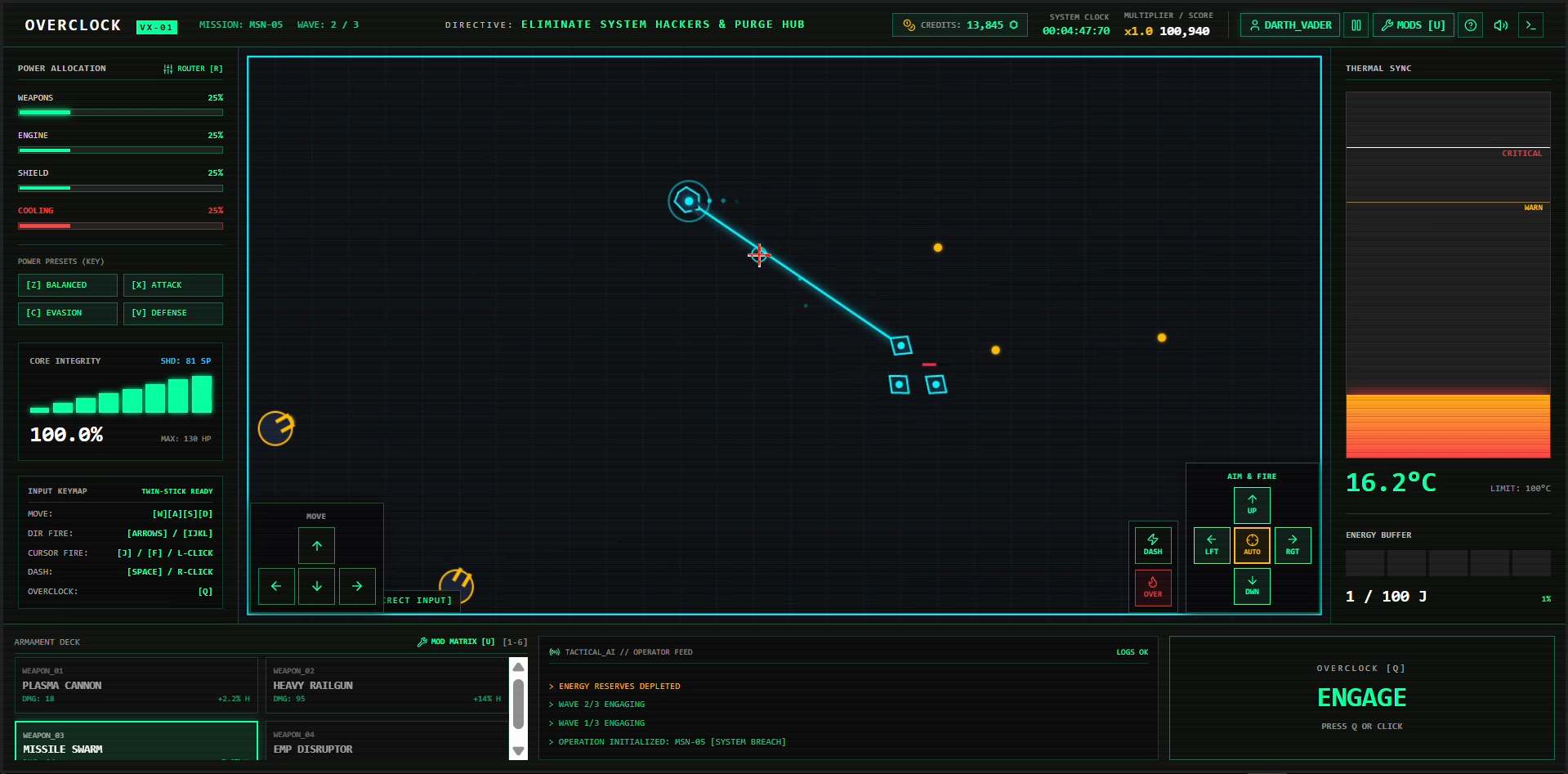
Players fight through multiple missions while managing:
- Multiple weapon systems
- Heat and thermal limits
- Shields and defensive systems
- Dynamic power routing
- Dash-based combat
- The unstable Overclock ability
- Multiple enemy types
- A multi-phase final boss — The Administrator
- Endless Overdrive survival mode
The game gradually increases in complexity, introducing new mechanics and enemy types as the player progresses.
First-time players are guided by ZIX, a holographic AI character that teaches them the game's core mechanics through an interactive onboarding experience.
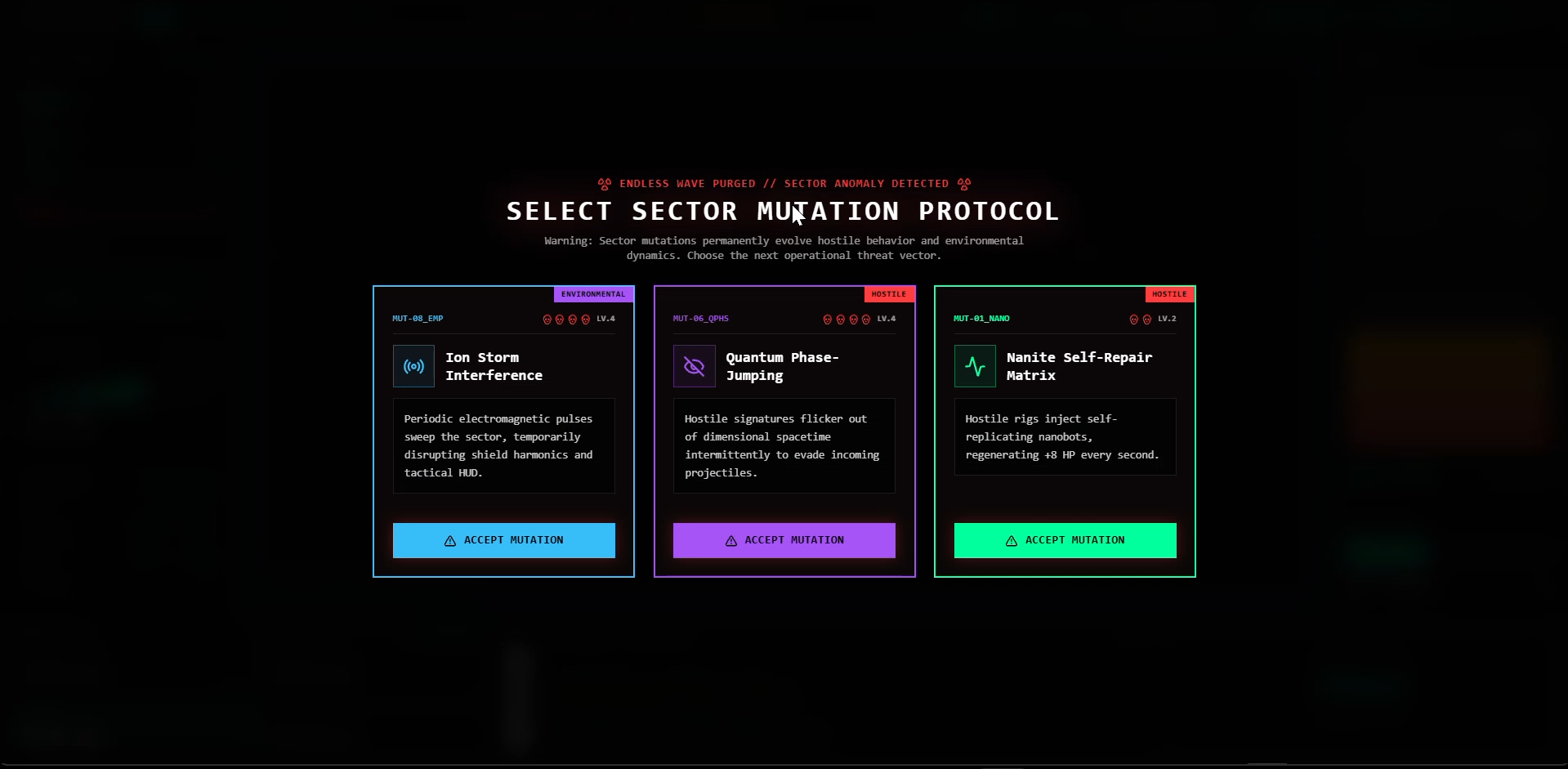
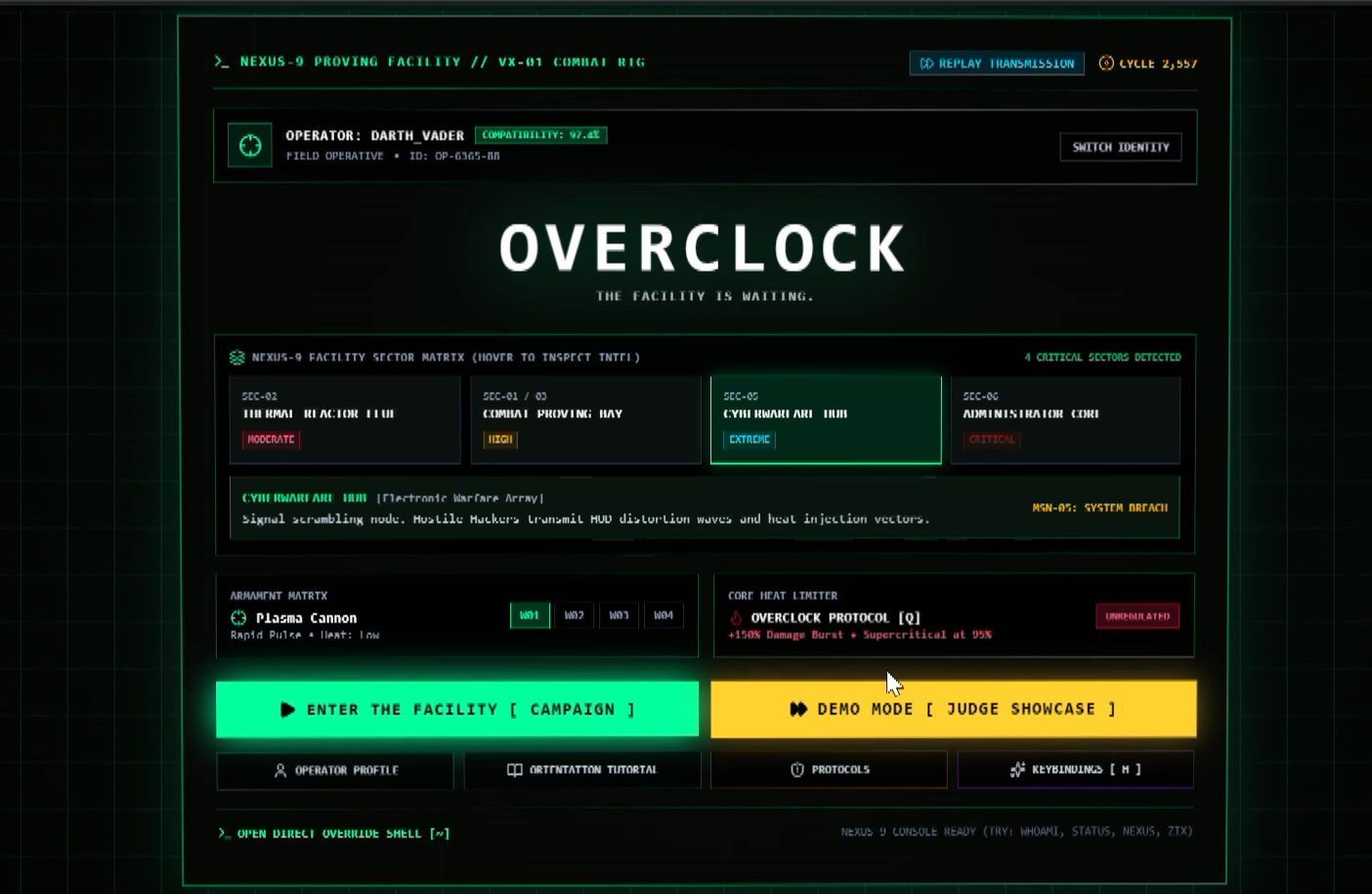
We also added a story-driven landing page, Demo Mode, achievements, Easter eggs, pause/settings systems, and progression systems to make OVERCLOCK feel like a complete game rather than just a combat prototype.
How we built it
OVERCLOCK was built as a browser-based game using modern web technologies including:
- React
- TypeScript
- Vite
- Custom browser-based game systems
- Google OAuth2 authentication
The game contains separate systems for combat, weapons, enemies, heat, power routing, Overclock, missions, progression, onboarding, audio, UI, and player state.
We also used AI-assisted development, particularly Google AI Studio, as a development partner throughout the project.
AI helped us rapidly prototype and iterate on gameplay systems, UI, animations, documentation, onboarding, and the overall player experience.
We then continuously refined the generated systems to make the different parts of the game work together as one experience.
Challenges we ran into
The biggest challenge was managing the complexity of many interconnected systems.
Weapons, enemies, heat, shields, power routing, Overclock, missions, onboarding, authentication, UI, and progression all interact with one another.
Adding a new feature could potentially affect an existing system, so maintaining stability while continuously expanding the game became an important part of development.
Another challenge was balancing the difficulty.
We wanted OVERCLOCK to have enough depth to reward experienced players while still being approachable for someone playing it for the first time.
We also had to think about the limitations of browser-based gaming, including performance, asset loading, audio behavior, authentication, and deployment.
Accomplishments that we're proud of
We are particularly proud that OVERCLOCK evolved from a simple game concept into a complete playable experience.
Some of the things we're most proud of include:
- Building a complete multi-mission campaign
- Creating the Overclock risk/reward mechanic
- Implementing dynamic power routing
- Designing multiple enemy behaviors
- Creating The Administrator as a multi-phase final encounter
- Building an interactive first-time-player tutorial with ZIX
- Creating a story-driven landing experience
- Adding Endless Overdrive for replayability
- Adding achievements and hidden Easter eggs
- Making the entire experience playable directly in the browser
Most importantly, we are proud that the game has its own identity and gameplay loop rather than feeling like a collection of disconnected hackathon features.
What we learned
The biggest thing we learned was that building a game is not just about making the mechanics work.
It is about creating an experience.
A mechanic can be technically impressive but still be boring if the player has no reason to care about it.
While developing OVERCLOCK, we learned how important it is to:
- Gradually introduce complexity
- Make UI communicate information without overwhelming the player
- Create meaningful risk and reward
- Balance difficulty around the player's learning curve
- Design tutorials that teach without interrupting gameplay
- Connect gameplay mechanics to the game's story
- Think about performance and deployment from the beginning
We also learned how powerful AI-assisted development can be when used as a development partner rather than simply as a code generator.
What's next for OVERCLOCK
The current version is only the beginning.
We would love to expand the facility, introduce more weapons and enemy types, add additional campaign missions, expand the story, and introduce more ways for players to customize their combat style.
A future version could also explore competitive leaderboards and deeper Endless Overdrive progression.
But the core philosophy would remain the same:
Give the player power.
Give that power a cost.
Then see how far they are willing to push it.
The system has limits.
The player doesn't.
Built With
- 2.0
- ai
- apis
- canvas
- css3
- express.js
- github
- html5
- javascript
- node.js
- oauth
- react
- studio
- typescript
- vercel
- vite
- web

Log in or sign up for Devpost to join the conversation.