-
-
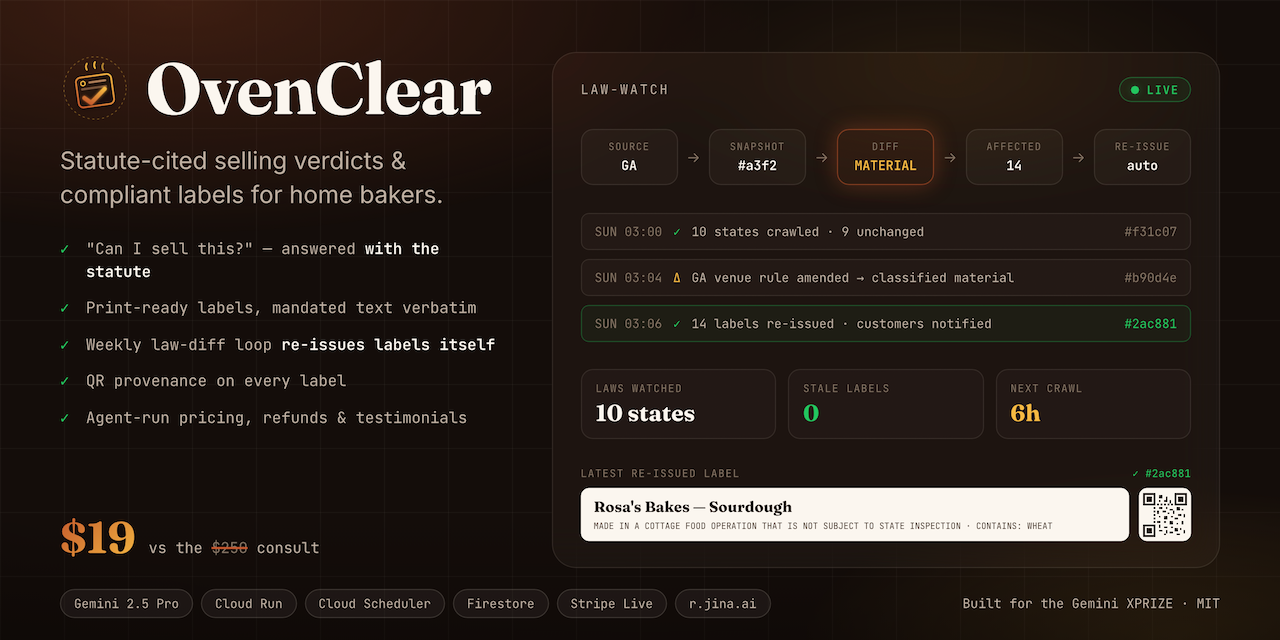
A $19 statute-cited verdict on whether your home kitchen can legally sell it — plus a print-ready compliant label.
-
The refusal is the product: cheesecake in Georgia is declined with the refrigeration rule quoted, and no checkout is offered.
-
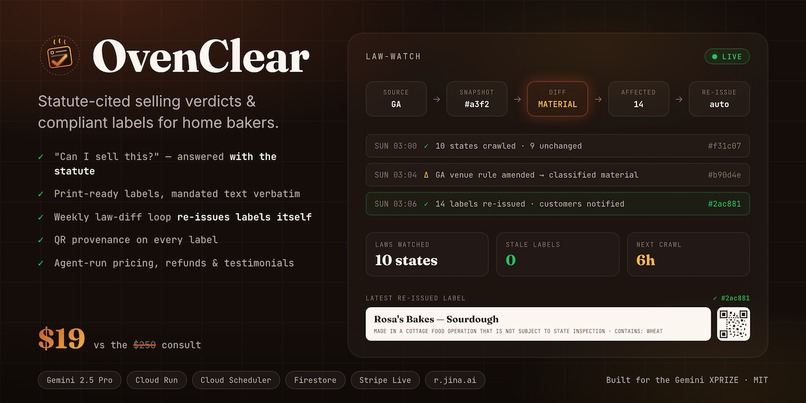
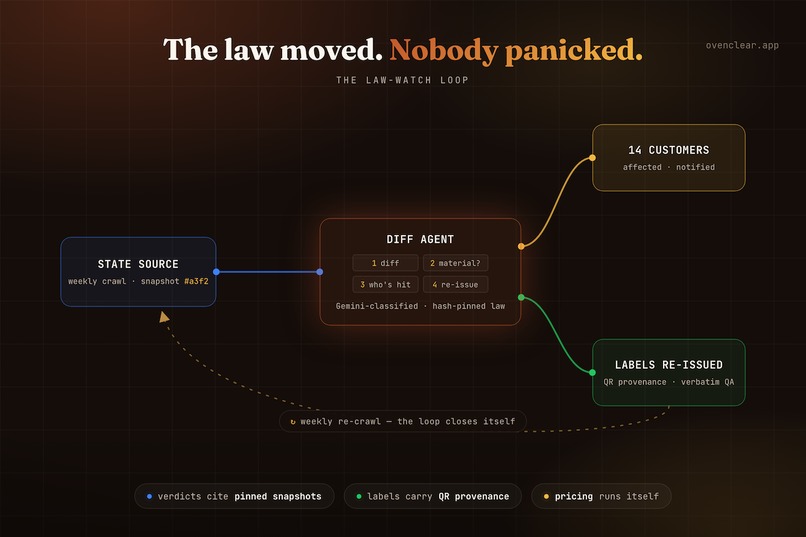
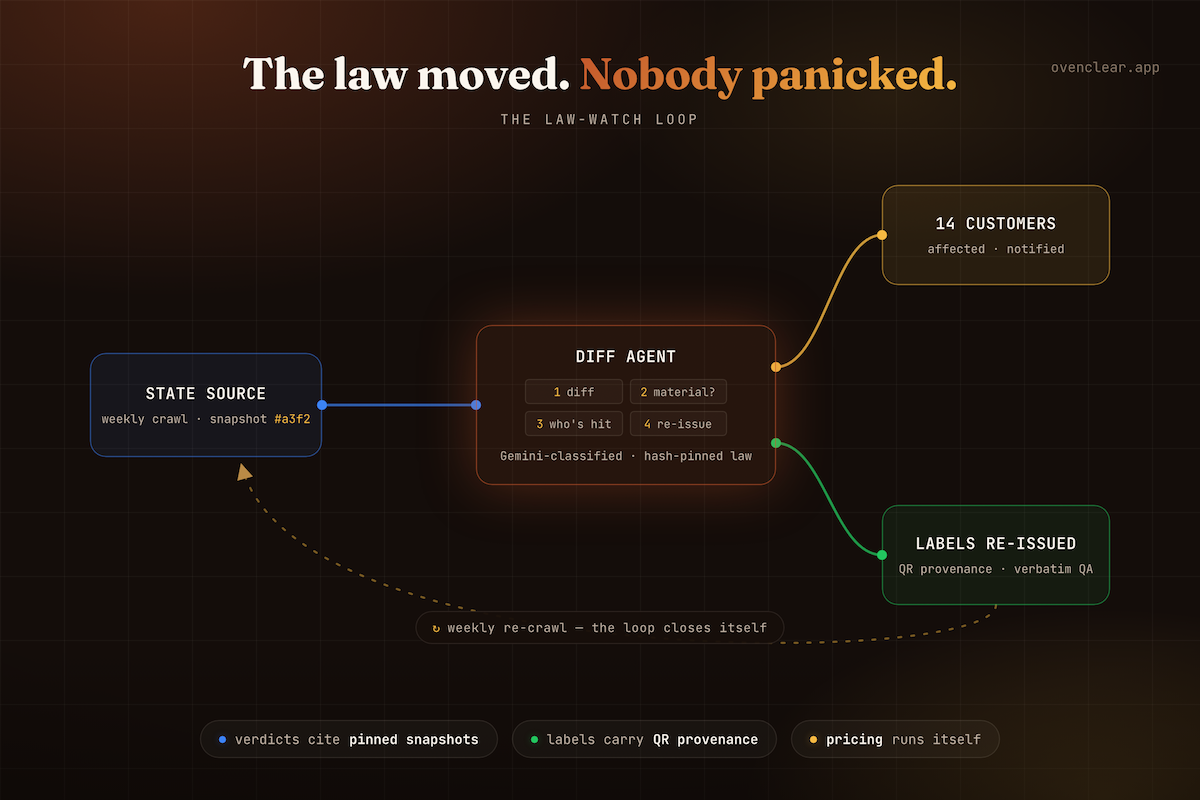
Law-Watch diffs state sources, classifies each change as material, regenerates affected labels and notifies their owners.
OvenClear: what the human did, what the AI does, and what actually happened
The product
Every US state writes its own cottage food law: which foods a home kitchen may sell, at which venues, under which licence, and the exact sentence that must appear on the label. A home baker guesses, gives up, or pays for a consult costing more than her first month of profit. OvenClear answers for a flat fee, quotes the rule it relied on, produces a label carrying the state's mandated wording, and reissues it when the law moves.
What the AI does, and what it is forbidden to do
The core engineering decision is a restriction rather than a capability. The compliance verdict comes from a deterministic decision table over a versioned rulepack, not a language model. No verdict is issued unless it carries a pinned hash of the dated source snapshot it was read from. No label ships unless every mandated sentence appears byte for byte, checked by substring containment rather than semantic similarity — a paraphrased legal sentence is a non-compliant label.
Gemini sits around that core and may widen recall, never change a decision. It maps what a person actually says — "my jam", "my sourdough" — onto the categories the rulepack knows, so the engine gets asked the right question, and it classifies whether a weekly diff on a state agency page is material or cosmetic. That is the hard problem in the subscription: most edits are cosmetic, and treating them as material would push a reissued label at every customer for nothing. The model cannot flip an eligible to a not-allowed or admit a label the gate rejected; if model and table disagree, the table wins and the disagreement is recorded.
The order path is agent operated end to end: intake, verdict, label composition, QA gate, delivery, and the law-watch loop that diffs snapshots, classifies each change, resolves who is affected, regenerates their labels and notifies them. Every decision is appended to a hash-chained ledger, signed with Ed25519 and rolled into a daily Merkle root, so a judge can re-derive it from the export; tampering with one row is caught and localised.
The agent is also allowed to refuse. Ask about cheesecake in a state that prohibits it and the order is declined with the refrigeration rule quoted back, marked refund due rather than fulfilled. Charging for a label someone cannot legally use would be the product failing, so it declines the money.
Human work versus AI work
I am one person and wrote very little of this code by hand. The implementation, tests and tooling were produced by Claude in a coding harness under my direction. That is the point of the category, so I will not dress it up as pair programming.
What was human: deciding the compliance decision must be deterministic and the model may only widen recall — the constraint everything else follows from. Going deep on two states rather than shallow on fifty, marking the rest as stubs rather than implying coverage we lack. Writing the invariants the tests enforce. Keeping the synthetic-rule-text disclosure prominent though it weakens the demo. Rejecting the model output that was confidently wrong, which is most of the real work.
What was AI: essentially all of the code, the 156 tests behind it, the benchmark harness, the
evidence tooling and the documentation. The claims are reproducible rather than asserted — npm run
ci runs the typecheck, tests, a determinism check, the end to end self test, the ledger verifier
with its tamper demo, and a benchmark gating on zero verdict flips.
Jobs and economic opportunity
Actual: none. No jobs created, no team beyond me, no contractor, no payroll, no customer.
Potential, as a claim rather than a result: every customer is someone trying to turn a home kitchen into a legal source of income, blocked not by skill but by a compliance question costing more to answer than the business earns in its first month. If it works, the opportunity is measured in home food businesses started and kept compliant, not in headcount here. Today that number is zero.
Category impact — Entrepreneurship and Job Creation
The category asks who gets to start a business. Cottage food law is an unusually clean case of a purely informational barrier: the oven, the recipe and the customer already exist, and the only thing stopping the sale is that nobody can afford to be told what the rule is. A $250 consult prices out precisely the person the exemption was written for.
Moving that answer from a professional service to a $19 artifact does not make anyone a better baker; it removes the reason the business never starts. The redefinition attempted here is narrower and more testable than "AI for compliance": an answer carrying its own proof — the quoted rule, the snapshot hash, a signed record — beats the same answer from a person, because it can be re-verified afterwards and it reissues itself when the law changes. No consult has that last property.
Where this actually stands
Revenue: $0.00 — May, June, July and August 2026 each $0. Arms-length customers: zero. Related-party revenue: zero. Marketing and customer acquisition spend: $0.00, disclosed as required even though nil. The storefront is deployed and public at https://ovenclear.edycu.dev, free to use, and its refusal path is verifiable there: a cheesecake in Georgia is declined with the refrigeration rule quoted and no checkout offered. Live Gemini calls in the deployed application: zero — no API key is configured in production, so the deterministic core answers every request. Stripe is on a test key, so no charge can be taken. The Texas law change in the demo is a labeled historical replay, and all rule text in the repository is synthetic, statute-shaped fixture data.
The engine is built, deployed and verified. The business is not. I would rather submit that sentence than a number I cannot produce a receipt for.
Built With
- bigquery
- cloud-kms
- cloud-scheduler
- codeql
- ed25519
- firestore
- github-actions
- google-cloud-run
- google-gemini
- merkle-tree
- node.js
- stripe
- tsx
- typescript
- vitest

Log in or sign up for Devpost to join the conversation.