About the project
Inspiration
Learning has never had more content, but it is still deeply fragmented.
A learner may have a course in one tab, notes in another app, documents in Drive, a deadline in Calendar, a project in GitHub, and an AI assistant that understands none of the surrounding context. Static courses teach everyone in the same order, while most AI tutors wait for a question, generate an answer, and measure engagement rather than capability.
More capable AI has also created a new problem: it is now possible to complete an impressive task without learning how to reproduce it independently.
We wanted to build a different kind of educational system—one organized around the learner’s real goal, existing material, current work, and demonstrated progress.
That became Outgrow: the AI tutor you’re meant to outgrow.
Outgrow is built around a simple principle:
Assistance should decrease as capability increases.
Ava helps the learner begin, observes meaningful work, asks before explaining, adapts the path from evidence, and eventually steps back so the learner can succeed alone.
We also wanted to address the other side of education. Teachers and subject-matter experts hold valuable knowledge, but converting that knowledge into high-quality, interactive, adaptive instruction is slow. Outgrow Forge turns expert material and demonstrations into living, versioned education that can improve from consented learner evidence.
What it does
Outgrow is a personal learning operating system.
A learner begins with a real outcome, such as:
- Preparing for a data analyst interview
- Understanding anatomy notes before an exam
- Debugging and deploying a React application
- Explaining a climate report clearly
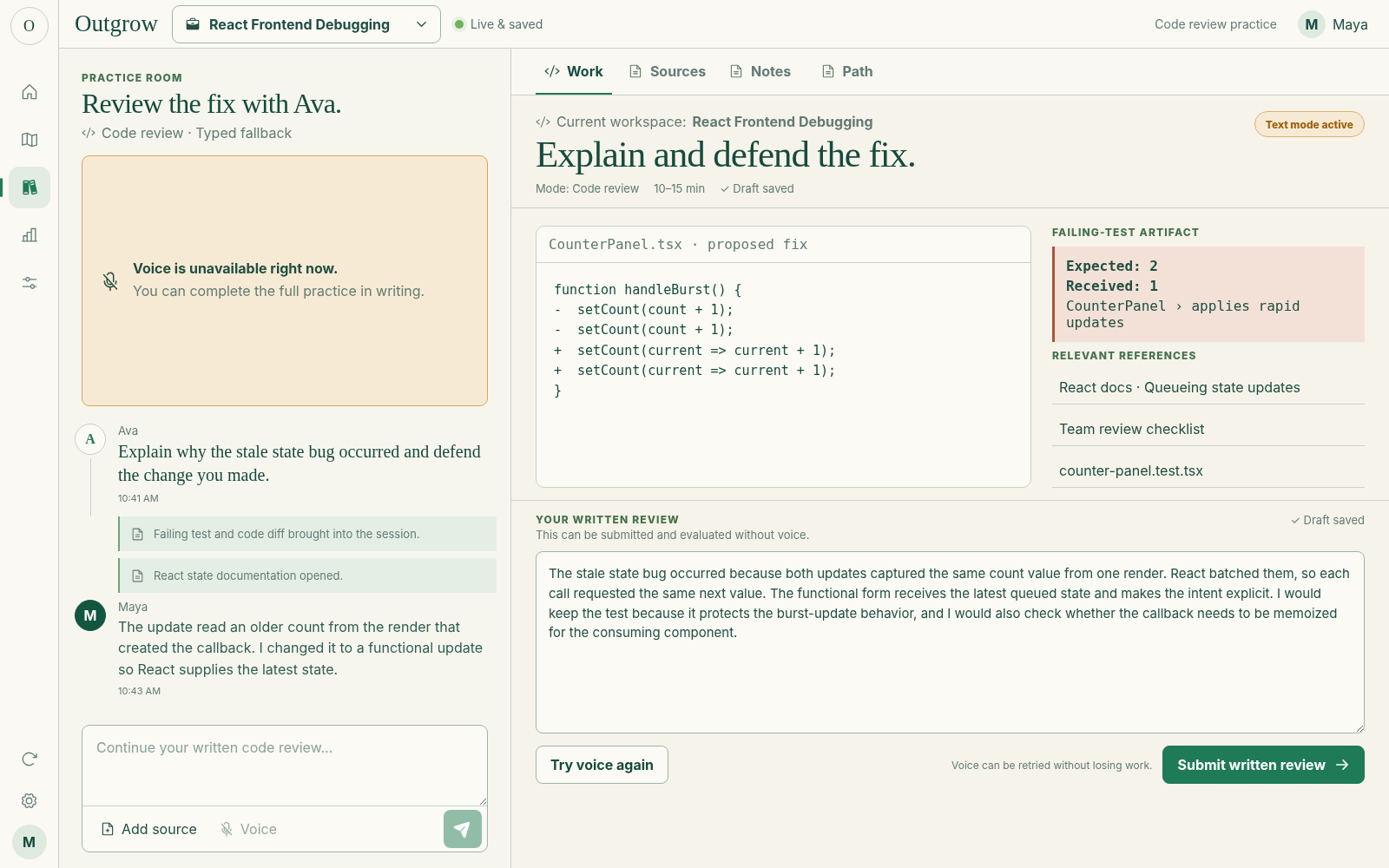
- Practicing an oral exam, presentation, or code review
They can add the material they already trust: documents, notes, URLs, datasets, repositories, images, deadlines, and previous work.
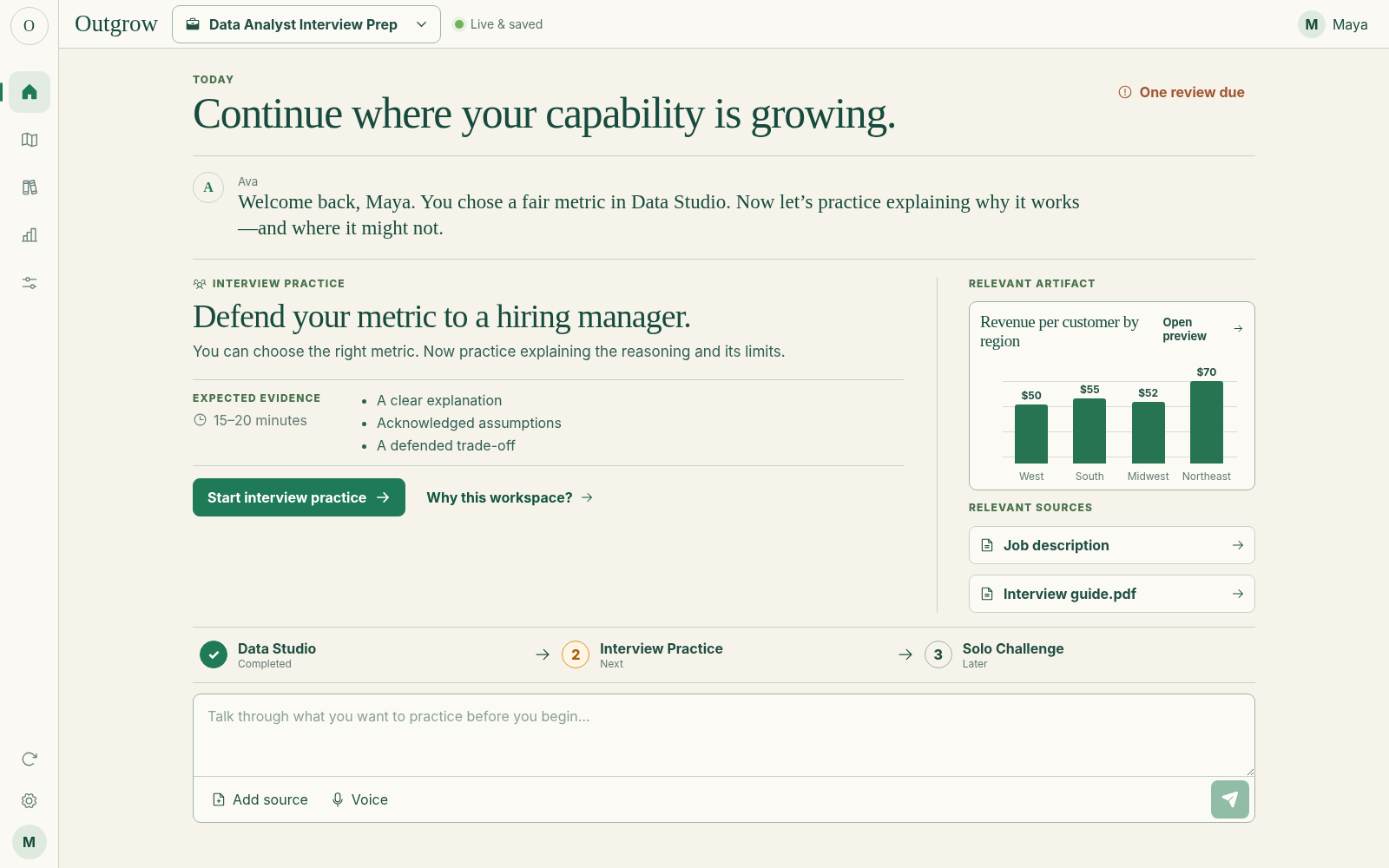
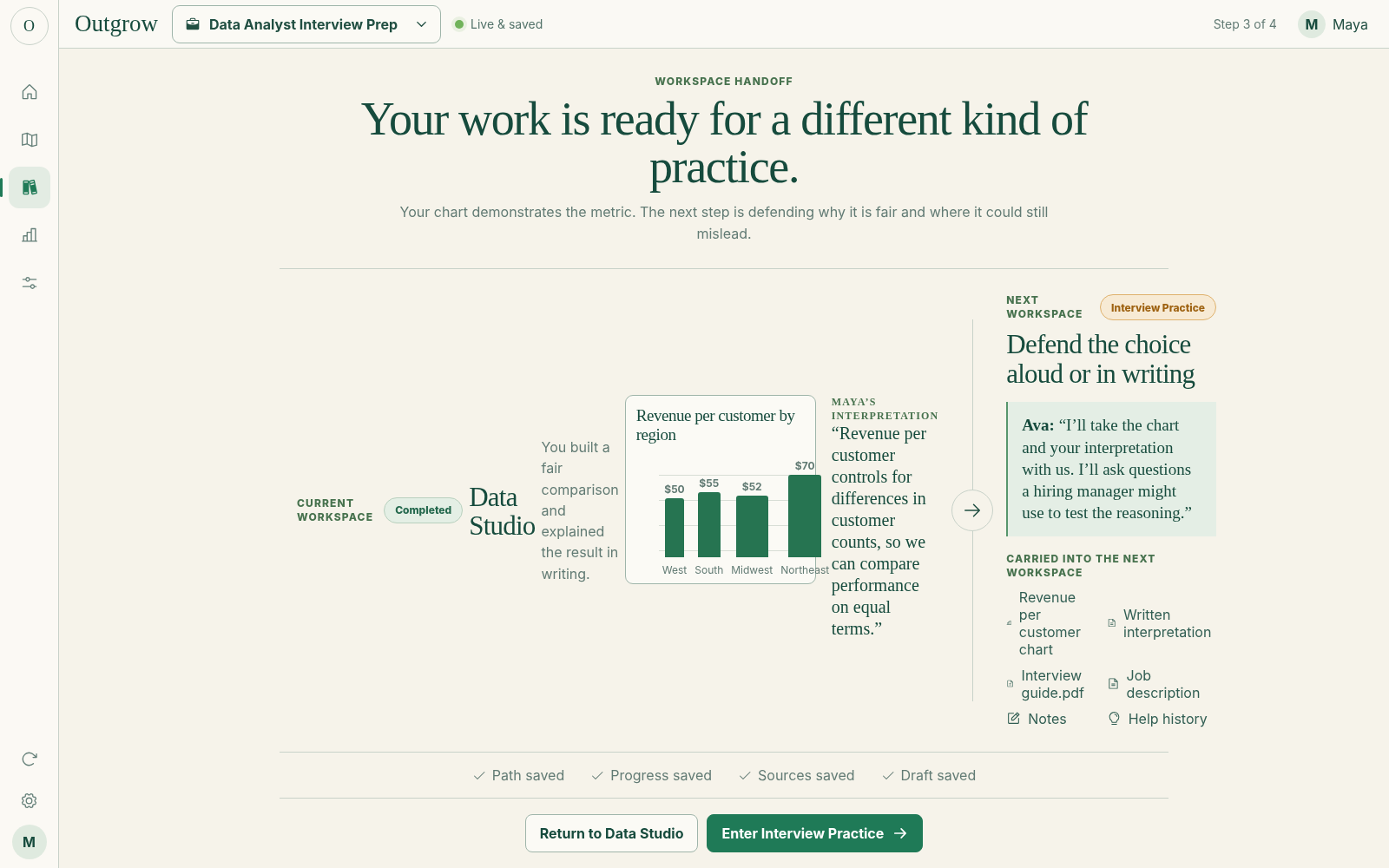
Ava uses that context to create a personalized path containing explanations, source material, practice, projects, reviews, and a fresh Solo Challenge.
The path is not generated once and frozen. It changes from evidence produced while the learner works.
Goal + sources
      ↓
Personalized path
      ↓
Real work
      ↓
Observed evidence
      ↓
Contextual help
      ↓
Visible path adaptation
      ↓
Fresh independent work
      ↓
Outgrown
Outgrow selects the environment required by each step:
- Learning Room for source-grounded lessons, notes, and interactive activities
- Data Studio for datasets, metrics, charts, dashboards, and analytical artifacts
- Coding Studio for real files, tests, terminal commands, builds, and previews
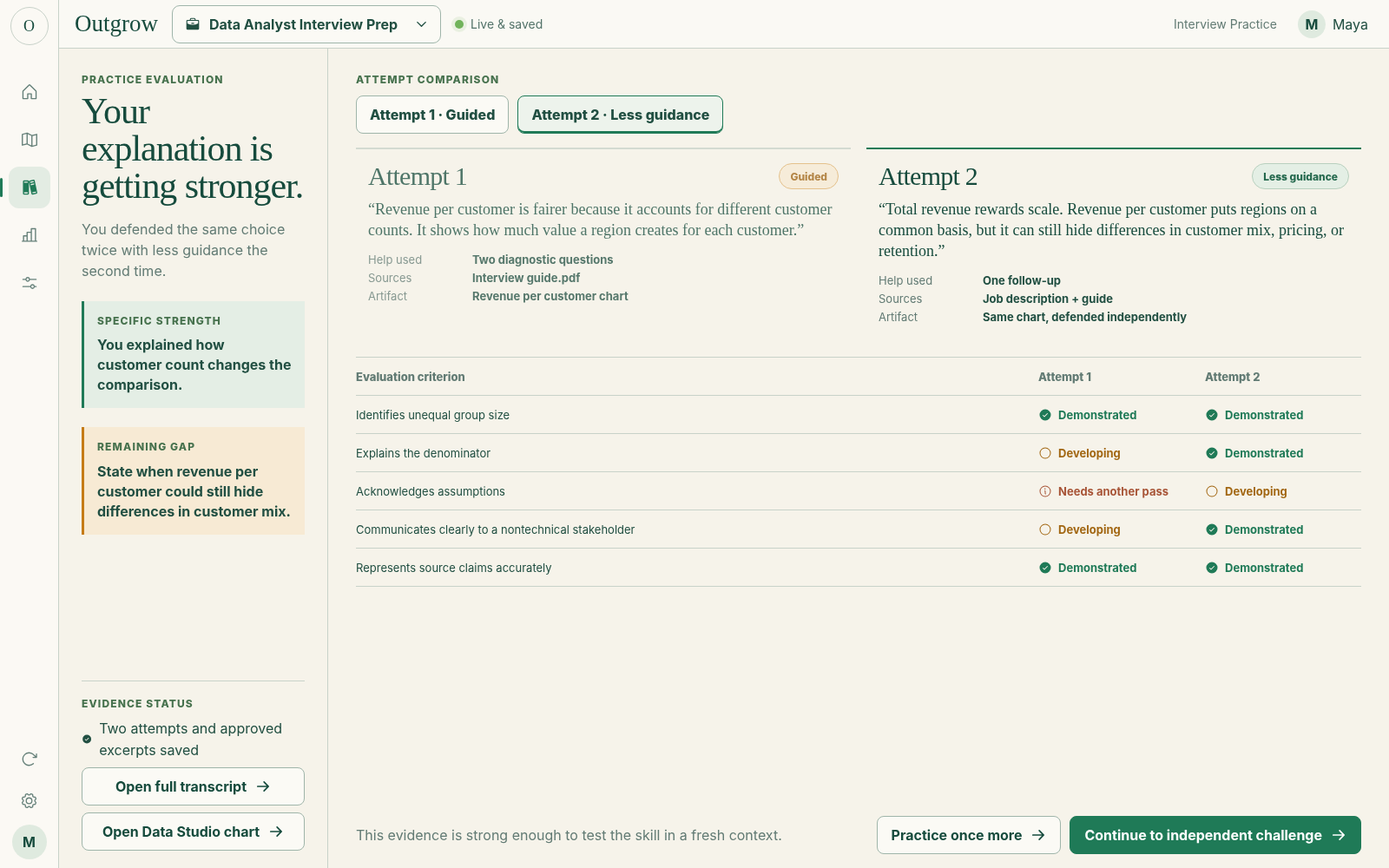
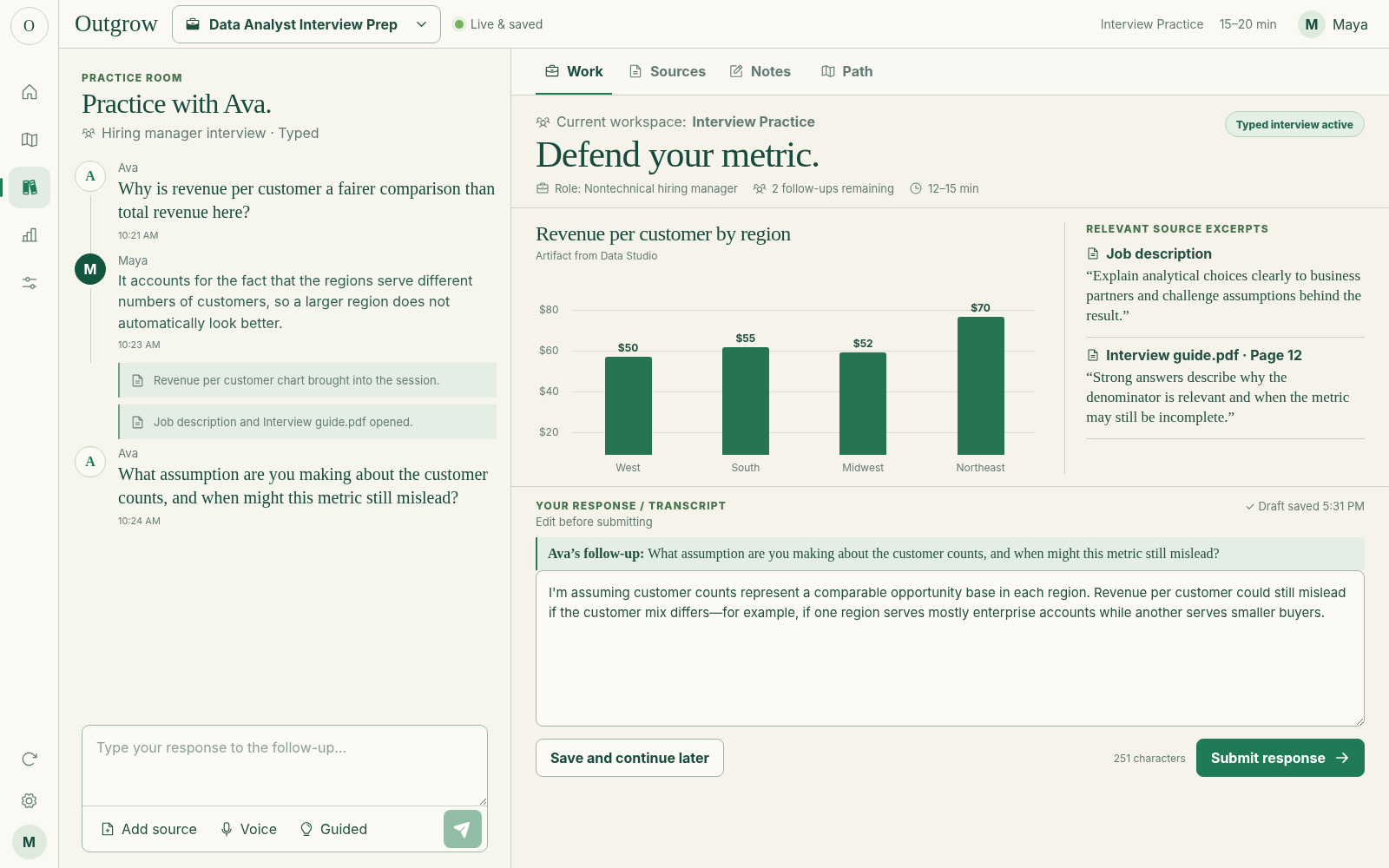
- Practice Room for interviews, oral examinations, presentations, code reviews, language roleplay, and teach-back exercises
Ava does not immediately reveal the answer. Depending on the learner’s preference and evidence, she can remain silent, ask a diagnostic question, point toward a relevant source, or provide a bounded hint.
The system records more than whether an answer was correct. It can preserve:
- The artifact the learner created
- The learner’s explanation
- Source grounding
- Rubric results
- Help that was used
- Path changes
- Independent transfer to fresh work
- Remaining uncertainty
Before a capability becomes Outgrown, the learner must apply it to a new situation with Ava out of sight.
Outgrow then provides:
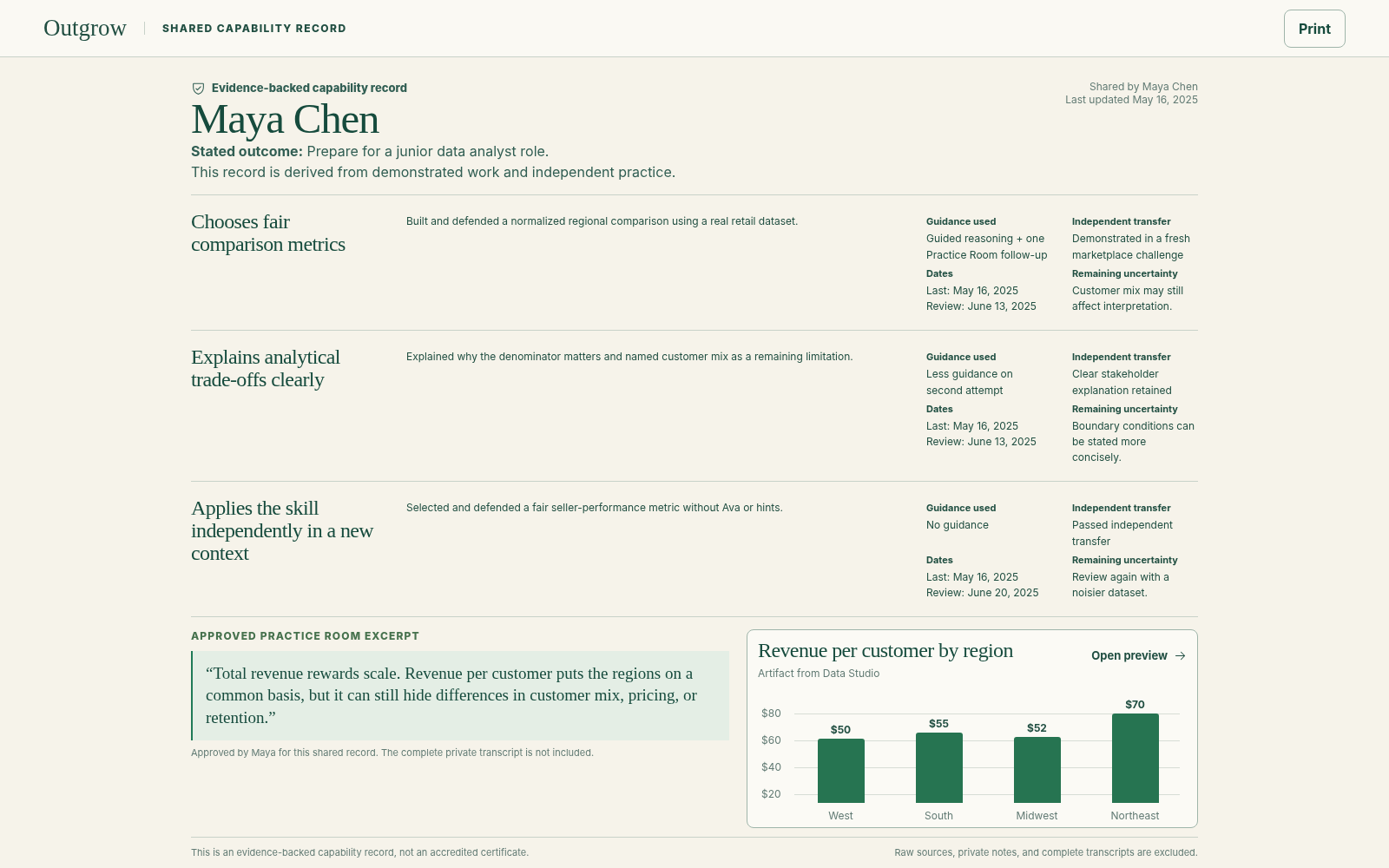
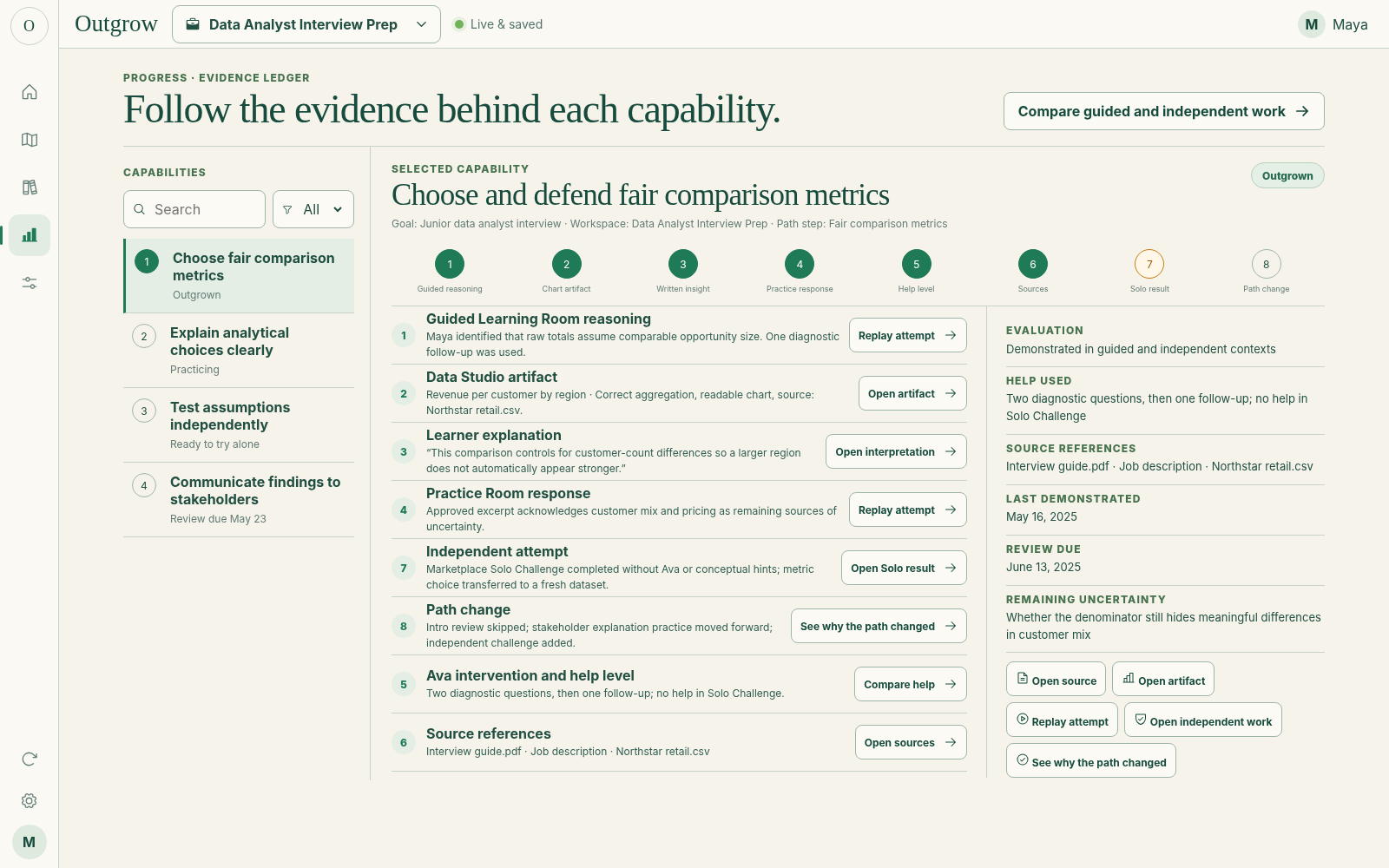
- An Evidence Ledger showing what each capability rests on
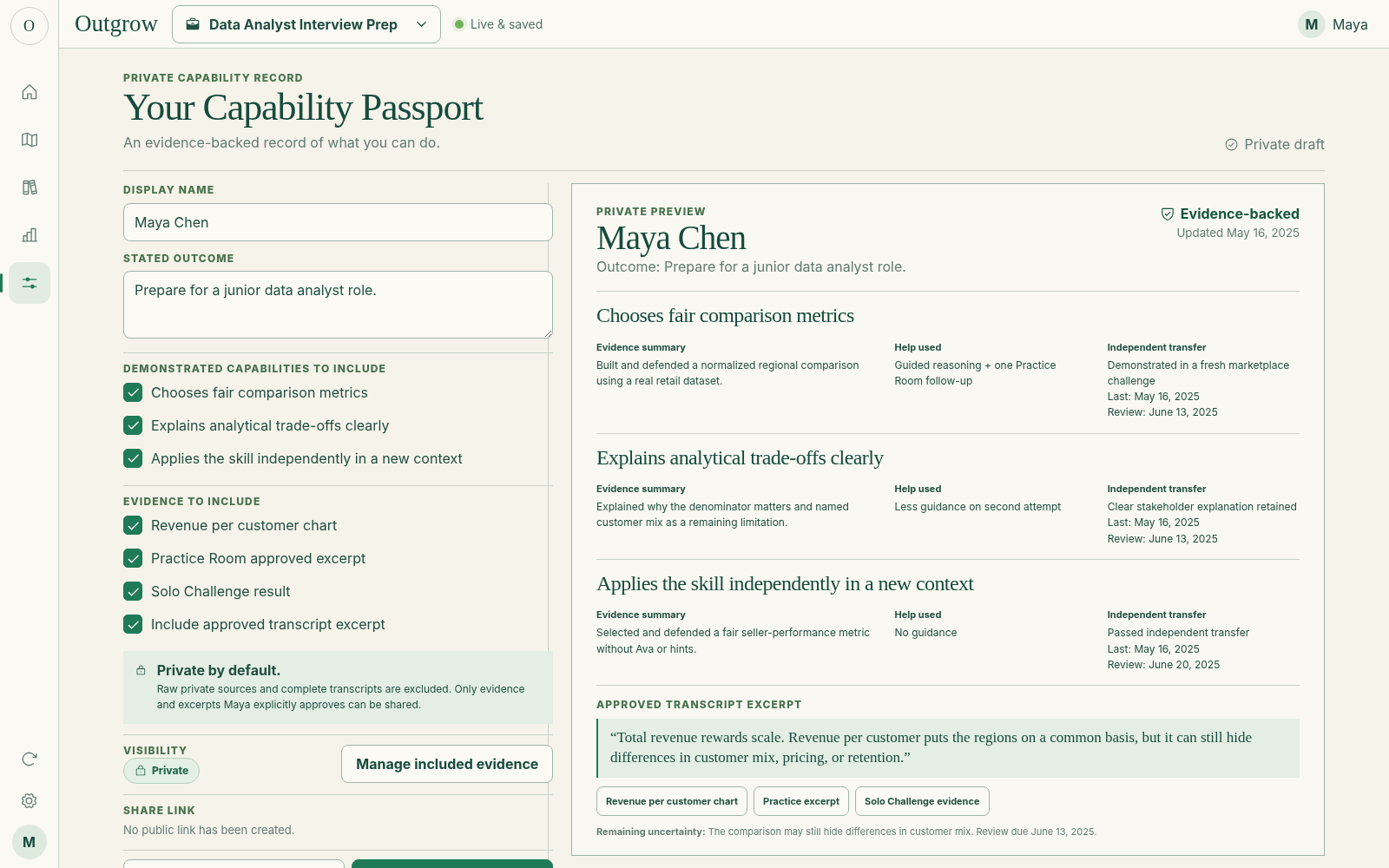
- A private-by-default Capability Passport
- Selected artifacts and learner explanations
- Source grounding and help history
- Independent-transfer evidence
- Review dates and remaining uncertainty
- A redacted, revocable sharing link controlled by the learner
Outgrow also supports educators and experts through Forge.
An expert’s material or demonstration becomes a reviewed Learning Blueprint and a versioned Topic. Learners receive personalized forks of that Topic inside the same Outgrow learning system.
With explicit consent, bounded learning signals can reveal where instruction is failing. A creator can then review and approve an improved version without silently changing the experience of learners already using the previous version.
How we built it
We built Outgrow as a full-stack TypeScript platform using Codex as our engineering partner and GPT-5.6 as the intelligence layer inside the product.
Codex helped us evolve the project from one deterministic learning demonstration into a production system with:
- Persistent learner workspaces
- Arbitrary goal-to-path generation
- Source-grounded activities
- Multiple learning environments
- Learner memory
- Executable coding sandboxes
- Practice Room and adaptive follow-ups
- Evidence Ledger and Capability Passport
- Forge and immutable Topic versioning
- Automated testing, CI, backups, and deployment
We used separate Git worktrees for focused platform, product-experience, Forge, Workbench, and integration work, then converged them into one tested system.
GPT-5.6 operates through strict, versioned structured-output contracts. It is used to:
- Turn goals and sources into personalized paths
- Generate source-grounded activities
- Select the appropriate learning environment
- Interpret meaningful learner evidence
- Coach without over-helping
- Generate adaptive follow-up questions
- Evaluate open-ended reasoning
- Rewrite future path steps
- Curate useful learner memory
- Convert expert evidence into a Learning Blueprint
- Propose evidence-backed curriculum improvements
The model never directly mutates learner state.
GPT-5.6 proposes a structured decision. Outgrow then validates ownership, evidence, source references, schemas, environment compatibility, and domain rules before persisting anything.
The main stack includes:
- Next.js, React, TypeScript, and Tailwind CSS
- PostgreSQL as the canonical learner and creator state store
- pgvector for relevant source and memory retrieval
- Redis and BullMQ for asynchronous work
- Drizzle ORM and Zod for typed persistence and validation
- Docker Compose for the production stack
- Disposable Docker workspaces for Coding Studio
- Monaco Editor, xterm.js, and DuckDB-WASM
- Codex app-server and the OpenAI Responses API
- Vitest and PostgreSQL integration testing
- Playwright across Chromium, Firefox, WebKit, mobile, accessibility, themes, and reduced motion
- Self-hosted GitHub Actions for CI and controlled deployment
The credential-free experience uses the same schemas, product components, and state transitions with a deterministic provider. Separately, the release was validated through eight real, no-fallback GPT-5.6 Sol operations.
Challenges we ran into
Moving beyond a scripted demonstration
Our first version delivered a strong data-analysis journey, but other goals still reused too much fixed state.
The hardest early challenge was turning one demonstration into a genuinely general platform where anatomy, coding, climate, finance, and data goals could produce materially different paths, activities, and environments.
We solved this by making PostgreSQL the canonical source of truth and introducing shared services for workspaces, paths, sources, activities, attempts, evidence, progress, memory, and adaptation.
Letting GPT-5.6 reason without giving it unchecked authority
Adaptive education requires open-ended reasoning, but learner progress cannot depend on unconstrained model text.
We designed a typed boundary in which GPT-5.6 proposes structured actions while the host application validates identity, evidence, source provenance, environment compatibility, and state transitions.
Maintaining one learner context across every environment
The Learning Room, Data Studio, Coding Studio, Practice Room, Ava, Today, memory, Passport, and Forge initially risked becoming disconnected products.
We created a shared learner-context layer and a persisted Workbench specification so every environment participates in the same evidence and adaptation lifecycle.
Distinguishing completion from learning
A correct result may have required substantial AI assistance.
We needed to record artifacts, explanations, interventions, and help without presenting learners with a punitive “AI dependency score.”
Our solution was a learner-readable evidence model followed by a fresh Solo Challenge.
Making sessions dependable
Learners should be able to leave during an activity, refresh, return later, or switch workspaces without losing drafts, transcripts, attempts, notes, or path state.
That required careful session restoration, idempotency, migrations, retries, autosave, service-recovery testing, backups, and isolated restore rehearsals.
Improving instruction without exposing learner transcripts
We wanted Forge to improve from real use without turning raw learner conversations into community data.
Forge therefore uses bounded, consented categorical signals tied to stable Topics, skills, activities, outcomes, and assistance levels instead of copying raw responses or transcripts.
Accomplishments that we’re proud of
We are proud that Outgrow became a working platform rather than a collection of disconnected AI demonstrations.
The current product includes:
- Persistent multi-workspace learning
- Arbitrary goal-and-source-driven paths
- Learning Room, Data Studio, Coding Studio, and Practice Room
- Adaptive questions and follow-ups
- Restored drafts and editable transcripts
- Rubric-based evaluation
- Evidence-linked path changes
- Curated cross-workspace memory
- Fresh Solo Challenges with Ava hidden
- Evidence Ledger and private Capability Passport
- Redacted, revocable Passport sharing
- Forge Topics, learner forks, learning signals, and immutable version history
- Reliable deterministic operation with a fully tested live GPT-5.6 path
Our verification included:
- Hundreds of automated unit and integration tests
- Dedicated PostgreSQL integration coverage
- Deterministic learning evaluations
- Eight successful live GPT-5.6 Sol operations
- Cross-browser Playwright coverage
- Desktop and mobile journeys
- Accessibility testing
- Light and dark theme verification
- Reduced-motion coverage
- Data Studio, Coding Studio, Practice Room, Passport, and Forge journeys
- Migration, service recovery, backup, and isolated restore testing
- Exact-release CI and deployment verification
We are especially proud that a learner can create a real artifact, defend the reasoning in Practice Room, pass a fresh Solo Challenge, inspect the evidence behind the capability, and choose exactly what becomes part of a shareable Passport.
What we learned
We learned that personalization is not changing the wording of a lesson.
Real personalization changes:
- What the learner does next
- Which environment they use
- How much help they receive
- Which prior evidence can be reused
- When they are ready to attempt fresh work
We learned that the best AI tutor sometimes does nothing. Productive silence, diagnostic questions, and bounded hints can be more educational than an immediate answer.
We learned that the model should propose and the product should decide. Strict schemas, source provenance, host-owned evidence, and deterministic validation made the system more dependable without removing the value of GPT-5.6’s reasoning.
We learned that completion is weak evidence. A useful learning system needs artifacts, reasoning, source grounding, assistance history, and independent application to fresh work.
We learned that learner memory should be curated rather than stored as a permanent transcript. Useful memory needs evidence, confidence, scope, expiry, correction, and learner control.
We also learned how much Codex changes the scale at which a small team can build. It allowed us to work across frontend systems, persistence, AI orchestration, executable environments, tests, migrations, CI, and deployment while continuously validating that those pieces still formed one coherent product.
What’s next for Outgrow AI
The next phase is to move from a deeply tested product into a real learner and creator network.
We plan to:
- Run focused pilots with students, career switchers, educators, and subject experts
- Expand Forge so creators can publish adaptive Topics from their own materials and demonstrations
- Add more Workbench templates for research, design, languages, finance, science, and creative skills
- Improve voice-based Practice Room experiences
- Add organization tools for schools, cohorts, and professional training
- Strengthen long-term review and capability refresh
- Help learners carry private, evidence-backed Capability Passports between education, projects, and professional opportunities
- Move production to a permanent cloud environment behind
outgrow.axcelner.com - Develop a sustainable creator and institutional model around adaptive, versioned learning
Our long-term vision is for Outgrow to become:
A personal school for every learner, a learning compiler for every expert, and a system in which education becomes more useful with every person who learns from it.
This version is condensed and reformatted from the full Outgrow project brief.
Built With
- bullmq
- codex
- codexappserver
- docker
- dockercompose
- drizzleorm
- duckdbwasm
- gpt-5.6
- monacoeditor
- motion
- next.js
- node.js
- openai
- pgvector
- playwright
- postgresql
- react
- reactflow
- redis
- tailwindcss
- typescript
- vitest
- xterm.js
- zod


Log in or sign up for Devpost to join the conversation.