Inspiration
Our inspiration for this project came from witnessing the real-world challenges disease outbreaks such as COVID-19 had globally. We wanted to create a tool that is capable of predicting future outbreaks by analyzing various socioeconomic factors. We hope that access to a tool like this can help governments and researchers make informed decisions to better prepare for and mitigate outbreaks.
What it does
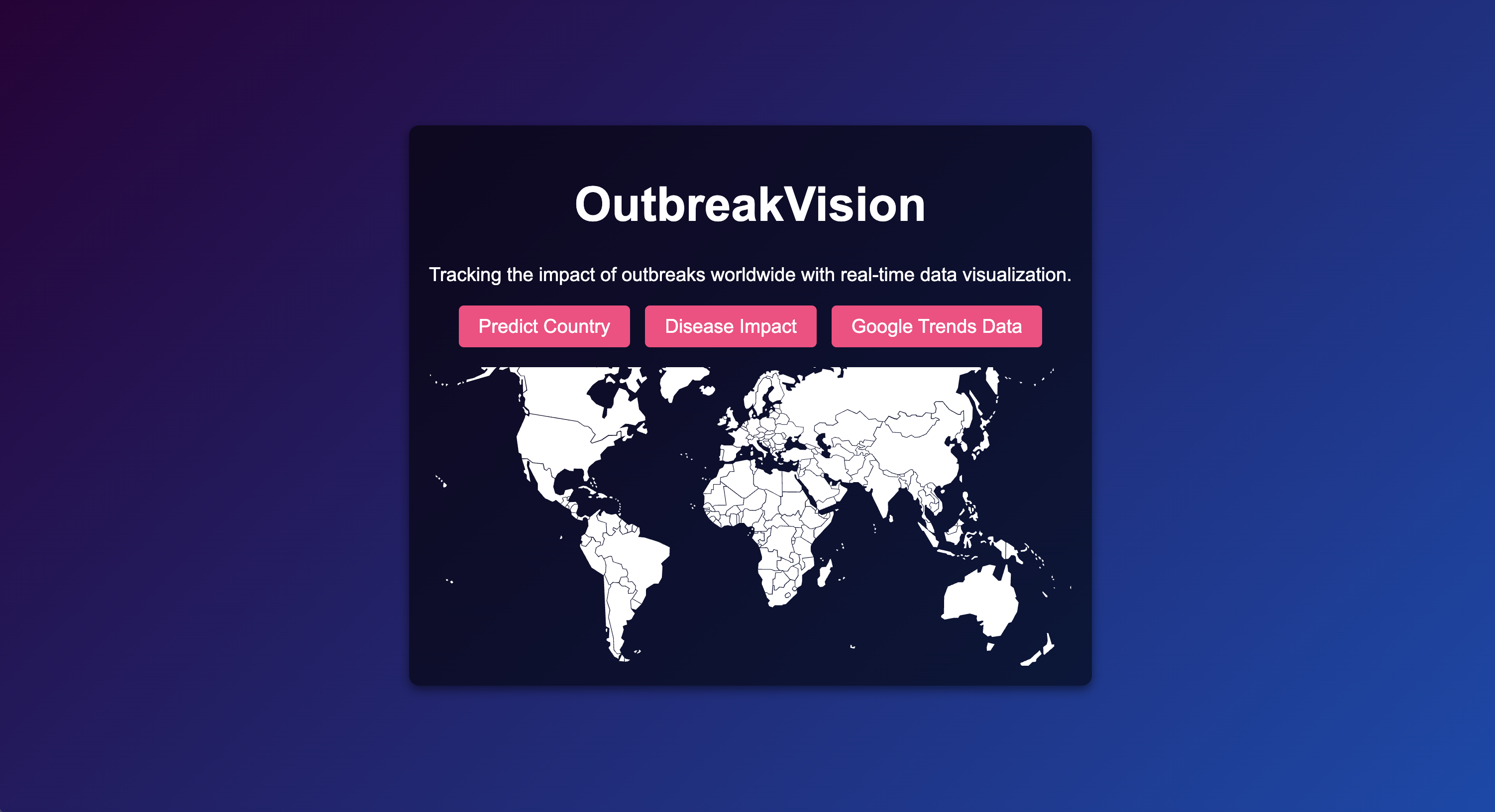
OutbreakVision is capable of simulating disease outbreaks and their global effects. Using data from recent outbreaks, our program can accurately simulate the effect a disease outbreak would have around the world and how quickly countries would be able to recover from it. Our program calculates these effects based on factors such as population density, travel, and healthcare access.
How we built it
We used mostly Worldbank Datasets to extract socioeconomic data and Covid-19 data for each country. We used this data to build a predictive model that estimates the negative impact of an outbreak on each country. Our model considers multiple factors including access to healthcare, economic stability, and population density. We created a simulation that dynamically maps how an outbreak would impact different countries over time. We used Pandas, with pandas and geopandas to process and analyze data, matplotlib to generate geographic visualizations, and OpenCV to create the video simulation.
Challenges we ran into
Almost all the data that we used wasn't perfect. The rows of countries we hoped to extract were never consistent within the datasets we used, there was often missing data, and it was also often hard to incorporate into one dataset that we could easily normalize, access, and model. We ran into hundreds of errors building the model to calculate the impact score for each country and trying to model the change in impact scores for each country over a period of time. We also struggled quite a bit to build the video simulation to display the change in impact number of each country over the timeframe.
Accomplishments that we're proud of
We learned how to implement a Random Forest model, enhancing our knowledge of machine learning, using this model as well to determine outputs for new data. Since we used data sets to train the model, we developed the skills needed to clean our data, eliminating irrelevant variables and adjusting for null values. Analyzing the Google Trends taught us how to extract information out of commonly available information in a unique way. We got more experience with working in a group, especially using GitHub to track everyone's branches.
What we learned
Our initial plan of building a simulation that could model a pandemic's starting location and then spread over a period of time, as well as how well a country recovered. However, we did not even come close to carefully thinking of the details of the logistics needed to implement this. We spent countless hours confused on where to go when we realized what we hoped to build was too complicated to accomplish within the limited time period of the hackathon. Hence, we learned that it is important to plan out each step needed to reach the goal of what we hope to build before we start to ensure what we hope to build is logistically possible with the time and skillsets we have available.
What's next for OutbreakVision
Next, we aim to enhance our project by adding data for how each country would handle and recover from a disease outbreak, making this tool more precise and helpful to others. We also plan to incorporate live google trends into our data in order to predict disease outbreak by looking at trending searches in different regions. Ultimately, we hope to improve this tool so that it can be used to assist in global disease outbreak prevention.


Log in or sign up for Devpost to join the conversation.