-
-
Outbound.
-
You are being monitored.
-
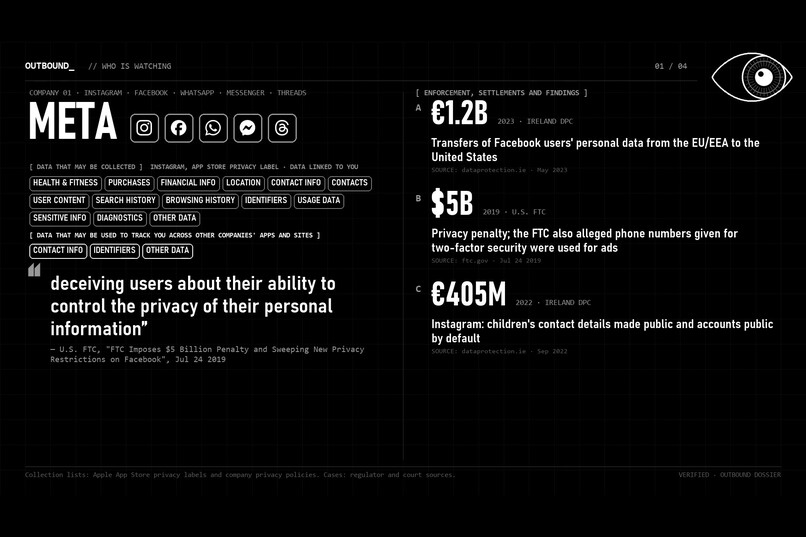
Meta.
-
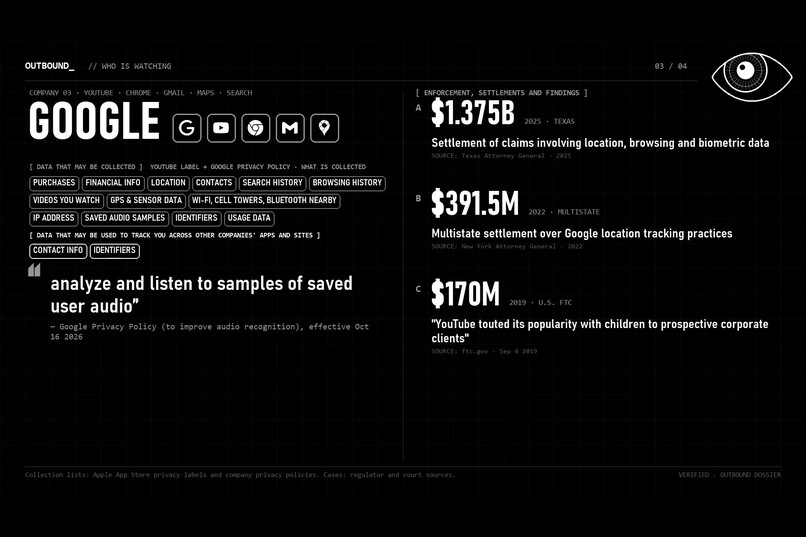
Google.
-
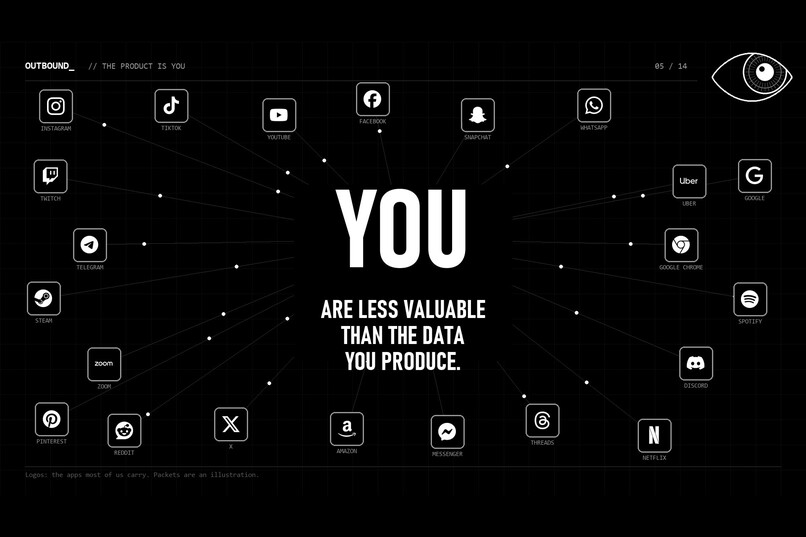
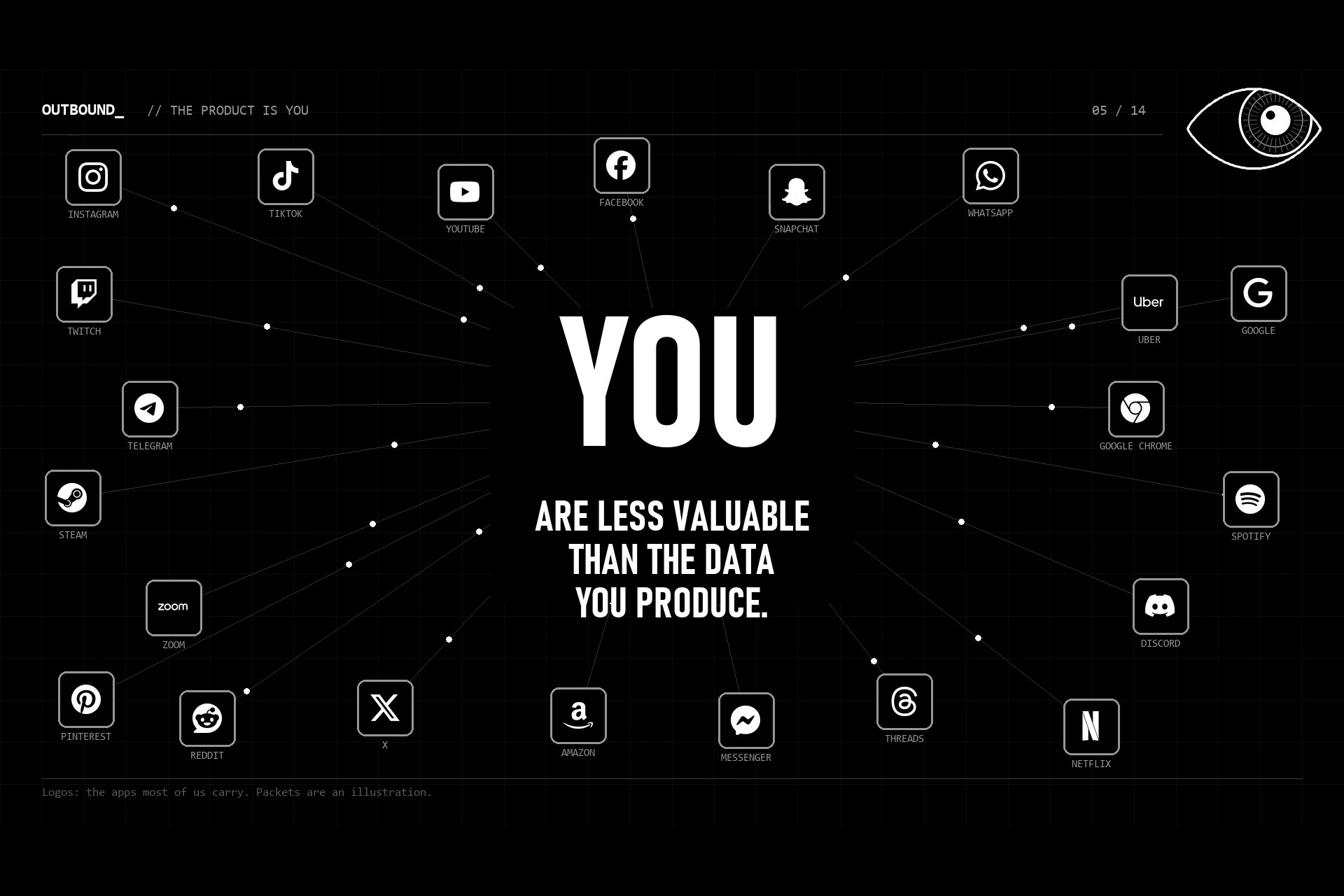
You are less valuable than the data you produce.
-
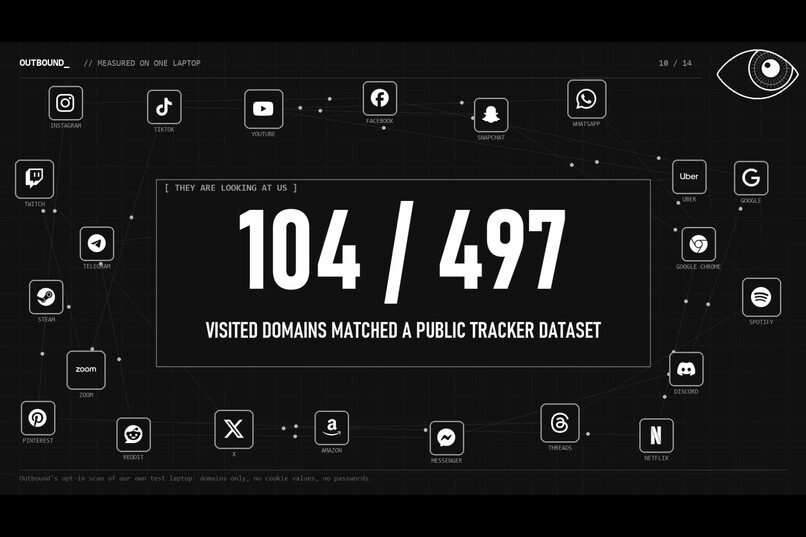
Our own laptop.
-
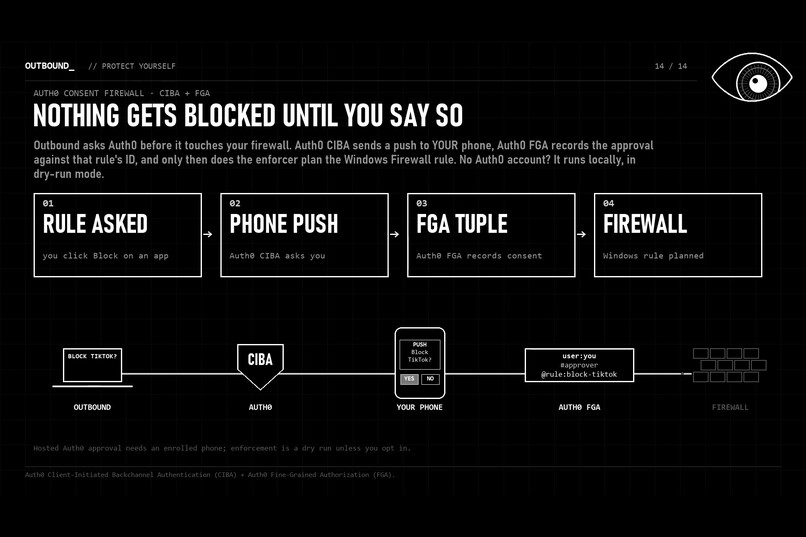
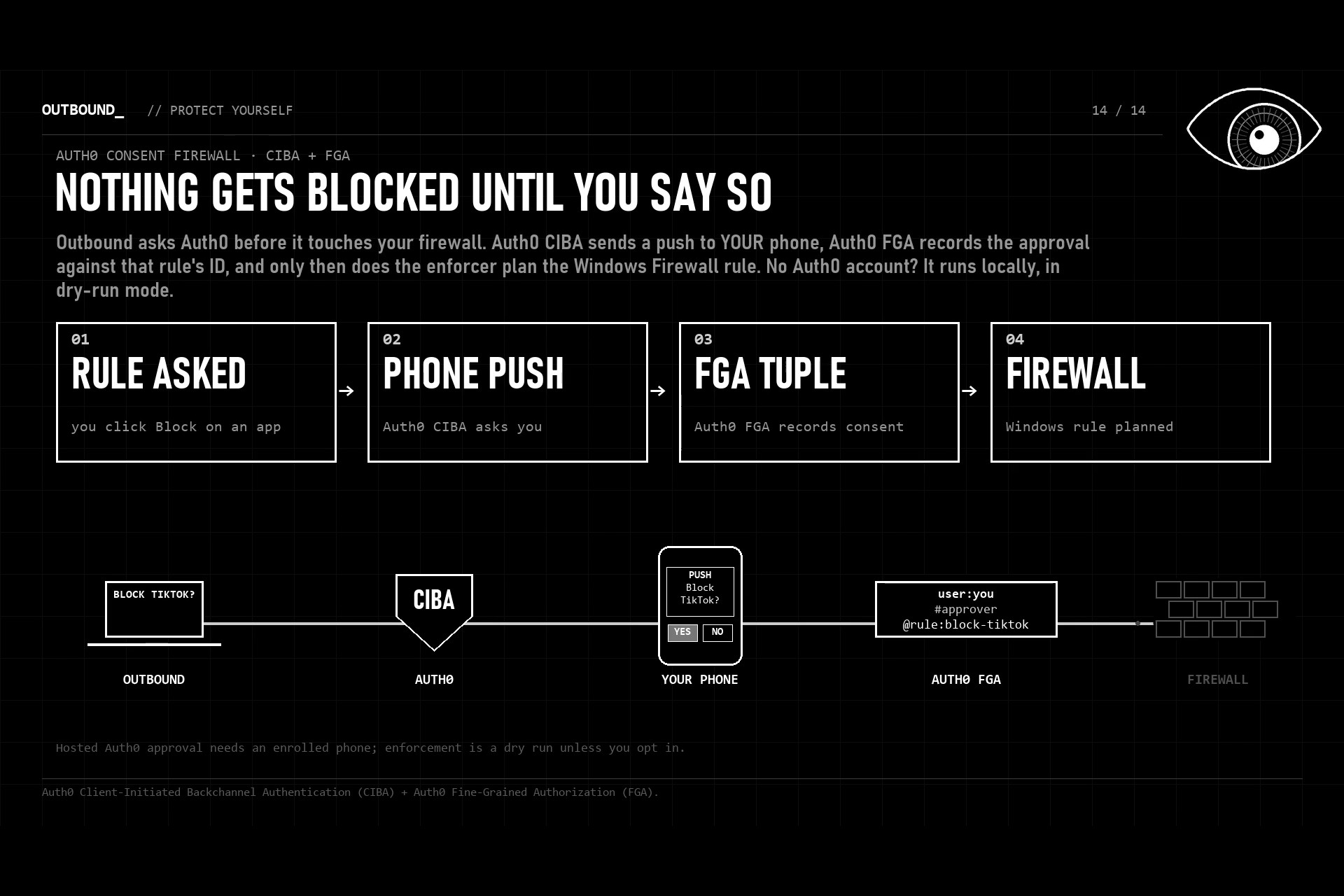
Auth0 consent firewall.
-
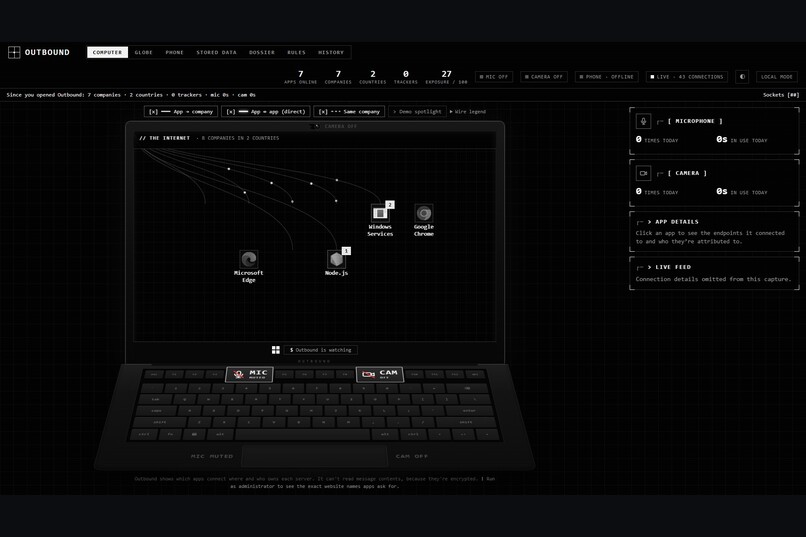
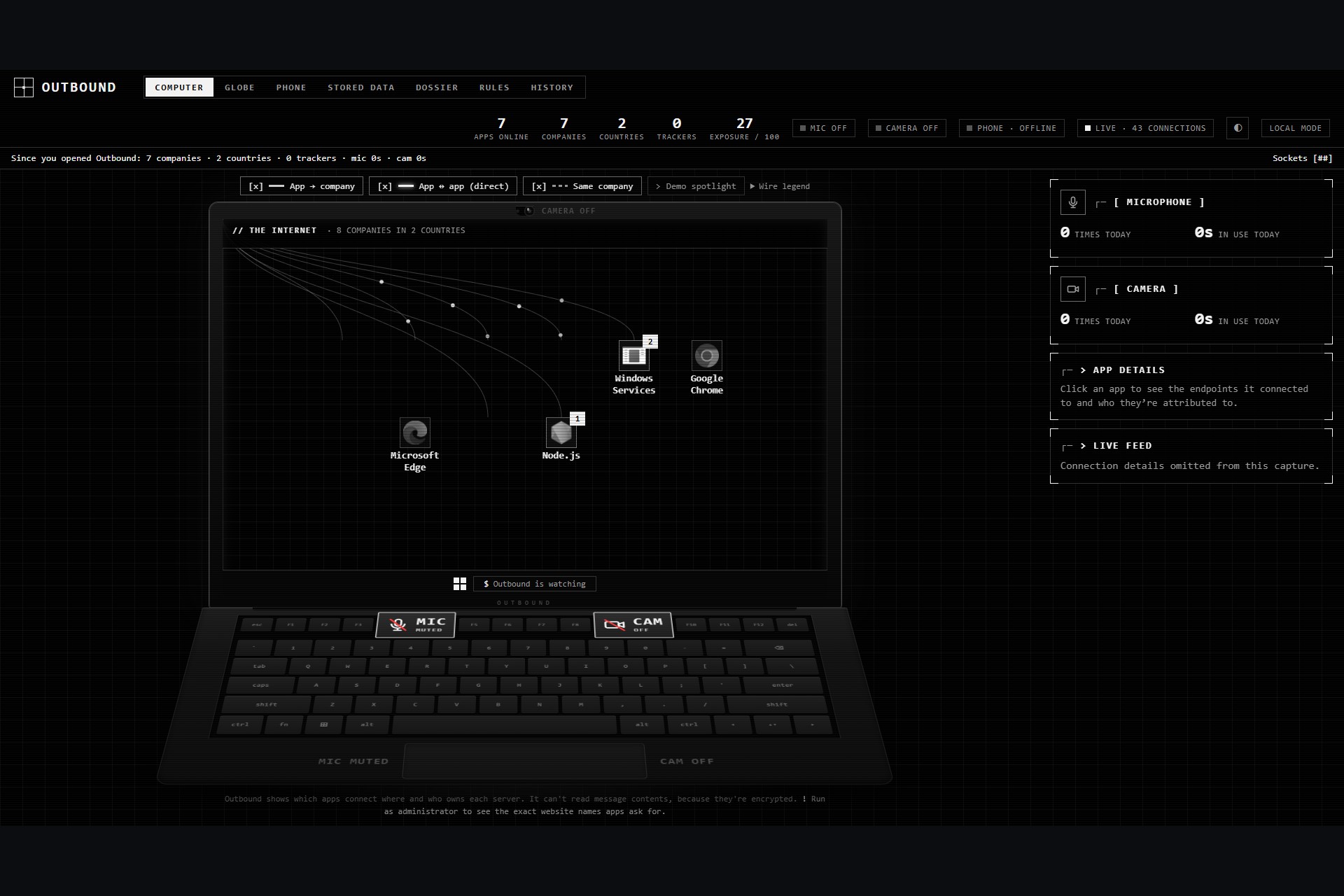
Computer view.
-
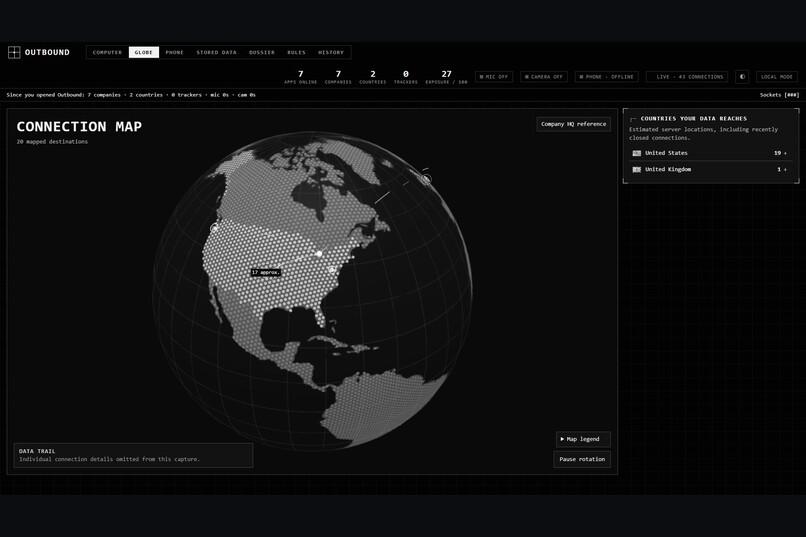
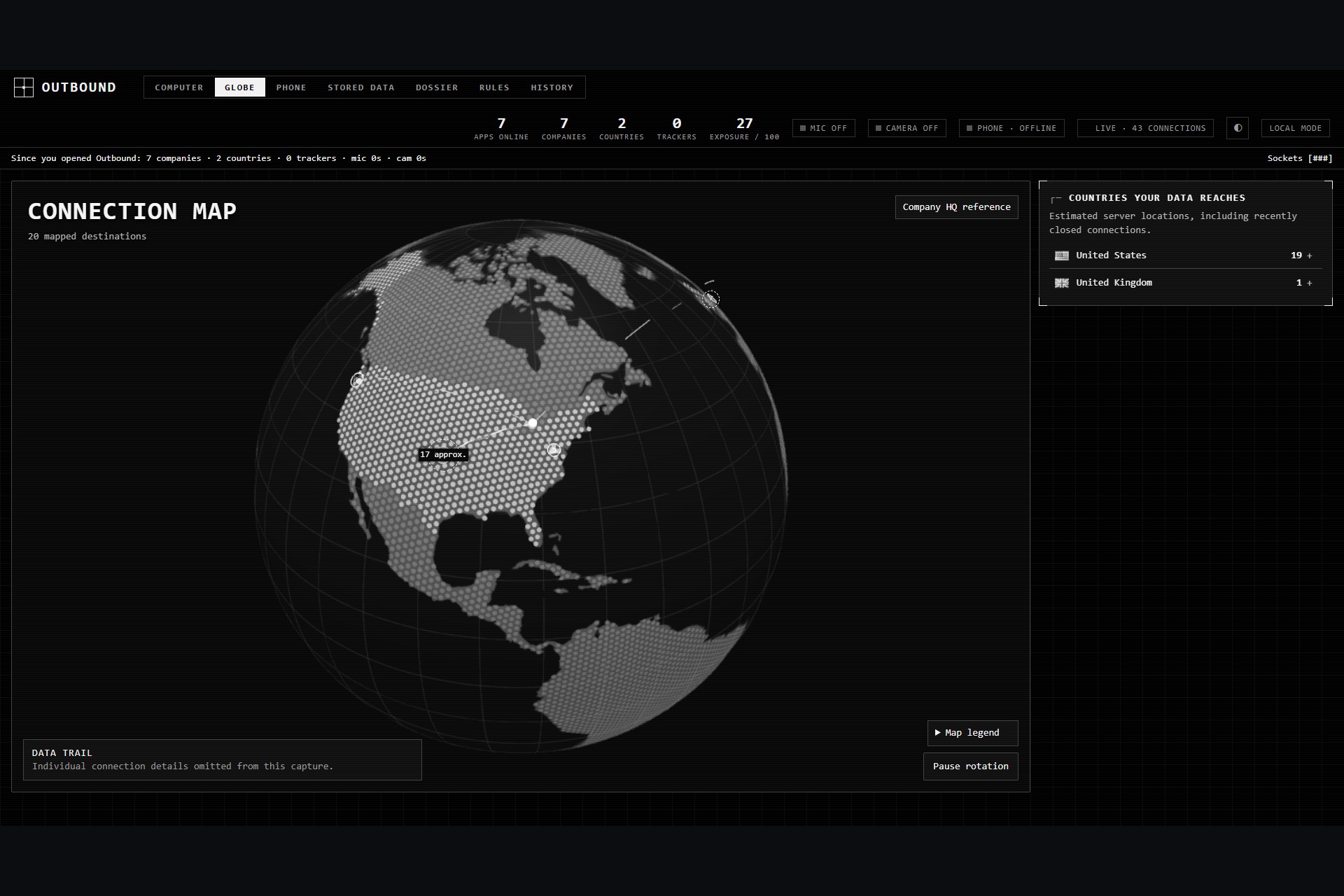
Globe view.
-
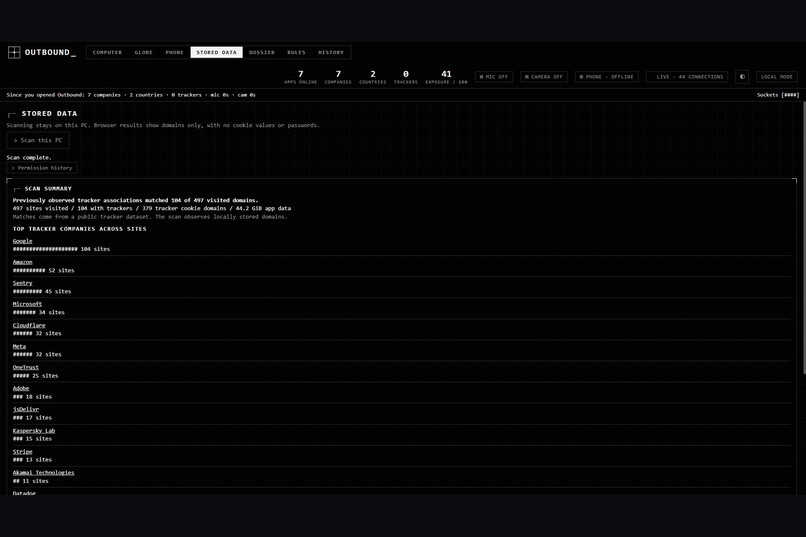
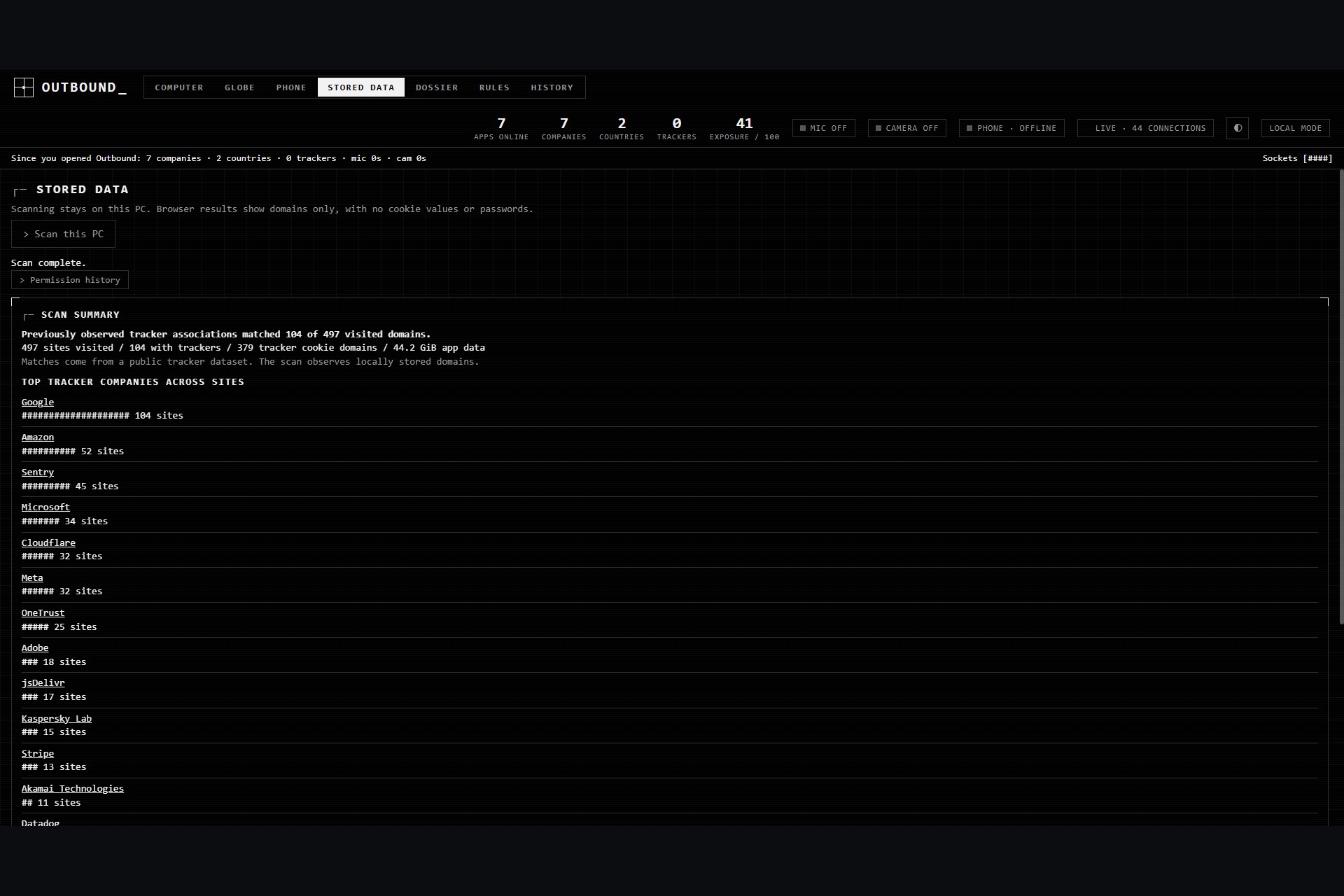
Stored data.
-
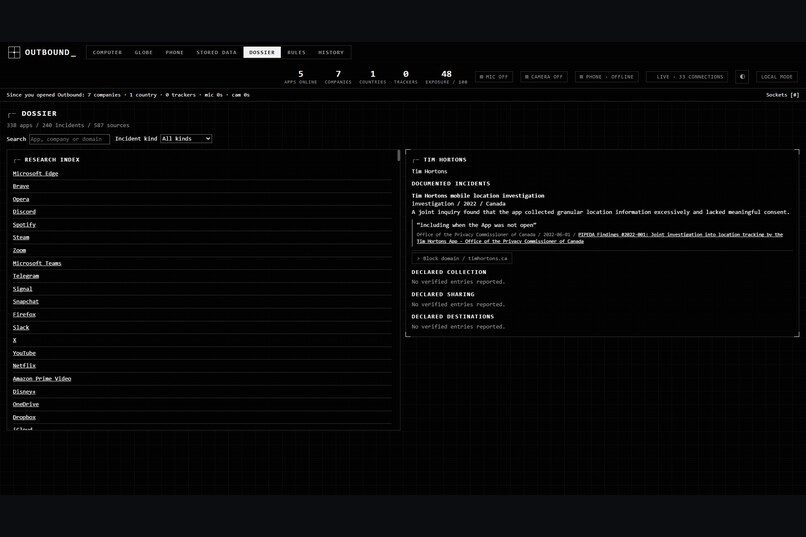
Dossier.
-
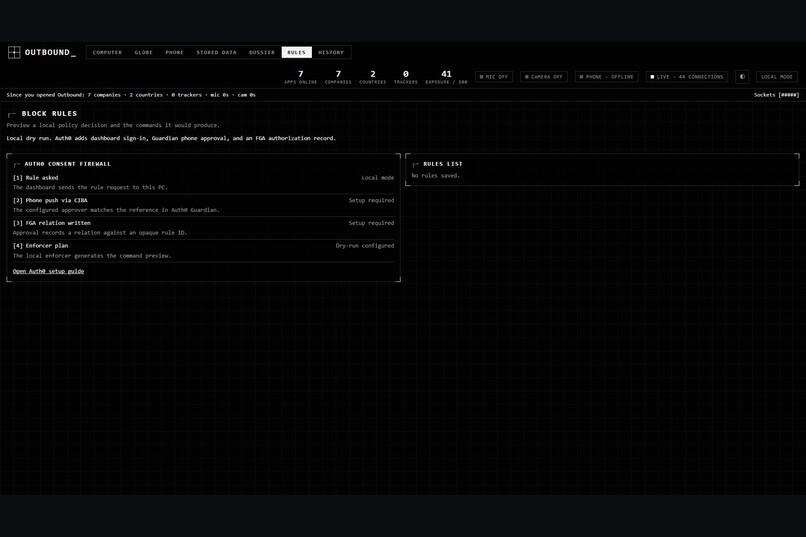
Rules.
-
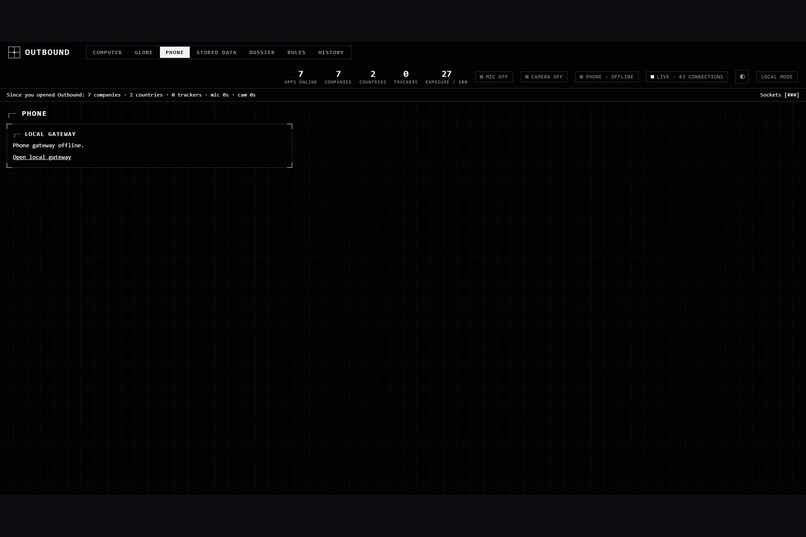
Phone.
-
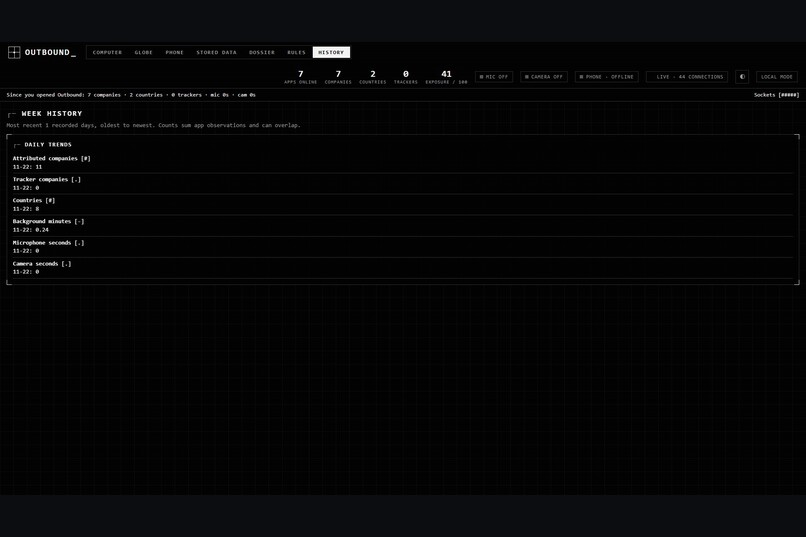
History.
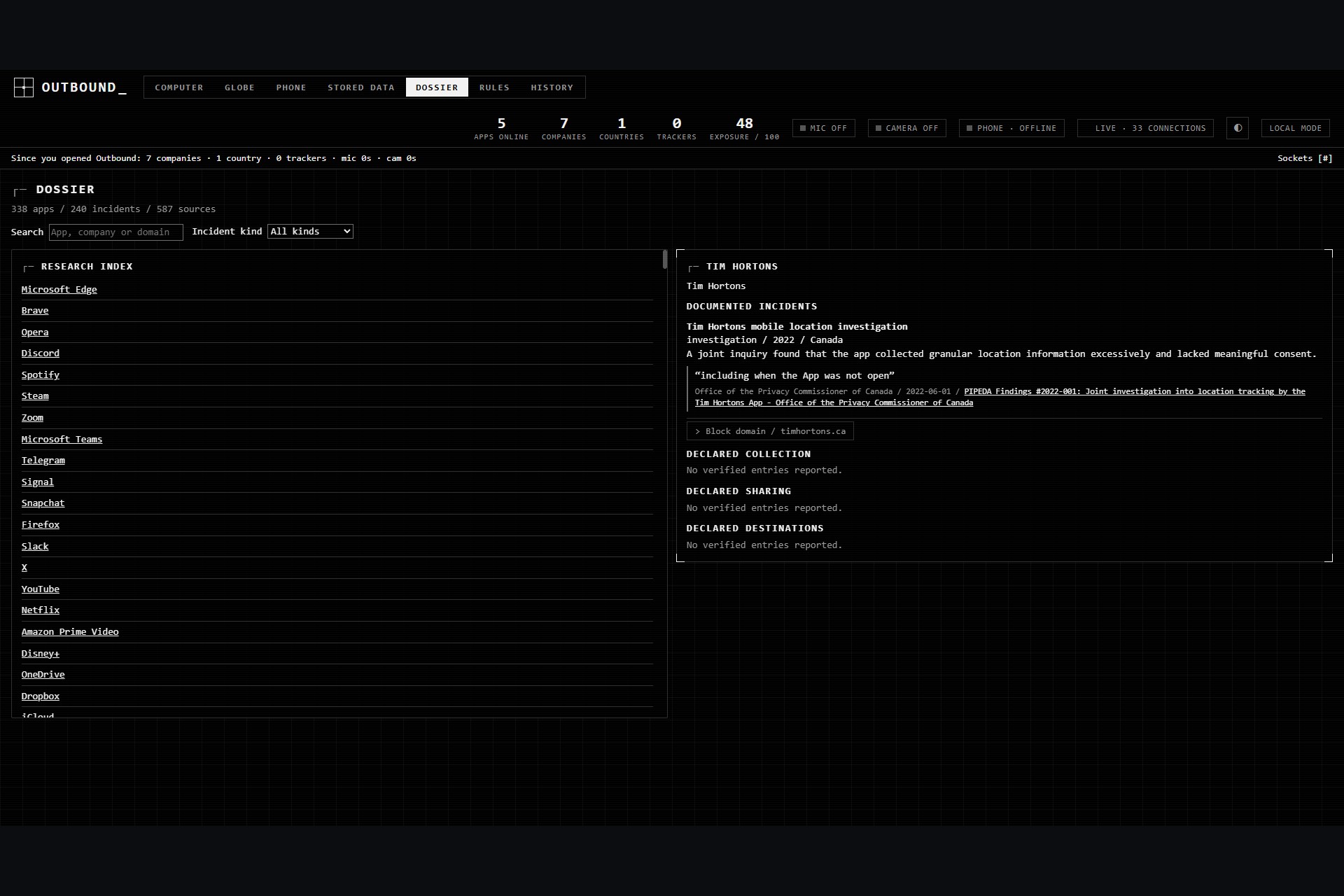
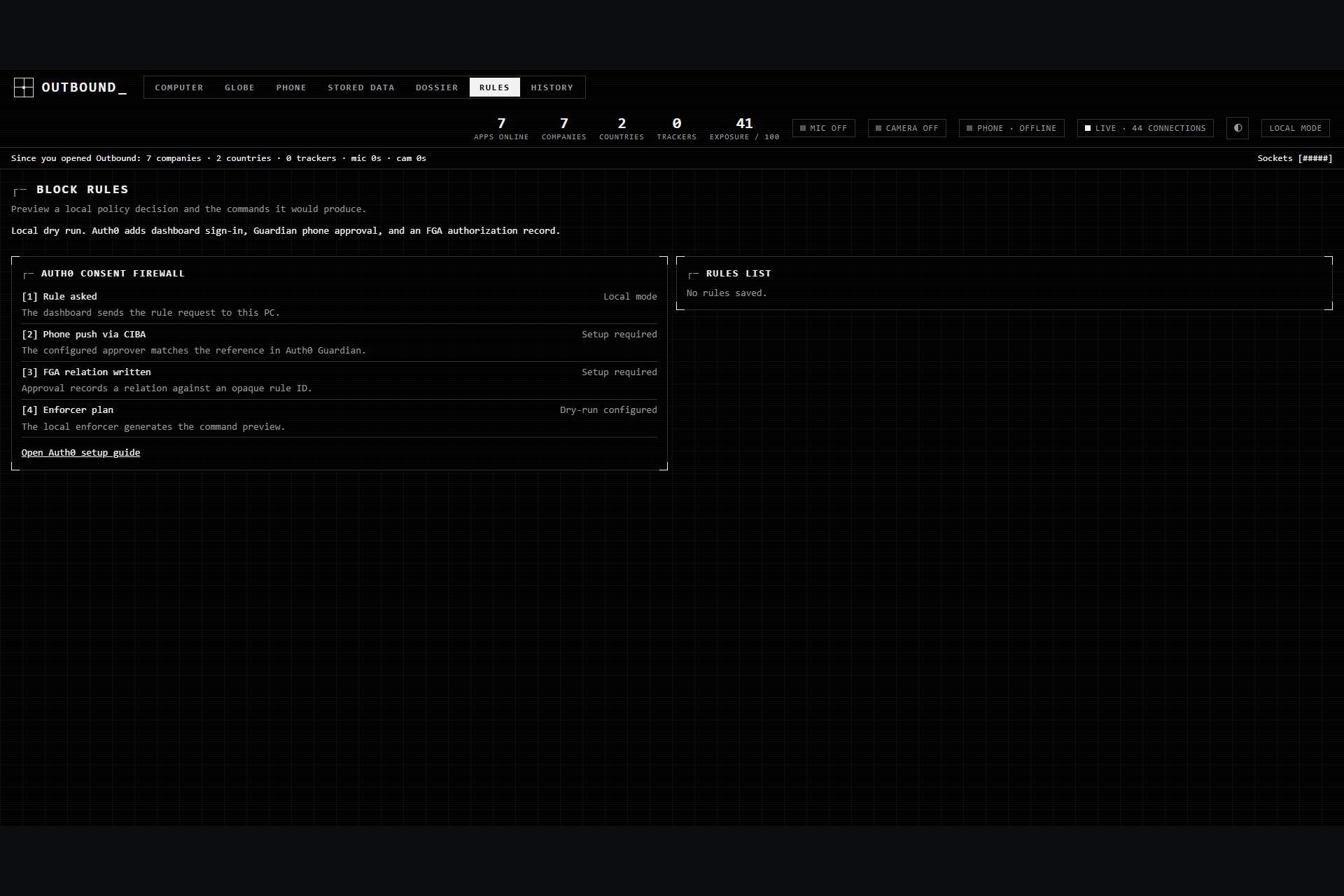
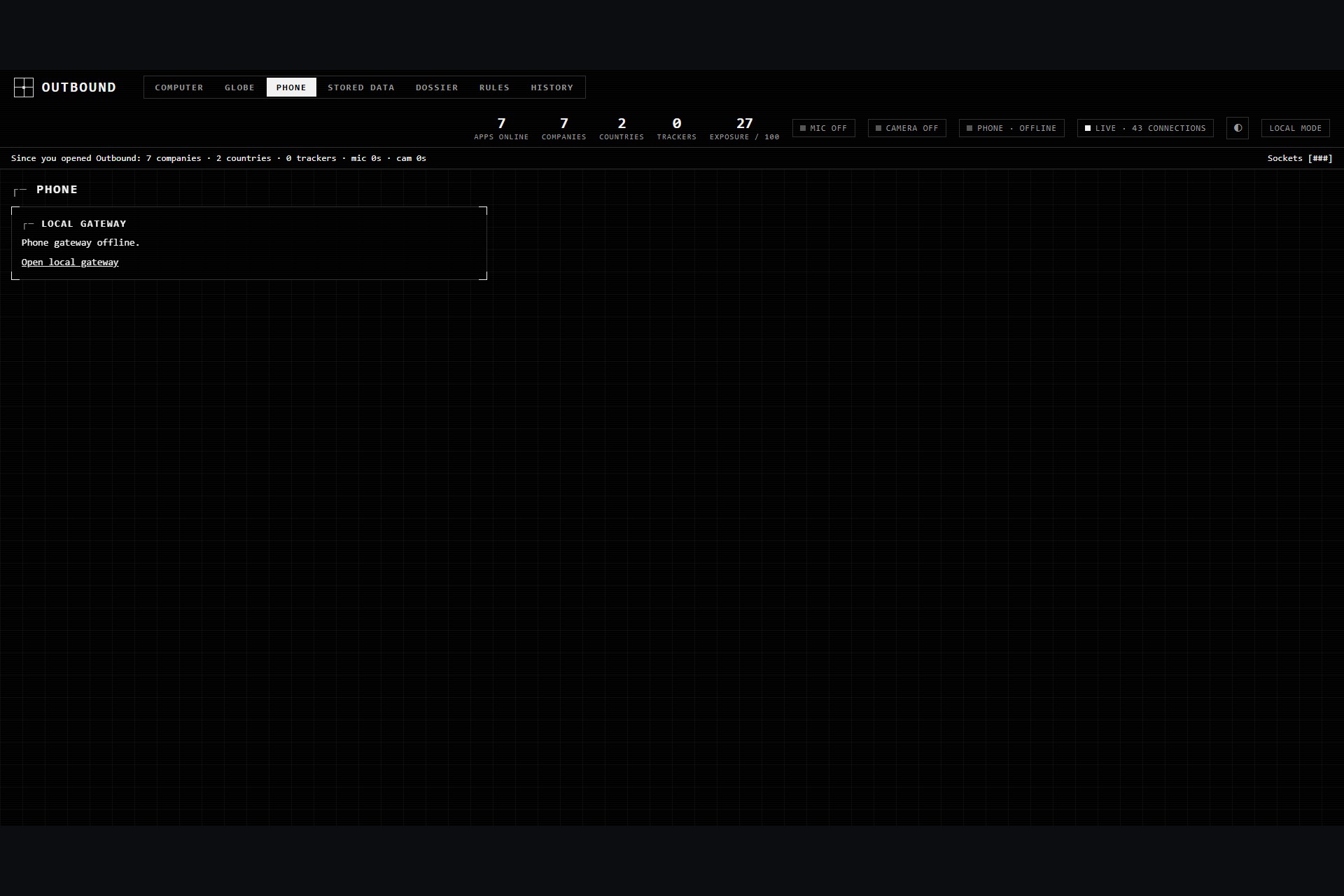
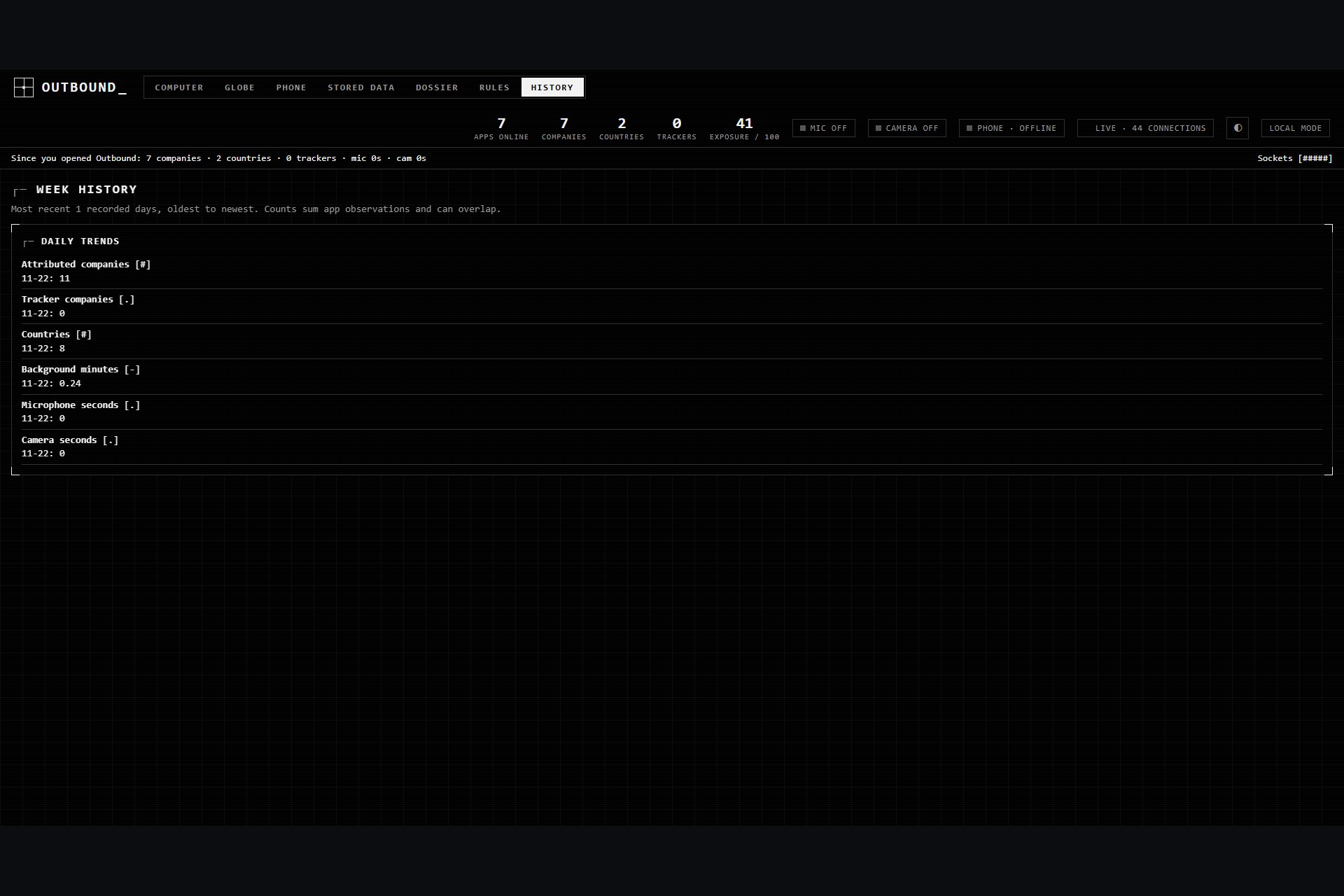
Inspiration
CBC Marketplace reported that the Tim Hortons app appeared to contact outside companies as soon as it opened (CBC Marketplace investigation). It made us wonder what our own laptops were doing. Your apps keep connections open in the background, often to companies you've never heard of, through servers in other countries. Privacy policies list categories, and regulators fill in the rest. Nobody puts it all on one screen, on your own machine, with sources.
What it does
Outbound is a local Windows dashboard that makes every connection answer four questions:
| Question | Outbound |
|---|---|
| Who is talking? | Live TCP endpoints joined to the running process, plus mic and camera indicators from Windows capture sessions |
| Where does it go? | Offline ASN and GeoLite2 estimates on a spinning globe, with company HQ reference points |
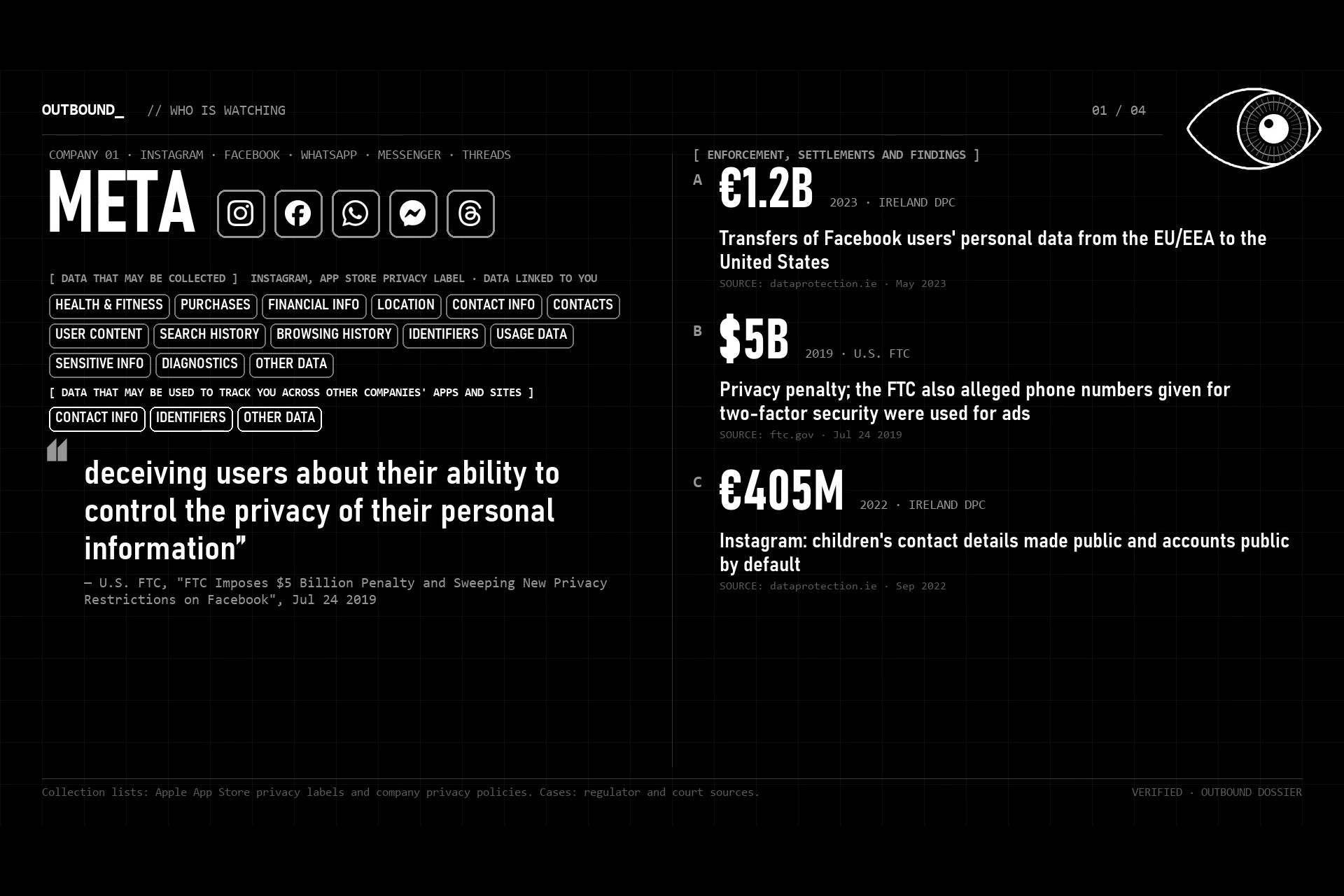
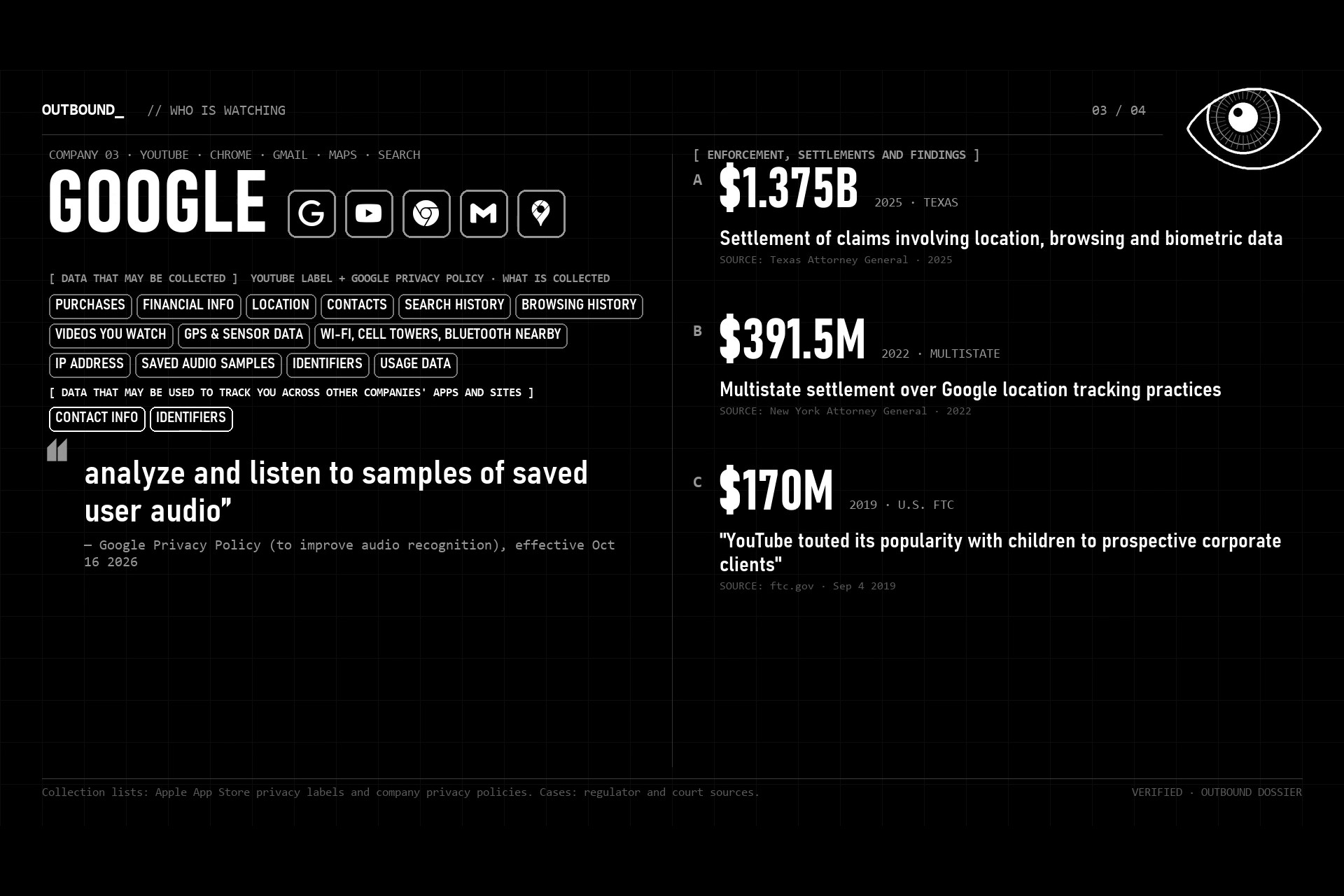
| Who is behind it? | A sourced dossier of 338 apps and 197 companies, with 240 incident records linked to regulator, court and company sources |
| Did you agree to that? | An Auth0 consent firewall: a CIBA push to your phone, an FGA consent tuple, then a Windows Firewall rule plan (dry run by default) |
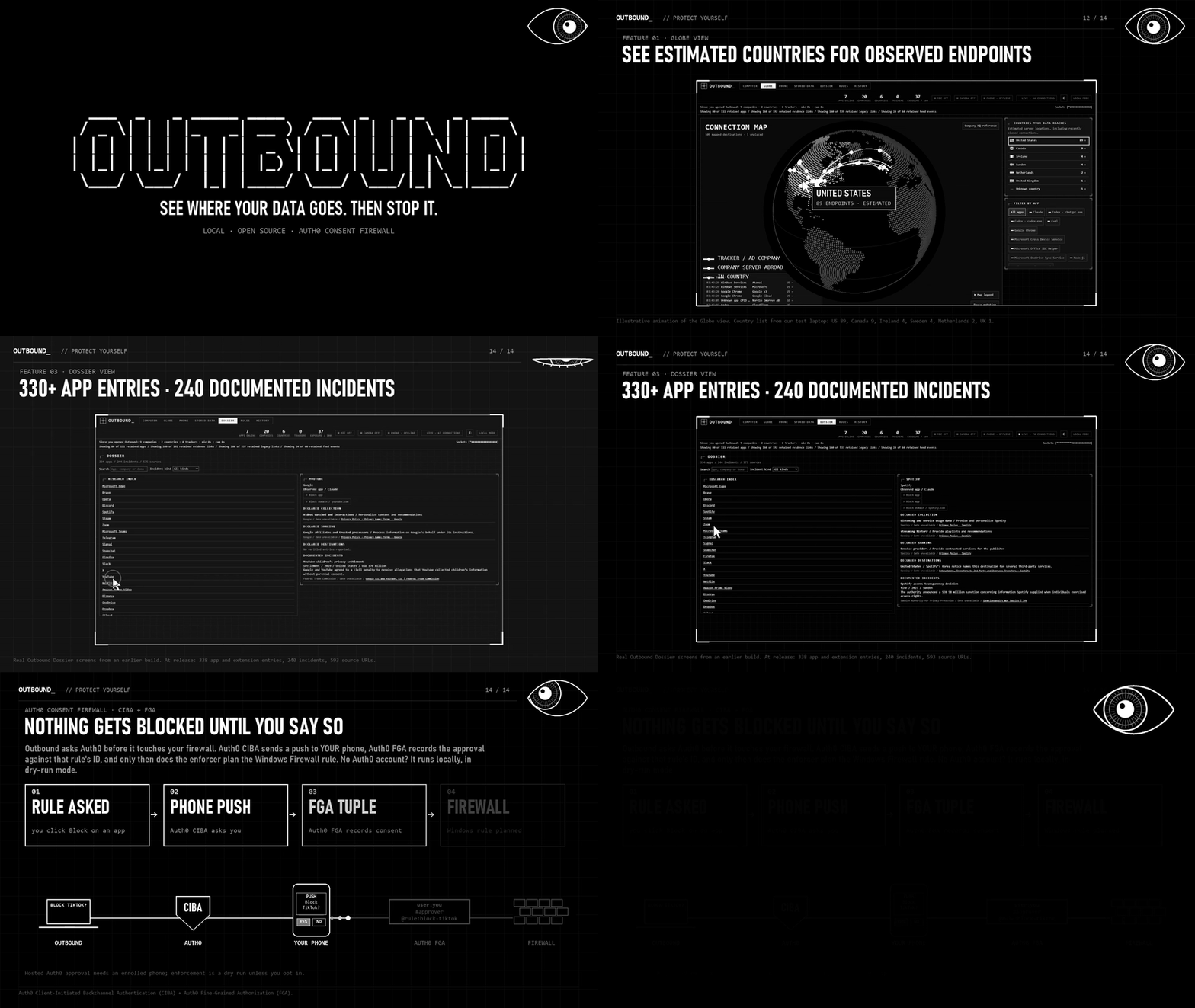
- Computer and Globe. See which apps hold connections right now, who owns each endpoint, tracker matches, and estimated server locations.
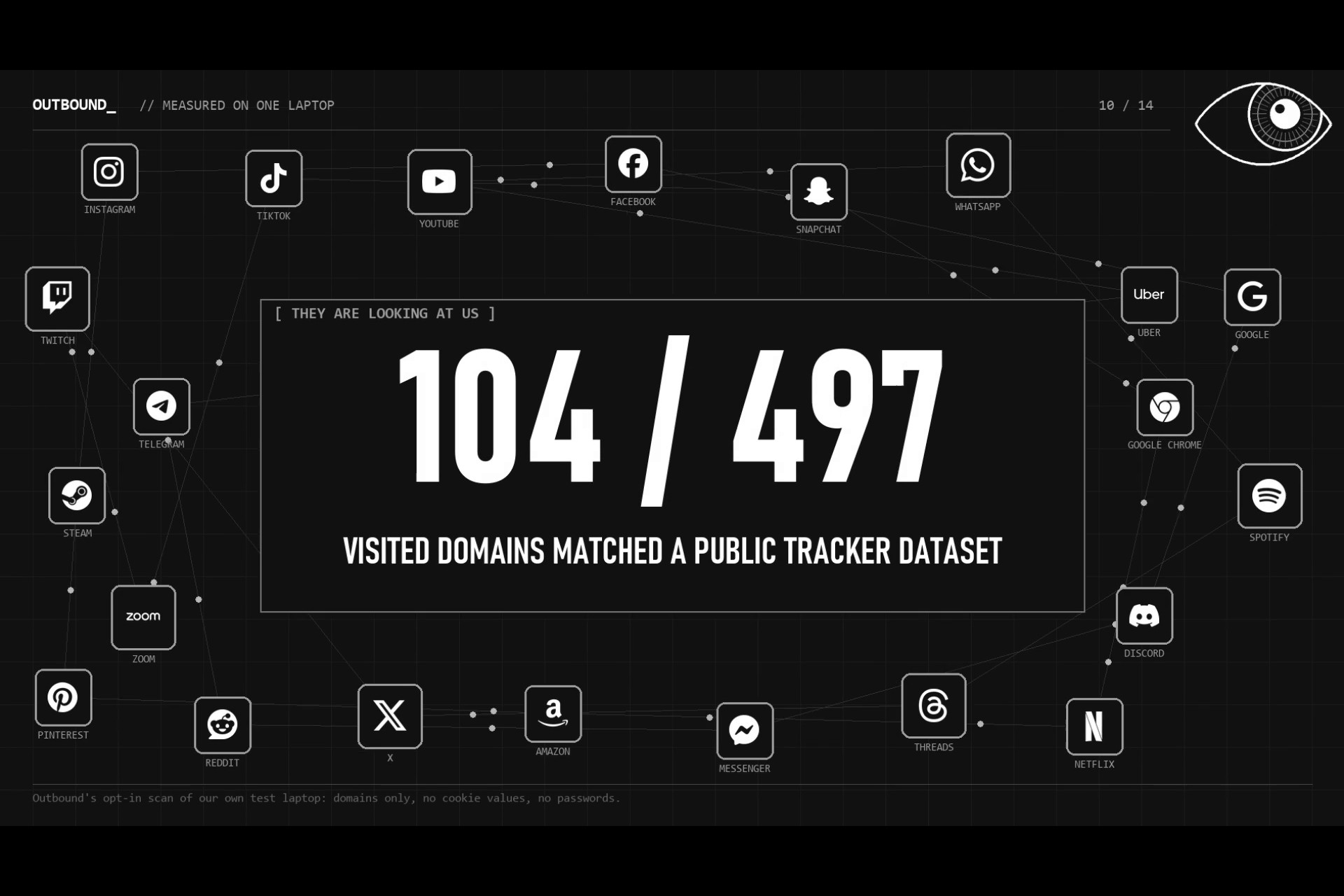
- Stored data. An opt-in scan summarizes browser history domains and cookie hosts, app-folder metadata, extension permissions, autoruns and Windows permission history. It skips password, autofill and token stores.
- Dossier, exposure and history. Public claims and documented incidents link to their original sources. Exposure scores show every factor and how much was covered. History and a Markdown report summarize what was observed.
- Rules and Phone. Blocking asks first. Auth0 CIBA sends a Guardian push, and Auth0 FGA records the approval. The Phone DNS gateway refuses tracker lookups unless you hold a time-limited FGA grant.
How we built it
- Collectors. PowerShell joins
netstatsnapshots to process IDs. Core Audio and Media Foundation report live mic and camera use, and the Windows privacy registry adds history. A Node.js 24 server streams state to the dashboard over Server-Sent Events. - Attribution. Offline ip-location-db ASN tables and geoip-lite place endpoints without sending your traffic anywhere. The Public Suffix List groups domains, and WhoTracks.me data flags known trackers. Globe.gl draws the map.
- Opt-in scan. A separate worker reads copies of the browser databases with Node's SQLite reader. It selects only hosts and counts, then deletes the copies.
- Auth0. The desktop policy engine calls CIBA
bc-authorizeand polls for the Guardian decision. On approval it writes an FGA tuple for an opaque rule ID. The Phone gateway's FGA model uses anunexpiredcondition, so tracker grants time out on their own. DNS answers for approved trackers are sent with TTL 0, so the grant is checked again on the next lookup. A tracker hidden behind a CNAME is checked again after the upstream answer arrives. - Safety defaults. Both dashboards bind to 127.0.0.1. Firewall rules stay in dry-run preview unless you set
OUTBOUND_ENFORCE=firewalland run elevated.
Challenges we ran into
- An IP address usually points to a CDN or cloud provider, not to the company behind it. We show the attribution we have and leave unknowns visible instead of guessing.
- The privacy registry lagged during live device tests, so live indicators come from Core Audio and Media Foundation, and the registry supplies historical context.
- Hosted Auth0 approval needs a Guardian-enrolled phone. Our hosted attempt stopped at enrollment, so we verified CIBA and FGA handling with fixture tests: approval, denial, expiry, grant checks and revocation. Hosted approval through revocation is still unverified end to end.
- Accuracy. We audited every claim in our promo video against its re-fetched primary source and reworded the 19 that overstated what the source says.
Accomplishments that we're proud of
- A full live rehearsal: we reopened a completed permission scan, found a regulator source in the Dossier, generated a dry-run firewall command for an observed app, and opened a country attribution on the Globe.
- The dossier has 240 incidents and 593 distinct source URLs, and every claim links to where it came from.
- It runs at 85–90 fps with 80 apps on screen, with zero console errors across all seven views in Chrome and Edge, and all 51 tests pass.
What we learned
Socket observations, registry timestamps and public tracker research answer different questions. Showing where each piece of evidence came from, and where coverage has gaps, lets a viewer tell a connection seen on this laptop apart from a relationship documented somewhere else.
What's next for Outbound
Verify hosted consent through approval and revocation on a Guardian-enrolled device, broaden the sourced dossier, and compare opt-in snapshots over time.


