The problem
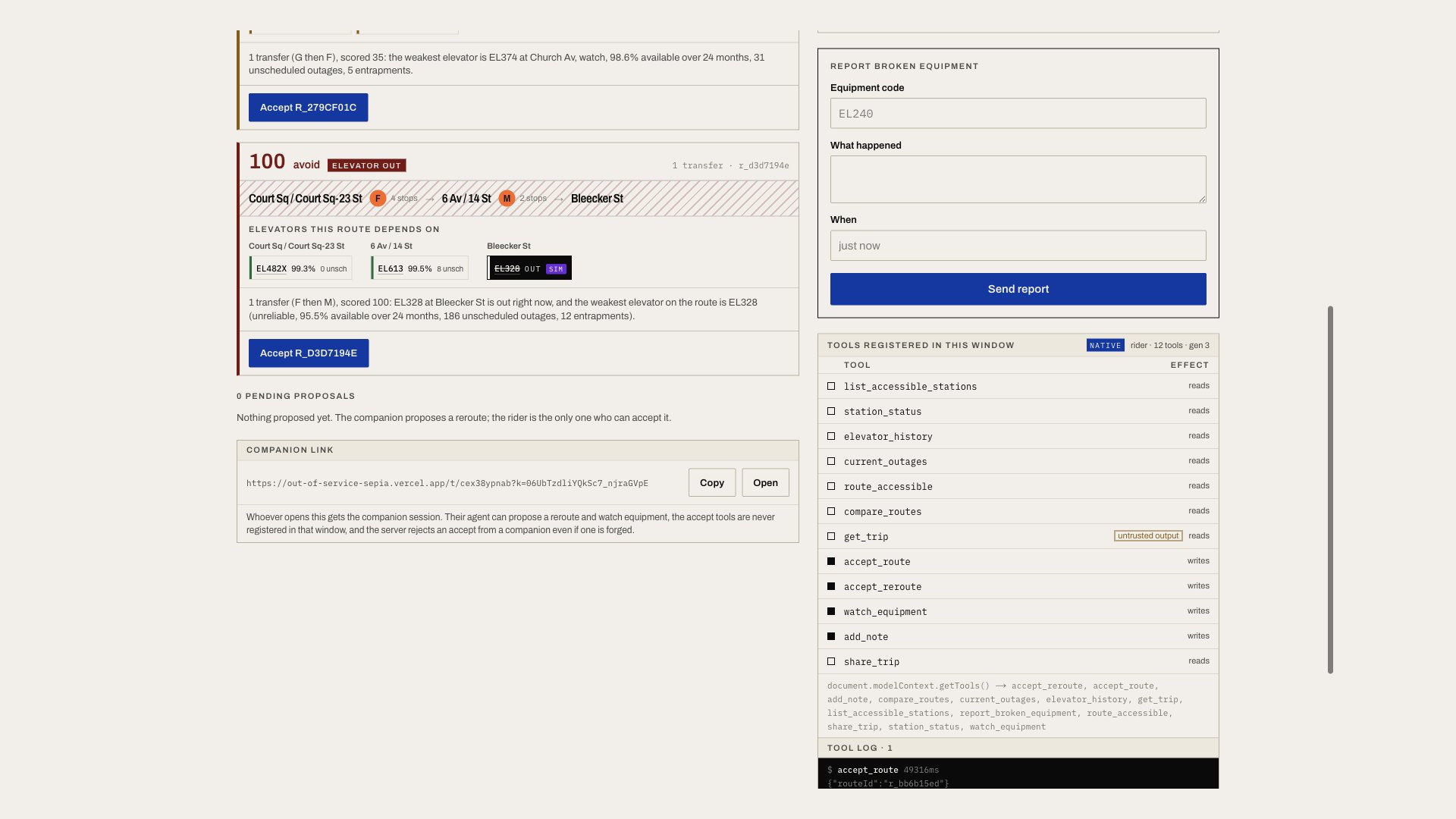
A wheelchair user at Court Sq is trying to reach Bleecker St. New York's subway has 160 accessible stations out of 472, and almost every one depends on an elevator. Advocates counted at least 25 elevator outages a day, median about four hours (Gothamist). If the one you need is out, you find out standing in front of it.
The person tracking that trip, a partner, an aide, an adult child, is somewhere else with a phone, reading the same feed the rider can and able to do nothing with it but text.
Planning around it barely works. The MTA status page says what is broken this minute, never what breaks often.
In July 2026 a class action about exactly this settled. CIDNY v. MTA now requires advance notice of outages, platform announcements every 15 minutes, and real-time alternate accessible routes (Disability Rights Advocates). The obligation exists now. The thing a rider holds does not.
What Out of Service is
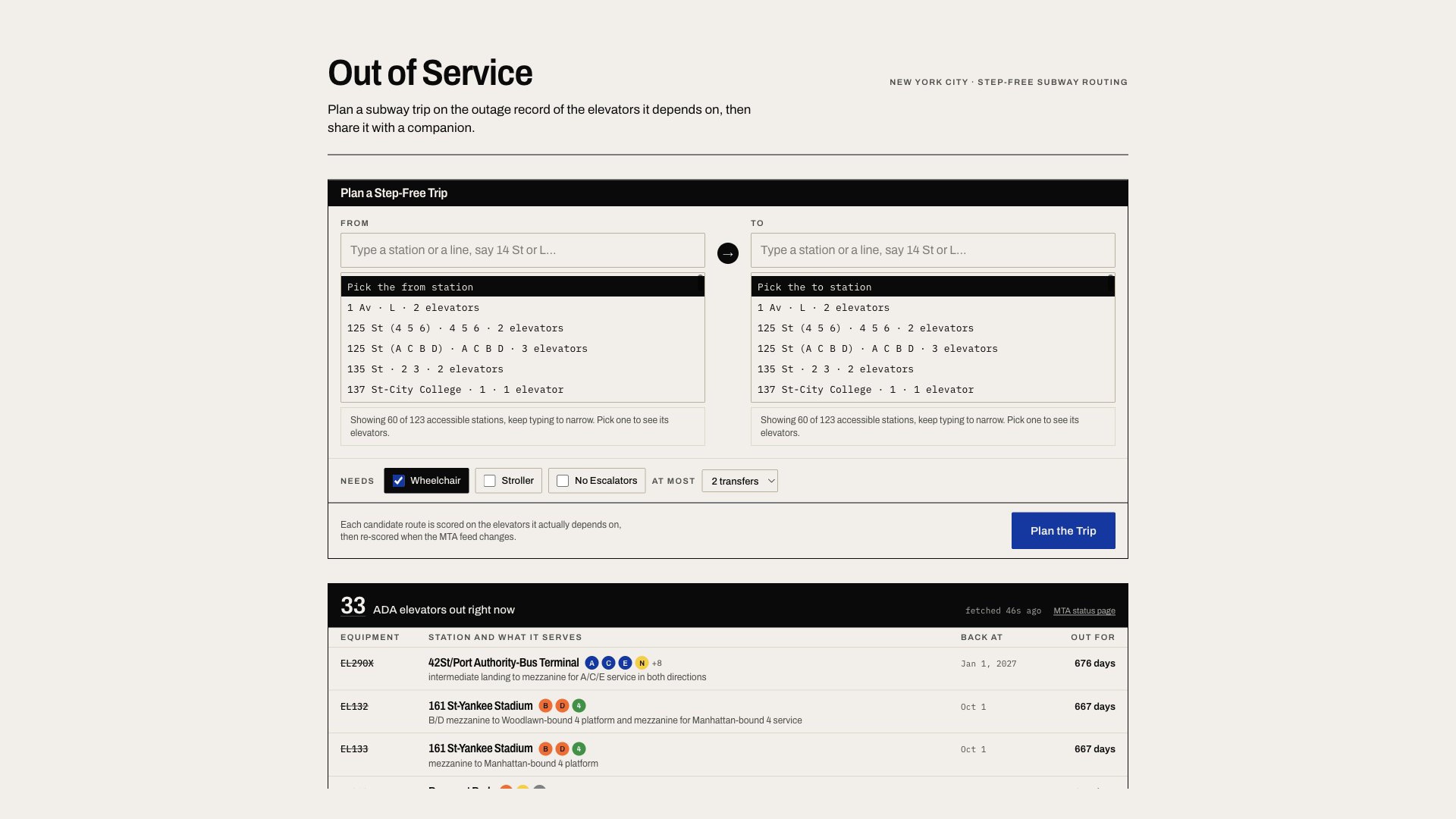
Out of Service scores every step-free route between two accessible stations on the specific elevators it depends on, using eleven years of MTA outage history joined to the live feed, so a route arrives as a number and a named list of equipment instead of a hope. The rider and the companion open the same trip on the same page, each with their own agent, and the two agents get different tools.
How it works
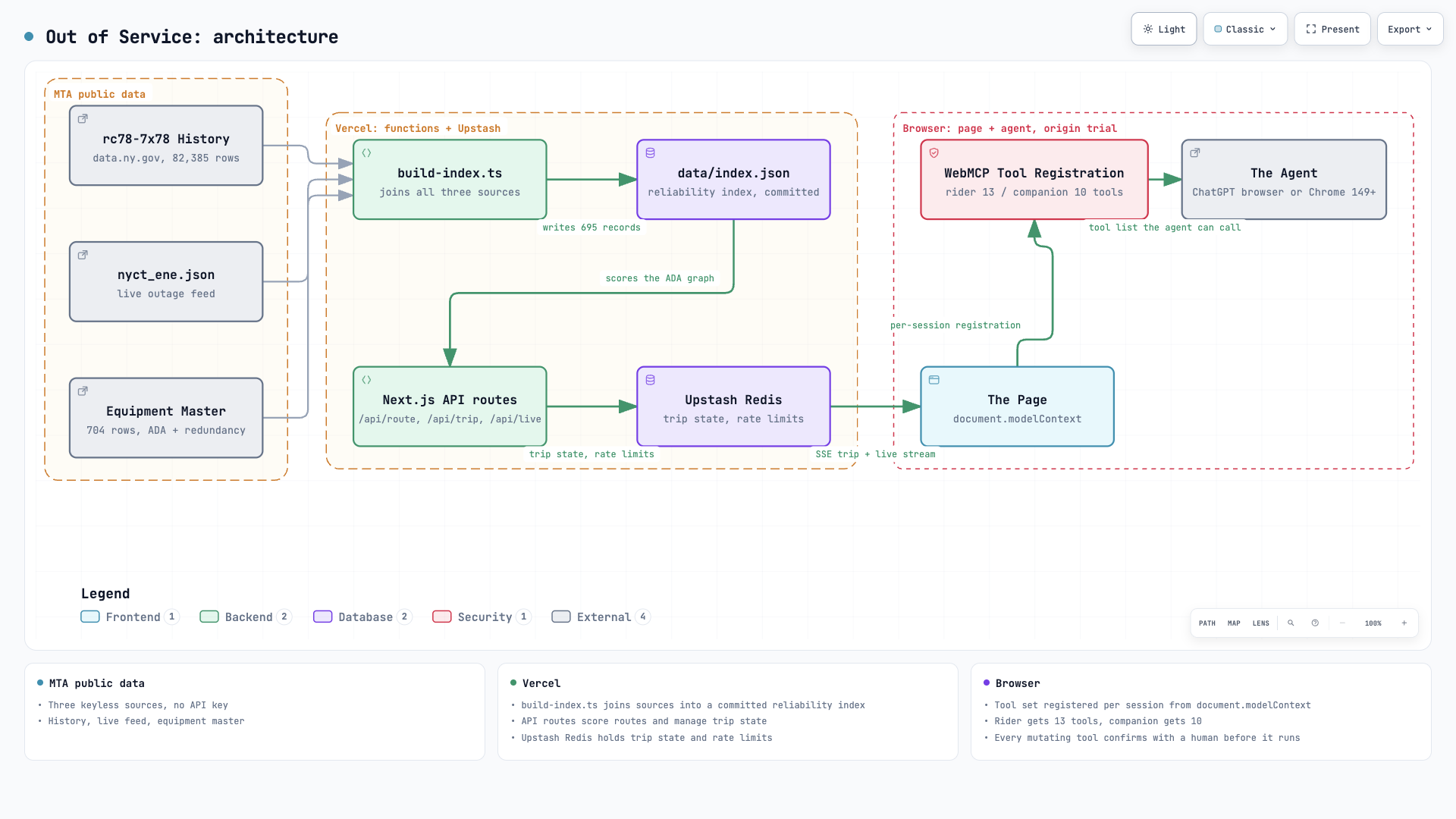
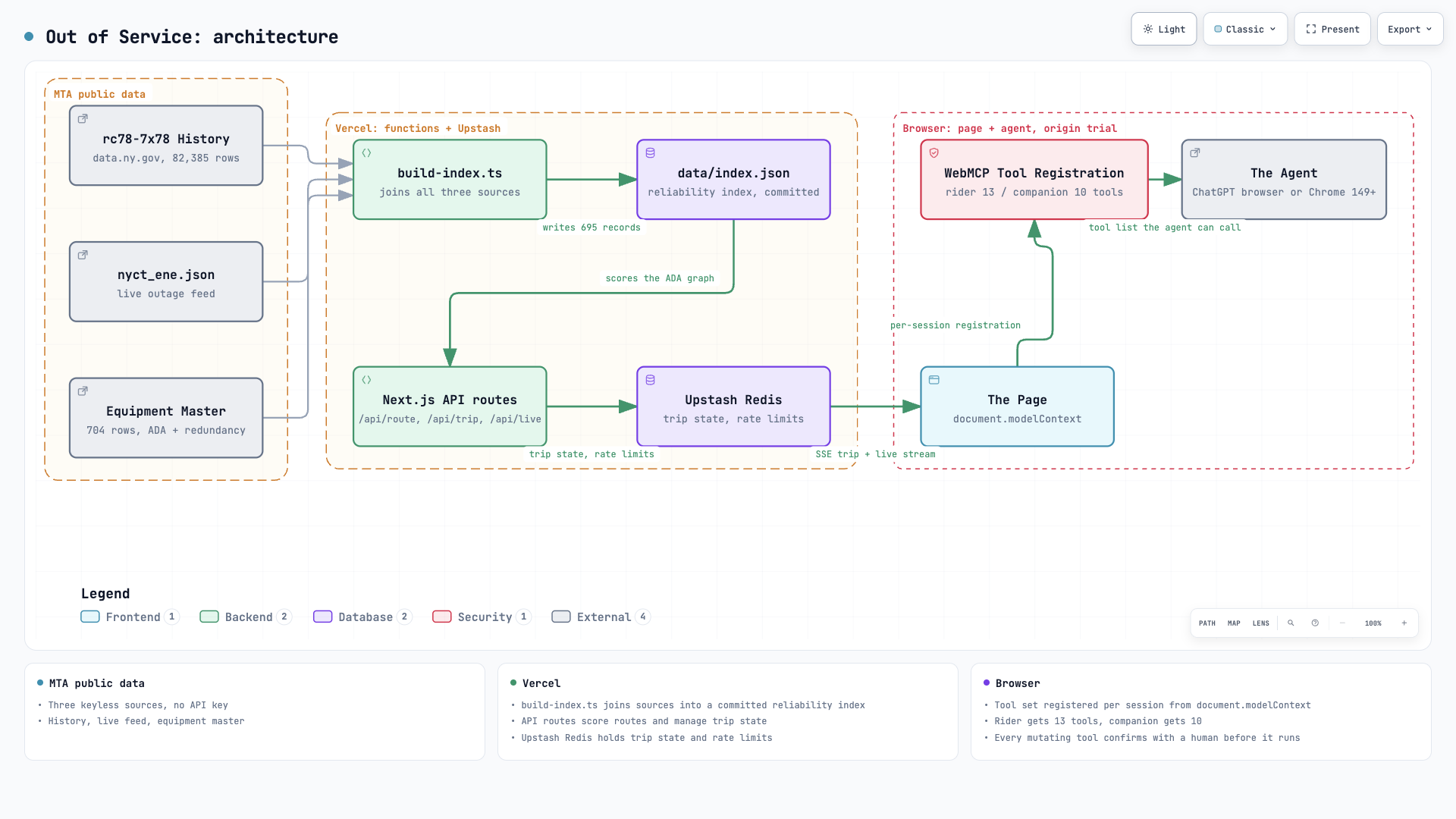
Three keyless MTA sources, joined into one committed artifact (docs/DATA.md): 82,385 monthly
availability rows over 695 equipment codes, 2015-01 to 2026-07, from NY State dataset rc78-7x78; the 704-row equipment master; and the live outage feed, 85 records at build time.
The join is data/index.json: 695 records, 413 elevators and 282 escalators across 123 accessible
complexes, each with 24 months of metrics, a percentile rank inside its own equipment type, a
tier, and a tier_reason naming the thresholds behind it. All 77 live-outage ids join into the index
(data/index-meta.json). Routing runs on a graph of those 123 elevator-dependent complexes: 558 ride edges over 23 lines,
472 of them asserted by the MTA's own next-accessible-station fields (docs/ROUTING.md).
The score is a sum, not a verdict: 25 per dependent unreliable elevator, 10 watch, 8 unknown, 2
reliable, halved where a second elevator makes the same move, 15 per transfer, plus 60 and a broken flag if a required non-redundant elevator is out live. Broken is never
"this station has an outage", always "this route needs this elevator, nothing else makes that
move, and it is out". Every number on screen is dotted, and clicking it opens the dataset, the
query and the row count.
Two people, two agents, one page
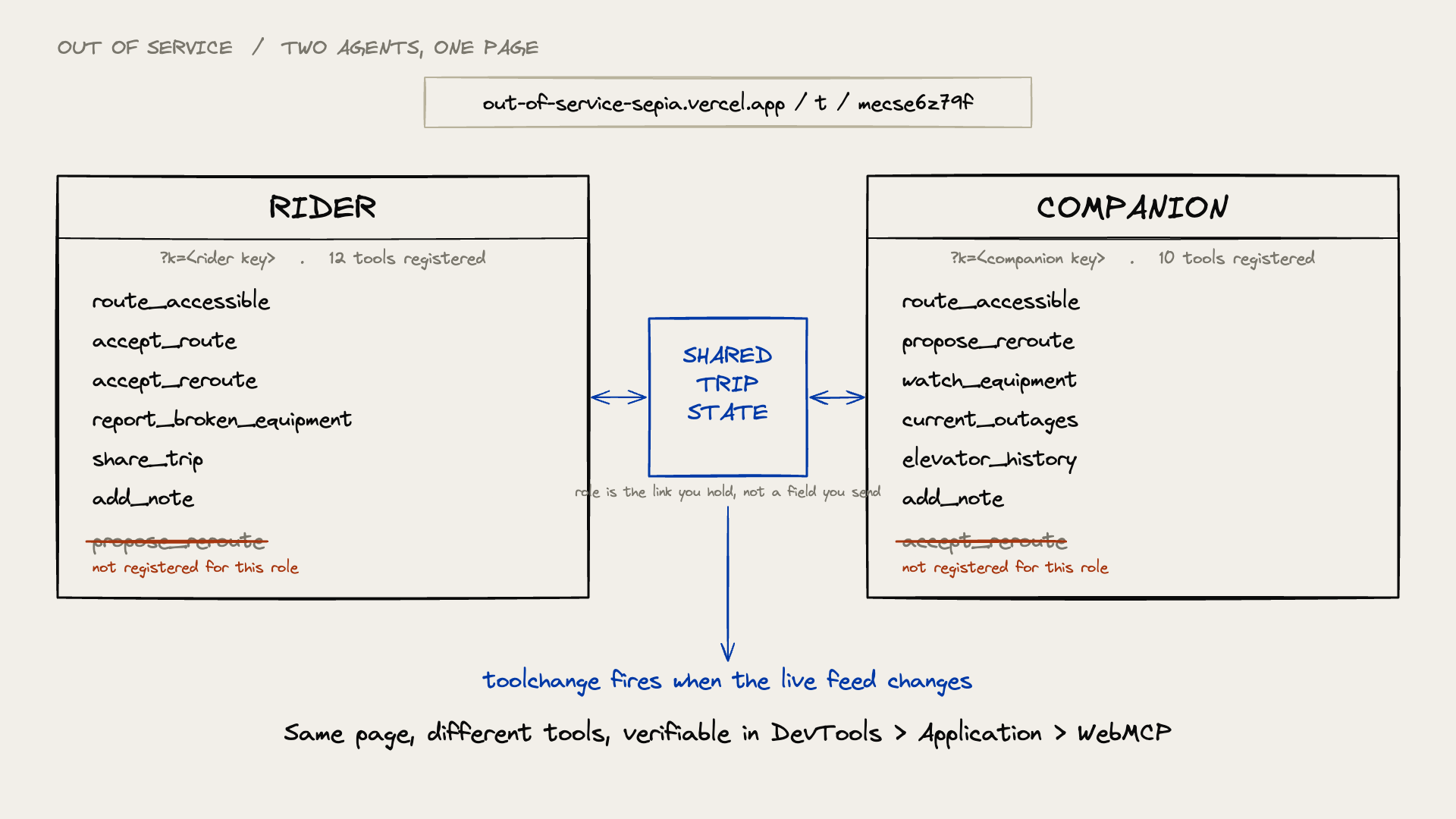
Creating a trip mints two unguessable keys. The rider gets /t/<id>?k=<riderKey>; the companion
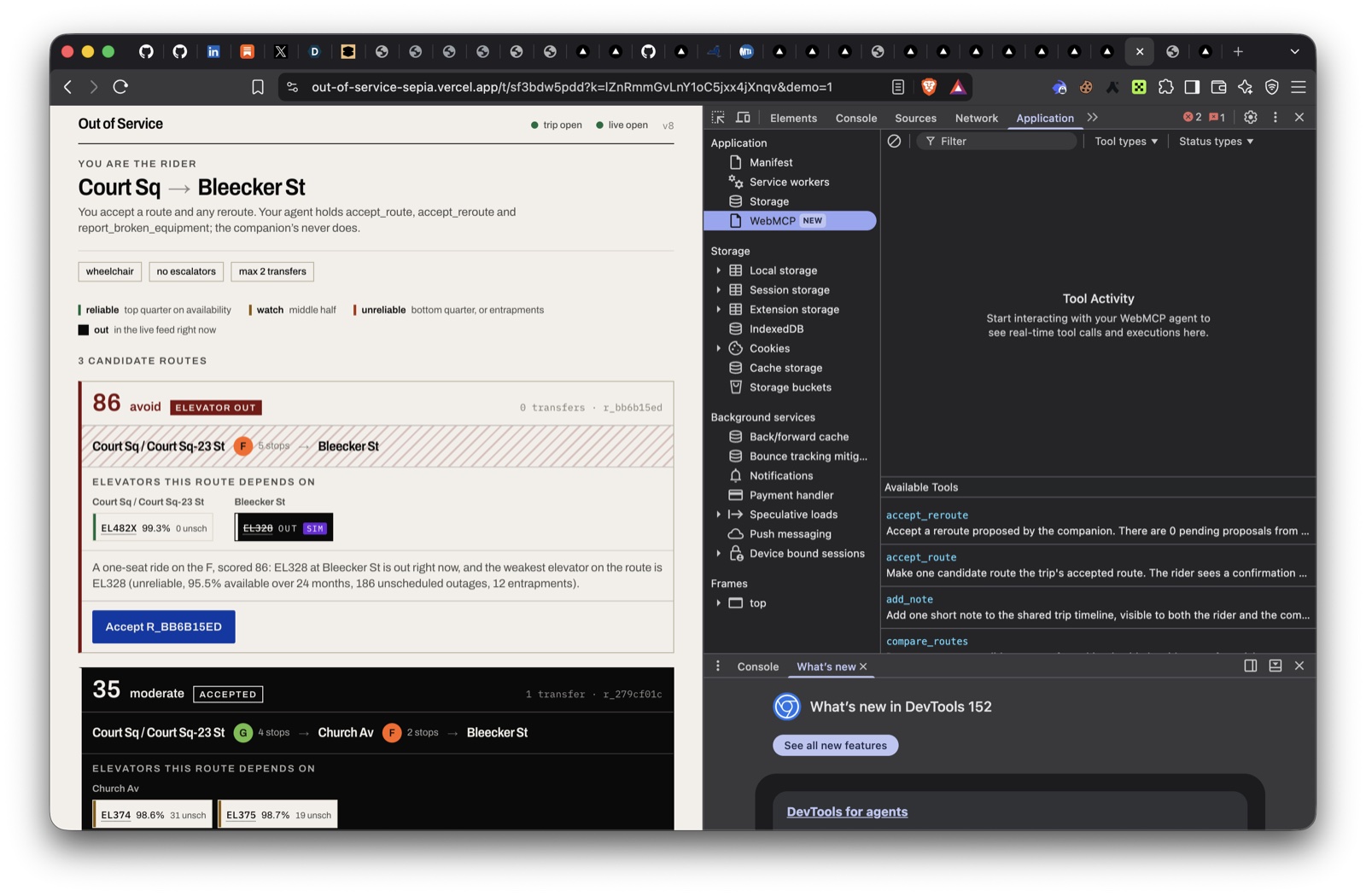
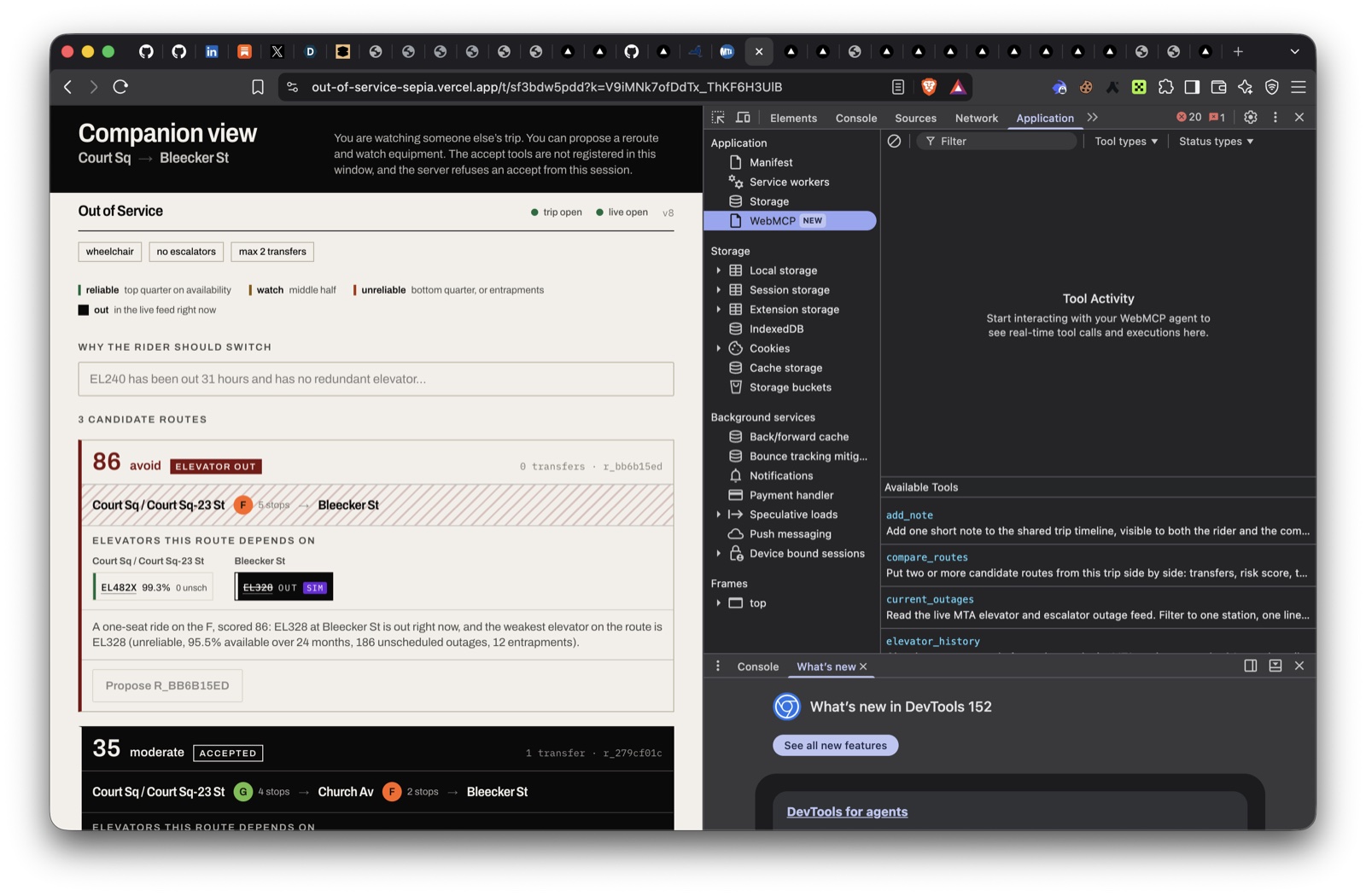
link is the same trip with the other key. Tools register per session from those keys, so DevTools >
Application > WebMCP lists 13 tools in the rider's window and 10 in the companion's, same origin,
same page, before either agent says a word.
Hiding a tool is not the boundary. POST /api/trip/:id/action derives the role from the key
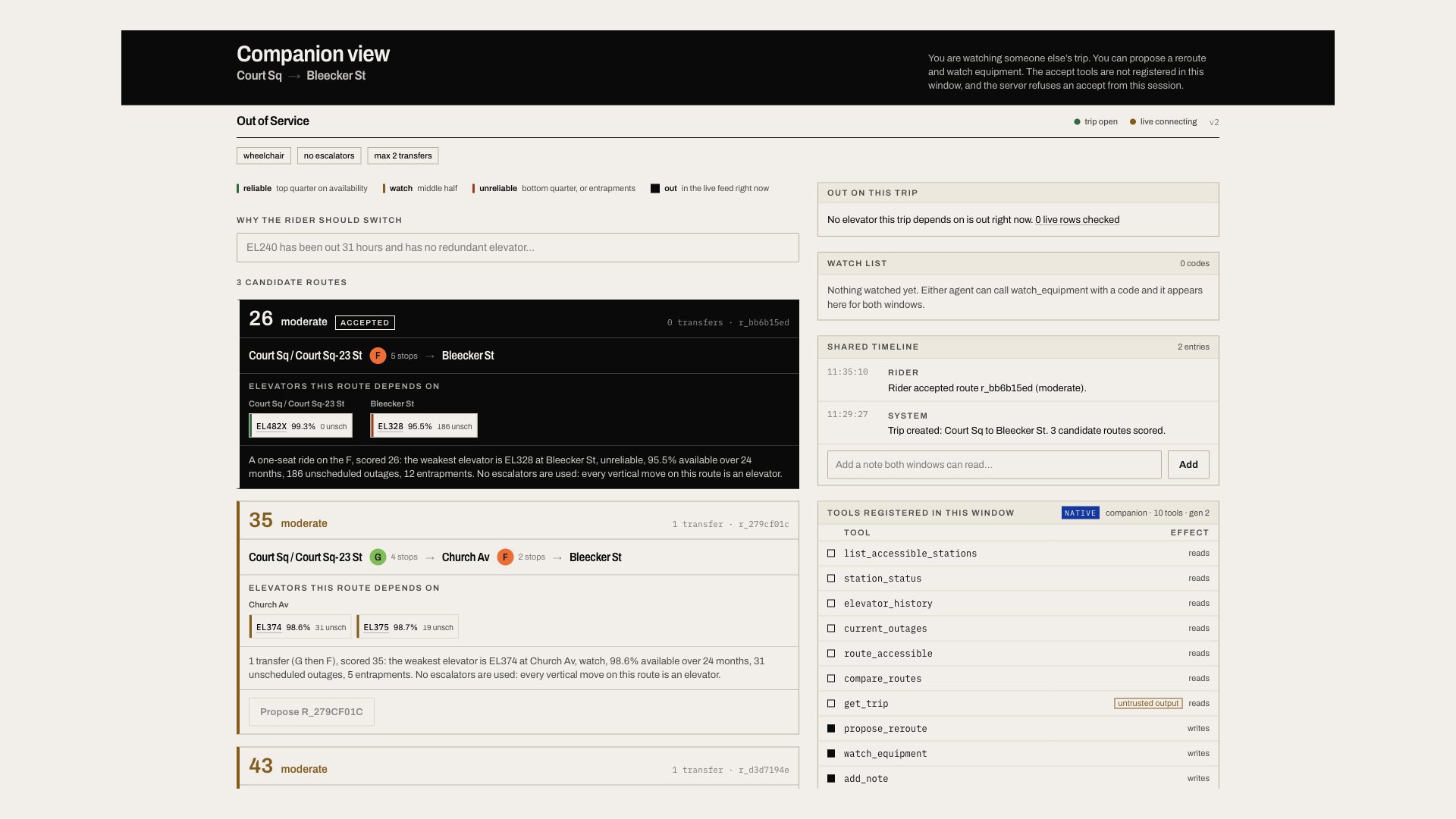
and ignores any role in the body, so a forged accept from the companion's session comes back 403: "Only the rider can accept route. You are the companion: propose a reroute
instead."
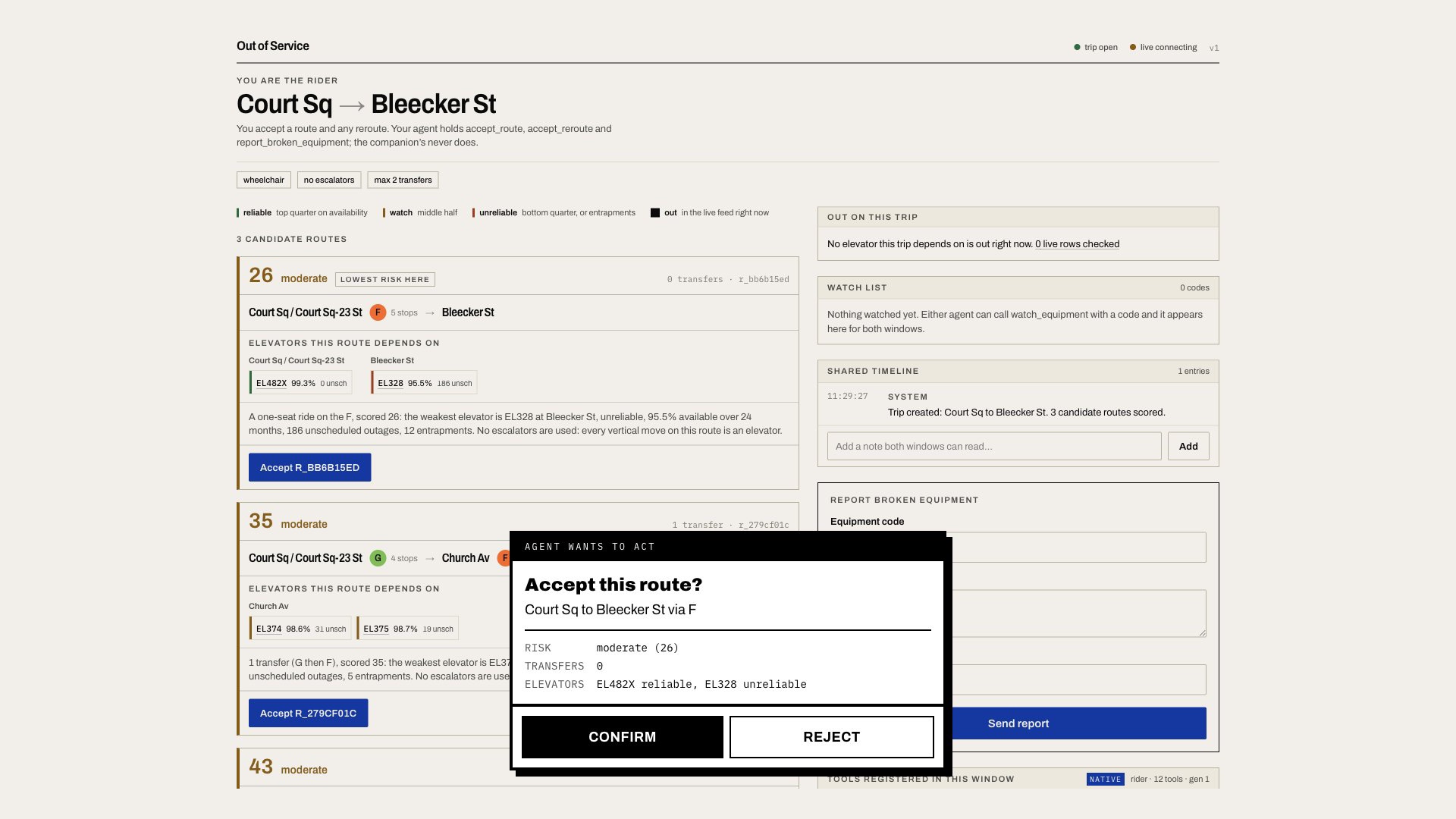
Every write parks inside execute behind a confirmation card and does not resolve until a person
presses Confirm. Reject rejects it in the rider's own typed words, so the agent hears "that
transfer is too long for me" and offers something else. The broken-equipment report is a declarative HTML form with no toolautosubmit: the agent fills
it in, a person sends it.
When the feed changes, the whole set re-registers and toolchange fires, and accept_reroute's
description goes from "0 pending proposals" to "1 pending proposal from your companion right now
(p1)".
Features
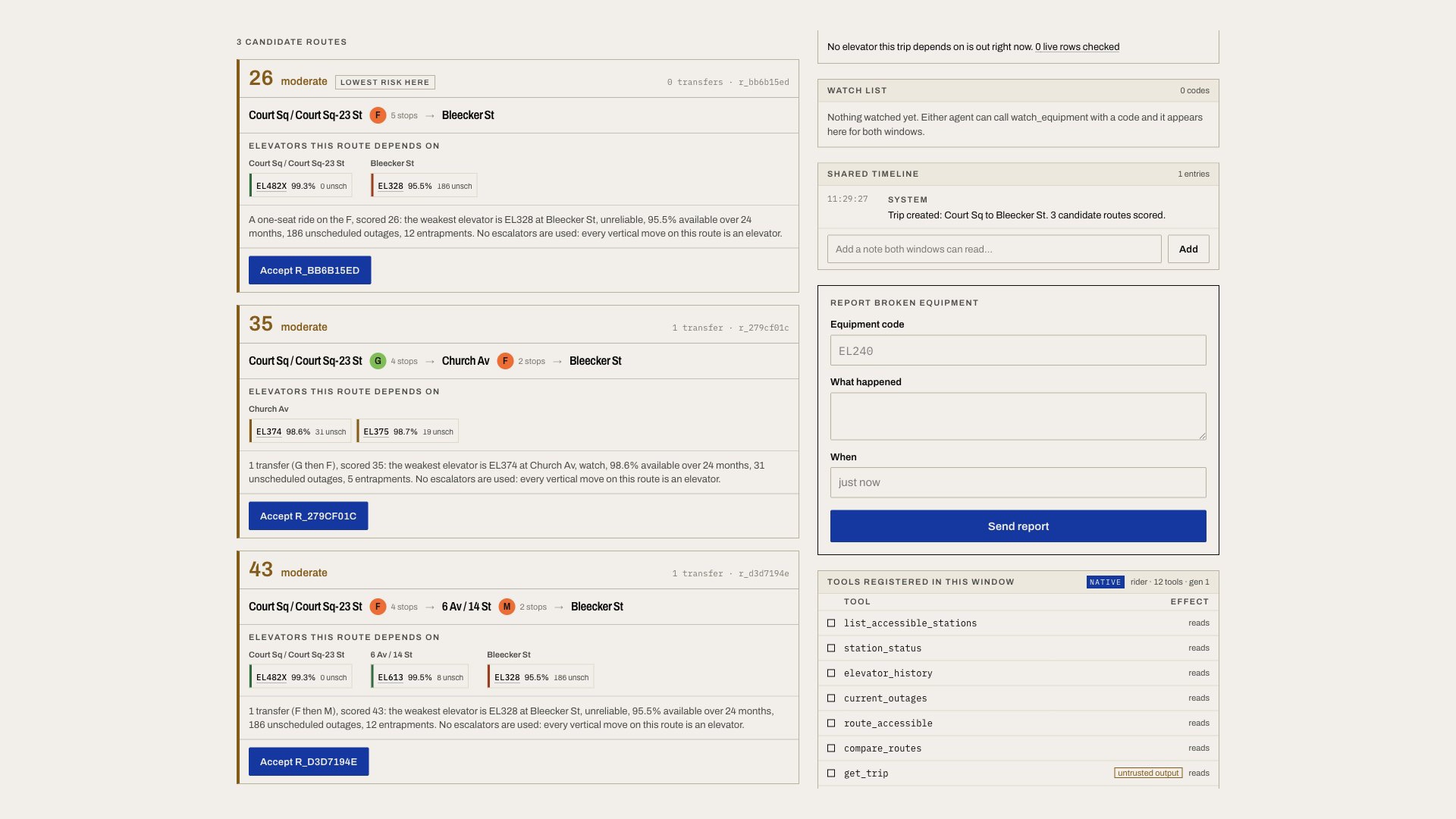
- Route scoring with tiers. Three routes, each with a risk number, a label and its elevators.
- Live station panel. Outages at both ends with the MTA's return estimates.
- Companion link. Its own capability key, its own tool set.
- Proposals and acceptance. The companion proposes with a reason, the rider accepts or rejects, both windows updating in about two seconds.
- Watch equipment. Subscribe to codes, see them in a watch list.
- Broken-equipment report. A declarative form the agent fills and a person sends.
- Source on hover. Every dotted number opens its dataset, query and row count.
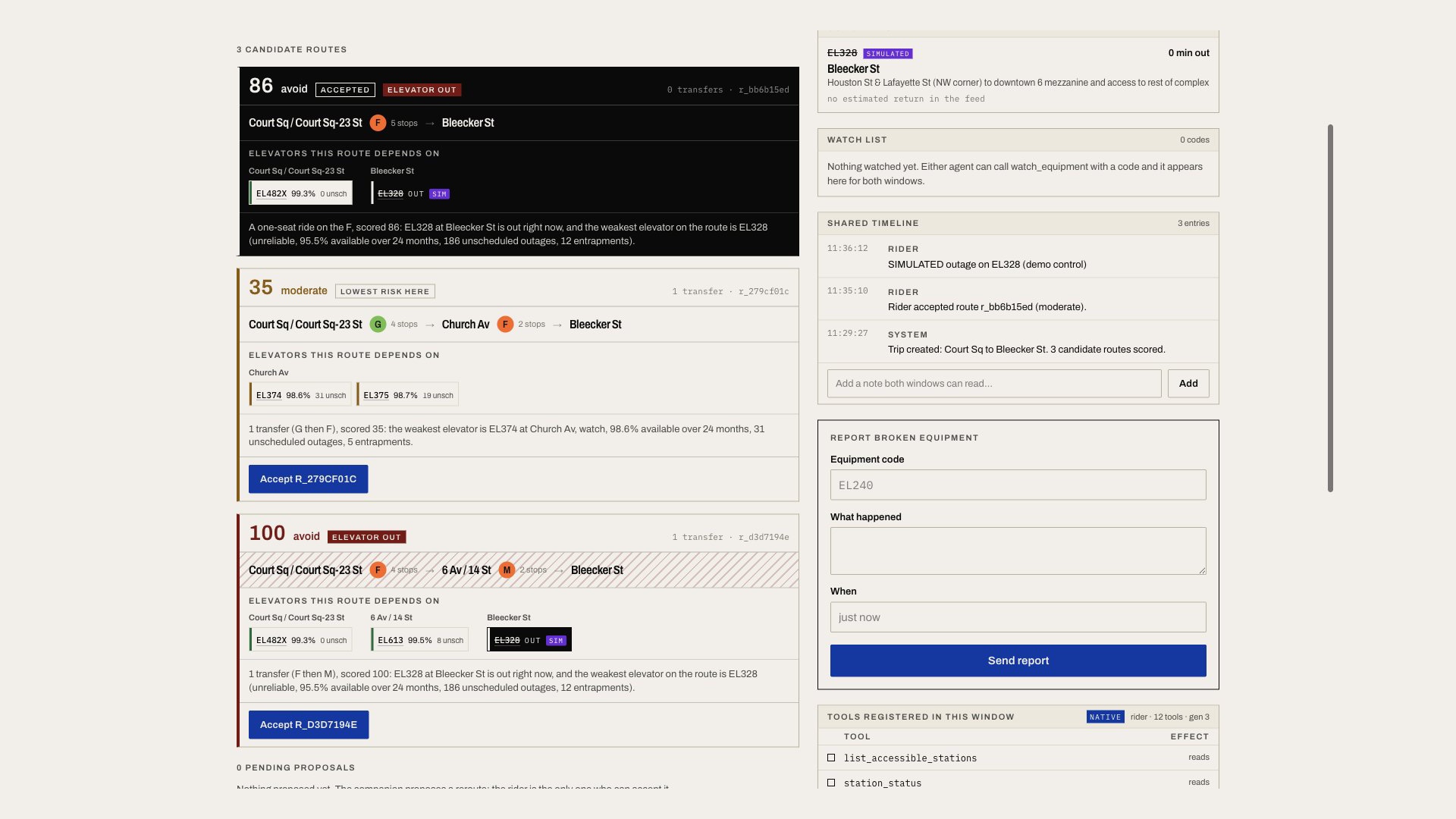
- Simulated outage. Forces one elevator out for the session, labelled SIMULATED throughout.
- Origin trial. The Chrome WebMCP token is in the page head, so stock Chrome needs no flag.
Why WebMCP is the right fit
Why this use case is a strong fit for WebMCP. Two humans with different authority share one page. WebMCP registers tools per session from inside the page, so one origin and one path present 13 tools to the rider's agent and 10 to the companion's. A server-side MCP server can express two roles, but not without a second deployment, an auth handshake and an account for the companion.
How it creates a better experience. Before: four equipment-code lookups across two MTA pages,
two minutes of cross-referencing, an answer good only for this minute. After: one
route_accessible call, under a second, three routes scored on their elevators' 24-month history. Court Sq (E M G 7) to Bleecker St returns the F at 26, G then F at 35 and F then M at 43
(2026-09-03 build). Take EL328 at Bleecker out and the F flips to 86, avoid, broken, and G then F is the
recommendation.
What people and agents can now do together that was difficult or impossible before. Two agents split one trip: the companion's watches the feed and proposes, the rider's surfaces it, a person confirms. The rider never has to trust the companion's agent, or ours, because the difference is enforced by the server and visible in DevTools.
How we implemented WebMCP. document.modelContext.registerTool only, never
navigator.modelContext, which moved to Document in the 27 May 2026 draft. Fifteen tools registered per session by role, each with a strict inputSchema and readOnlyHint, and
untrustedContentHint on get_trip alone, the one tool returning text another human typed.
Mutations build their own confirm gate inside execute, because WebMCP has no destructive-action
annotation and requestUserInteraction() has not shipped; create_trip and
report_broken_equipment are declarative forms without toolautosubmit. evals/ follows Chrome's guidance: 17 fixtures carrying role, page and state, one a
companion asking to accept, where the right answer is no tool call. The runtime reads
document.modelContext once before anything touches it and otherwise loads
@mcp-b/webmcp-polyfill, with a badge printing native, polyfill or unavailable.
What is real today, and what is next
NYCT subway only: no PATH, no commuter rail, no buses. Tiers are percentiles of the equipment's own population, so "unreliable" means unreliable for New York, not against an absolute standard. Direction is the honest blind spot: 65 of 264 platform-touching elevators call themselves "Manhattan-bound", meaning south from the Bronx and north from Brooklyn, and the master's borough column is empty on all 704 rows. Those are reported as possible dependencies, inflating a route's risk rather than hiding one.
Next: MTA alert subscriptions per watched elevator, so a watch list pushes instead of polls; more cities, because the same open-data shape exists elsewhere; and the two-agent pattern outside transit, a pharmacist and a caregiver on one prescription page, where one proposes a substitution and only the other accepts.
Built With
- next.js
- tailwind
- typescript
- upstash
- vercel
- vitest
- webmcp


Log in or sign up for Devpost to join the conversation.