Inspiration
Modern tech stacks face heavy operational friction from handling repetitive data intake and manual routing, while complex pipelines lead to long processing bottlenecks and integration drop-offs.
What it does
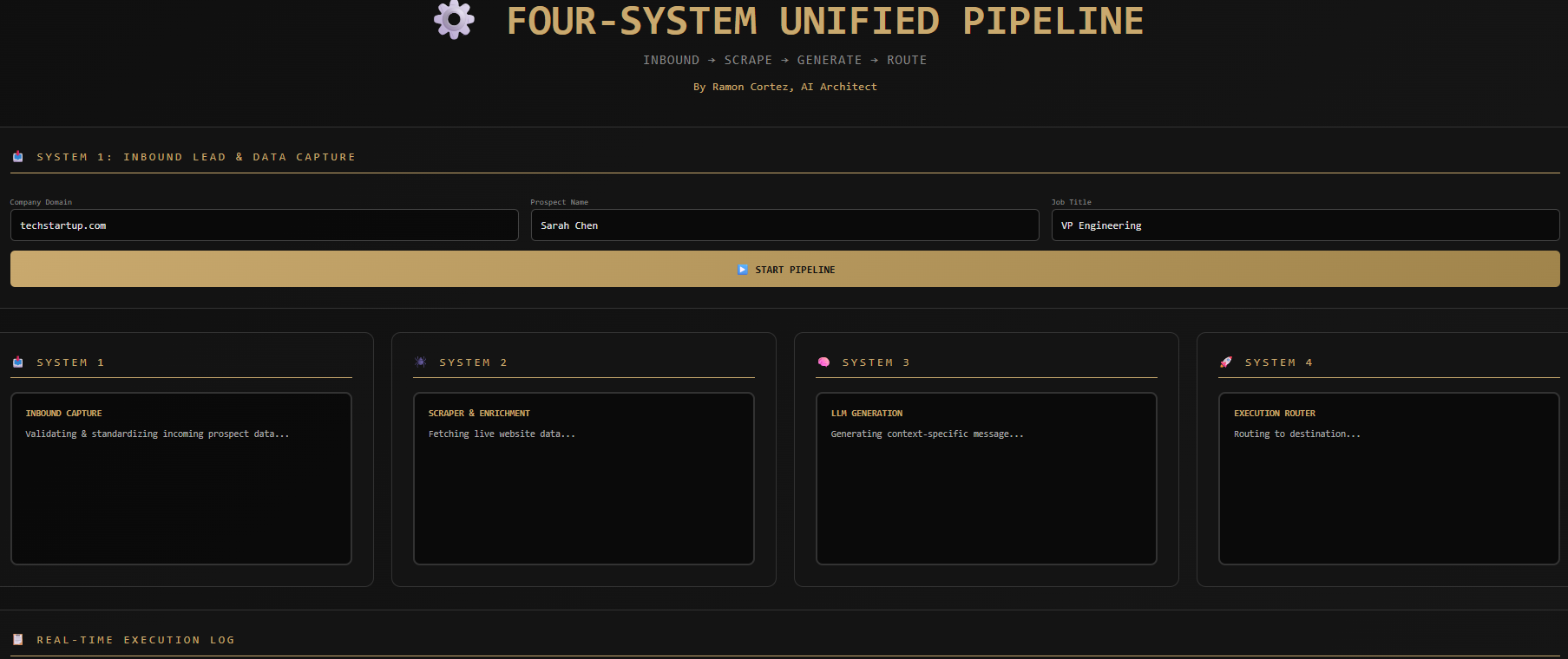
The Four-System Unified Pipeline is an autonomous, low-code multi-agent architecture designed to ingest raw prospect data, execute live website scraping, synthesize intent-specific messaging via LLM generation, and route execution downstream without custom code.
How we built it
Built using Relevance AI for agent orchestration, GitHub for version control and documentation, and static hosting for the user interface, configuring strict multi-system data flows and automated fallback loops.
Challenges we ran into
Balancing pipeline flexibility with deterministic state-syncing across concurrent agent sessions to ensure data flows smoothly without race conditions or dropped payloads.
Accomplishments that we're proud of
Successfully deploying a fully functional, end-to-end multi-agent pipeline that handles asynchronous data streams, live scraping, and dynamic routing seamlessly.
What we learned
The power of low-code agent orchestration in building robust, production-grade workflows without getting bogged down in boilerplate infrastructure code.
What's next for Four-System Unified Pipeline
Expanding automated telemetry loops and integrating advanced event-driven state triggers for larger enterprise deployment workflows.
Built With
- github
- lowcode
- netlify
- relevanceai
- statichosting
