Inspiration
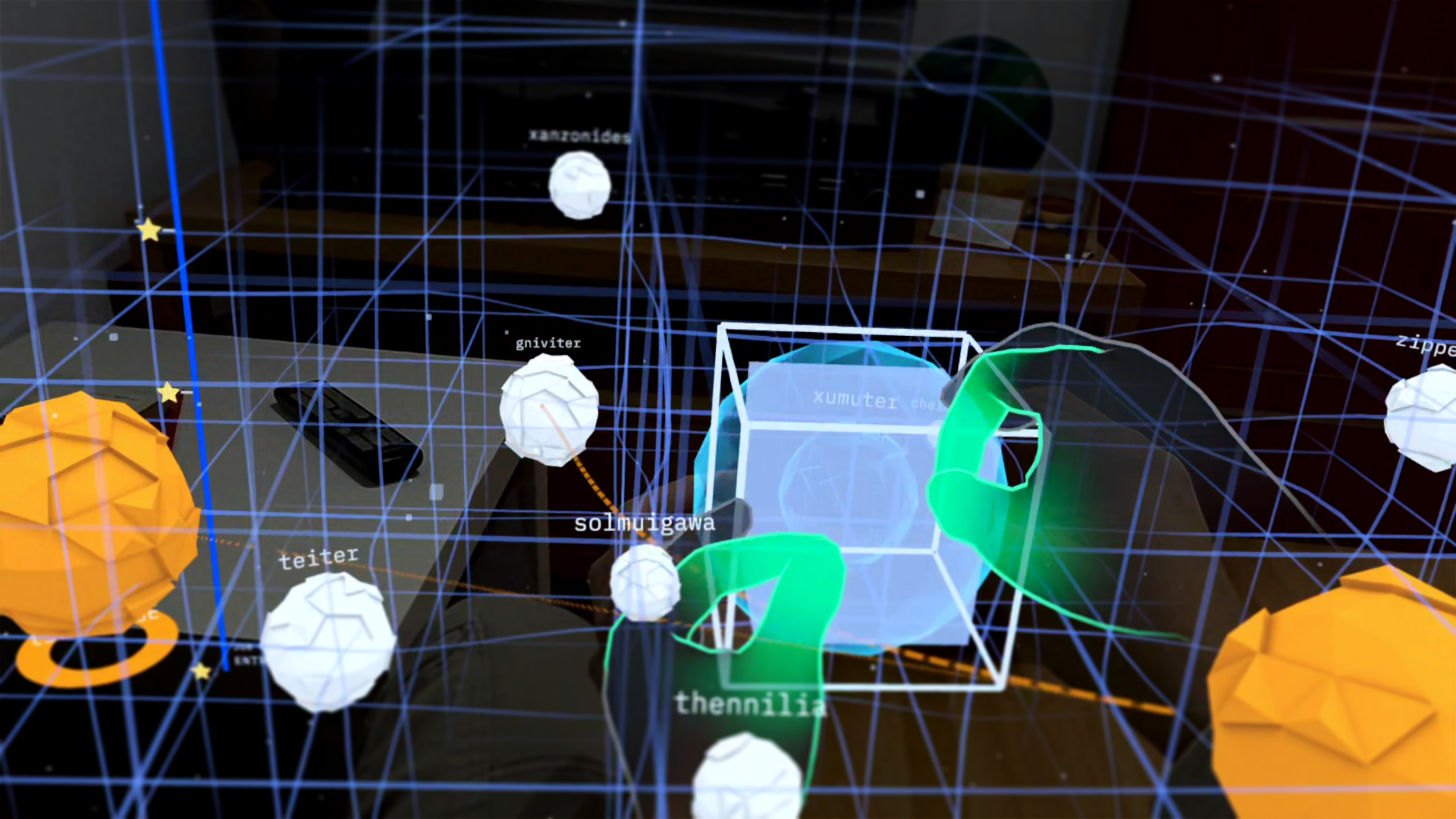
The competition's own line, "the future of VR is in your hands, literally," set the challenge: what can your hands do that a controller can't? Our answer was to grab space itself. Everyone has seen the rubber-sheet picture of relativity, where mass bends space and paths follow the bend, but nobody gets to touch it. Mixed reality let us put that sheet on your desk. The name is the pun: your space and outer space.
What it does
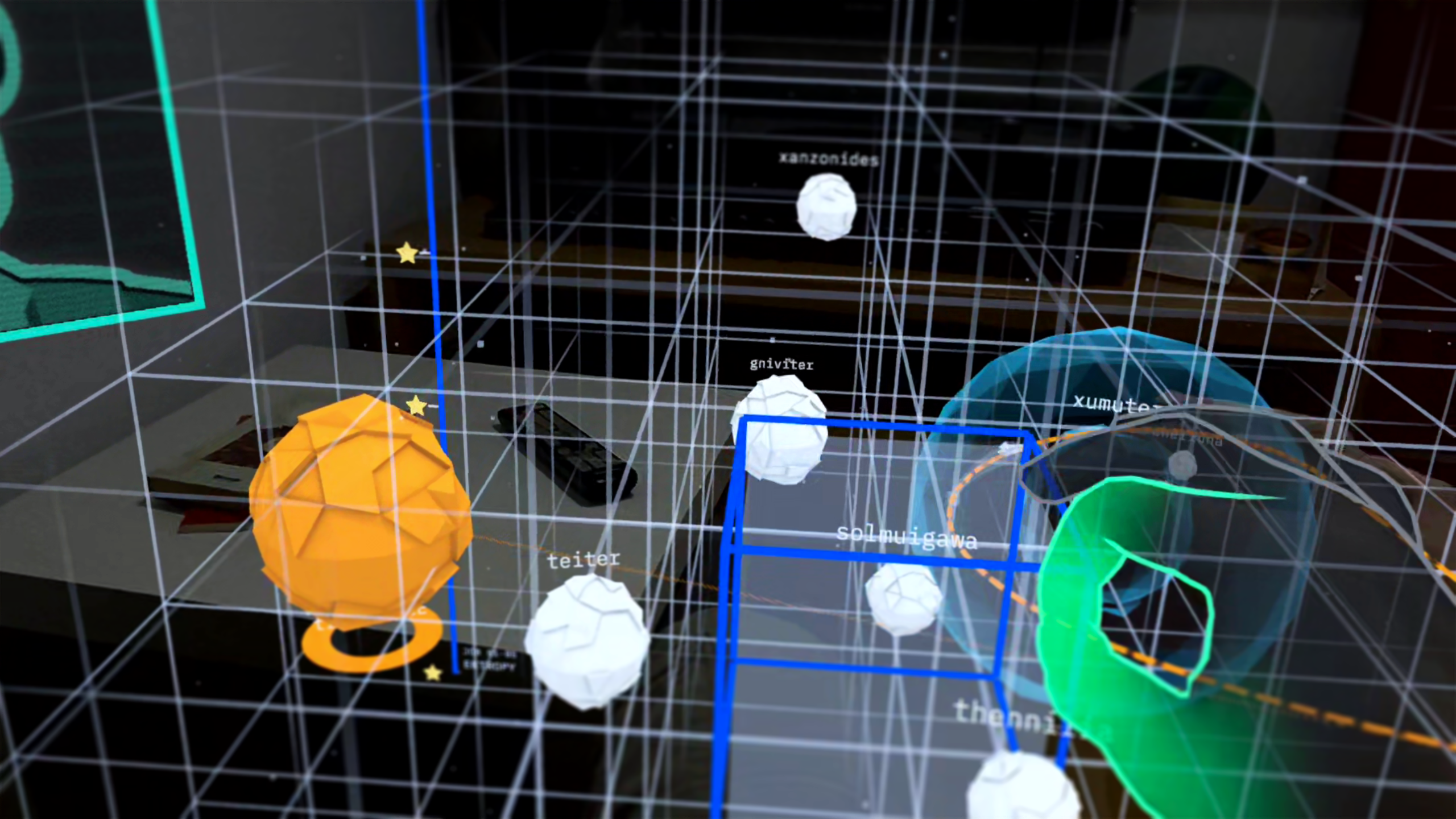
Our Space is a seated mixed-reality puzzle game. A miniature universe floats over your real table, and you run an interstellar transport company where every job is a delivery from one star to another.
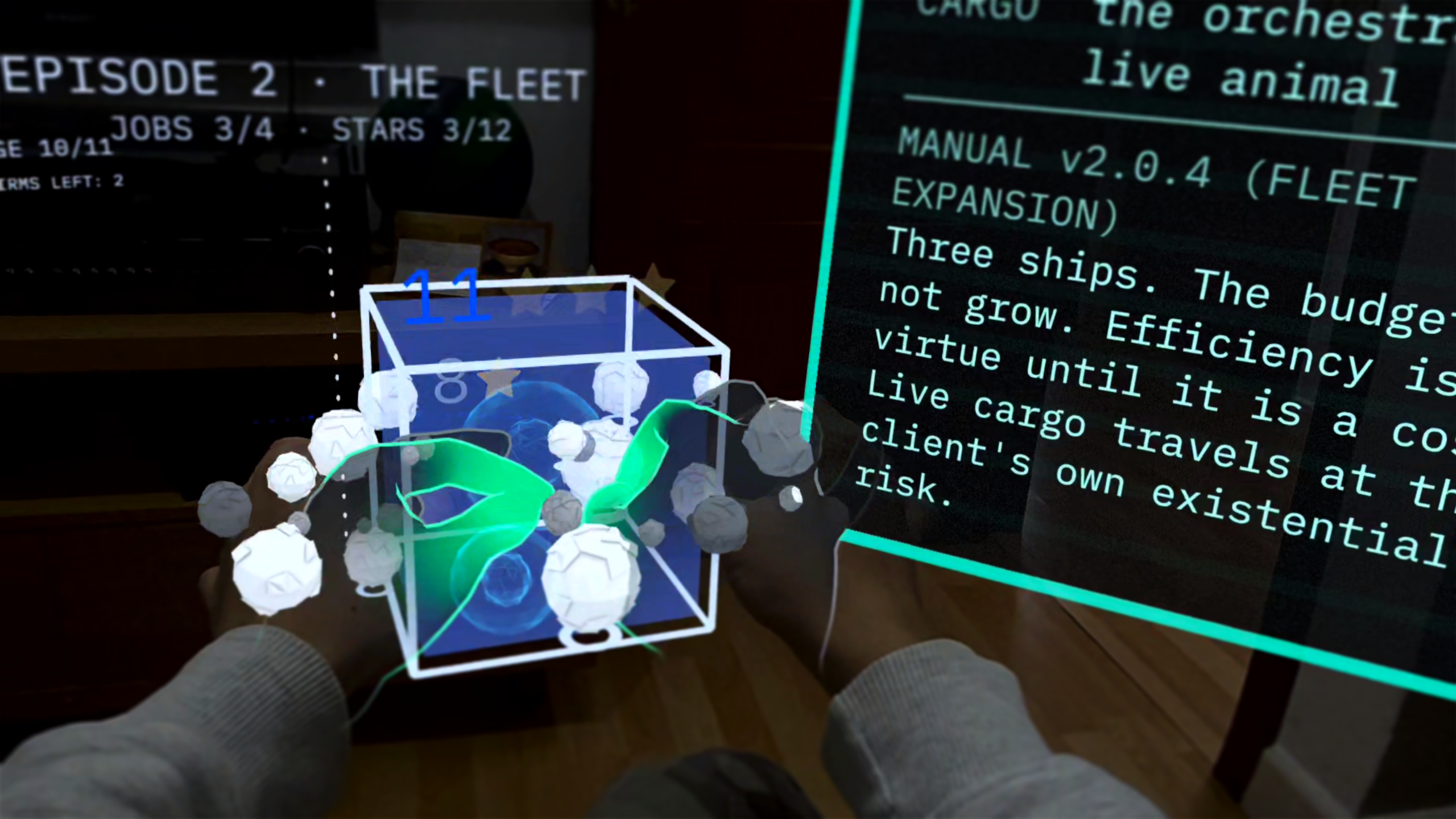
Your one tool is the cube. Pinch inside it with both hands and pull. The space inside stretches or shrinks, and the planets spread and grow. A grown planet is heavier, because mass scales with volume:
$$m \propto r^3$$
Gravity is inverse-square, so a heavier planet bends the ship's path harder:
$$\vec{a}(\vec{x}) = \sum_i \frac{G\, m_i}{\lvert \vec{r}_i - \vec{x} \rvert^2}\, \hat{u}_i$$
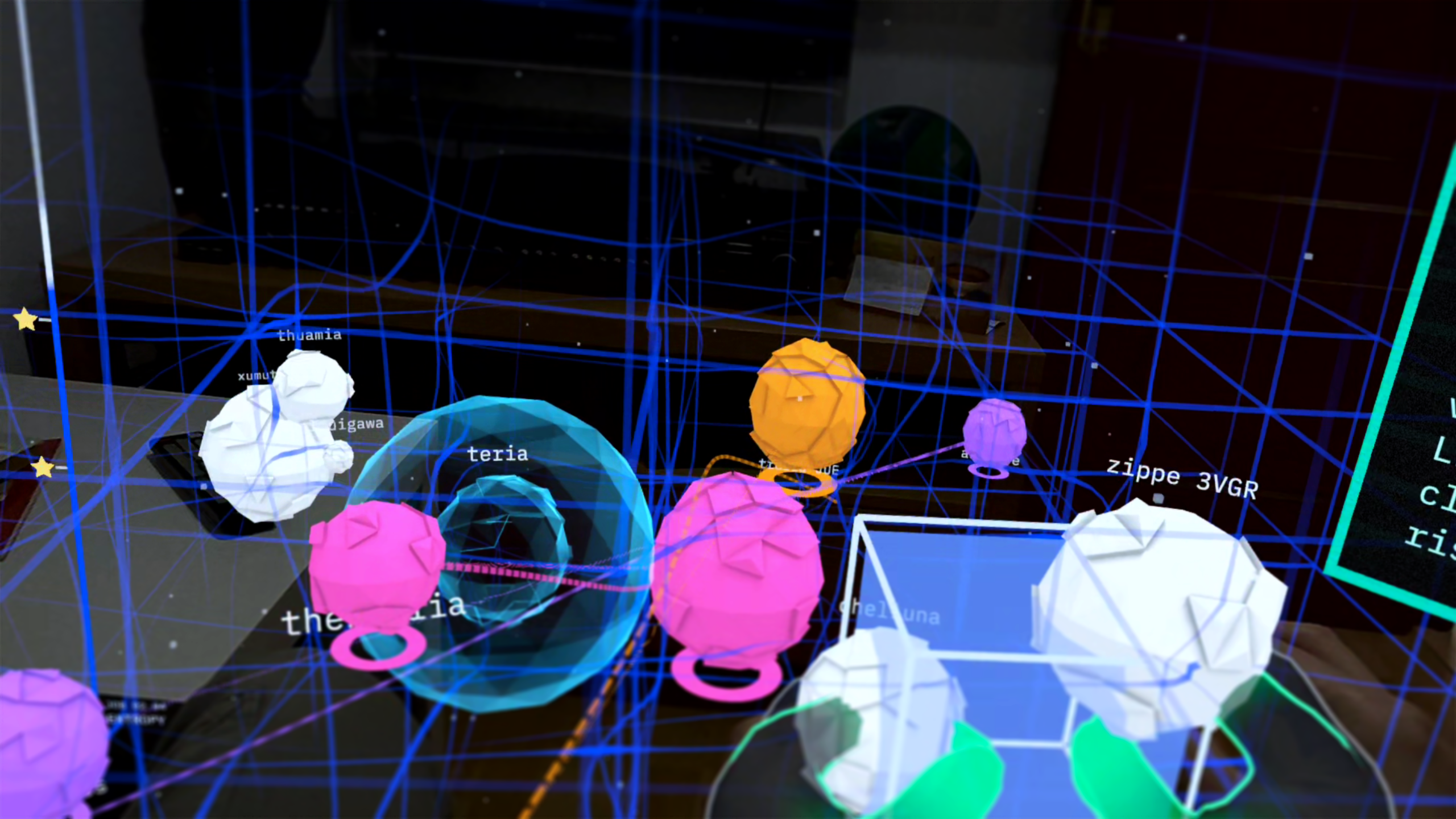
Grow a planet to bend the path, or shrink one to clear it. The predicted path updates live while you shape, and when you let go the ship flies.
Every edit spends entropy. Each job's budget is three times the cost of the best solution we found offline. Run out before the ship arrives and the job fails. Spend at most half the budget for three stars, or at most two thirds for two.
The run has eleven jobs in two chapters. Chapter 1 teaches the cube one idea at a time: scale, centre, clear, move, several zones, assist and a capstone. Chapter 2 is the fleet, where several ships share one field and one budget.
How we built it
- Unity with the Meta XR SDK: passthrough, hand tracking, and MRUK to anchor the universe in your room.
- A Newtonian field: the physics is plain inverse-square gravity. Relativity is the language and the feel, not a simulation of Einstein's equations.
- Baked jobs: an editor-only creator scrambles a field and runs a full solution search. Every shipped job is proven solvable, and the search also sets its budget.
- The field shows the game: the lattice warps, the entropy bar sits on the grid edge, and the passthrough strains as the budget drains, so there are no score panels.
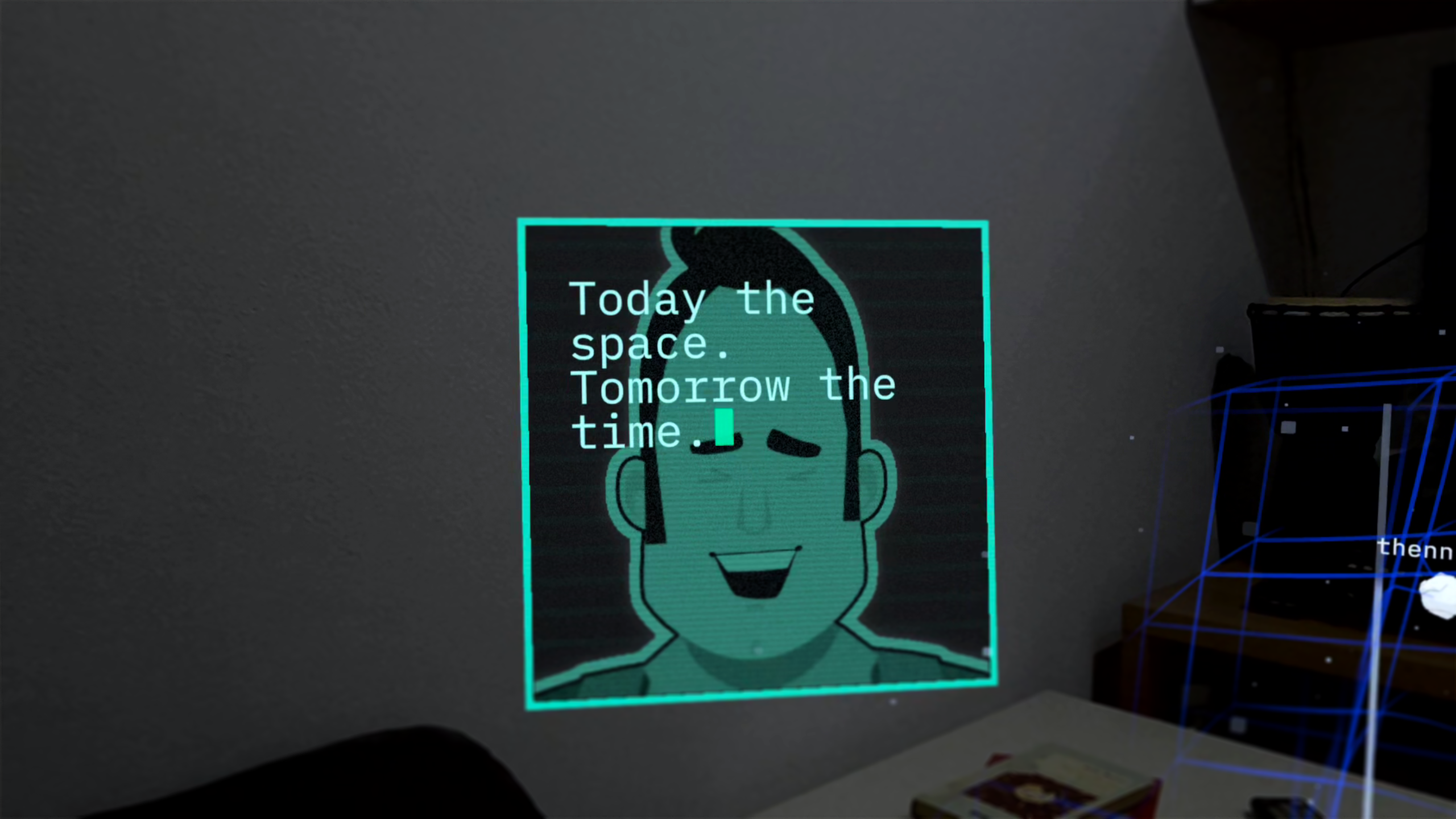
- Jim, the dispatcher, hands over each job with voiced lines.
- Small slices: each piece of work was sized to fit a morning and closed with a short post-mortem. Fast EditMode tests cover the rules, and the headset covers everything else.
Challenges we ran into
- The constraint cliff. The first idea was a management game with many live routes sharing one field. Moving one planet broke every route. Constraints grow with ships × destinations while the player's freedom stays small, so levels became unsolvable, not hard. We moved to one job at a time.
- Room-scale did not fit. An early version spread planets around your room, but a seated player does not walk to a planet, so we moved everything into a bubble at arm's reach.
- Reading the field. Showing gravity wells from the first frame looked like chaos in the headset. Drawing only what the player changed made it readable.
- Bugs that only showed up on the headset. In the editor the world origin hides mix-ups between world and local space. Those layouts only broke on the device, so every layout is now tested under a moved, rotated parent.
Accomplishments that we're proud of
- The whole game is played with your hands, menus included, and needs no controller.
- Every job is baked and proven solvable.
- A two-ship test level turned into a whole second chapter within days.
- The feedback lives in the field rather than on floating panels.
What we learned
- One session in the headset settled questions our design docs had argued about for weeks.
- A visual cue should show what the player changed, not everything that is there.
- One verb is enough. The same pinch bends a path or clears it, depending on its direction.
- Seated MR is its own discipline: comfort, reach and readability come before spectacle.
What's next for Our Space
- A store release: chapters 1 and 2, plus about 150 baked freelance contracts with a finer efficiency score.
- A daily contract: the same job for every player each day, ranked on leaderboards.
- Chapter 3, the instrument: resize the cube to change how much one pinch touches, then rotate its contents to aim a well.


