-
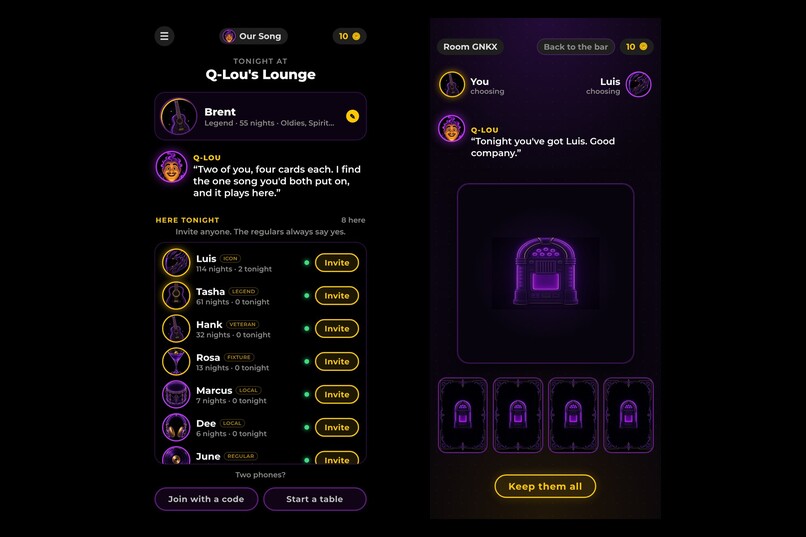
Tonight at Q-Lou's Lounge: who is here, who is playing. Invite anyone, the regulars always say yes. Then the deal, one card of each suit.
-
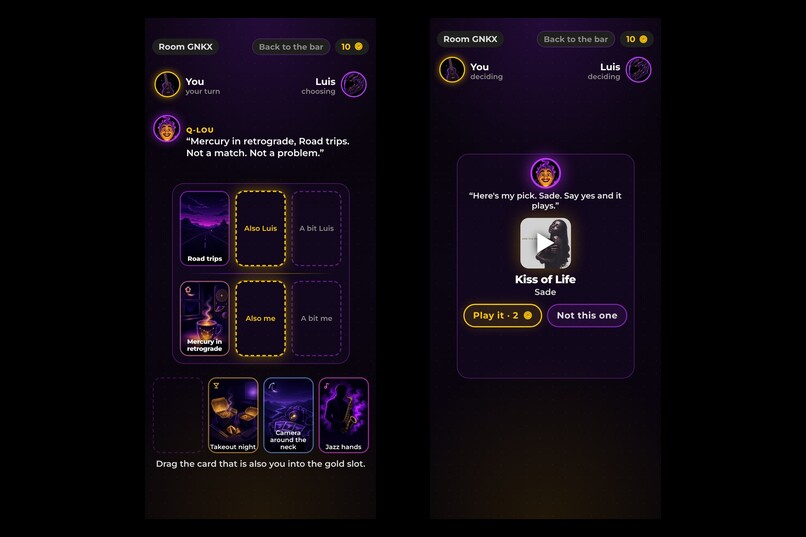
Round two: the first pair is up, the next card goes in the gold slot. Then the pick: Play it, two tokens each, or Not this one.
-
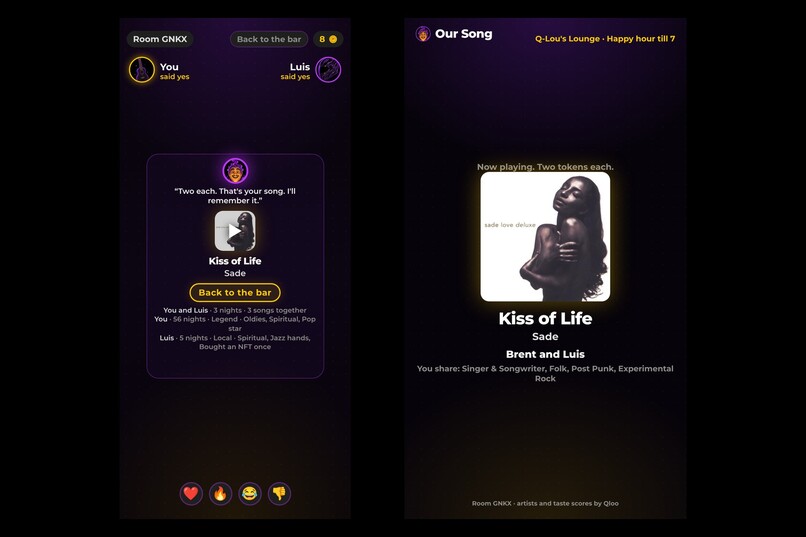
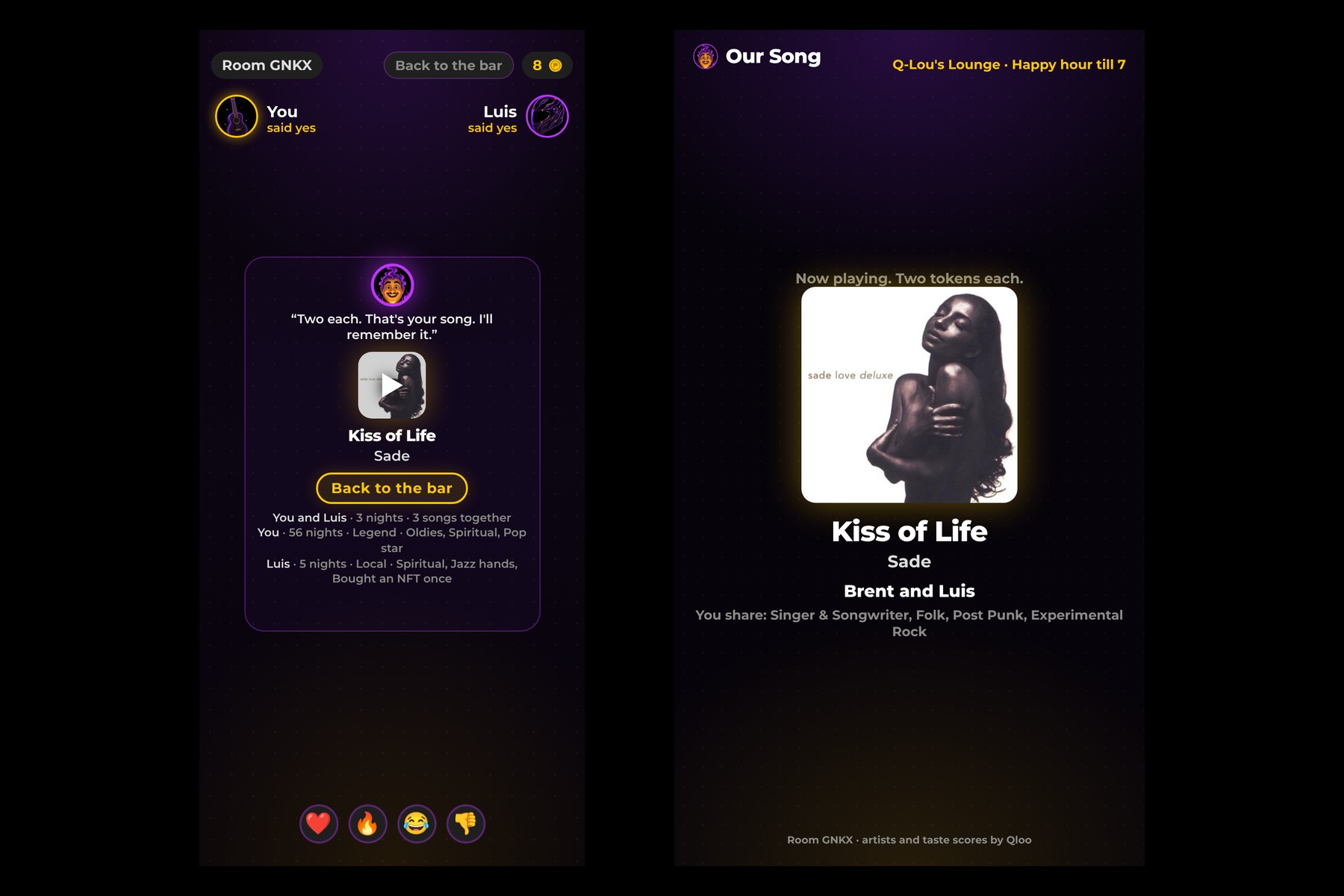
The keepsake: who said yes, nights together, each one's favorite cards. And the same table on the bar's own screen.
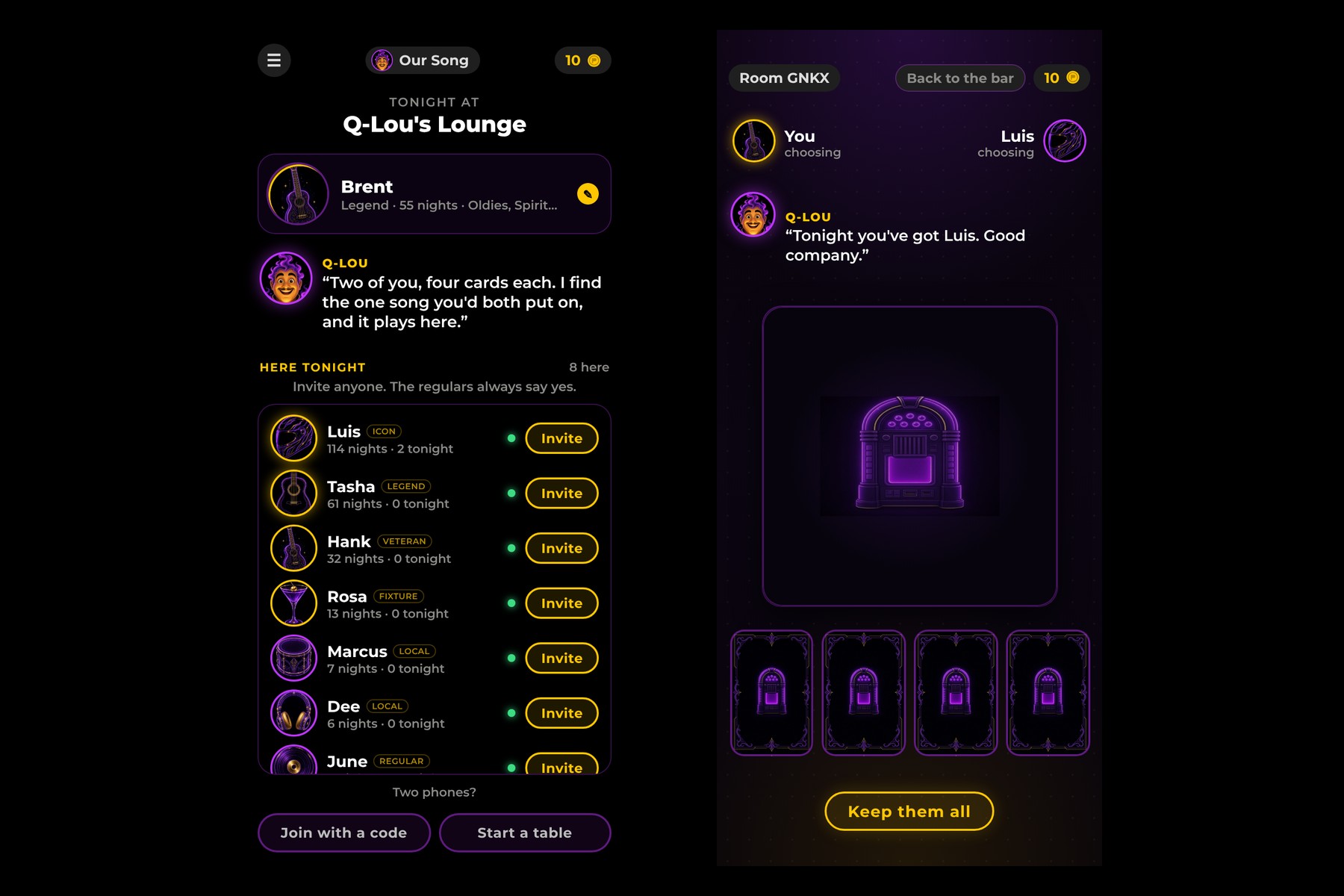
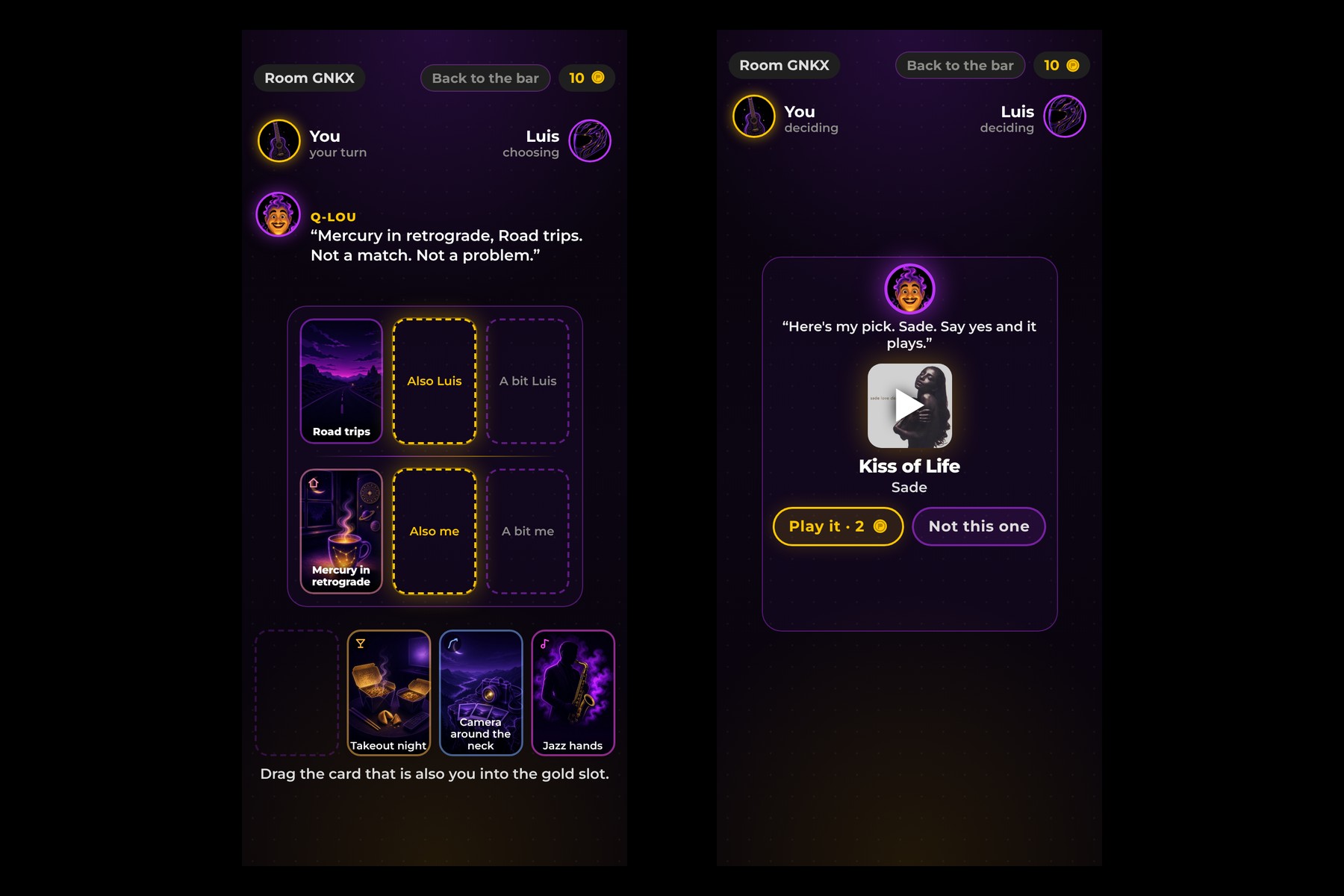
One line. Two people at a bar, four cards each, and Q-Lou, the genie in the jukebox, finds the one song they would both put on. Then it plays.
Try it. https://boostersplace.com/bt/app/play. Tap Who are you? and give a name, then press Invite on anyone in the list. The regulars always say yes. Ninety seconds. On a laptop the page adds a live ledger of every Qloo call beside the phone.
The problem
A bar jukebox is a one-person machine in a room full of people. You pay, you pick, the room gets your taste. TouchTunes runs that jukebox in more than 63,000 venues and its app already lets patrons react to songs and send credits to friends. What it does not have is a reason for two people to choose a song together.
Our Song is that reason. Strangers get an icebreaker. Friends get a referee for the aux cord. Couples get a song. It is built as a feature inside a jukebox app: free to play, and it ends with a paid play that two people chose.
How it plays
- The room. The entry screen is the bar tonight (Q-Lou's Lounge in the demo; in a real venue, the bar's own name): who is here, who is playing, songs played tonight, the last one. Your picture and your title sit by your name. Press Invite on anyone here, or join with a code on two phones.
- The deal. Four cards, one of each suit. Stage is what you turn up (Jazz hands, Outlaw country). Bar is what you order (Whiskey, Queso on everything). Road is your Saturday (Trail head, Batting cage). Porch is you at home (Dog person, Bookworm). Tap any card that is not you and Q-Lou swaps it. 101 cards, each one a verified Qloo signal.
- Three rounds. One card each: most you, also you, a bit you. Drag it into the gold slot. Both cards turn over together and Q-Lou says one thing about the pair.
- The song. The cards drift back to him. He finds the artist both of you score highest on and brings back the top track. Play it, two tokens each, or Not this one, and he brings one more, two picks at most. Then Back to the bar.
- The end. The song, who said yes, and what the venue knows: nights together, songs together, each one's nights and favorite cards. Emotes to react.
Partners, not competitors. Nobody wins over anybody. The song does.
Where Qloo is
Every number in the game is Qloo's. The laptop view shows a live ledger of each call as it happens.
- Cards are signals. Each card is one Qloo tag or audience (
/v2/tags,/v2/audiences), checked against the live API before it was let into the deck. Cards whose signal came back as noise were left out. - The matrix. Before any game, Qloo scored all 101 cards against 2,003 artists that bars play (
/v2/insightswithfilter.results.entities): one matrix, built once, refreshed on a schedule. Columns are standardized so a life card and a genre card pull by rank, not by how wide Qloo's numbers run. A bar cannot wait forty seconds for a song; the matrix makes the draft instant. - The pick. Your three cards weigh 3, 2, 1; cards you swapped out pull against. Each partner gets a curved score for every artist (standardized, so one wide column cannot dominate). The weaker score decides, so nobody gets dragged along to the other one's song.
- The live check. The top three are re-scored live (
/v2/insights),/v2/analysis/comparesays what the two of you share, and the song is the artist's top track. - The control. Beside every pick, a plain language model guesses from the same cards with no data, and Qloo scores that guess too. Both appear on the ledger, so you can see the difference for yourself, game by game.
Without Qloo there is no deck, no matrix, no pick. The game would not work.
Why it is agentic
Q-Lou acts on his own at every step: he deals, swaps a card when asked, scores the hands, drafts the pick, verifies the top three live, re-picks when a partner says no, pairs people in the room, and seats a house regular when nobody is free. The humans only choose cards and say yes or no.
The venue
The bar is the customer. The game is free and sits in front of a paid play. The last 25 picks at a venue sit out of the draft, so regulars do not hear the same song twice. The venue screen shows the table on the bar's TV. Nicknames, pictures and titles live at the venue (Regular at one night, Local at five, Legend at fifty), no account, no login; in a jukebox app the account already exists.
What is real and what is not
Real: every Qloo call, the matrix, the pick, the control, the venue log, the two-phone play, the house regulars who sit in when you are alone. Not real: the jukebox does not actually play the song (there is no jukebox), tokens are play money, and the room pairs people by nickname at one venue rather than by the app's own pairing.
Built with
Python, FastAPI, one HTML file for the phone, the Qloo Insights API, OpenRouter for the control guess only. Hosted on a small Hetzner box behind Cloudflare. MIT license. Card and character art generated in Grok from style-locked prompts; no people, no faces. Built from scratch during the submission period.
Team
Brent Rafferty, with Claude as the builder. Built in four weeks for the Qloo Agentic Hackathon.
Built With
- cloudflare
- fastapi
- html5
- javascript
- openrouter
- python
- qloo

Log in or sign up for Devpost to join the conversation.