Inspiration
In North Carolina, about 10.9 percent of people are currently experiencing food insecurity (1). This is about 1.2 million individuals (1). In US homes, around 20% of food waste is attributed to confusion around expiration dates (2). Our team, Oodles, was inspired by the prospect of clarifying food expiration dates to cut down on food waste. There are currently many food banks and organizations aimed at cutting down on food waste. These foodbanks take in expired food from local grocery stores, assess the quality according to extended “best by” dates, and ship out food to food insecure individuals These food banks simply use a food-extension guideline to assess if the food is still okay to eat. They (and any consumer) are able to do this because many of the dates on food packaging are only for optimal flavor or quality, but the products are still perfectly good to eat after the “best by” date. Our product is aimed increasing eco-equality by helping foodbank workers to more efficiently determine if a product is still good by using image-AI to recognize a food product and extend its best buy date.
About Oodles
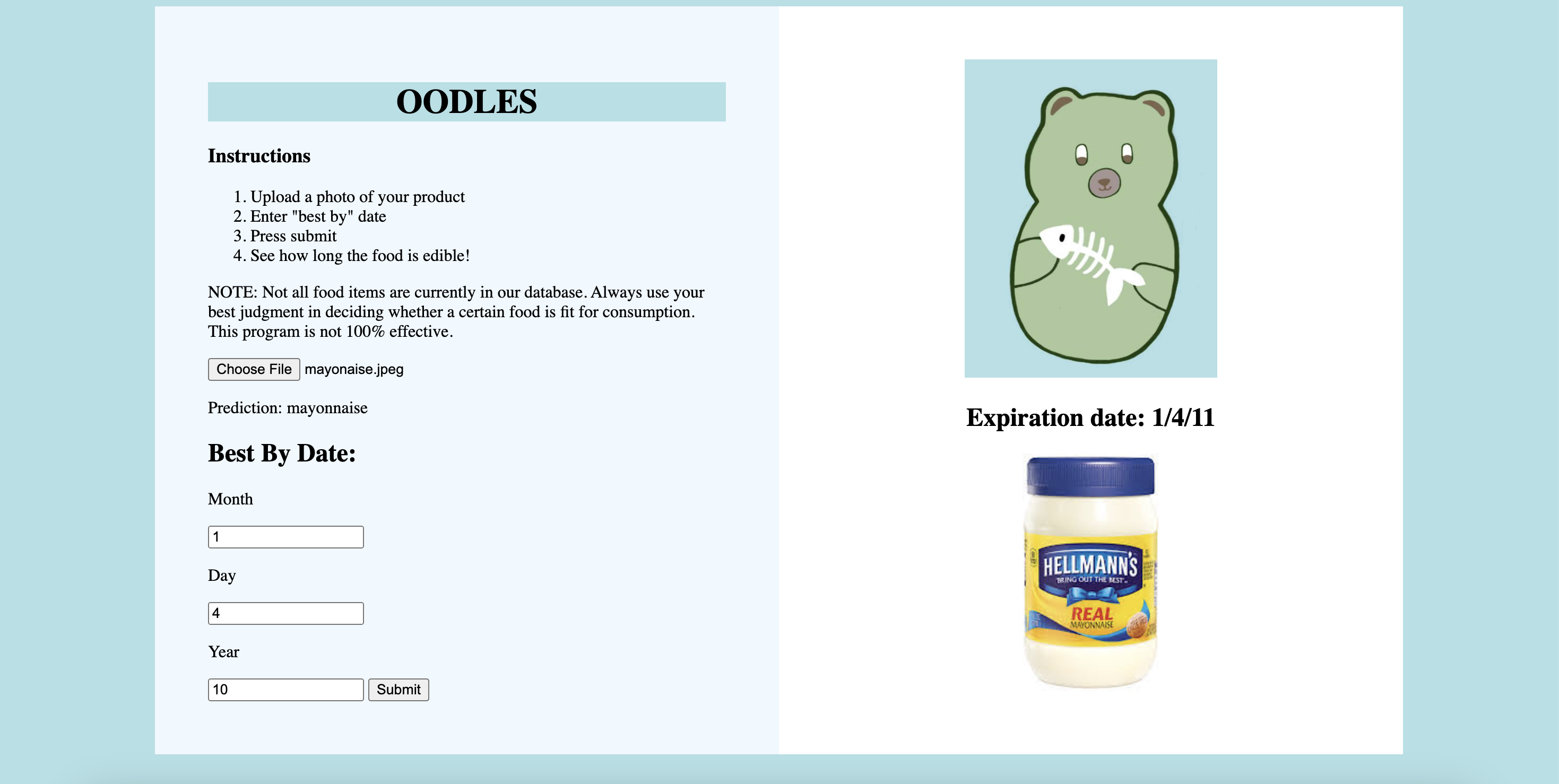
To use Oodles, users upload a picture of their product to our website and enter the "best buy" date on the container. Oodles then uses AI to detect what food is pictured and automatically gives the user an extended "best buy" date based on national food-safety standards. This product is especially applicable for food bank workers, as it has the potential to majorly expedite the food sorting process, helping foodbanks to ship out more food, faster.
How We Built Oodles
Our project took advantage of PyTorch's model for image recognition. We compared the user's uploaded images to the database of ImageNet images, and paired it with the most fitting title. With this, we ran into some issues with the limited category options, and had to rename some ourselves. Our code is based in HTML, with CSS used for styling, and JavaScript for functionality. After receiving the food prediction, JavaScript would take the information provided by the user under the "best-by date" forms, and adjust it to the extended food date of the detected item. All of these features combine to make the functionality listed above for our Oodles software.
Challenges We Faced
We faced many challenges when developing Oodles, including issues with our AI and our JavaScript code. For our AI model, the AI incorrectly identified some items and our image database, ImageNet, had a limited supply of very specific food images. We solved the AI model issues by rerouting some of the consistently-wrong answers to say the correct answer instead. For our JavaScript code, we saw bugs and experienced new issues in every run. To overcome these issues, we debugged our code after every consecutive iteration. It took a lot of time trying to figure out our model, but it was well worth it in the end.
Accomplishments We're Proud Of
Our team is proud of developing the Oodles website despite numerous roadblocks and challenges. Our team is proud of how each team member tackled something they were unfamiliar with. Anna tackled PyTorch, AI, and the backend coding to develop her coding skills a lot. Caroline learned a lot about HTML and CSS. Lily was an asset to the team even without coding, as she worked on our presentation clarity, visibility, and Oodles interface usability. Charlotte was an asset in a similar way, as she brought knowledge on the subject, communicated our story and project, and worked on various other tasks. We all learned about AI and coding basics.
What We Learned
The whole Oodles team had a great time working together to create our Oodles website. We all learned valuable skills and knowledge in coding, usability, and sustainability throughout the hackathon. Our team had two members that knew how to code and two that had minimal experience. The two members new to coding both learned a valuable introduction to Github and html, developing extremely valuable skills for future use.
What's Next?
In order to improve the current prototype, our group would first change the machine learning model used for the image recognition. With more time, the product could be more accurately taught and therefore more successful. Also, the program is currently targeted towards packaged products, but could be used for produce in order to recognize wilting or rot in unsafe foods.
In terms of website design, the addition of a section on the homepage for general expiration date information would be a huge user benefit. This addition would allow the product to be more accessible to consumers and attempt to combat food waste in households. Additionally, information about the correct storage and disposal of each food item could encourage processes such as composting and donating as opposed to throwing away food.
Finally, if the app was targeted towards grocery stores and large chains, it could prevent food waste at a large scale by preventing the disposal of safe foods. This could be done through encouraging the stores to donate to food banks as an alternative to throwing away the food.
Acknowledgements and Resources
- Thank you to the SMath Hackathon team for all of the help and support on this project. Also thank you to all volunteers who helped us overcome road-bumps to develop a successful Oodles!
- https://www.ncdhhs.gov/ncdhhs-state-action-plan-nutrition-security-2023-2024/open#:~:text=In%20North%20Carolina%2C%20about%2010.9,to%2010.0%25%20by%20December%202024.
- https://foodinstitute.com/focus/is-the-end-of-expiration-dates-upon-us/
- https://www.accfb.org/wp-content/uploads/2017/09/New-Logo-Food-and-Code-Date-Extensions.pdf
Built With
- css
- html
- imagenet
- javascript
- pytorch


Log in or sign up for Devpost to join the conversation.