-
-
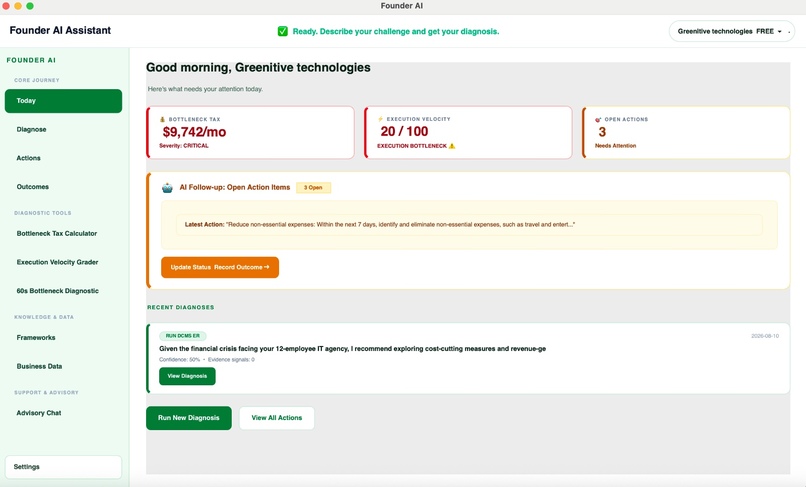
Home page
Founder AI — From Business Advice to Measurable Execution
Inspiration
Over nearly two decades of working with startups, enterprises, and business leaders, I kept seeing the same problem.
Founders rarely suffer from a lack of information.
They have dashboards, spreadsheets, CRM data, financial reports, advisors, books, AI chatbots, and countless recommendations. Yet when the business slows down, the hardest questions remain:
What is actually holding the business back?
What evidence proves it?
What should I do next?
And after I act, how do I know whether the decision actually worked?
I had developed 13 Founder Frameworks from my experience working through these kinds of business problems. But frameworks sitting in a book or document still depend on the founder knowing which framework to use, interpreting it correctly, and converting the insight into execution.
That led to Founder AI.
Our goal is not to build another chatbot that gives founders more advice.
Our goal is to build a Closed-Loop Executive Operating System for founders that moves from business evidence to diagnosis, from diagnosis to execution, and from execution to measurable outcomes.
The core loop is:
Observe → Diagnose → Prove → Decide → Act → Measure → Learn
What Founder AI Does
A founder starts with a real business challenge, such as:
"We have enough leads, but deals are taking too long to close."
Founder AI combines that challenge with available business context and analyzes the problem using our proprietary Founder Frameworks.
Instead of immediately generating generic recommendations, the system works through a structured reasoning process.
It identifies the likely constraint, selects the appropriate framework, retrieves relevant framework knowledge, evaluates the available evidence, and generates an actionable diagnosis.
The founder can then move from insight into execution.
Recommendations become concrete action items that can be tracked through Pending, In Progress, and Completed states.
When an action is completed, the founder can record the actual outcome and business impact.
Those historical outcomes can then become context for future diagnoses.
This creates the closed loop:
Business Problem → Evidence → Diagnosis → Decision → Action → Outcome → Better Future Context
That is the fundamental difference between Founder AI and a traditional AI advisor.
How We Built It
Founder AI is designed as a hybrid desktop-and-cloud application.
The desktop experience is built with Python and PyQt6, giving founders a dedicated workspace for business diagnosis and execution.
The product includes:
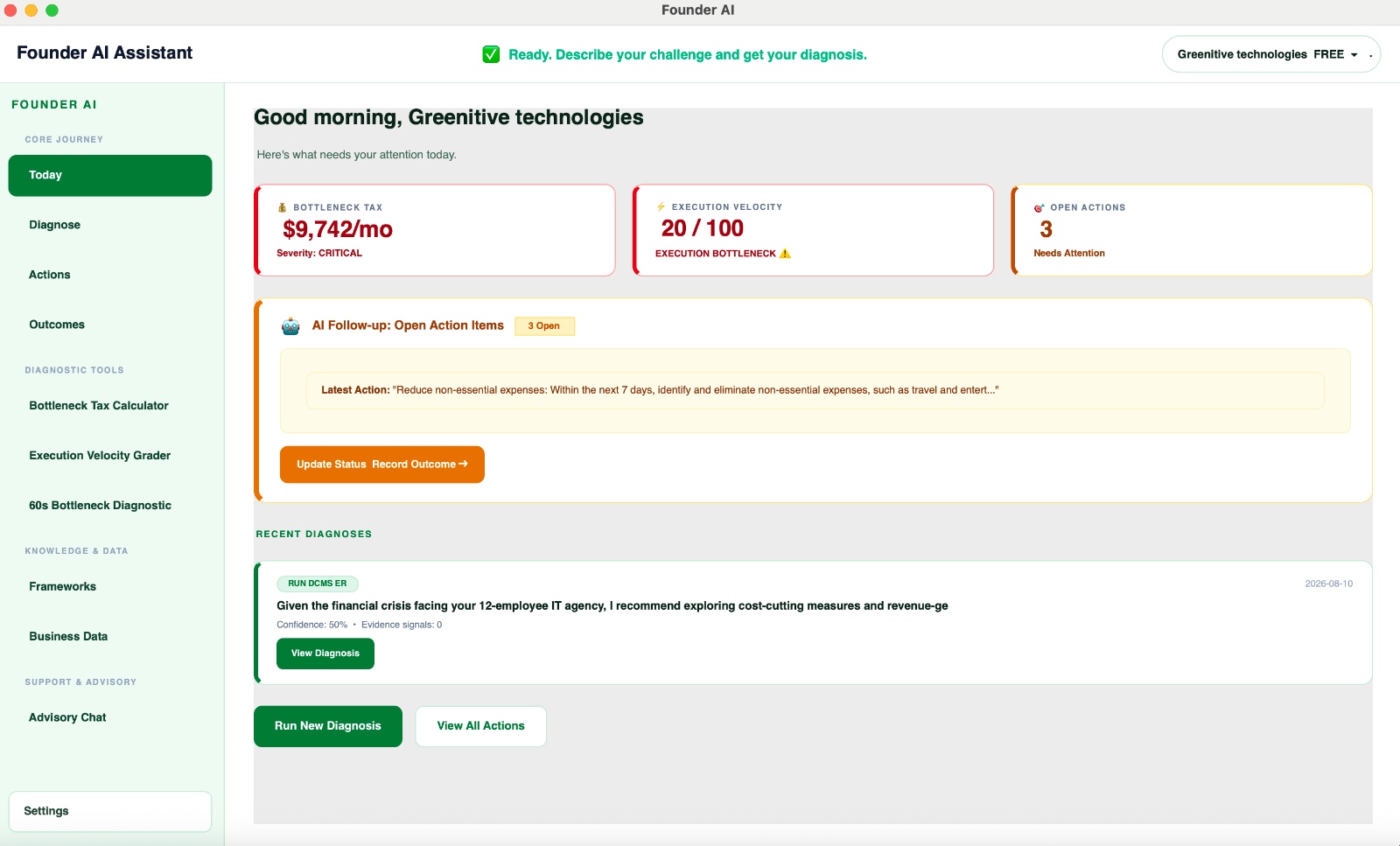
- Today — an executive command center
- Diagnose — AI-powered business diagnosis
- Actions — execution tracking
- Outcomes — measurement and historical results
- Founder Frameworks — our proprietary business methodology
- Business diagnostic tools
- Business context and data
- AI advisory capabilities
Behind the interface is a specialized multi-agent reasoning pipeline.
Different stages handle:
- Business-context assessment
- Founder Framework selection
- Retrieval of relevant framework knowledge
- Historical outcome context
- Strategy generation
- Execution planning
- Structured response composition
Rather than relying entirely on one unrestricted prompt, we separate responsibilities so that the system can reason through the founder's problem in a more structured and explainable way.
Building with Gemini and Google Cloud
Google's AI and cloud technologies provide the scalable intelligence layer of Founder AI.
The architecture uses Google Cloud services for cloud-based reasoning and secure service execution, while preserving a local-first desktop experience.
Our cloud architecture includes components such as:
- Google Gemini / Vertex AI for advanced AI reasoning
- Google Cloud Run for secure backend services
- Google Cloud Secret Manager for protecting server-side credentials
- Cloud Firestore for cloud session data
- Local SQLite persistence for desktop actions and diagnosis history
This hybrid architecture is important for our customers.
Founders frequently work with commercially sensitive information. We therefore designed Founder AI so that local workflows and local persistence can coexist with more powerful cloud intelligence when required.
The desktop client is also designed so that master cloud API credentials do not need to be embedded directly inside distributed application binaries.
From AI Recommendation to Execution
One of the biggest lessons from building Founder AI was that generating a good AI answer is only the beginning.
A founder does not create business value by receiving an impressive paragraph.
Value is created when a decision results in action and that action produces a measurable outcome.
This changed how we designed the product.
Instead of stopping after diagnosis, Founder AI maintains action and diagnosis records locally.
A recommendation can become an execution item.
An execution item can produce an outcome.
And an outcome can become historical context for a future diagnosis.
This gives Founder AI something that a stateless conversation does not naturally provide:
business continuity.
Challenges We Faced
1. Reducing Hallucination and Increasing Trust
Business recommendations can have real financial consequences.
We learned that simply asking a powerful language model for a confident recommendation is not sufficient.
Founder AI therefore combines AI reasoning with structured Founder Frameworks, retrieved knowledge, business context, evidence signals, and confidence information.
The objective is not merely to produce an answer.
The founder should be able to understand why the system reached that conclusion.
2. Turning Strategy into Execution
Our early versions behaved too much like an AI report generator.
They could produce detailed strategic analysis, but the founder still had to translate that analysis into work.
We redesigned the experience around actions and outcomes so that recommendations can continue beyond the diagnosis itself.
3. Building for Sensitive Business Data
Founders may provide financial information, operational data, customer context, and strategic plans.
This led us toward a hybrid architecture that combines local persistence and local AI capabilities with secure Google Cloud services.
4. Product Complexity
Founder AI contains multiple capabilities: proprietary frameworks, AI reasoning, retrieval, local inference, cloud inference, actions, outcomes, advisory experiences, and business tools.
One of our biggest product lessons was that technical capability does not automatically create a good customer experience.
We learned to organize the product around the founder's journey rather than around the underlying technology.
The customer should not need to understand agents, vector databases, model providers, or orchestration.
They should simply understand:
What is wrong? Why? What should I do? What happened after I did it?
What We Learned
The most important lesson has been surprisingly simple:
Founders don't need more AI answers. They need better decisions that turn into measurable execution.
We also learned that AI becomes more valuable when it has structure.
The Founder Frameworks provide domain structure.
Business data provides evidence.
Gemini provides reasoning capability.
Actions provide execution.
Outcomes provide feedback.
Together, these components allow us to move beyond a one-time AI conversation toward an operating loop for business decision-making.
We also learned that real customer feedback is dramatically more valuable than building features in isolation.
Founder AI has begun reaching real customers, including our first paid software subscribers. That early validation is helping us determine which parts of the system create enough value that founders are willing to pay for them.
What We're Building Toward
Our long-term vision is to make sophisticated business operating intelligence accessible to founders who may not have a CFO, COO, strategy team, data team, or board of experienced advisors.
Imagine Founder AI continuously understanding the signals across a company:
Revenue → Customers → Operations → Product → Execution → Outcomes
and helping the founder identify the constraint that matters most right now.
Then, instead of producing another dashboard or report, it helps the founder decide what to do, execute the decision, measure the result, and remember what worked.
That is the future we are building:
An AI operating system that doesn't just tell founders what to do — it helps them understand what is holding the business back, proves it with evidence, turns the decision into action, and measures whether it worked.
Built With
- ai-agents
- chromadb
- generative-ai
- google-cloud
- google-cloud-firestore
- google-cloud-run
- google-cloud-secret-manager
- google-gemini
- google-vertex-ai
- langchain
- llama-3.2
- multi-agent-systems
- ollama
- pyqt6
- python
- rag
- sqlite

Log in or sign up for Devpost to join the conversation.