Inspiration
In 2004 Google Desktop Search promised something that sounded obvious: search your own computer the way you search the web. In 2011 it was discontinued, and the idea went to the grave with it. Everything moved to the cloud, except our files. They are still there: a thesis in WordPerfect that no program opens, a 2008 backup ZIP nobody remembers, a diary whose accents turned into ñ, a contract you know you signed but can't find.
We kept asking ourselves the same question we ask a search engine every day, but about our own disk: "where did I leave the poem I wrote for Rosa?". And there was no one to ask. So we built someone: OUIJA, a board where you ask your questions and the spirits of your files answer.
What it does
OUIJA resurrects personal desktop search with today's AI, running entirely on your computer, and resurrects the files that search left behind:
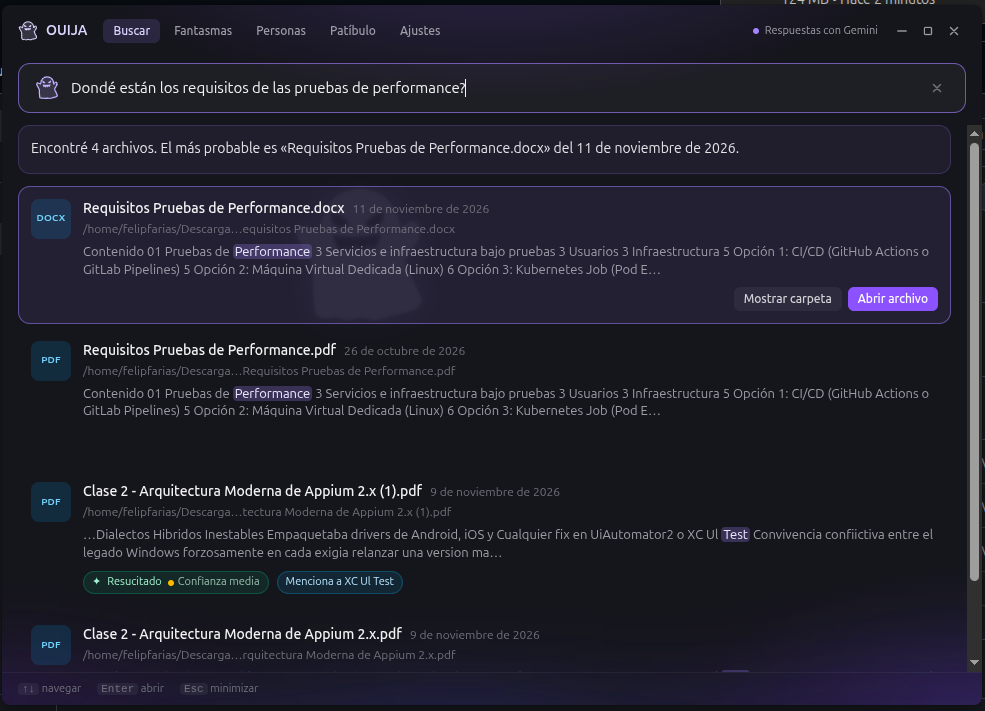
- Ask the board. Type what you remember, in your own words. OUIJA searches by meaning and tells you where the file is, even if it lives inside an old backup, and only cites files that really exist.
- Dead formats come back to life. WordPerfect, WordStar, Works, Write, Lotus, old
.doc/.xls, DOS text in CP437/CP850 and broken encodings (mojibake). When no converter can open a file, OUIJA rescues the text from its raw bytes and shows how confident it is. - Bring to the present. A resurrected file can be saved as a modern
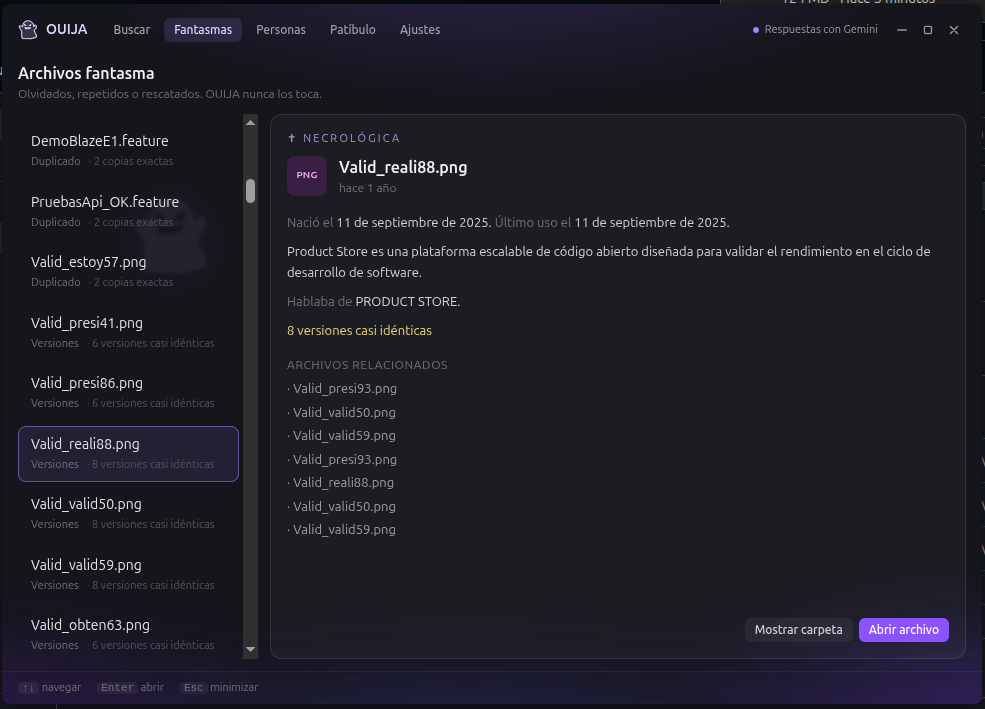
.docx/.xlsx, or as clean UTF-8 Markdown when it is too damaged. The original is never touched. - Ghosts. Files forgotten for years, exact duplicates and near-identical versions, each with its own obituary: when it was born, when it was last used, what it talked about and who it mentioned.
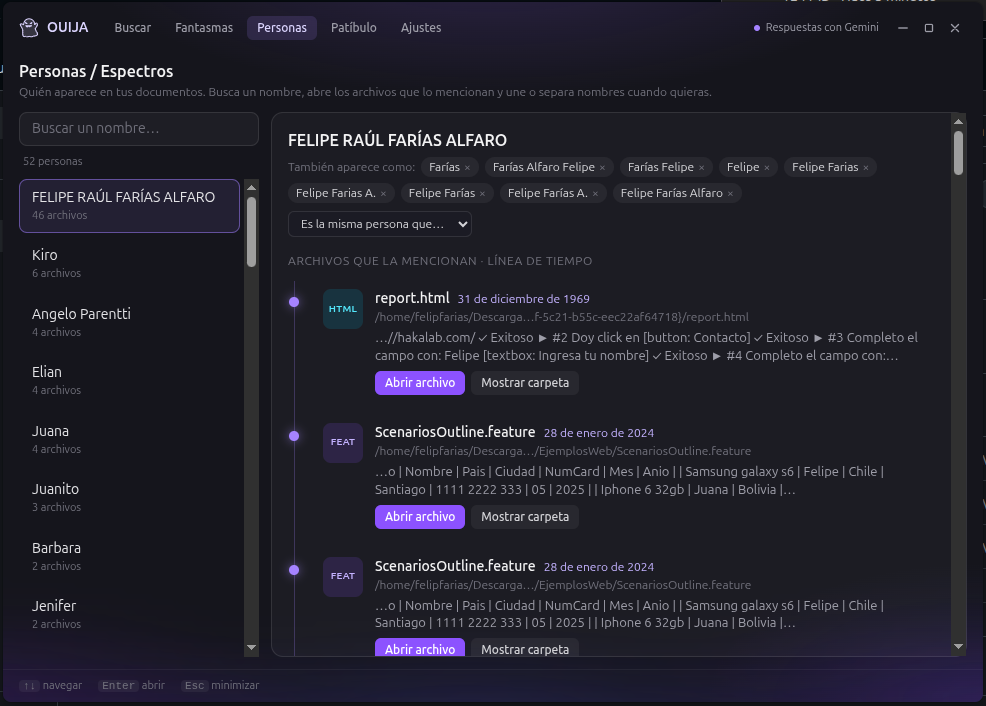
- People / Specters. Who appears in your documents and when, on a timeline. "Rosita" and "Rosa" can be merged into one person.
- The Gallows. Everything sent to the trash, with what OUIJA remembered about it. From Resurrection you bring it back to where it was, never overwriting anything.
- Live changes. New, modified and deleted files are detected while the app is open.
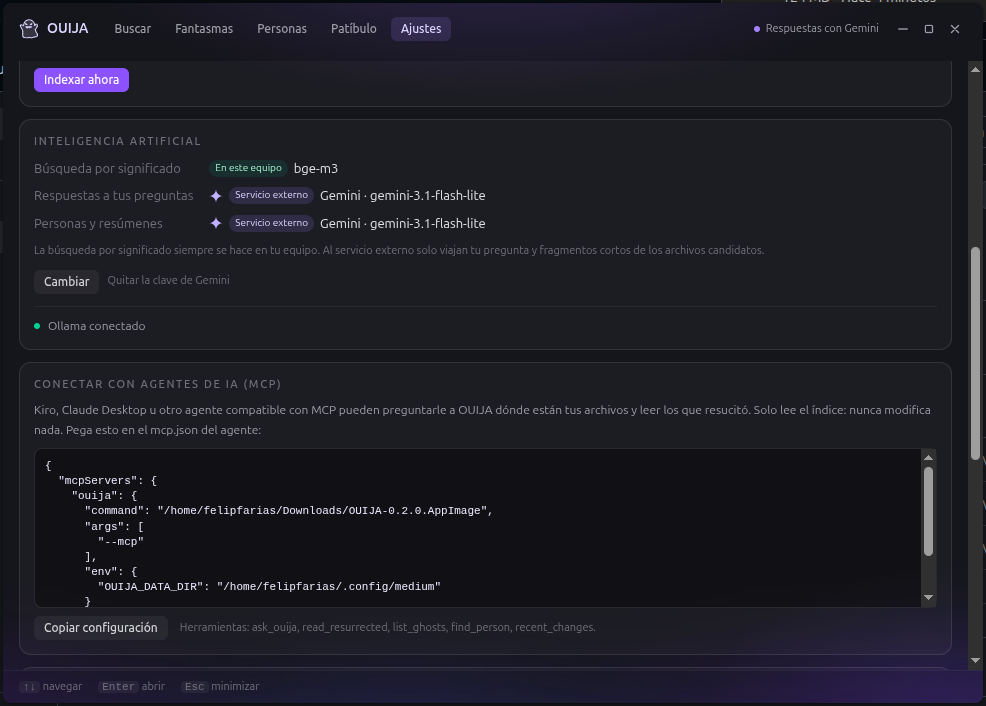
- MCP server. Kiro, Claude Desktop or any MCP agent can ask OUIJA where your files are and read the ones it resurrected. A 1994 file format becomes context for a 2026 agent.
- Six languages: Spanish, English, Portuguese, French, Japanese and Chinese.
- Private by default. Embeddings and the language model run locally through Ollama. Optionally you can use Claude, OpenAI, Gemini or DeepSeek with your own key, and only your question and short snippets of the candidate files are sent.
All of this sits in a haunted interface where the theme does real work: a storm and drifting ghosts on the welcome screen, subtle fog and distant lightning in the app, and a guided tour narrated by the spirits.
How we built it
OUIJA is an Electron + React + TypeScript desktop app for Windows and Linux. The domain core (src/core) has no Electron dependency, so we could test it on its own.
Indexing. A scanner walks the folders you hand over, extracts the text (LibreOffice headless for old formats, Tesseract for images, a forensic carver for the rest), splits it into chunks and embeds them with bge-m3 through Ollama. Everything goes into SQLite with FTS5 for keywords and sqlite-vec for vectors. Files whose content can't be read are still indexed by name, folder and type, so a question like "the Haka Lens logo" finds a PNG.
Search. We combine the semantic and lexical rankings with Reciprocal Rank Fusion:
$$\text{RRF}(d) = \sum_{r \in {\text{vector},\,\text{FTS}}} \frac{1}{k + \text{rank}_r(d)}, \qquad k = 60$$
A local model (qwen3.5:4b) turns the question into filters (dates, file type) and then writes an answer using only the retrieved candidates. Every cited path is checked against the index before it reaches the user.
Ghosts. Near-identical versions are found with 3-word shingles, MinHash (128 permutations) and LSH (32 bands), so we never compare every file with every other:
$$\Pr\big[h_{\min}(A) = h_{\min}(B)\big] = J(A,B) = \frac{|A \cap B|}{|A \cup B|}$$
Two files are versions of each other when the estimated Jaccard similarity is at least 0.6.
MCP. The MCP server reuses the same core in a passive mode: it only reads the index the app keeps up to date (SQLite in WAL mode, so both run at once), never loads API keys and never writes anything.
With Kiro. We followed a spec: 17 requirements in EARS format, a design and an ordered task plan in .kiro/specs/. Steering files kept the non-negotiable rules visible to the agent (everything local, never modify the user's files, cite only real paths), and a hook ran the typecheck and tests on every save. We wrote 10 correctness properties as property-based tests with fast-check, plus 373 unit tests and 53 end-to-end tests that launch the real app against real Ollama models.
Challenges we ran into
- Indexing changed history. Reading every file updated its last-access time, so every file looked recently used and the ghosts disappeared. We now read with
O_NOATIME. - Encodings lie. Short DOS texts with accents looked like valid Windows-1252 (
"d¡a","Concepci¢n"). We added a penalty for symbols inside words. A property-based test also showed that some mojibake is ambiguous by nature ("Ñ“"), and we documented it as a known limit instead of guessing. - Models invent files. A language model will happily cite a path that doesn't exist. Validating every citation against the index became a property, and the property caught real cases.
- Real folders are not test folders. Our first real-world test asked for a logo and found nothing, because we only indexed documents. That forced us to index every file type.
- Packaging. Native libraries can't load from inside Electron's
.asar, transparent windows can't be resized reliably, Wayland blocks global shortcuts, and an AppImage changes its internal path on every launch, which broke the first MCP configuration we generated. - Privacy versus power. Offering external AI providers without leaking documents meant keys encrypted with the system keystore that never reach the UI, and a strict rule about what may be sent.
- Two trash formats. Restoring from the freedesktop trash and from Windows
$Recycle.Bin($Ifiles in two versions), without ever overwriting a file.
Accomplishments that we're proud of
- Asking for a poem and getting back its 2008 draft, inside a ZIP backup, rescued from a WordPerfect file that no installed program can open.
- Kiro calling OUIJA over MCP and reading that same file as plain text.
- Everything works offline, on a normal laptop, with no account and no cloud.
- The spooky theme isn't decoration: ghosts, obituaries, specters and the gallows are how the app explains what it found.
- Correctness backed by properties, not hope: the app never cites a file that doesn't exist and never modifies an original.
What we learned
- Spec-driven development pays off on a project this size: each task had a clear definition of done, and the contracts (
MemoryStore, the IPC API) let us build the core and the interface separately. - Property-based tests find bugs that example tests miss, especially in encodings and in how a model's answers are validated.
- Hybrid search beats pure semantic search for personal files: names and dates matter as much as meaning.
- Local AI is ready for this: a 4B-parameter model and a multilingual embedding model are enough to answer real questions about a real disk.
- Steering files work best when they hold the few rules that must never break.
What's next for OUIJA
- macOS support, and a signed Windows installer.
- More resurrections: floppy and CD images, old mail archives (
.pst,.mbox), PalmOS and early phone backups. - Audio and video, through local transcription, so you can ask what was said in a recording.
- Photos by content, using a local vision model.
- Time travel: compare versions of the same document across the years.
- A Kiro Power that bundles the OUIJA MCP server with ready-made prompts for agents.
Built With
- electron
- html5
- kiro
- mcp
- typescript


