OuiCare: Revolutionizing Patient Care with AI 🚀
🌟 Inspiration
Healthcare professionals often face the daunting task of processing vast amounts of patient data—from medical history and lab results to family records and recent symptoms. This can be overwhelming and time-consuming, potentially impacting the quality of care. We were inspired to create OuiCare to empower doctors with cutting-edge AI tools that streamline decision-making, reduce cognitive load, and improve patient outcomes. Our mission is to make healthcare smarter, faster, and more reliable.
🚀 What It Does
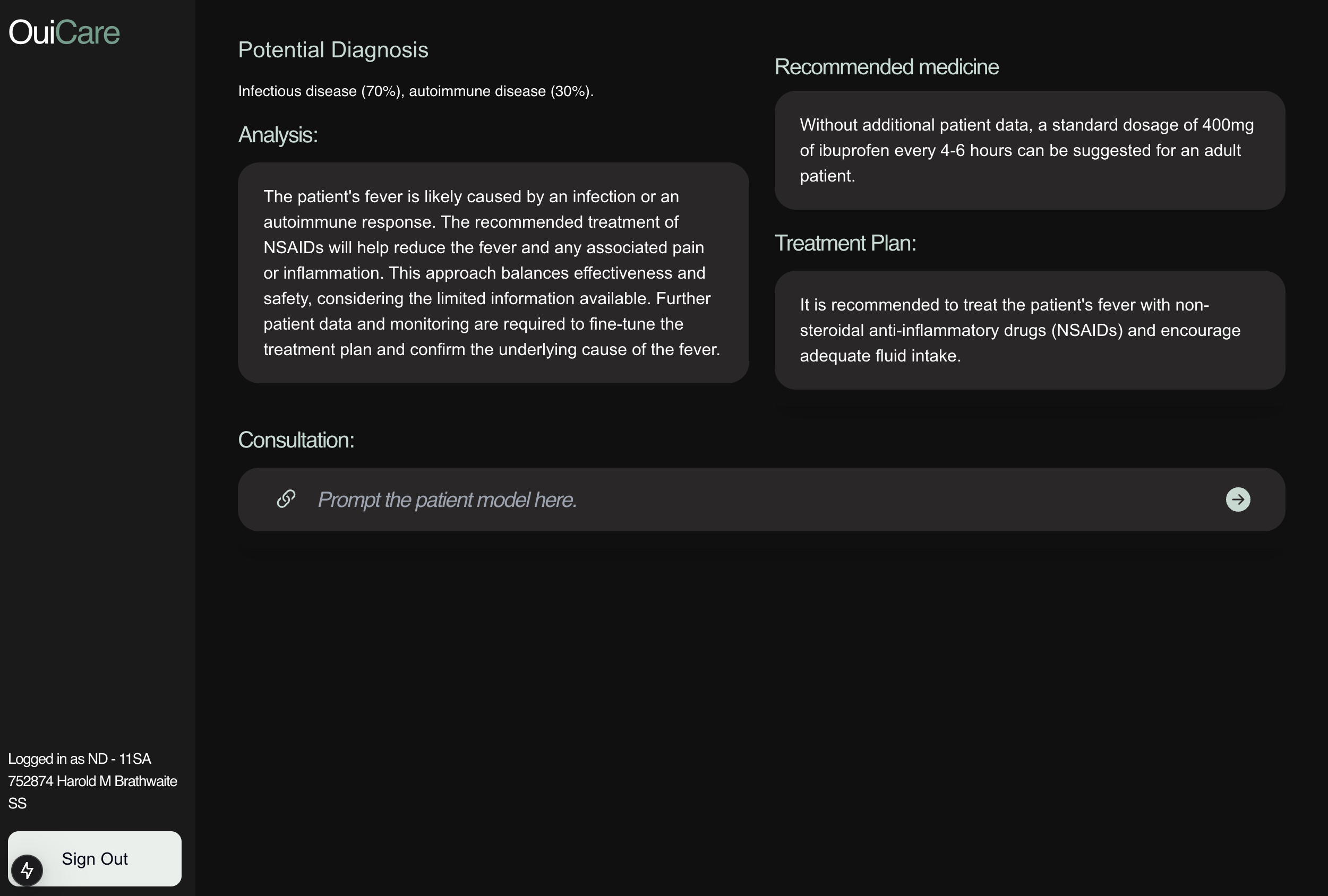
OuiCare is an AI-powered assistant designed to simplify and enhance the healthcare decision-making process. It combines medical history, lab results, family records, and symptoms into streamlined patient profiles, offering concise summaries for doctors. Using a Retrieval-Augmented Generation (RAG) pipeline, it analyzes this data to provide AI-driven insights, including potential diagnoses and tailored recommendations. OuiCare also assists with decision support by offering guidance on drug dosages, prescriptions, and diagnostic clarity. Additionally, it seamlessly integrates synthetic patient data from Synthea with hospital databases, enabling deeper analysis and personalized care.
🛠️ How We Built It
The frontend of OuiCare, built using React, provides doctors with an intuitive interface to input patient data or upload images via UploadThing, delivering actionable insights seamlessly. The backend, powered by FastAPI, processes patient data with advanced tools, including Cohere's AI Chatbot API for summarizing profiles and generating insights, Pinecone for storing and retrieving vectorized patient data in the RAG pipeline, and Sentence Transformers to encode text for efficient similarity searches. Additionally, synthetic patient records from Synthea were processed and stored to form the backbone of the training data, enabling accurate and robust analysis.
🤯 Challenges We Ran Into
We faced several challenges during the development of OuiCare. Parsing through synthetic datasets and integrating them with hospital data proved to be both complex and resource-intensive, highlighting the issue of data overload. Fine-tuning the Retrieval-Augmented Generation (RAG) pipeline for accurate retrieval and summarization required extensive iterative testing and optimization. Ensuring seamless communication between the React-based frontend and the FastAPI backend was another significant technical hurdle. Additionally, balancing the complexity of medical data with the capabilities of AI demanded careful validation to maintain reliability and ensure the tool’s effectiveness for healthcare professionals.
💡 What we've learned
Thug it out. Typing this Devpost description for the project starting at 8 after an all nighter to try and get this project working really highlights the classic hackathon experience. With this being a first or a second hackathon for most of us, we're just proud that we've learned to put ourselves out there and just start building, as well as the thugging it out part where we just kept going. Even thought it's exhausting, it's an invaluable experience most of us are proud of.
🔮 What's Next for OuiCare
- Enhanced Features: Add support for medical image analysis, such as detecting abnormalities in X-rays or scans.
- Real-Time Integration: Link directly to live hospital databases for real-time patient data updates.
- Mobile Application: Develop a mobile version of OuiCare for on-the-go access.
- Expanded AI Models: Incorporate specialized models trained on medical datasets for even more accurate diagnostics.
- HIPAA Compliance: Ensure full compliance with healthcare privacy regulations to prepare for real-world deployment.
Built With
- auth0
- cohere
- fastapi
- langchain
- langsmith
- nextjs
- pinecone
- python
- react
- rest
- typescript
- uploadthing


Log in or sign up for Devpost to join the conversation.