-
-
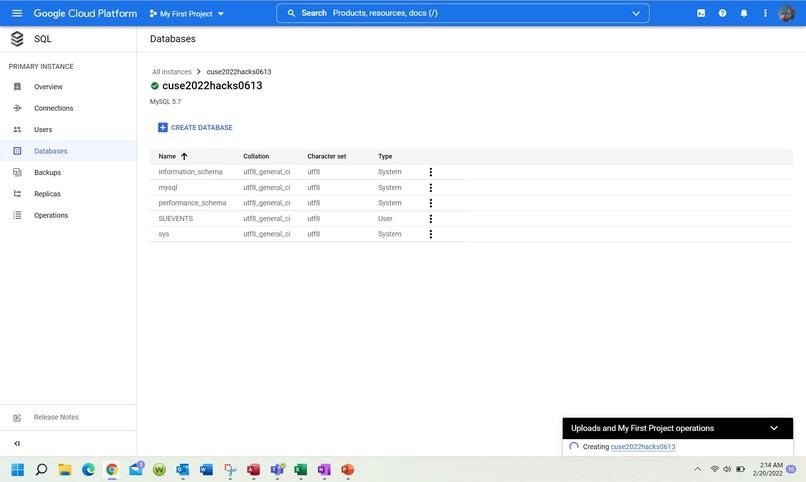
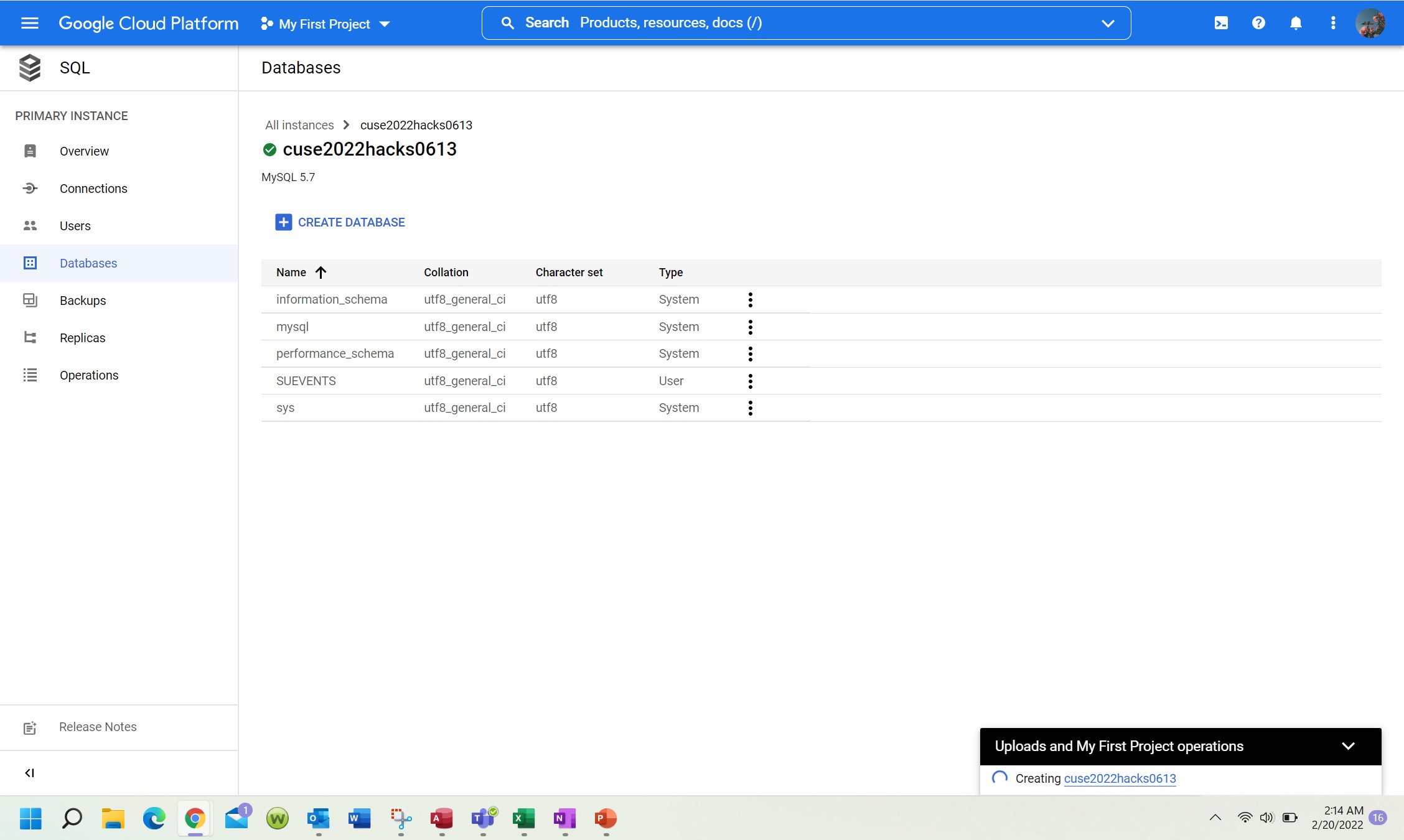
SUEVENTS database created with Google Cloud Platform's SQL
Inspiration
Currently, Syracuse University has an events calendar where all on-campus activities are listed. However, not all community members are aware of the website due to an overwhelming amount of sources that organizations use to spread the word on their events. In addition, we understand that not all community members are on social media, check their emails, or even look at flyers. This is what initially sparked the idea of creating a website that all university members can reach for the sole purpose of discovering on-campus events/activities. The website personalization for students, who are the primary users. Therefore, once we discussed what features we wished the website could have, we decided to look from two different perspectives, not only from the students point of view, but also from the event organizers’. All team members are involved in campus affiliations and understand how difficult it can get when it comes to recruiting new members and simply making the rest of the campus community aware of such events.
What it does
Offers an easy-to-use interface for both the event organizers and student users. For event organizers, they can make their event's information as detailed as wanted, while still being able to make changes and notify students about these changes automatically. For students, Otto's Organizer offers a single place where all events will be displayed and even allows them to personalize their search to meet their needs and interests. Eventually, with access to Syracuse University Events API, all data will be implemented in the website to make it easier on the event organizers' side.
How we built it
With web development in mind, we assigned roles to team members; two on the frontend and two on the backend. As we communicated our progress, we began to implement more resources such as Google Cloud Platform, MOS Access, rep.lit, and Github. We initially began creating a repository in Github to use as a collaborative medium. Since Otto’s Organizer is currently exclusive to Syracuse University members, we used Firebase for authorization. Along the way, we ran into an obstacle regarding the API key needed for database access, therefore, we switched gears and created an instance using Google Cloud Platform's SQL. For demo purposes, we also created a simplified database suing Microsoft Access. Simultaneously, the frontend engineers used HTML and Javascript to create the website. Once all aspects were completed, we combined everything into one final piece, and Otto's Organizer was born.
Challenges we ran into
To access the Syracuse University Events API, an API key was required, which, due to short notice, we were unable to attain from Administrators. We then went back to the drawing board and switched gears. We eventually decided to create a database using Google Cloud Platform's SQL and eventually created a simplified database on Access for demo purposes. While using Google Cloud Platform, there was an issue regarding the credits in which was quickly resolved with the help of MLH and the members from Google. Due to lack of experience in coding, we had trouble on assigning roles for each team member. However, in order to make use of each individual's skillsets, we put the effort in learning from one another and eventually found several resources regarding coding languages and helped one another when needed. While trying to run the code behind the website, we were unable to get it to work until we finally realized to add the run command.
Accomplishments that we're proud of
We are proud of our ability to complete a project that was not the easiest due to the concepts and challenges faced during the planning/coding process. We left this hackathon with more knowledge about the amount of work that goes into abstracting and displaying data. Moreover, we proactively came up with our own idea about the calendar.
What we learned
In terms of creating an idea, we learned that it is great to have a backup plan due to the amount of times that we had to change our idea. Additionally, we had the great opportunity to hone our public speaking skills during our pitch to communicate the idea that we had and executed through the four to five minute presentation. Ultimately, this hackathon was the first for many in the group, so we tried to learn as much as we could about different databases, programming languages, etc.
What's next for Otto's Organizer
We believe that the Otto Organizers have a project that can be continued since it is based on a relevant problem. Fortunately, it does not dynamically affect our lives, but more so does not showcase what the university could offer. Also, this project does not need a major timeline; with a bit more time we could figure out a way to complete this project.
Built With
- access
- firebase
- github
- google-cloud
- google-cloud-sql
- html
- javascript
- parsehub
- rep.lit
- sql

Log in or sign up for Devpost to join the conversation.