Inspiration
People usually describe home-help needs in everyday language, not through service categories, schedules, and technical filters. This becomes especially important when a request may actually concern regulated healthcare, an emergency, or sensitive personal information.
We built Otthonsegítők AI CareFlow to explore how conversational intake can remain simple without handing safety-critical decisions to an unrestricted language model.
What it does
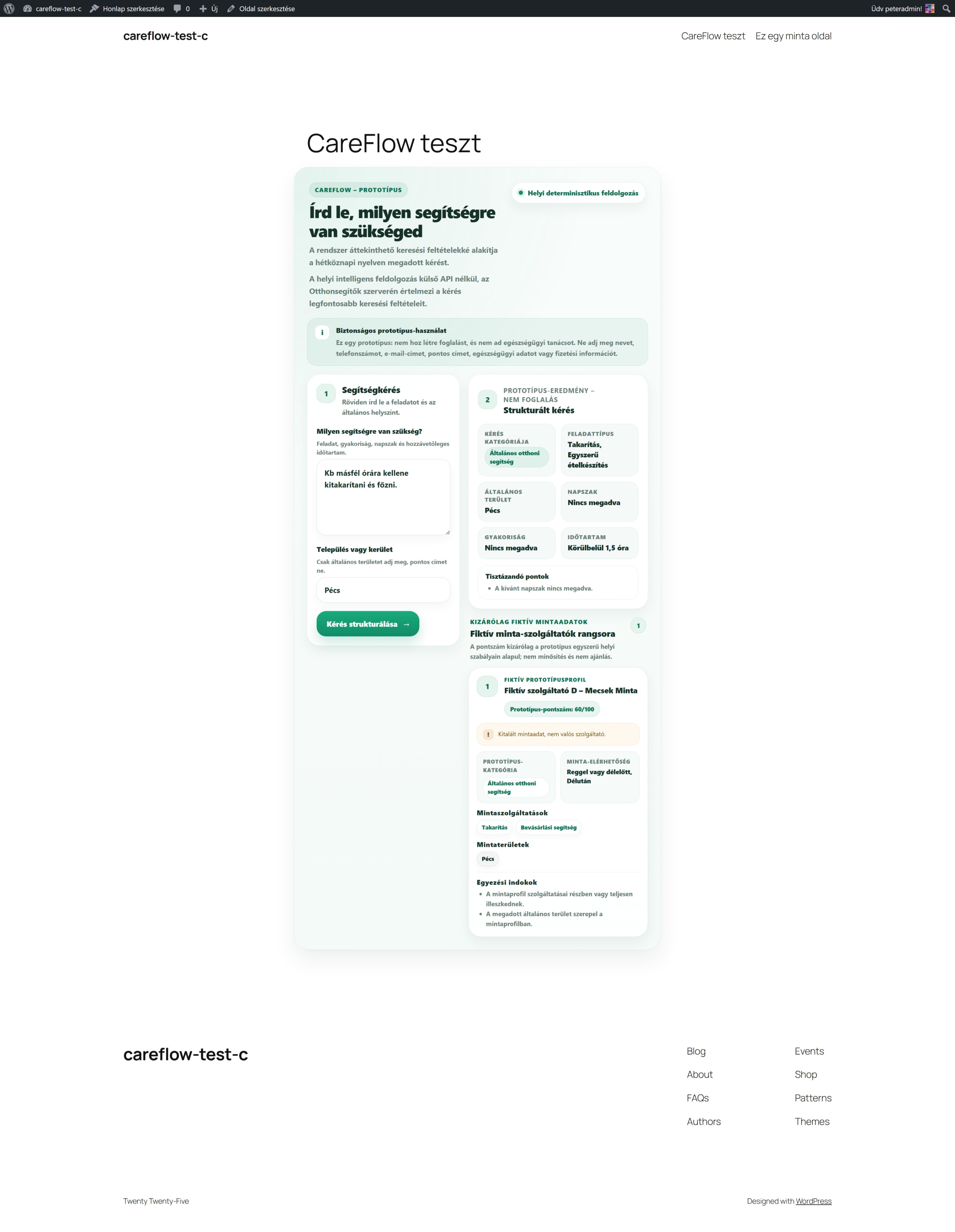
CareFlow is a WordPress prototype for Hungarian-language home-help requests.
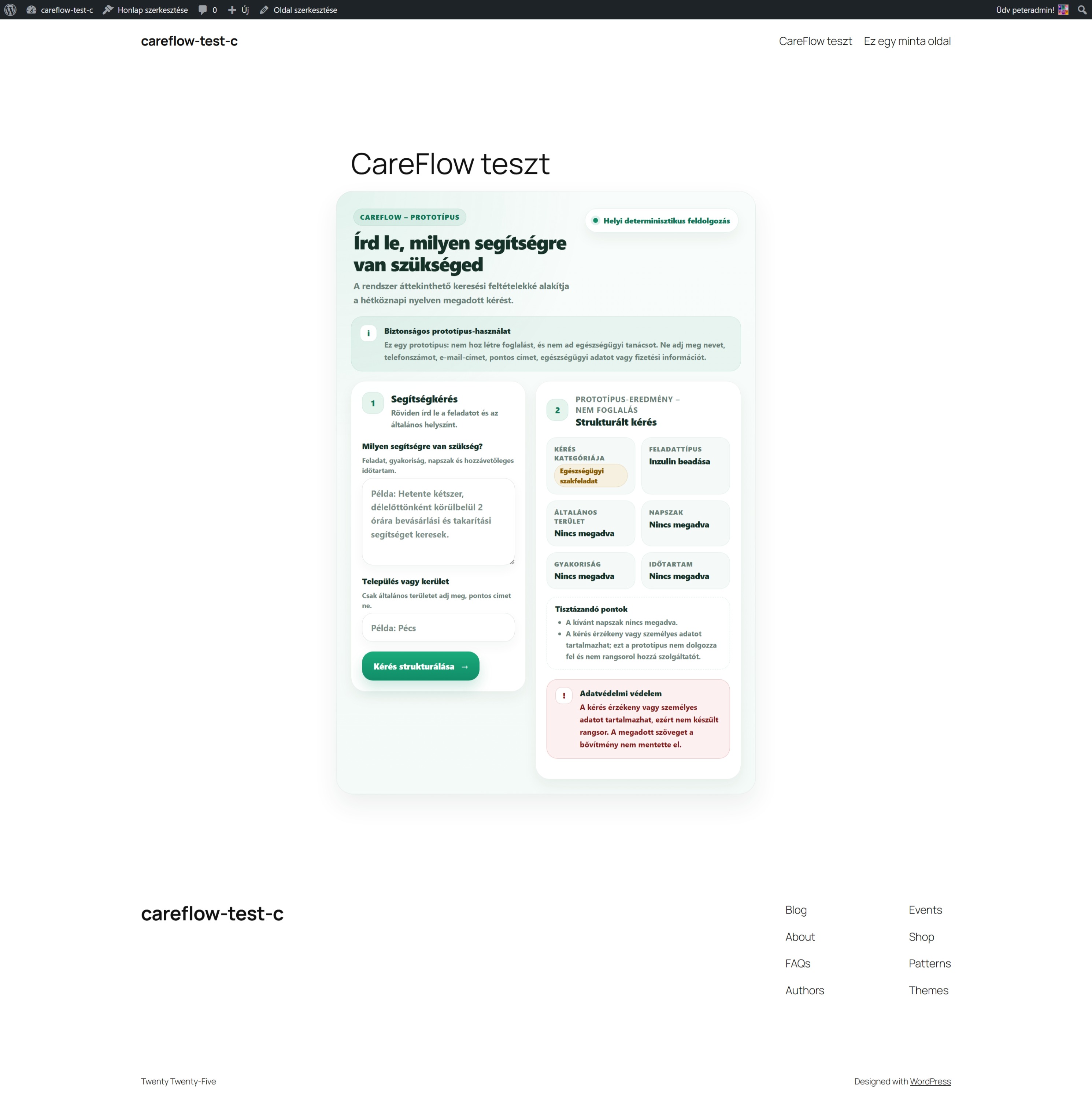
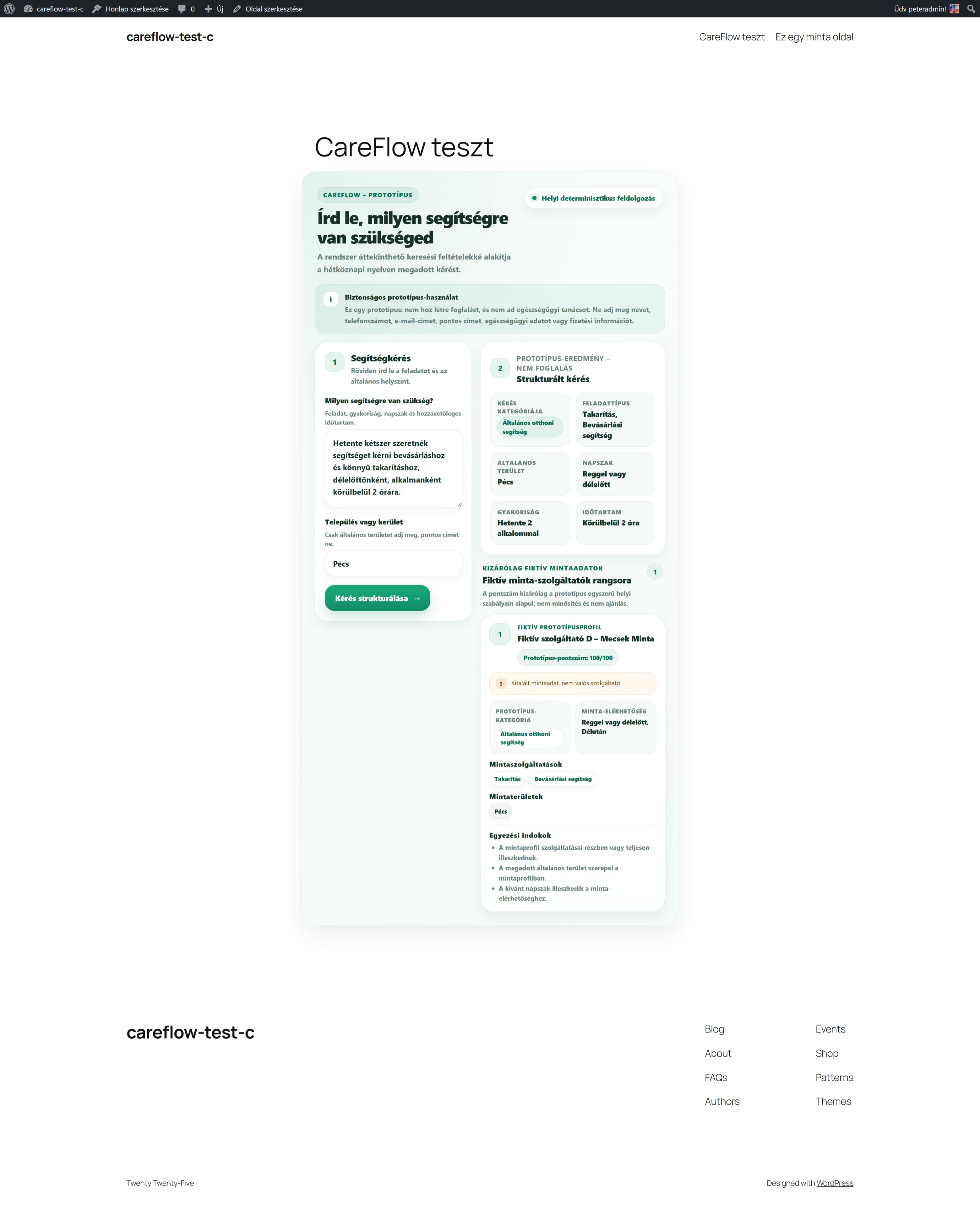
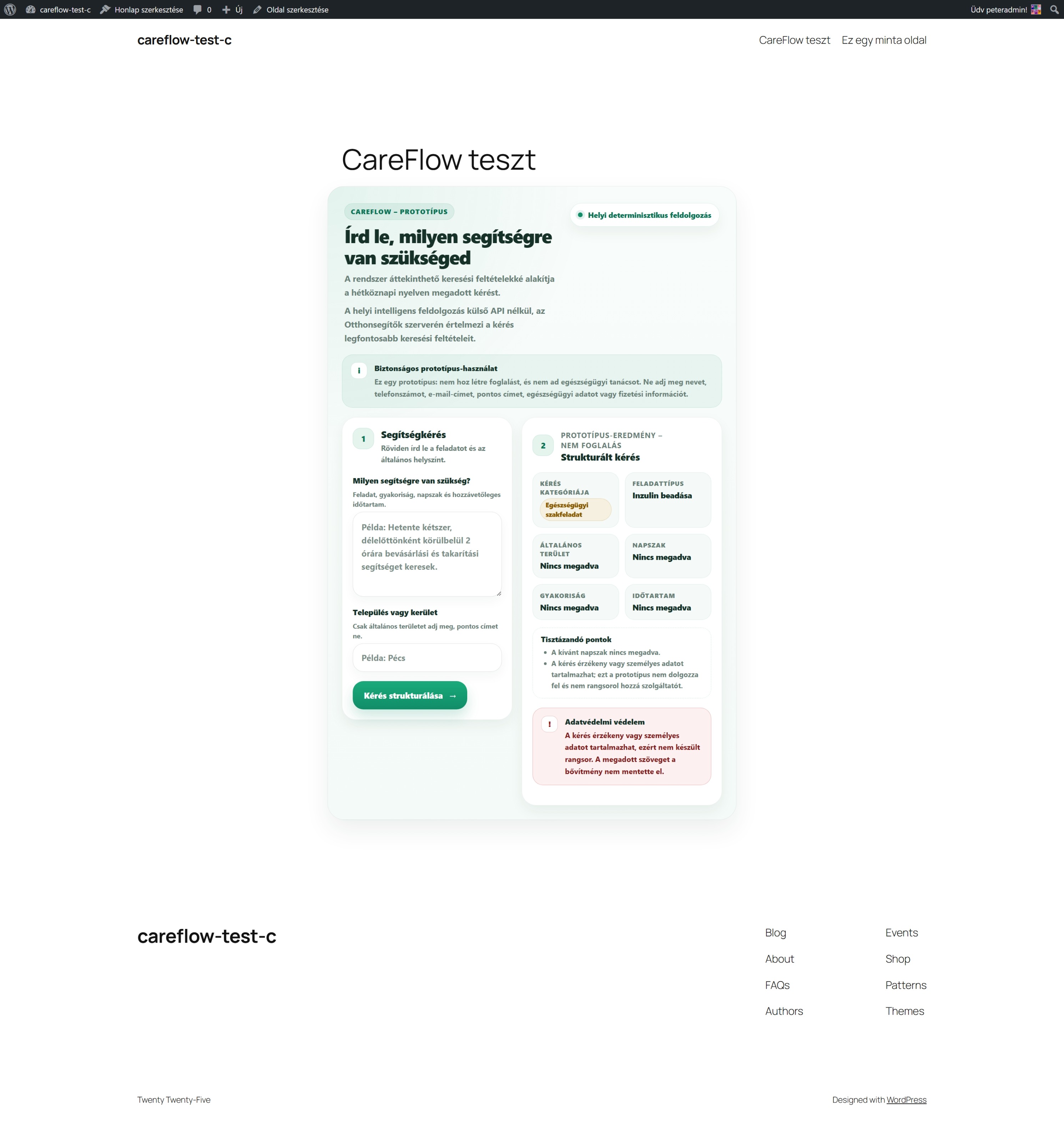
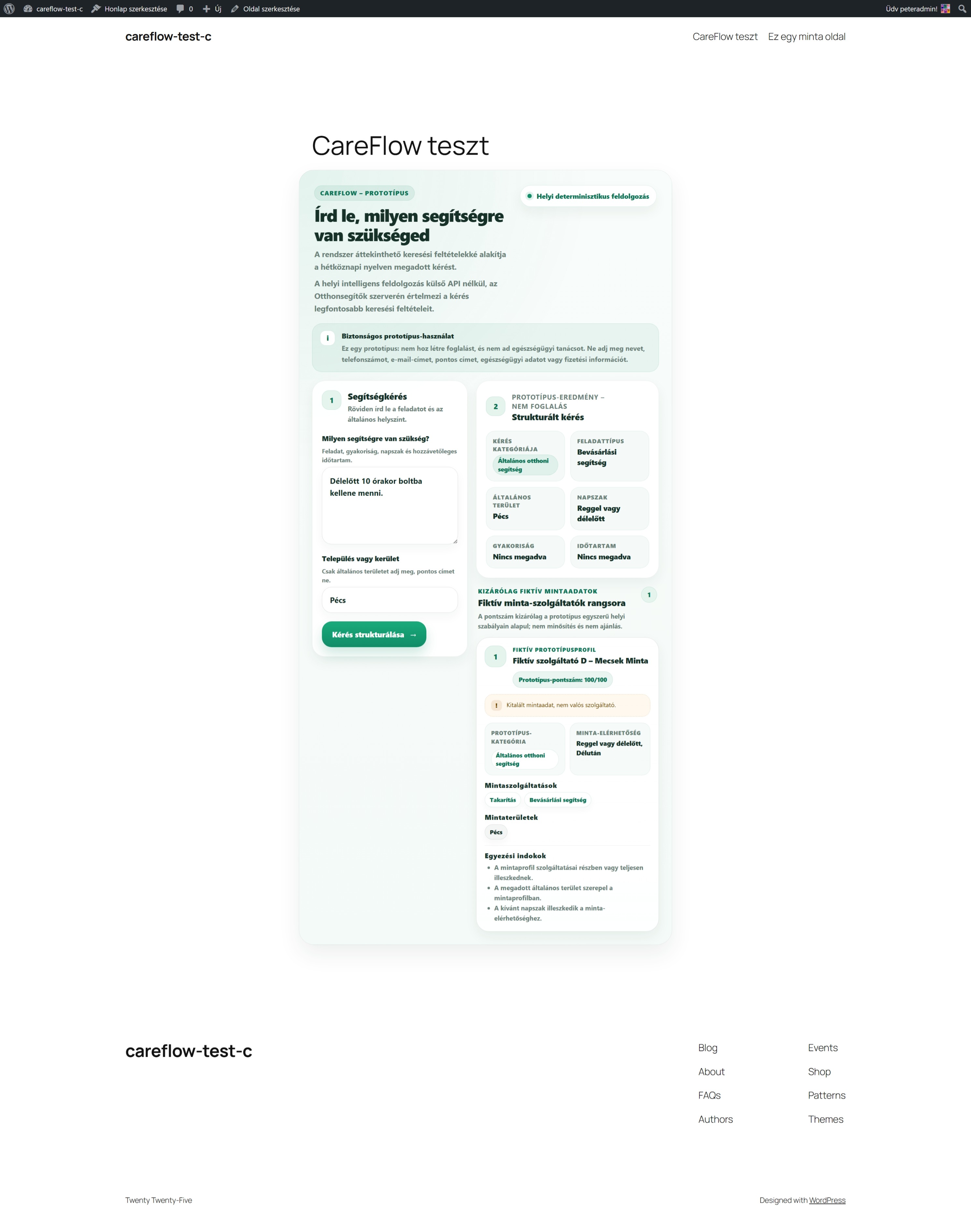
A user describes what kind of help they need and provides only a broad location. CareFlow converts the request into structured search criteria such as:
- task type
- daypart
- frequency
- approximate duration
- broad service area
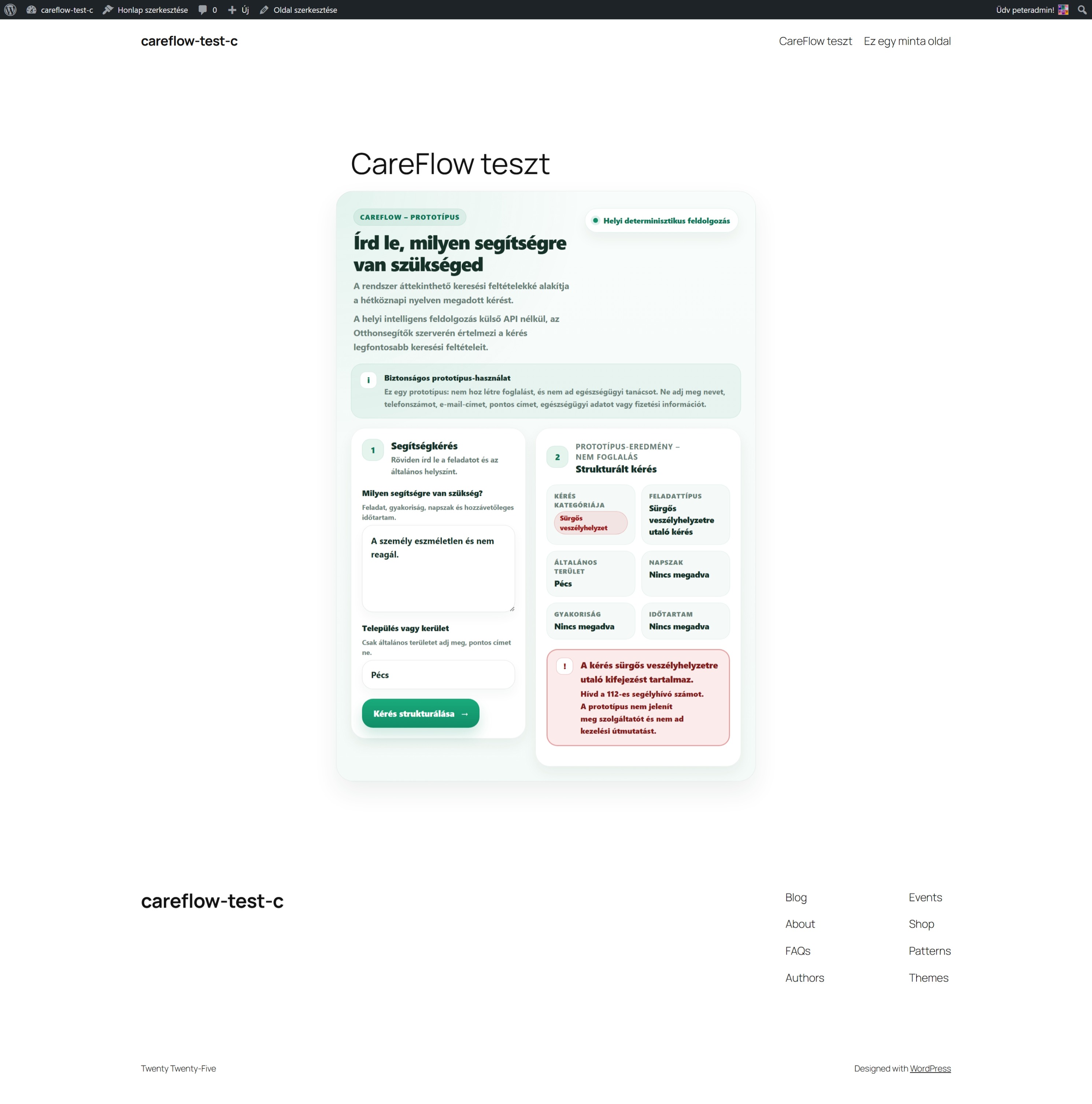
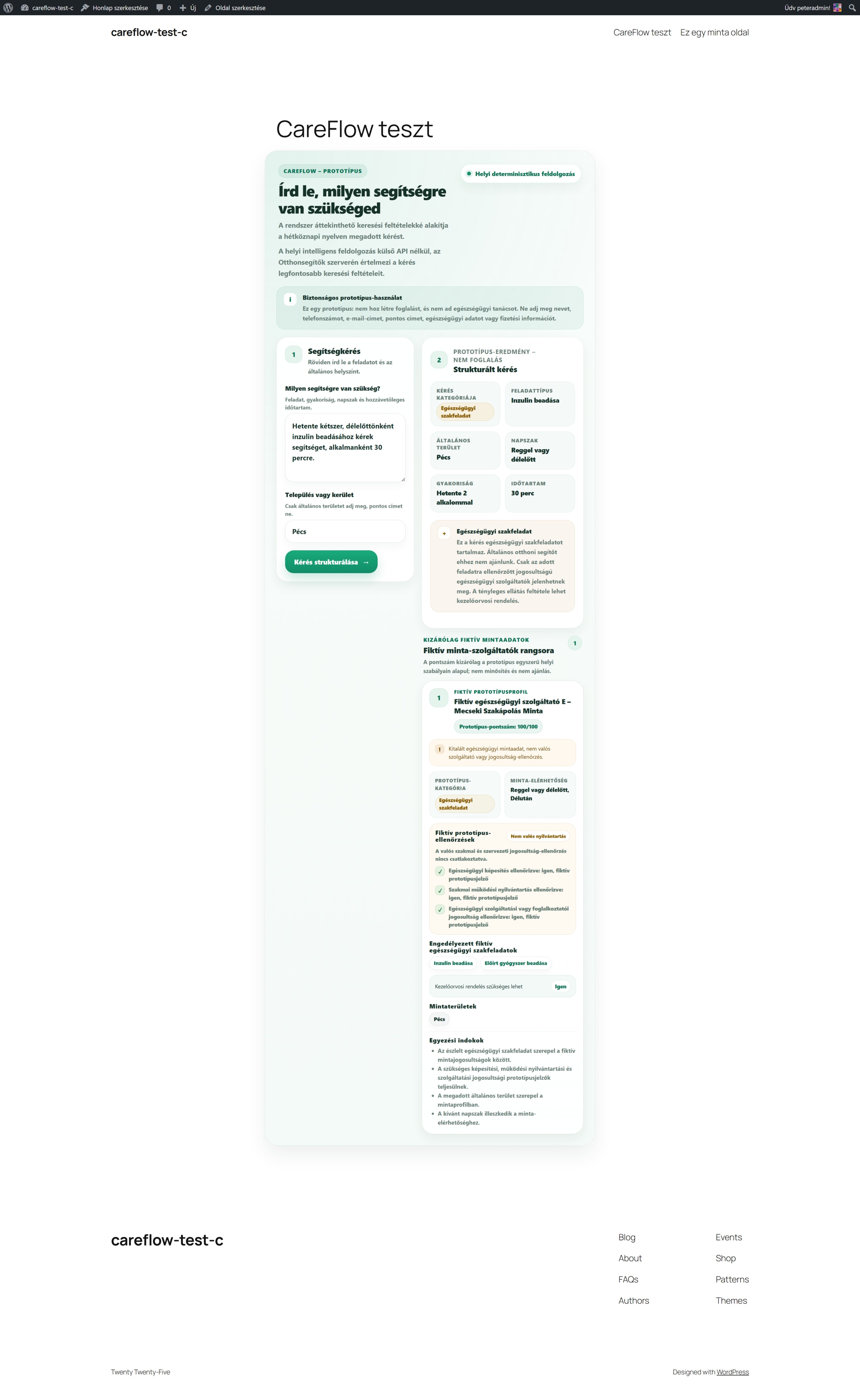
Every request is then assigned to one of three safety-first routes:
GENERAL_HOME_HELPREGULATED_HEALTHCAREURGENT_EMERGENCY
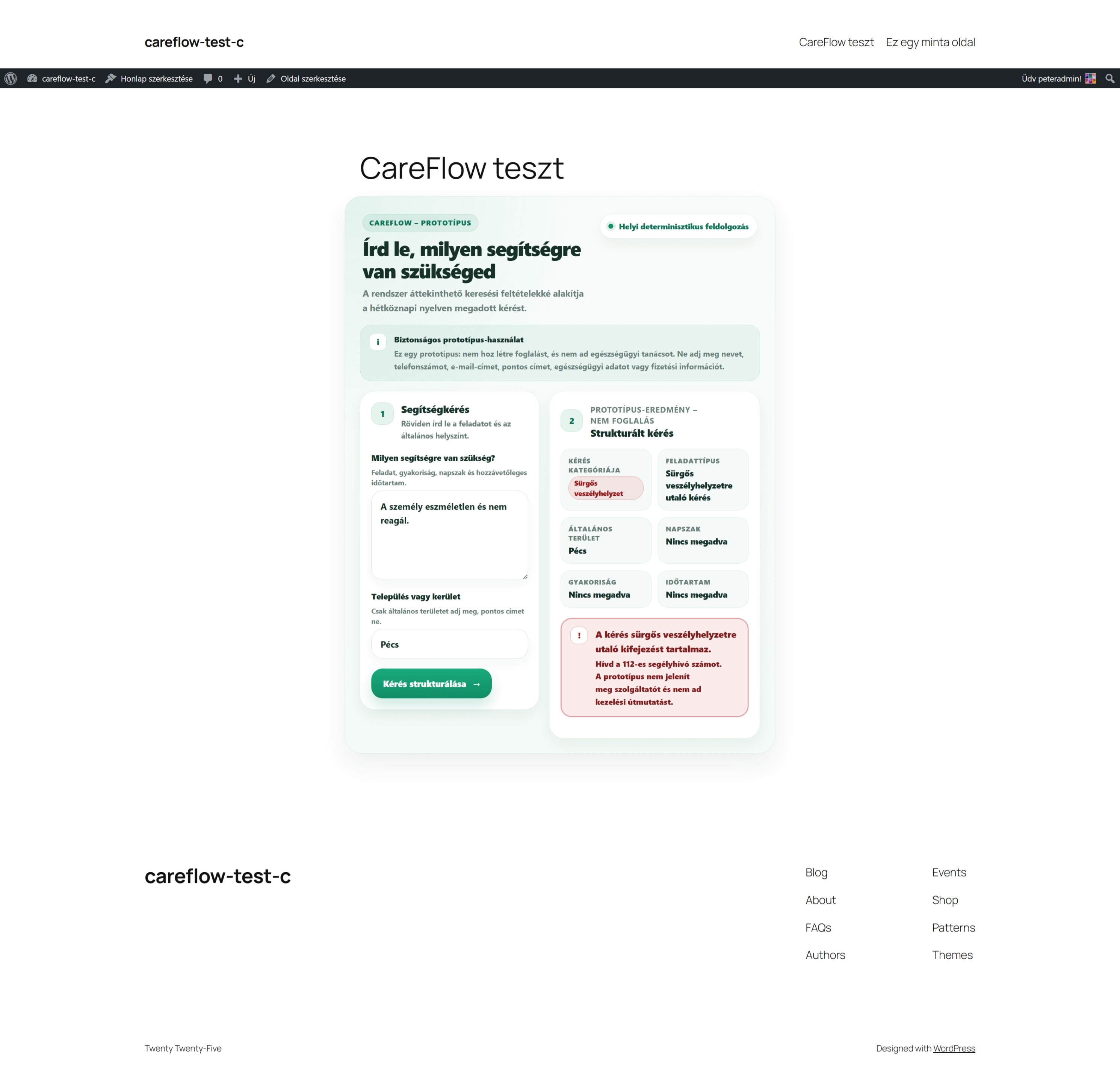
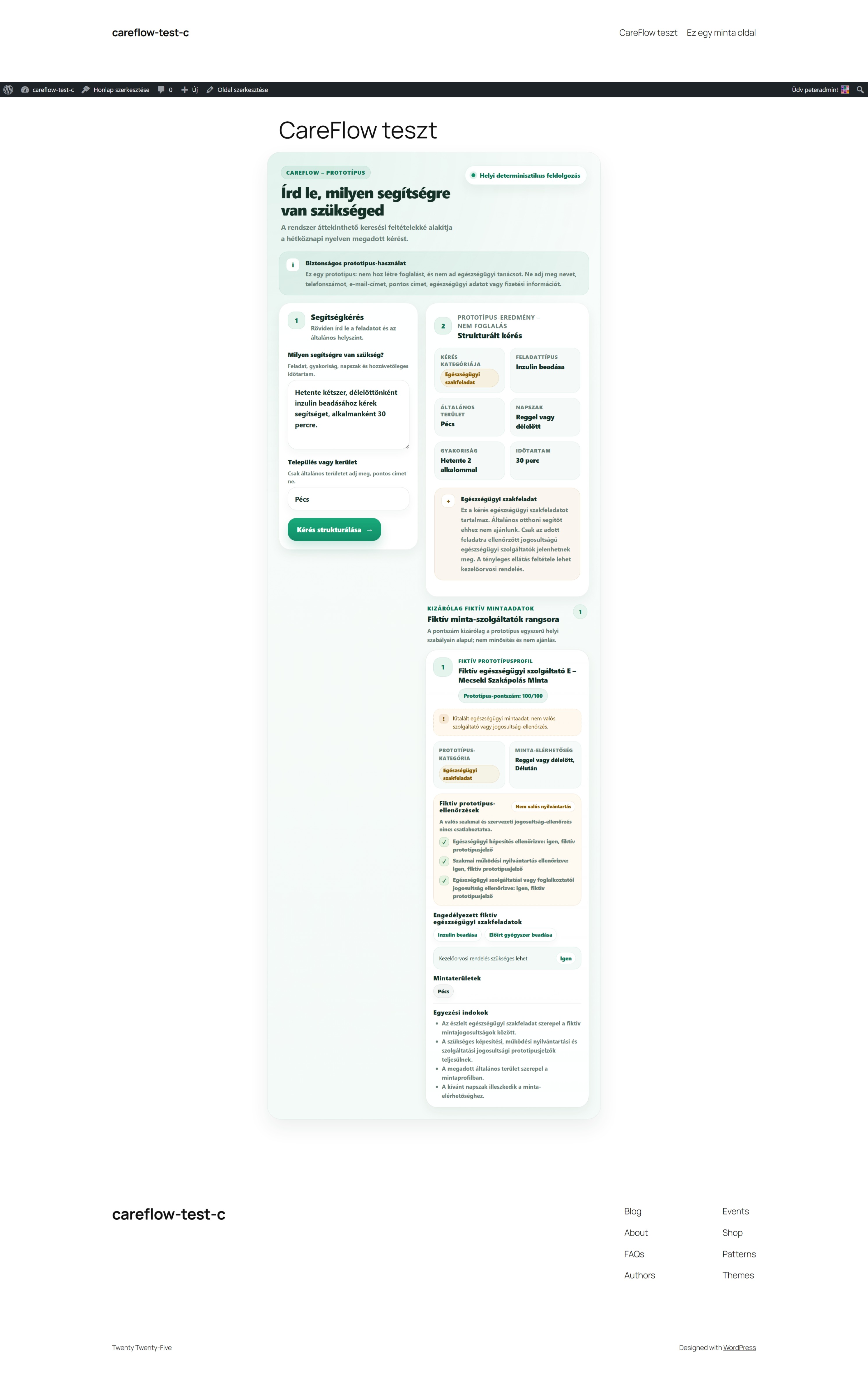
Emergency language disables provider matching and clearly directs the user to call 112. Regulated healthcare tasks are separated from ordinary home-help providers. Requests containing contact details or other sensitive information are blocked from matching.
All provider records displayed in the prototype are fictional test data. CareFlow does not create bookings, verify real healthcare professionals, give medical advice, or store submitted requests.
How we built it
The prototype is implemented as a standalone WordPress plugin using server-side PHP, HTML templates, and CSS.
Its processing pipeline is:
- WordPress nonce, sanitization, and input-length validation
- Deterministic Hungarian request parsing
- Authoritative privacy, emergency, and healthcare safety gates
- CareFlow Local Intelligence
- Optional GPT-5.6 structured enhancement
- Deterministic provider eligibility, scoring, and ranking
- Escaped server-rendered output
CareFlow Local Intelligence is a narrow, network-free Hungarian interpretation layer. It recognizes supported expressions, synonyms, inflections, negation, accent variations, conservative spelling mistakes, frequency, daypart, and duration.
It runs entirely on the WordPress server and requires:
- no API key
- no external network request
- no model download
- no third-party runtime
- no per-request model fee
The optional GPT-5.6 Responses API adapter is already implemented behind strict privacy and eligibility gates. It is disabled by default and has not been activated using a paid API key. We do not claim a completed live GPT-5.6 API request.
If activated later, GPT-5.6 may only propose a small allowlisted structured result for safe general-home-help requests. It cannot alter emergency or healthcare classification, enable blocked matching, view provider records, or change provider ranking.
How we used Codex
Codex was our main development collaborator throughout Build Week.
It helped with:
- architecture and processing-order design
- WordPress and PHP implementation
- deterministic safety-boundary review
- Hungarian local interpretation rules
- optional GPT-5.6 adapter architecture
- debugging and regression-test creation
- documentation and submission preparation
The finished prototype passed 54 automated PHP regression assertions, PHP 8.2.29 syntax checks, and manual LocalWP tests covering general help, healthcare routing, emergency handling, sensitive-data blocking, negation, duration, and clock-time interpretation.
Challenges we faced
The main challenge was improving natural-language usability without allowing an AI enhancement layer to control safety decisions.
We solved this by fixing the safety route before any enhancement is allowed to run. Both Local Intelligence and the optional GPT-5.6 adapter are additive only. They cannot weaken deterministic healthcare, emergency, privacy, or provider-eligibility rules.
Another challenge was cost. A home-help platform may receive many small requests, so even inexpensive API calls can accumulate. The working default therefore uses a zero-cost local interpretation layer, while preserving a controlled GPT-5.6 upgrade path for later use.
Accomplishments that we are proud of
- A functioning Hungarian natural-language WordPress prototype
- Zero-cost and network-free default operation
- Explicit emergency, healthcare, and privacy boundaries
- Conservative handling of negation and minor spelling errors
- An optional privacy-gated GPT-5.6 architecture
- Deterministic provider matching that remains independent of AI output
- 54 passing automated regression assertions
- Clear fictional-data and medical-safety disclosures
What we learned
Useful AI-assisted intake does not require giving a language model authority over every part of a workflow.
A hybrid architecture can use constrained language interpretation for convenience while keeping safety, privacy, eligibility, and ranking under deterministic control.
We also learned that Codex is valuable not only for generating code, but for reviewing assumptions, creating bounded tests, identifying edge cases, and maintaining an auditable development process.
What's next
The next steps are:
- connect CareFlow safely to the internal Otthonsegítők search filters
- expand the supported Hungarian vocabulary
- test the GPT-5.6 adapter in an isolated environment
- improve ambiguity handling
- design a separately governed real-provider verification workflow
- complete legal, privacy, security, and healthcare-governance review before any real healthcare deployment

Log in or sign up for Devpost to join the conversation.