-
-
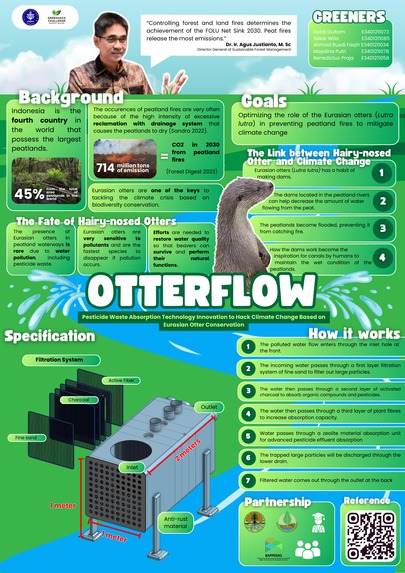
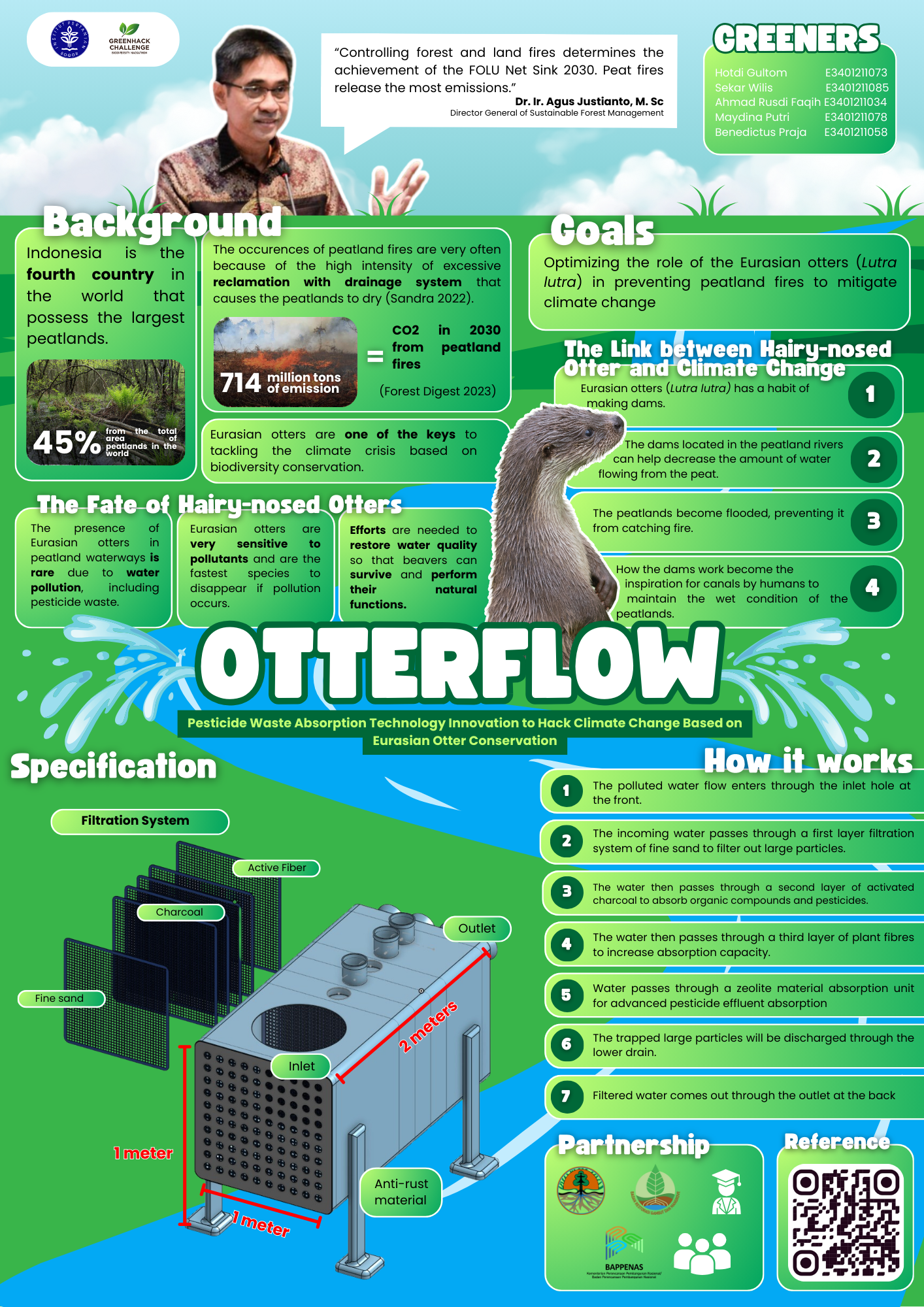
OtterFlow infograhy poster
Inspiration
OtterFlow is an implementation of our understanding that nature is already in a state of balance. However, irresponsible human actions often accelerate the destruction of nature. Take the Eurasian otter, a species that has become endangered due to the impact of pesticide pollution in water bodies. In fact, they have a natural role as dam builders in water bodies so that the flow of water can be retained and absorbed by the surrounding land. The dams built by the beavers have the same function as canal blocks built by humans to perform the rewetting function on peatlands. Basically, nature already has its own mechanism to keep peatland fires at bay, but human activities influence and often have domino effects such as peatland drainage. This drainage makes peatlands highly flammable and contributes to releasing huge amounts of carbon into the atmosphere.
What it does
OtterFlow filters water contaminated by pesticide and then release it, making it safer for the environment and otters
How we built it
OtterFlow was created using Onshape, a cloud-based product development system that provides CAD software. The process involves several stages with various tools and features within the application. The first step is initial sketching to define the basic shape of the component. Once the sketch is complete, the extrude feature is used to give thickness and dimension to the main component. For parts that require smooth shape transitions, such as joints between components, the loft tool is applied to create a smooth transition between two or more sketched profiles. Also, for design efficiency and consistency, the pattern feature is utilised to repeat certain parts, such as filter components. With this approach, the tool can be designed in detail and with precision, facilitating a visual understanding of how it works and its effectiveness. In order to implement in the real world, a partnership strategy with the Ministry of Environment and Forestry (MoEF), Peat and Mangrove Restoration Agency (BRGM), Academia, Directorate of Water Resources of Bappenas and local communities is required. All of these institutions are stakeholders who have the authority to protect peatlands and waterways to ensure the success of this project.
Challenges we ran into
The focus of this project was limited to pesticide pollutants, whereas the water pollutants that disturb otters are numerous and varied, and some of them are very challenging. This challenge required more advanced filtering technologies or the incorporation of multiple sorbent media types to effectively treat a wide range of pollutant compounds. The participation of local communities is also crucial to maintaining sustainable operations, but a lack of understanding and awareness of the impact of pesticides on ecosystems can be a barrier. Community education and training on the importance of equipment maintenance is necessary.
What we learned
Otters have a habit of building natural dams. Natural dams in peat streams prevent more water from escaping from the peat so that the peatland becomes waterlogged, preventing fires. This way of working inspired the construction of canal blocks by humans to keep peatlands wet. The presence of otters in peatland waterways is rare due to water pollution, including pesticide waste. Otters are very sensitive to pollutants and are the fastest species to disappear if pollution occurs. Therefore, we are trying to restore water quality so that otters can survive and carry out their natural functions with OtterFlow as an Innovation in Pesticide Waste Absorption Technology to Hack Climate Change Based on Otter Conservation.
What's next for OtterFlow: Pesticide Waste Absorption Technology Innovation
We are planning organize the production of this product in 2025, to actualize this product in 2026 and do the controlling in 2027.
Built With
- onshape


Log in or sign up for Devpost to join the conversation.