-
-
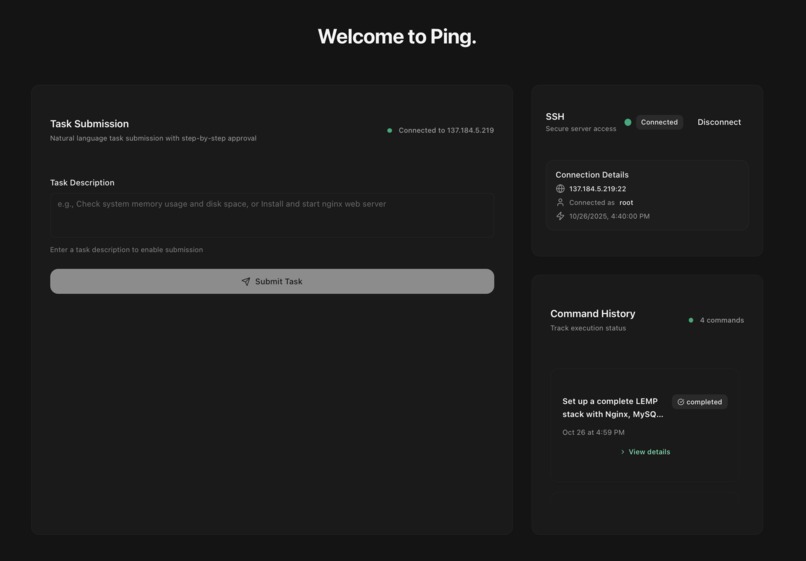
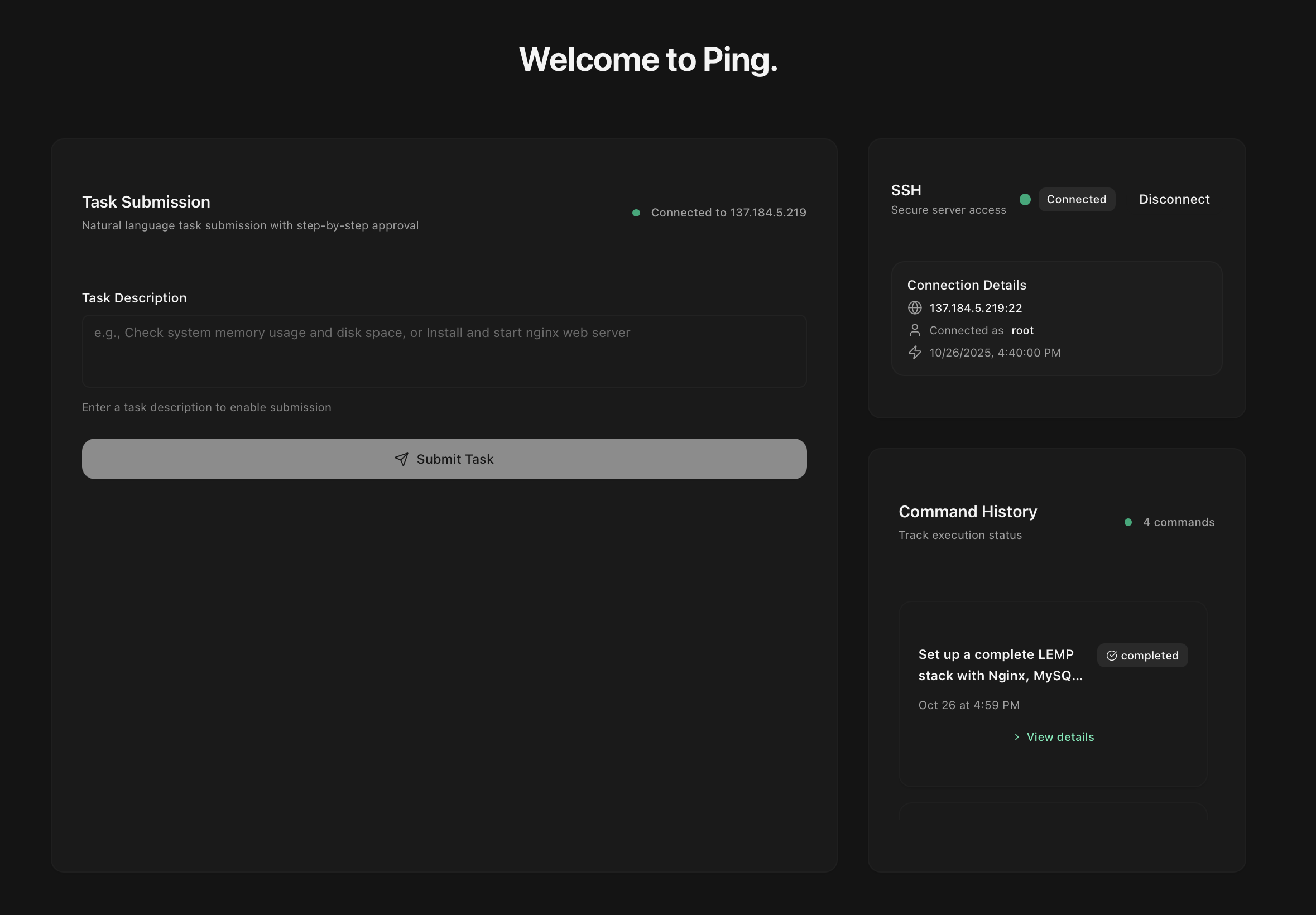
UI Interface connected to server
-
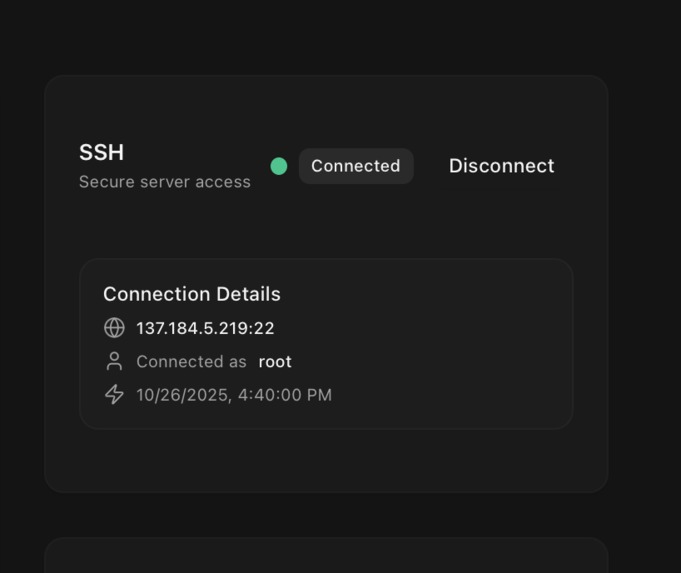
Server status via SSH connection
-
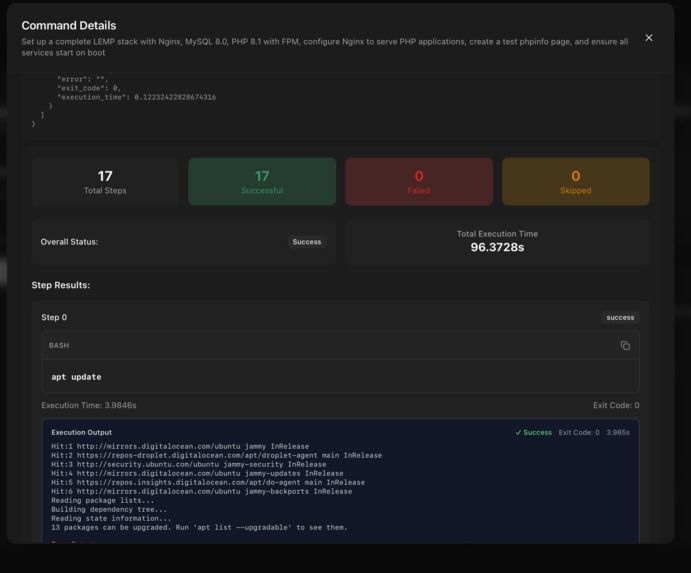
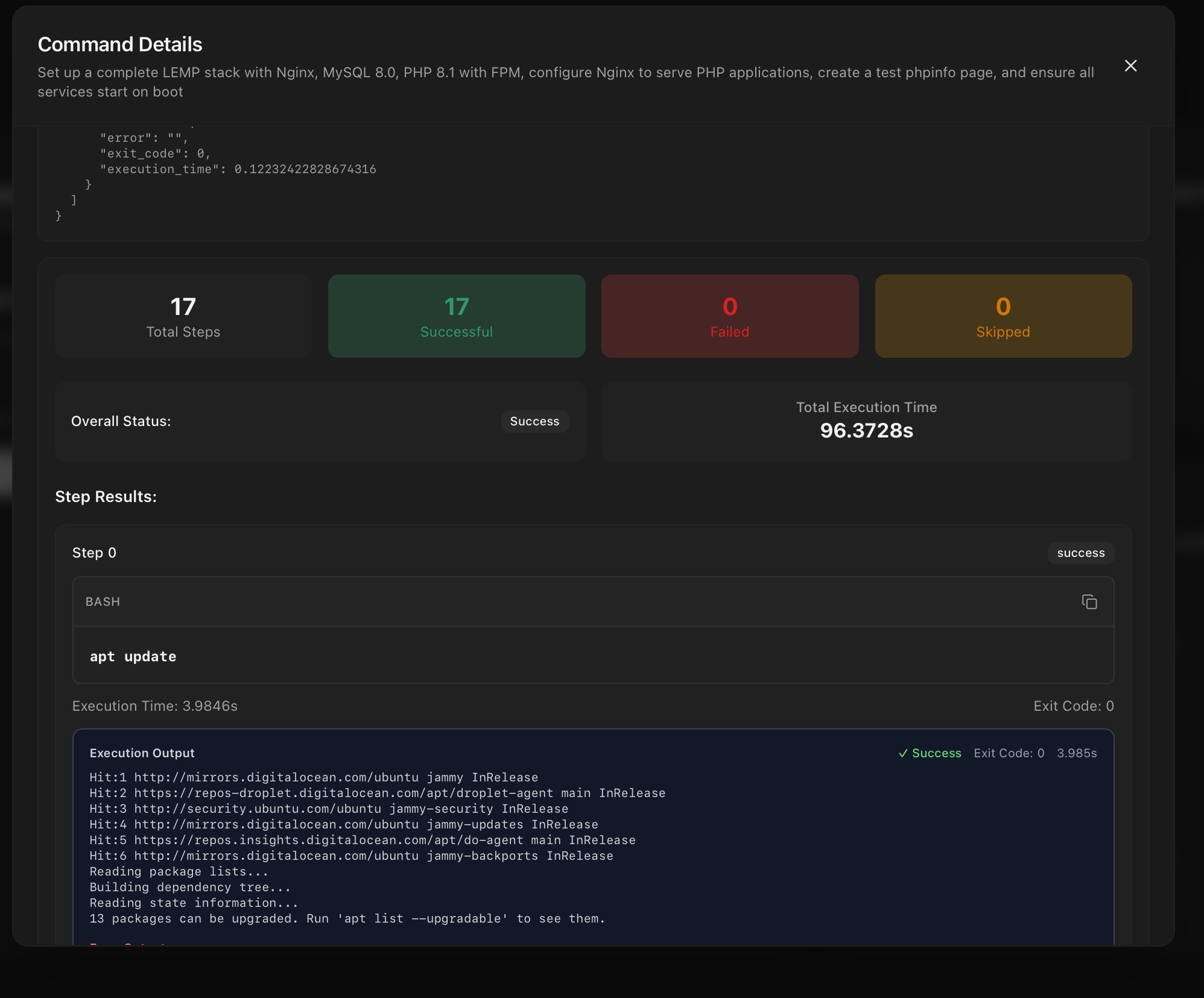
Command Details with runtime and all outputs for audit logging
-
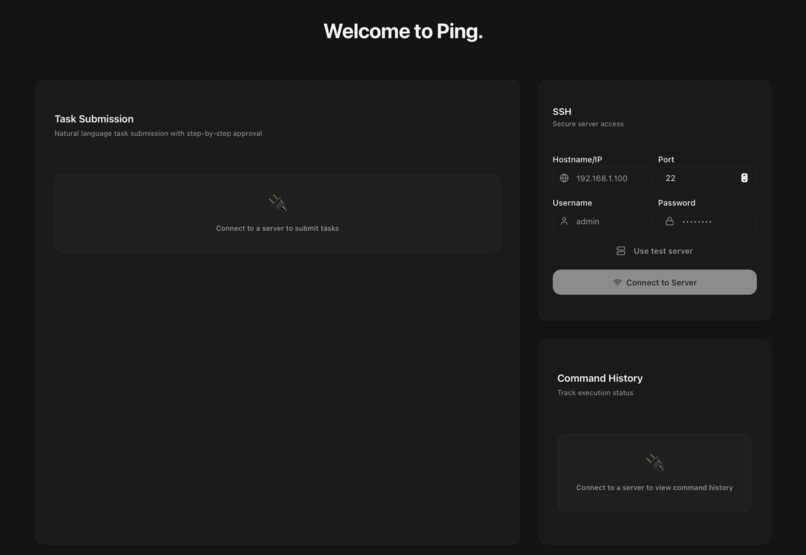
UI before SSH connection
-
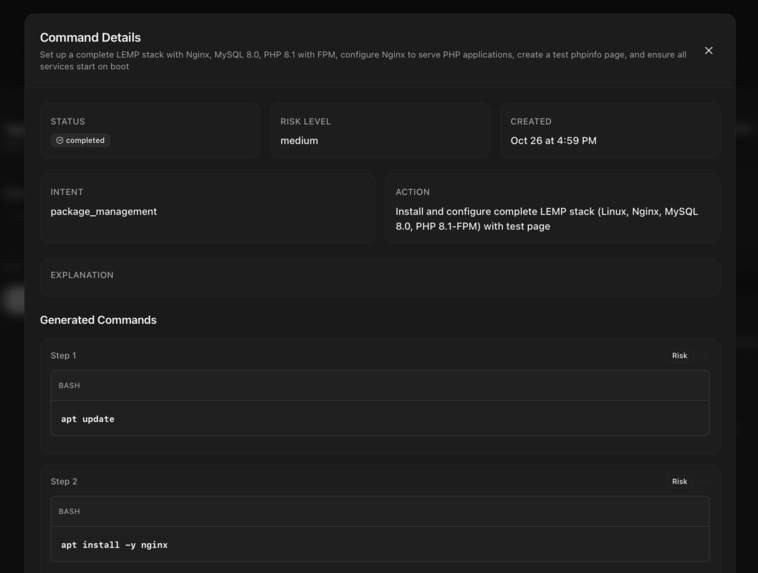
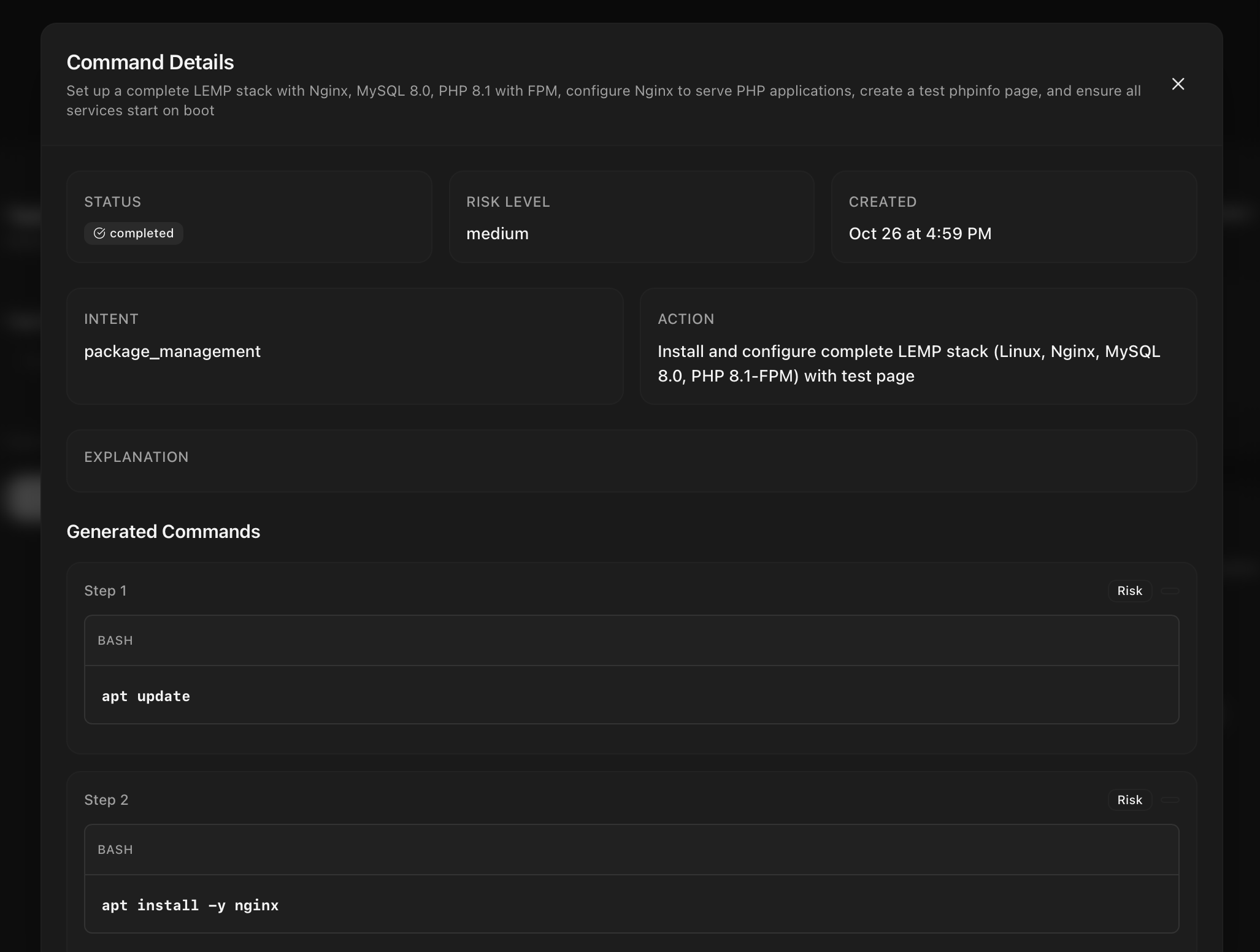
Command Details


Ping AI - Intelligent DevOps Agent
Inspiration
Modern DevOps engineers are drowning in tool sprawl, juggling Ansible, Terraform, Jenkins, PagerDuty, Datadog, and 15+ other specialized tools. The current landscape forces a painful trade-off: AI tools are fast but unsafe for production, while traditional tools are safe but require manual playbooks and deep expertise. Whether deploying updates or diagnosing a 3 AM production outage, engineers spend more time coordinating between tools than solving problems.
We built Ping AI to bridge this gap, combining the speed of AI with the safety and compliance of traditional DevOps tools.
What it does
Ping AI is an intelligent DevOps agent that transforms natural language into production-ready server operations. Here's how it works:
The Workflow:
Connect - User provides SSH credentials to their server through our secure web interface
Describe - User types what they want in plain English: "Set up a complete LEMP stack with Nginx, MySQL 8.0, and PHP 8.1"
Analyze - Ping automatically connects to the server and profiles the entire environment:
- Operating system type and version (Ubuntu 20.04, CentOS 7, etc.)
- Available resources (RAM, CPU, disk space)
- Installed tools and package managers (apt, yum, docker, etc.)
- Running services and port bindings
- User permissions and capabilities
Generate - Using Claude Sonnet 4.5, Ping creates a sequence of production-ready commands tailored specifically to that server. For a 1GB RAM Ubuntu server, MySQL gets different memory settings than a 16GB CentOS server. If nginx is already running, Ping configures around it.
Review - User sees each command before it runs, along with:
- What the command does in plain English
- Risk level (low/medium/high)
- Expected outcome
- Potential issues
Execute - After approval, Ping runs commands with real-time output streaming. Users see exactly what's happening as it happens.
Verify - Ping confirms success, logs everything for compliance, and provides troubleshooting if issues arise.
This entire workflow reduces multi-hour DevOps tasks to minutes. A complete LEMP stack that normally takes 2-3 hours of manual configuration completes in 90 seconds. Docker installation drops from 30-45 minutes to 45 seconds. The key is context awareness: every command is generated with complete knowledge of the specific server infrastructure, not generic scripts from Stack Overflow.
How we built it
The backend uses FastAPI with Anthropic Claude Sonnet 4.5, featuring 180+ lines of carefully engineered system prompts optimized for DevOps operations. We built a sophisticated system detection pipeline that profiles the OS, resources, tool inventory, running services, and user capabilities before every command generation. This context feeds into Claude's 200K token window for truly intelligent adaptation.
For safety, we engineered a multi-stage system with pre-validation checks, AI-powered risk assessment, approval workflows, idempotency guarantees, error handling, and audit logging. We implemented robust JSON parsing with multiple fallback strategies to handle edge cases in AI output, achieving 99.9%+ reliability.
Security uses Fernet symmetric encryption for SSH credentials with auto-generated keys and session-based authentication. The real-time execution engine streams SSH output non-blocking with exit code tracking and detailed error reporting.
The frontend is built with Next.js 15, TypeScript, and Tailwind CSS, providing real-time execution feedback and a clean interface engineers actually want to use.
Challenges we ran into
Claude occasionally returned malformed JSON or wrapped responses in markdown code blocks. We solved this with a multi-stage parsing pipeline featuring three fallback strategies: direct JSON parsing, markdown code block extraction, and regex-based extraction with error correction.
Maintaining persistent SSH connections across multiple commands while handling network interruptions and concurrent sessions required building a robust connection pooling system with automatic reconnection, health checks, and graceful degradation. Each user session gets isolated connections with automatic cleanup.
Different Linux distributions use different package managers, init systems, and tool availability. We implemented comprehensive system detection that profiles the OS before command generation, enabling Claude to generate native commands for each distribution.
Ensuring commands could be safely re-run after partial failures required engineering prompts that generate idempotent commands with existence checks, proper flags, and rollback procedures.
Accomplishments that we're proud of
Ping AI eliminates hours of monotonous DevOps work, transforming multi-hour tasks into 90-second operations. Take a real example: "Set up a complete LEMP stack with Nginx, MySQL 8.0, PHP 8.1 with FPM, configure Nginx to serve PHP applications, create a test phpinfo page, and ensure all services start on boot." This task typically requires 1-2 hours of manual configuration, documentation lookup, and troubleshooting. Ping completed it in 90 seconds with 18 production-ready commands tailored to the specific server environment.
What makes this possible is our context-aware architecture. Every single command Ping generates is built with deep knowledge of the target server: its operating system and version, available RAM and CPU resources, installed tools and package managers, running services and port bindings, and existing configurations. This isn't generic script execution. When Ping sets up MySQL on a 957MB RAM system, it automatically adjusts memory configurations. When it detects Ubuntu versus CentOS, it uses apt versus yum. When it finds nginx already running, it avoids port conflicts.
We achieved 99.9%+ JSON parsing reliability through our multi-stage fallback system, and sub-second response times for command generation. The system works across six major Linux distributions with zero-downtime deployment support. Our safety layer makes AI-driven DevOps genuinely trustworthy with pre-execution validation, risk assessment, approval workflows, and encrypted credential storage. Ping AI is production-ready from day one, successfully deploying complete infrastructure stacks, Docker environments, database automation, and performance monitoring on real servers.
What we learned
AI prompt engineering requires meticulous iteration. Our final 180-line system prompt resulted from hundreds of refinements. Explicit formatting instructions are critical, context prioritization matters, and temperature tuning (we use 0.1) ensures consistent outputs.
Generic commands from Stack Overflow rarely work out of the box. Truly useful automation requires deep context awareness: OS-specific nuances, resource constraints, tool availability, and service dependencies. We learned that security must be built in from the start with encryption, audit logging, secure failure modes, and input validation.
Real-time feedback is critical for trust. Users need to see live command output, execution time tracking, and detailed error messages. Production systems need multiple fallback strategies for robustness: our multi-stage JSON parsing, connection pooling with health checks, and graceful degradation keep the system usable even when components fail.
What's next for Ping AI
We're building multi-server orchestration to execute commands across fleets simultaneously with intelligent coordination for rolling deployments and centralized logging. Advanced rollback capabilities will include automatic snapshot creation before risky operations and one-click rollback to known-good states.
Infrastructure-as-Code integration will parse existing Terraform and Ansible configurations, generate IaC from natural language, and detect drift. We're adding Windows Server support with PowerShell command generation for hybrid infrastructure management.
Enhanced security features include role-based access control for team collaboration, integration with Vault and AWS Secrets Manager, and security policy enforcement. We're also building Kubernetes support for natural language deployments and intelligent pod scaling.
The ultimate goal is creating the next abstraction layer for infrastructure management. Engineers will describe what they want in plain English and trust AI to execute it safely in production, fundamentally rethinking how humans interact with infrastructure.
Built With
- claude
- coderabbit
- css
- cursor
- digitalocean
- fastapi
- git
- javascript
- linux
- next.js
- npm
- paramiko
- pip
- postgresql
- python
- react
- sql
- sqlalchemy
- sqlite
- ssh
- tailwind
- typescript
- uvicorn



Log in or sign up for Devpost to join the conversation.