Inspiration
In La Réunion, mutual aid is part of everyday life. People constantly look for someone nearby to repair something, maintain a garden, rent an object, find a local professional, discover a producer, or give away something they no longer need.
However, the major peer-to-peer service platforms used in mainland France are barely established in France’s overseas territories. Local needs are therefore often handled through scattered Facebook groups, private messages, word of mouth, or informal listings.
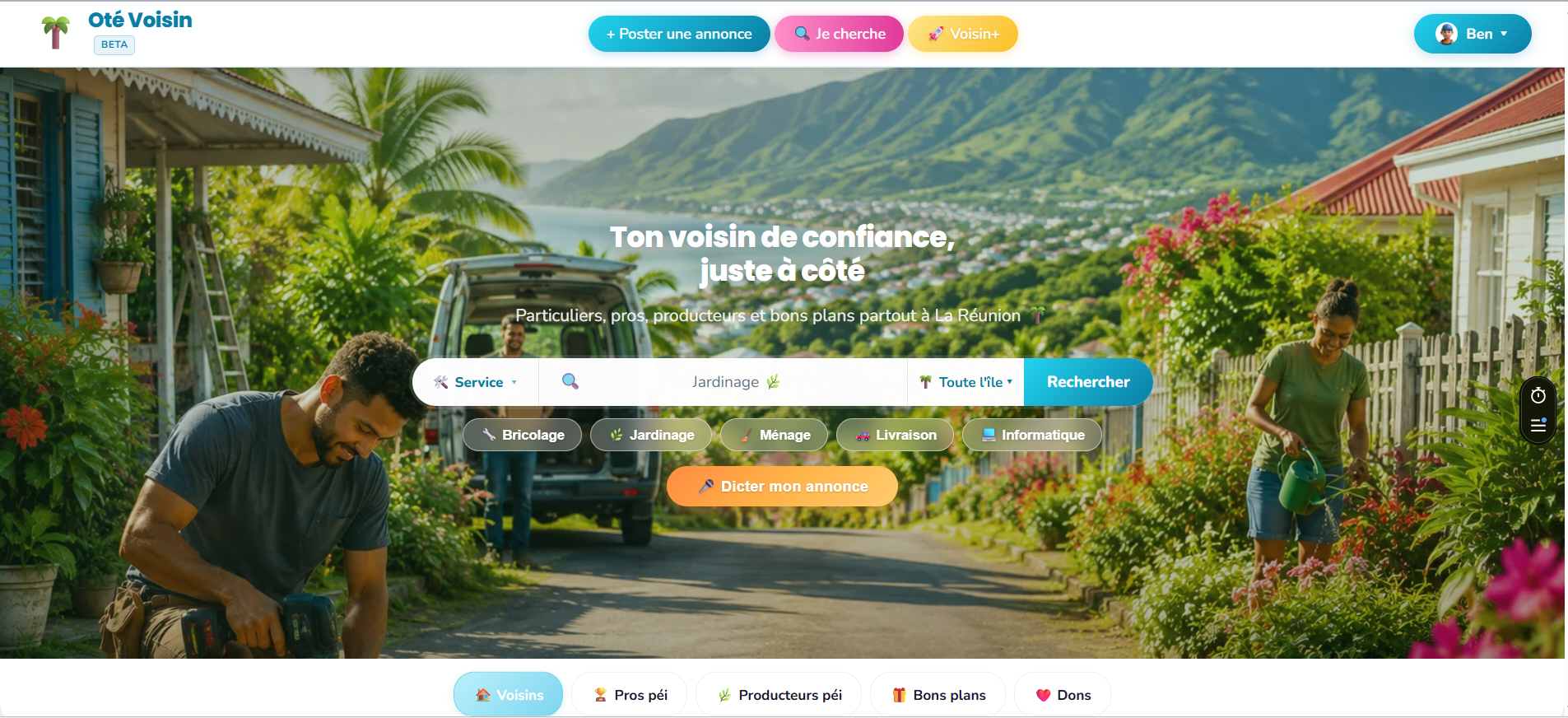
I created Oté Voisin to turn this existing culture of mutual aid into a structured, trusted, and accessible hyperlocal marketplace designed for La Réunion.
I came from a commercial background and started developing the product roughly four months before this submission, with almost no initial software-development experience.
What it does
Oté Voisin brings several local use cases together in one platform:
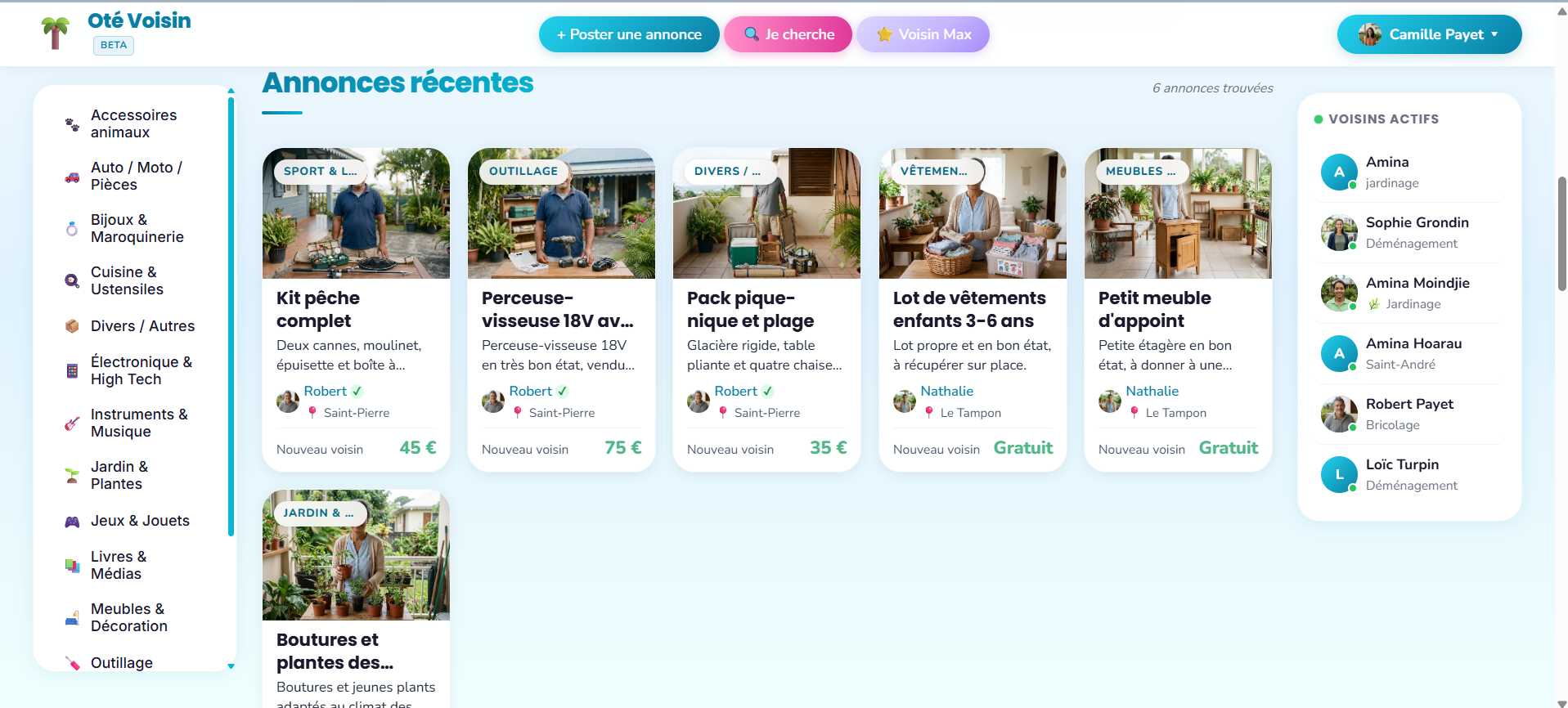
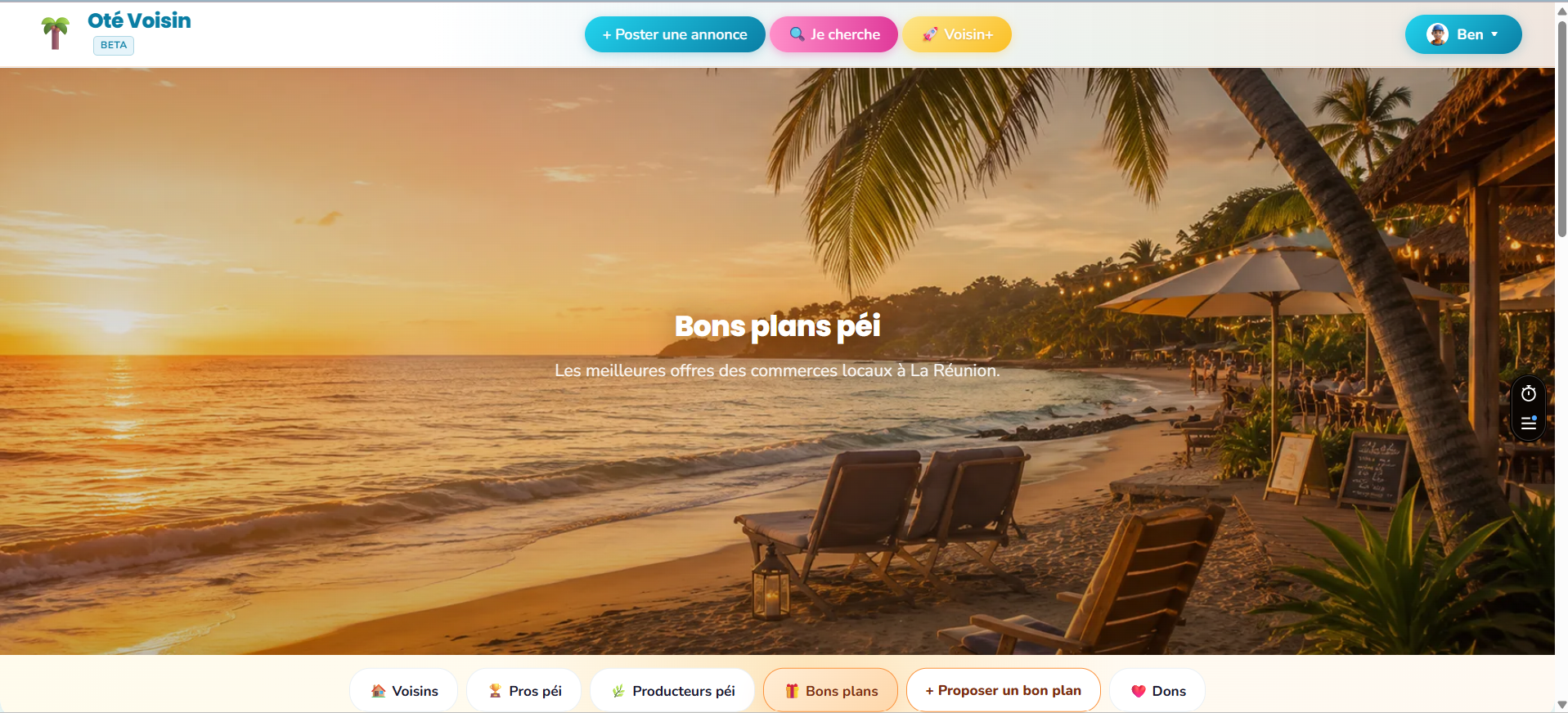
- Voisins for services, requests, objects, and rentals
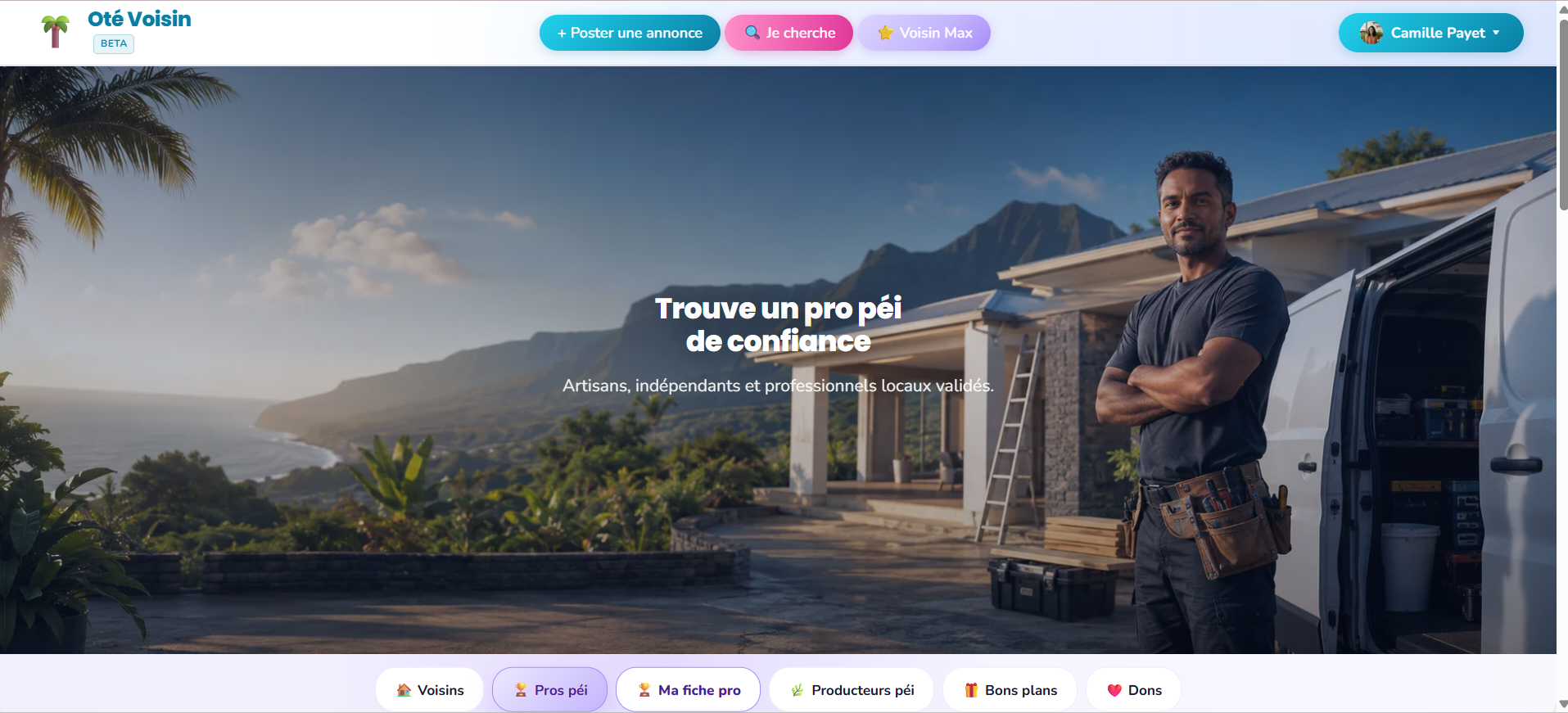
- Pros péi for local professional profiles
- Producteurs péi for farmers and local producers
- Bons Plans for territory-based offers
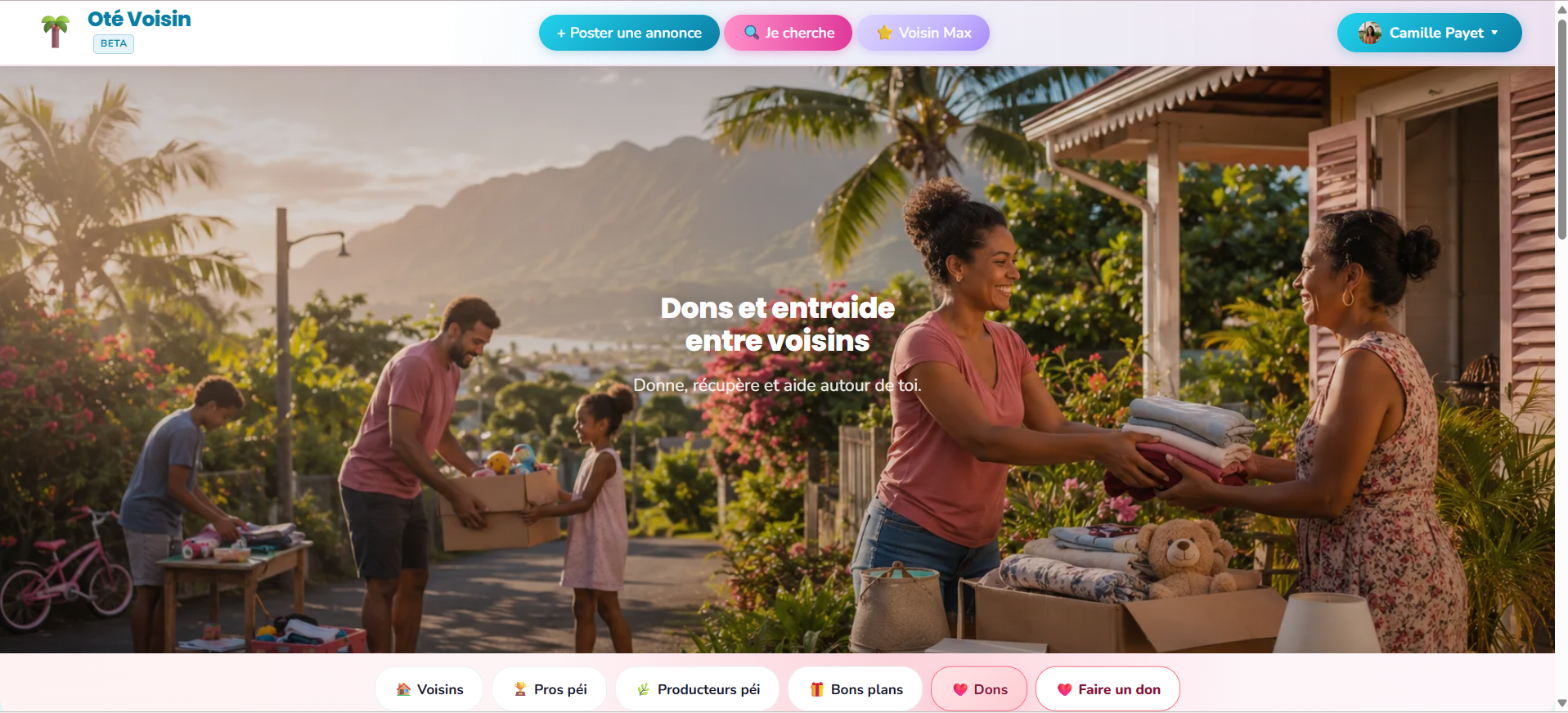
- Dons for commission-free donations
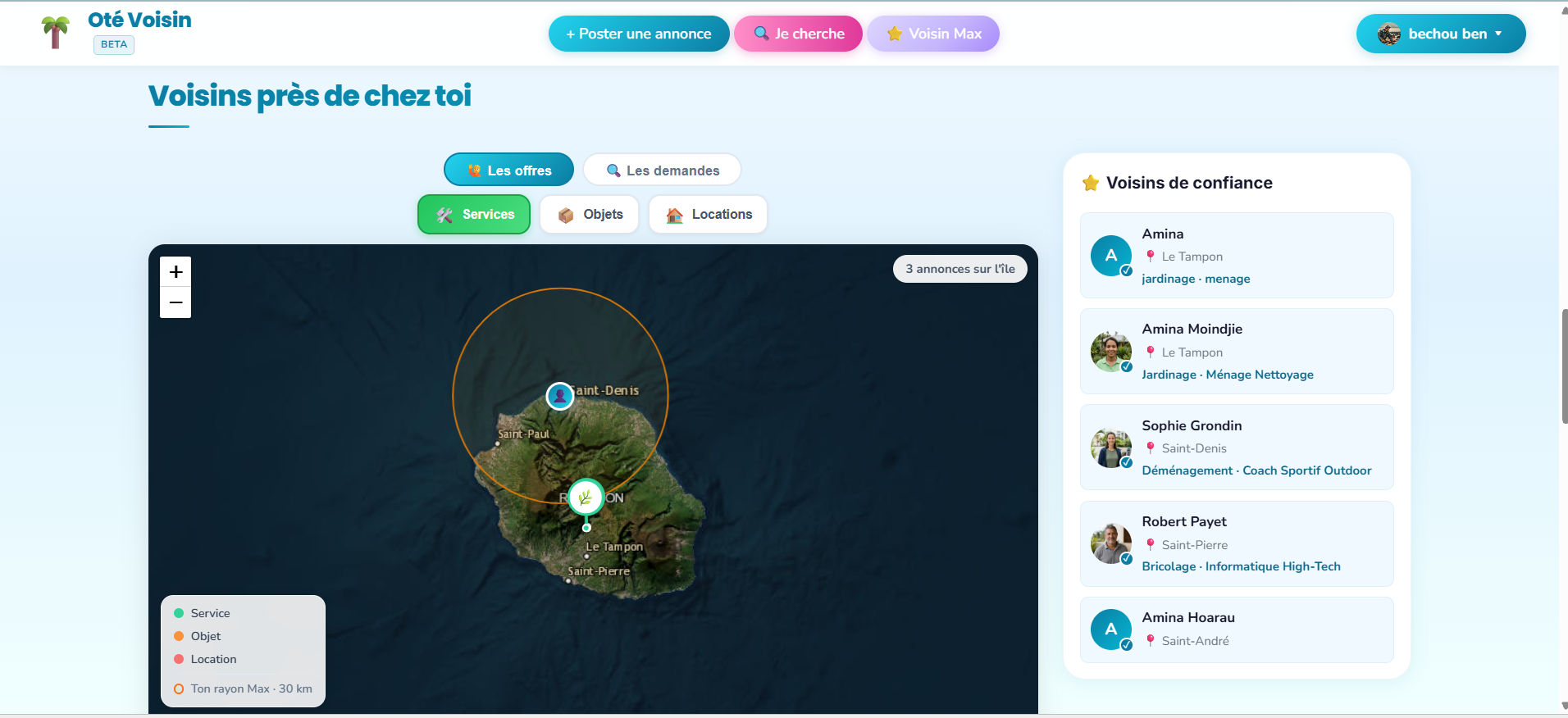
Users can publish listings, search by category and municipality, use a dynamic map, communicate through internal messaging, follow a mission, and build a local reputation through contextual reviews.
The matching system considers the category, municipality, distance, and intervention radius. The objective is not only to show listings, but to connect each local need with the most relevant nearby person.
Oté Voisin also includes a mobile application with demonstrable core journeys. Full web/mobile parity is still in progress.
Accessibility through voice and local AI
Some users are less comfortable with written forms or digital interfaces. Oté Voisin therefore explores voice-assisted publishing.
A user can simply describe a need aloud. During the Build Week demonstration:
- Whisper transcribed the voice locally
- Qwen 7B ran locally through LM Studio
- Qwen structured the request and assisted with moderation
- n8n orchestrated the local workflow
The moderation assistant can flag suspicious content, abnormal prices, or wording that requires human review. It also considers French and some Reunionese Creole expressions.
The AI does not make the final moderation decision. It raises and documents potential issues, while the final decision remains human.
The public marketplace is deployed online, but Whisper, Qwen 7B, LM Studio, and n8n are not yet continuously connected to the production environment. Their operational production integration is planned for the coming weeks.
How I built it
The main stack includes:
- React and Vite
- Node.js and Express
- PostgreSQL
- Railway
- Vercel
- Stripe
- Twilio
- Cloudinary
- Leaflet
- Expo for mobile
- Whisper
- Qwen 7B through LM Studio
- n8n
The GitHub repository was imported at version 1.0 in June 2026, while product development had started roughly four months before the Build Week submission.
Before Build Week, the product already included the marketplace foundation: authentication, listings, maps, messaging, requests, initial payment flows, and the main infrastructure.
During Build Week, I focused on strengthening the product rather than pretending that the entire platform had been created in one week.
The work included:
- contextual reputation and verified reviews
- French and Reunionese Creole-aware moderation assistance
- a more reliable voice-publishing workflow
- Stripe subscription, refund, dispute, payout, and idempotency safeguards
- business rules for professionals, producers, deals, and donations
- stronger authorization and public-data filtering
- safer separation between local and production environments
- navigation, onboarding, maps, and accessibility improvements
- mobile demonstration flows
- QA, adversarial reviews, testing documentation, and submission preparation
From July 13 to July 21, this process produced 87 traceable Git commits: 32 feature commits, 45 fixes, 6 documentation commits, and 4 repository-maintenance commits.
How I used GPT-5.6 and Codex
I used GPT-5.6, through ChatGPT Plus, as the project’s technical orchestrator.
It helped me break the roadmap into reviewable work packages, prepare precise technical briefs, analyze reports, define testing protocols, challenge architectural choices, and control delivery steps.
Codex contributed to audits, investigation, implementation, targeted fixes, testing, and verification of sensitive marketplace logic.
When the usage limit of my current plan was reached, I reported the interruption and continued implementation with Claude under the same human-led review, testing, and Git-release process. When Codex became available again, I brought it back into the same thread for targeted audits, implementation, verification, and preparation of the final demonstration.
The AI tools acted as a technical team, but I remained responsible for:
- product vision
- architecture
- business rules
- security decisions
- validation of changes
- exact Git staging
- builds and tests
- deployment and release decisions
Challenges
The hardest challenge was not creating screens. It was maintaining coherent rules across a real multi-sided marketplace.
Different verticals require different permissions, commissions, quotas, subscriptions, visibility rules, moderation rules, and user journeys.
Payment-related features also required particular care around double clicks, concurrent requests, refunds, disputes, payout eligibility, and idempotency. Some sensitive financial operations remain gated by feature flags or operational onboarding requirements.
Another major challenge was using AI without making it decorative or misleading. I wanted AI to solve a real accessibility problem while keeping the final human decision visible and explicit.
Finally, building and reviewing such a large product alone required a strict process: one writing agent at a time, read-only adversarial audits, exact-file staging, repeated builds, and human approval before every release.
Accomplishments
I am proud that Oté Voisin is no longer just an idea or a visual prototype.
It is a deployed, multi-vertical marketplace with real product logic, a public web application, mobile demonstration flows, mapping, matching, messaging, reputation, payment safeguards, local AI experiments, and extensive testing documentation.
I am also proud of having built and directed this project after beginning with almost no development experience four months earlier.
What I learned
I learned that AI can dramatically accelerate development, but speed alone is not enough.
The most important work remains:
- defining the right product
- asking precise questions
- challenging generated code
- testing edge cases
- protecting user data
- controlling Git and production releases
- deciding what should not be automated
AI became useful when I treated it as a technical team that required direction, review, contradiction, and accountability.
What’s next
The next steps are:
- continuously connecting the local AI workflow to production
- completing web/mobile parity
- expanding multi-account and real-user testing
- recruiting the first high-quality local service providers
- strengthening moderation and operational support
- launching first in La Réunion
After validating the model locally, Oté Voisin could be adapted to Mayotte, Guadeloupe, Martinique, French Guiana, and other overseas territories that share similar challenges.
Oté Voisin was born in La Réunion, but it was designed for territories that are too often ignored by the largest digital platforms.
Built With
- cloudinary
- expo.io
- express.js
- javascript
- jwt
- leaflet.js
- lmstudio
- n8n
- node.js
- postgresql
- pwa
- qwen7b
- railways
- react
- restapi
- stripe
- twilio
- vercel
- vite
- whisper

Log in or sign up for Devpost to join the conversation.