-
-
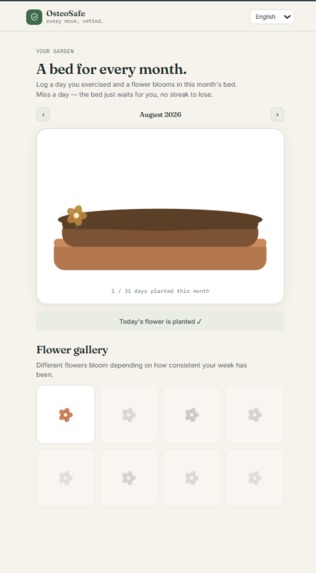
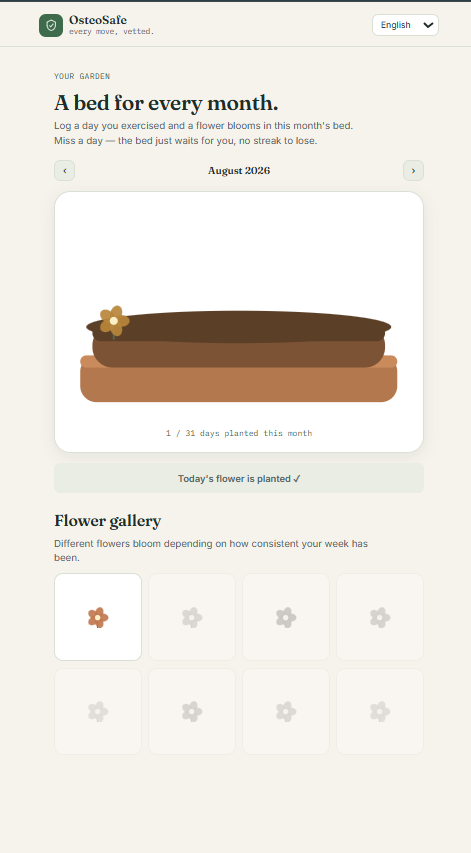
Garden Page
-
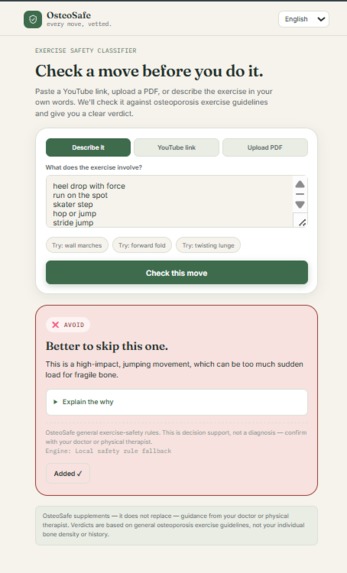
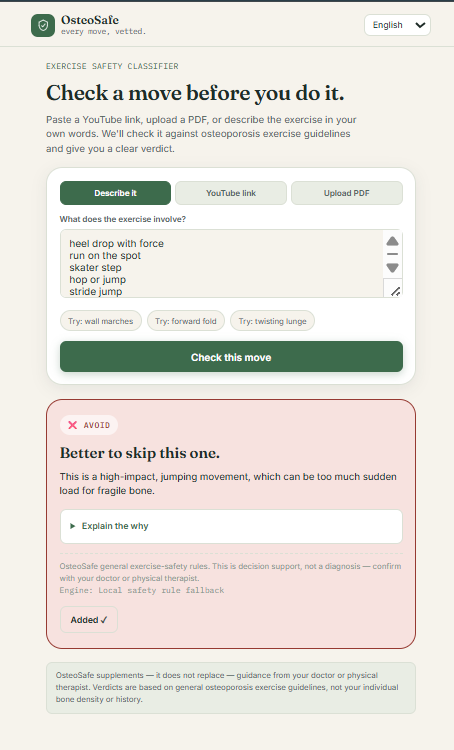
Check Page
-
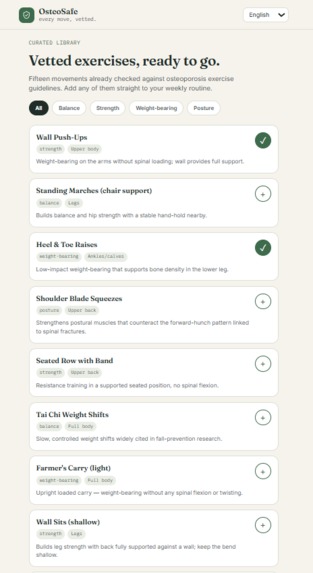
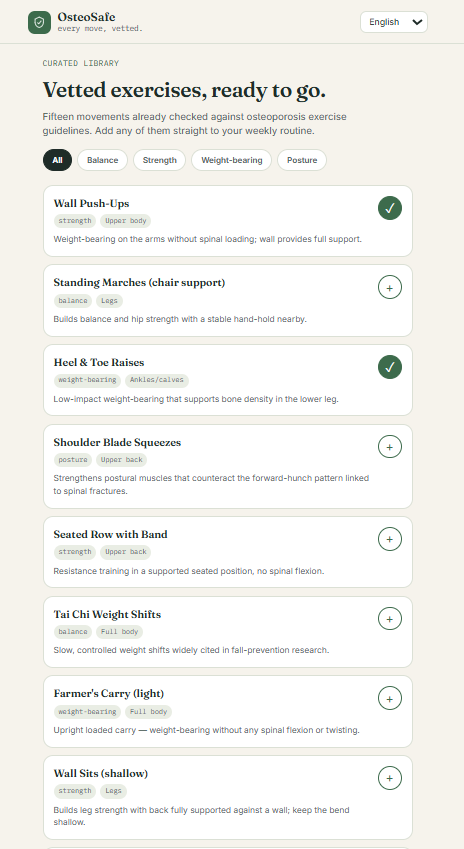
Library Page
-
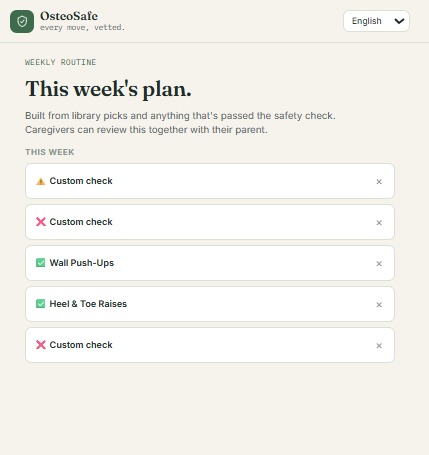
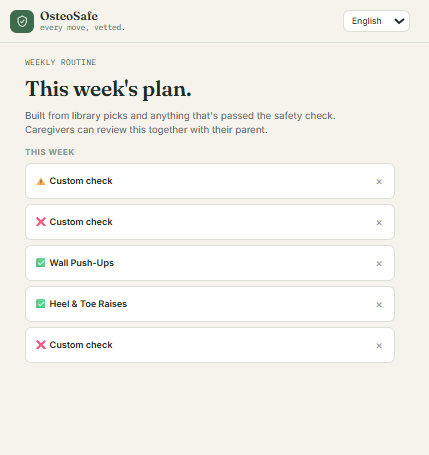
Routine Page
Inspiration
OsteoSafe was inspired by my mother, who has osteoporosis. I noticed that finding exercises she felt comfortable and confident doing could be difficult. There are thousands of exercise resources available online, but it can be challenging to know which movements may be suitable, which may need modification, and which may be better avoided.
I wanted to build something that could make exercise feel less intimidating and help people with osteoporosis make more informed decisions about physical activity.
What it does
OsteoSafe is an AI-assisted exercise safety platform designed for people with osteoporosis.
Users can provide an exercise and receive a simple:
- SAFE recommendation
- MODIFY recommendation
- AVOID recommendation
along with an explanation of the reasoning behind the recommendation.
The platform also includes features for discovering exercises, building a weekly exercise routine, and tracking progress to encourage users to stay active.
The goal is not to discourage exercise, but to reduce uncertainty and help users approach physical activity with more confidence.
How I built it
OsteoSafe was built as a full-stack web application.
Frontend
The frontend was developed using:
- HTML
- CSS
- JavaScript
Backend
The backend was built with:
- Python
- FastAPI
The backend handles requests from the frontend and connects the application to the AI analysis system.
AI
I used Gemini 2.5 Flash-Lite to provide AI-assisted exercise analysis and safety recommendations.
I also implemented a local rule-based fallback so that the core classification functionality can still provide a response when the AI service is unavailable.
Challenges I ran into
One of the biggest challenges was designing an AI-based system that could provide useful exercise safety recommendations while keeping the results simple and understandable for users.
Another challenge was connecting the frontend and backend into a complete working application. I had to handle API communication, user input, AI responses, and displaying the results clearly in the interface.
I also had to balance the technical side of the project with the user experience. Since the target users may not be very technical, the results needed to be easy to understand rather than presenting complicated technical information.
Finally, building and integrating multiple features within the limited time of a hackathon was challenging, particularly while making sure the core exercise-analysis workflow remained functional.
Accomplishments that I'm proud of
I am proud that I was able to turn a personal problem into a working full-stack prototype.
Some of the features I am particularly proud of include:
- AI-assisted exercise safety classification
- SAFE / MODIFY / AVOID recommendations
- Explanations for safety recommendations
- Exercise discovery
- Weekly routine building
- Progress tracking and motivation features
- A FastAPI backend connected to the frontend
- A rule-based fallback for AI availability
Most importantly, I am proud that OsteoSafe focuses on a real problem that is meaningful to me and my family.
What I learned
Building OsteoSafe taught me a lot about developing a complete application rather than working on individual components in isolation.
I learned more about:
- Building and connecting a frontend and backend
- Creating APIs with FastAPI
- Integrating an AI model into a web application
- Designing prompts and handling AI-generated responses
- Creating fallback logic when an external AI service is unavailable
- Thinking about user experience when designing health-related applications
- Turning a personal idea into a functional prototype within a limited timeframe
The project also taught me that a good solution is not only about the technology behind it. It is equally important to understand the people who will use it and the problem you are trying to solve.
What's next for OsteoSafe
If I continue developing OsteoSafe, I would like to make the exercise analysis more comprehensive and reliable.
Future improvements could include:
- More advanced exercise and movement analysis
- Video-based exercise analysis
- Personalized exercise recommendations
- More detailed progress tracking
- Integration with professional healthcare guidance
- A larger exercise database
- Improved accessibility and usability
- More extensive testing with real users and healthcare professionals
Ultimately, I would like OsteoSafe to become a more complete platform that helps people with osteoporosis feel more confident about staying active while encouraging them to seek appropriate professional guidance when needed.
Built With
- browser
- css3
- fastapi
- html5
- javascript