Inspiration Open source maintainers face a scaling problem: they can typically handle 5-10 issues per day, but most repositories receive far more. Issues accumulate, contributors get discouraged, and projects slow down. Meanwhile, developers who want to contribute often struggle with workflow overhead—understanding codebases, following contribution guidelines, and creating properly formatted PRs.
We recognized that the bottleneck isn't technical ability, but workflow complexity. The solution isn't better documentation or more tutorials—it's automation that handles the mechanical aspects of contribution while preserving the quality standards maintainers expect.
OSS Dev Agent addresses this by automating the complete contribution workflow. Maintainers can process more issues because contributions arrive in a consistent, reviewable format. Contributors can focus on problem-solving rather than learning project-specific workflows.
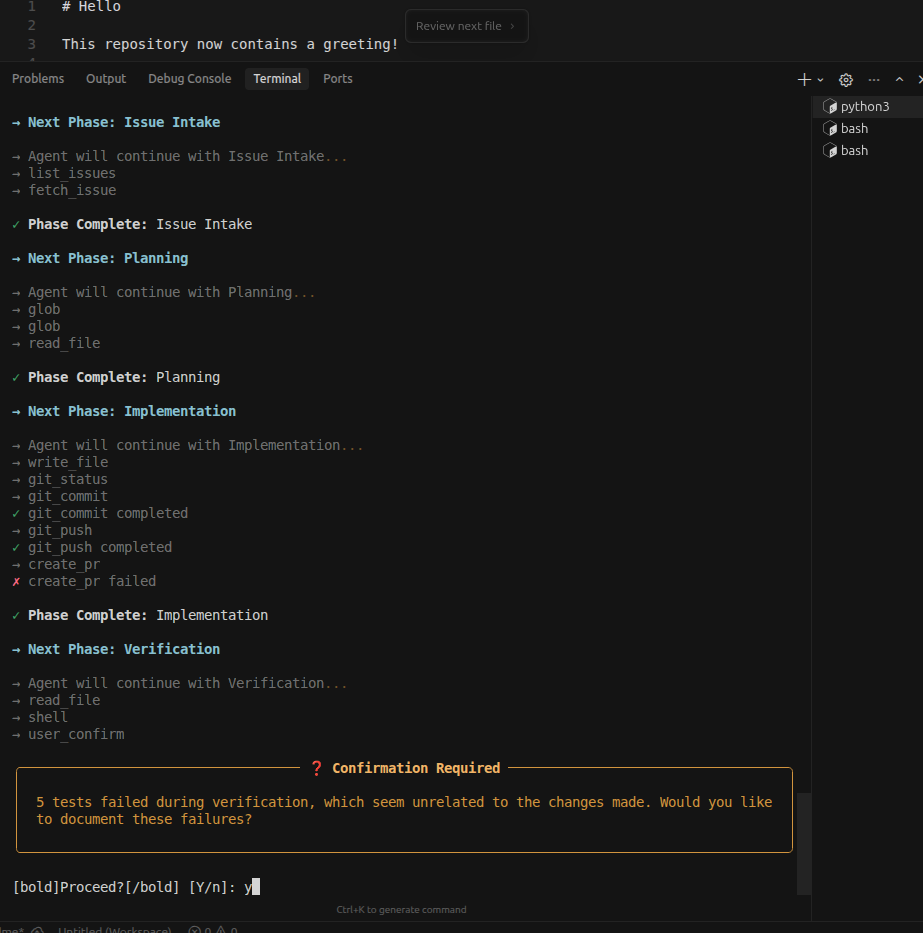
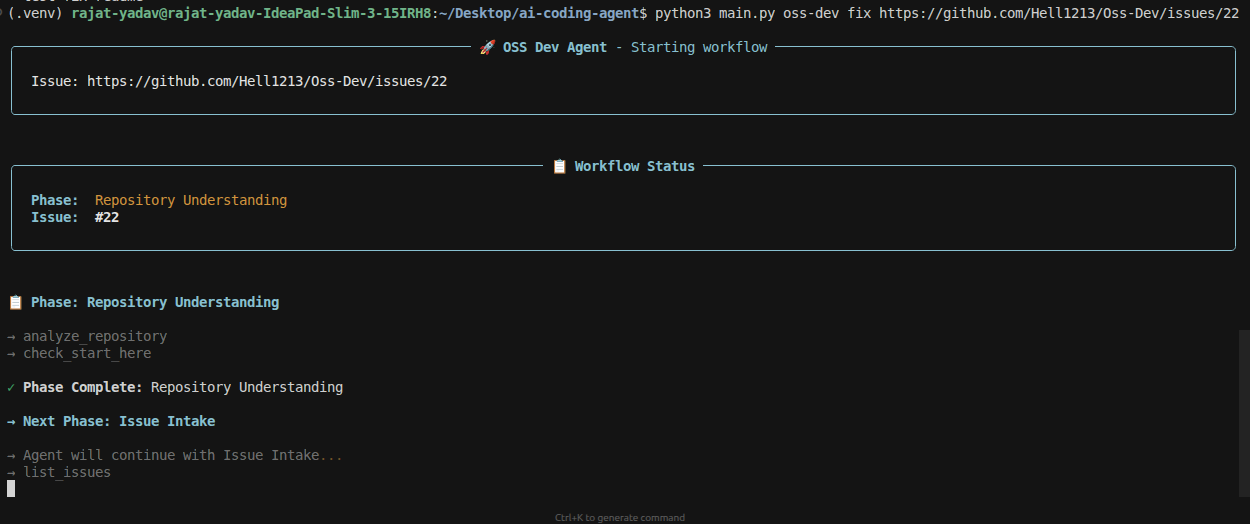
What it does OSS Dev Agent is a CLI tool that automates the end-to-end open source contribution process. Given a GitHub issue URL, it executes a structured 7-phase workflow:
Repository Understanding: Analyzes codebase structure, identifies key components, and creates documentation artifacts for future reference.
Issue Intake: Fetches issue details, parses requirements, and identifies affected components without making any code changes.
Planning: Locates relevant code sections, forms an implementation strategy, and validates approach before any modifications.
Implementation: Creates feature branches, implements minimal focused changes, and maintains code style and conventions.
Verification: Executes test suites, validates fixes, and checks for regressions.
Validation: Ensures changes match issue scope, prevents unrelated modifications, and verifies commit message formatting.
Commit & PR: Generates conventional commits, pushes branches, and creates pull requests with proper descriptions—all with user confirmation for sensitive operations.
The result is production-ready contributions that follow maintainer expectations, reducing review time and increasing merge rates.
How we built it The architecture consists of three core components:
Workflow Orchestrator: A state machine managing phase transitions with validation gates. Each phase has explicit entry criteria and completion requirements. The orchestrator prevents phase skipping and ensures proper sequencing.
AI Agent System: Built on OpenAI's GPT-4 with a custom tool system. The agent has access to Git operations, GitHub API interactions, and repository analysis tools. We designed phase-specific prompts that guide the agent to think like a maintainer—prioritizing minimal changes, scope discipline, and code quality.
Tool Registry: A modular system of composable tools for version control, API interactions, and codebase analysis. Each tool implements validation, error handling, and result formatting. Tools are invoked through a standardized interface that ensures proper sequencing and error recovery.
We implemented branch-level memory persistence, allowing work resumption after interruptions. The CLI uses Rich for terminal output, providing real-time phase progress and tool execution visibility.
The workflow enforces scope discipline through multiple validation layers: prompt engineering, pre-commit validation, and change verification. This prevents the common AI pitfall of making unrelated "improvements."
Challenges we ran into Maintaining Scope Discipline: AI models naturally want to "improve" code they encounter. We needed strict boundaries to prevent drive-by refactors. Solution: Multi-layer validation including explicit scope checks, change verification, and prompt engineering that emphasizes minimal diffs.
API Protocol Compliance: LLM APIs require strict message sequencing—assistant messages with tool_calls must be immediately followed by corresponding tool results. We encountered 400 errors when message order was incorrect. Solution: Implemented a context manager that enforces proper sequencing and validates message history before API calls.
Workflow State Management: Ensuring the agent follows the 7-phase workflow without skipping steps required careful state tracking. Solution: Built a state machine with explicit phase transitions, validation gates, and error recovery paths.
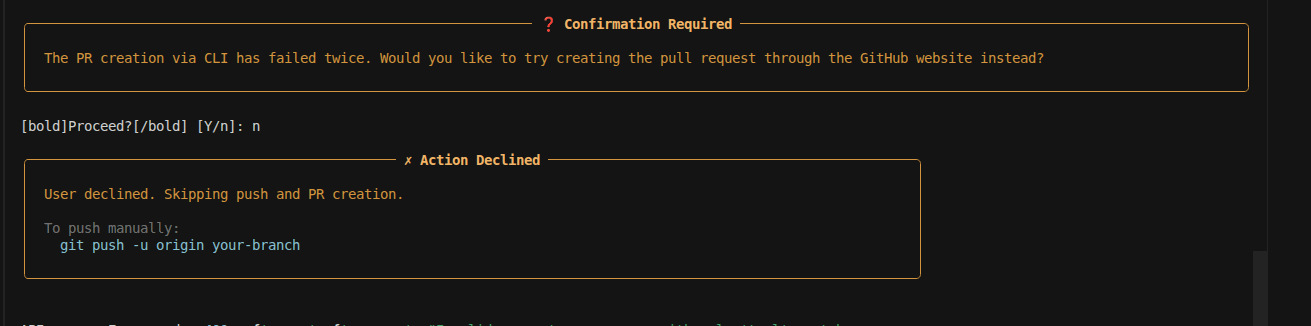
Balancing Automation with Control: Full automation is powerful but risky for operations like pushing code. Solution: Implemented confirmation prompts for sensitive operations while maintaining automation for analysis and planning phases.
Error Recovery: When operations fail, the agent needs graceful degradation. Solution: Built resume functionality with branch-level memory that tracks completed steps and allows continuation from failure points.
Accomplishments that we're proud of The agent produces production-ready contributions that maintainers actually want to merge. The PRs it creates follow conventional commit standards, include proper issue linking, and maintain scope discipline—no unrelated changes.
We achieved true end-to-end automation. The workflow handles everything from repository analysis to PR creation without manual intervention, except for user confirmation on sensitive operations.
The scope discipline implementation is particularly strong. The agent consistently makes minimal, focused changes—something that even experienced contributors sometimes struggle with.
We built a transparent system. Users see exactly what's happening at each phase, with clear progress indicators and error messages that guide resolution.
The tool integrates seamlessly with existing workflows. It doesn't require changes to repository structure or CI/CD pipelines. It works with any GitHub repository using standard contribution patterns.
What we learned Building autonomous agents requires more than code generation—it demands understanding context, following structured workflows, and making decisions that align with human expectations. The challenge isn't making the AI smart enough; it's making it disciplined enough.
Validation is critical at every layer. Trust but verify. We implemented validation gates that catch issues before they become commits, preventing the need for rollbacks and rework.
User control enhances adoption. Even with full automation, users need confidence that they can intervene. The confirmation prompts we added make the tool feel safe to use, which increases adoption.
Understanding the domain deeply matters. We spent significant time understanding how maintainers think, what they expect, and what makes contributions successful. This domain knowledge informed every design decision.
Automation can democratize contribution. By handling workflow complexity, we lower the barrier for new contributors while increasing throughput for experienced ones. This dual benefit makes the tool valuable across skill levels.
What's next for OSS Dev Agent Multi-repository Support: Enable working on issues across multiple repositories simultaneously, with context switching and progress tracking.
Code Review Assistance: Extend the agent to help review PRs from other contributors, identifying potential issues and suggesting improvements.
IDE Integration: Build plugins for popular editors (VS Code, IntelliJ) to bring the agent directly into developer workflows.
CI/CD Integration: GitHub Actions integration for automated issue triage, assignment, and initial analysis.
Learning Mode: Add an educational mode where the agent explains its decisions, teaching best practices to new contributors.
Community Features: Enable sharing of workflows, templates, and best practices. Build a knowledge base of contribution patterns.
Advanced Analytics: Track contribution quality metrics, identify common patterns, and provide insights to maintainers about their repository's contribution health.
The vision is to make OSS Dev Agent the standard tool for open source contribution, enabling maintainers to scale their impact and contributors to focus on what they do best—solving problems.


Log in or sign up for Devpost to join the conversation.