-
-
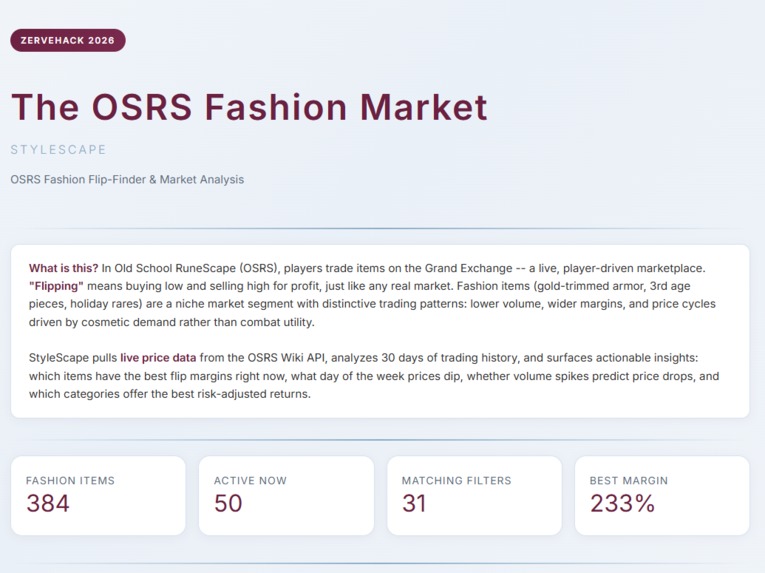
OSRS Fashion Flip-Finder & Market Analysis
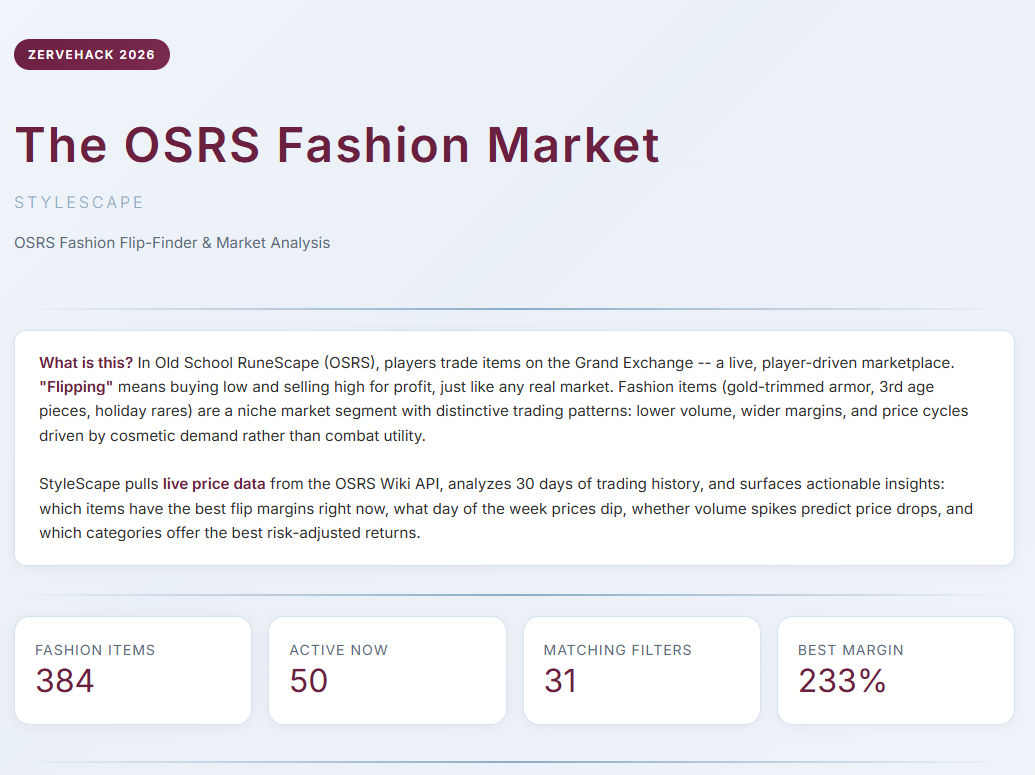
StyleScape: OSRS Fashion Market Intelligence
Inspiration
Old School RuneScape's Grand Exchange is a real, player-driven economy where millions of transactions happen daily. Most flipping tools focus on high-volume combat gear, but I've always been drawn to fashion items like gold-trimmed armor, 3rd age pieces, and holiday rares. They trade differently: lower volume, wider margins, and prices driven by cosmetic demand rather than combat meta shifts. I wanted to know if there were exploitable patterns hiding in that data, and whether I could build something that surfaces them automatically.
What It Does
StyleScape pulls live pricing data from the OSRS Wiki Real-Time Prices API and analyzes 30 days of market history across roughly 200 tracked fashion items. It goes beyond a simple price table. Live flip opportunities are ranked by a composite flip score combining margin percentage and volume. Day-of-week price effects show which days items trade cheapest versus most expensive, computed as a normalized price index across all items. Category risk versus return profiles plot volatility against median margin to identify which fashion categories offer the best risk-adjusted flips. Volume spike analysis measures whether sudden trading surges predict next-day price movement, binned by magnitude from 1.5x to 5x and above. Per-item trading tips let you search any item for a full breakdown including trend direction, 30-day range, best days to buy and sell, volatility warnings, and liquidity assessment.
How I Built It
The project was built on Zerve using Python, Streamlit, Pandas, and Plotly. Zerve's agent workflow handled the iteration cycle from initial data exploration to production app. The data pipeline hits three OSRS Wiki API endpoints for the live view, then loops through 30 daily snapshots for historical analysis. All insights are computed live with no hardcoded findings.
Challenges
The OSRS Wiki API is rate-limited and has no batch endpoint for historical data, so loading 30 days means 30 sequential requests. I added caching with a 5-minute TTL and a progress bar to keep the experience responsive. Normalizing prices across items with wildly different GP values, from a 500 GP beret to a 500M GP partyhat, required computing per-item price indices before aggregating patterns like day-of-week effects.
What I Learned
Building StyleScape taught me that treating a game economy with the same rigor as a financial dataset actually works. I learned how to normalize prices across items with wildly different values so patterns like day-of-week effects don't get skewed by a single high-value item. I also got a lot of practice thinking about what makes an insight actionable versus just interesting.

Log in or sign up for Devpost to join the conversation.