-
-
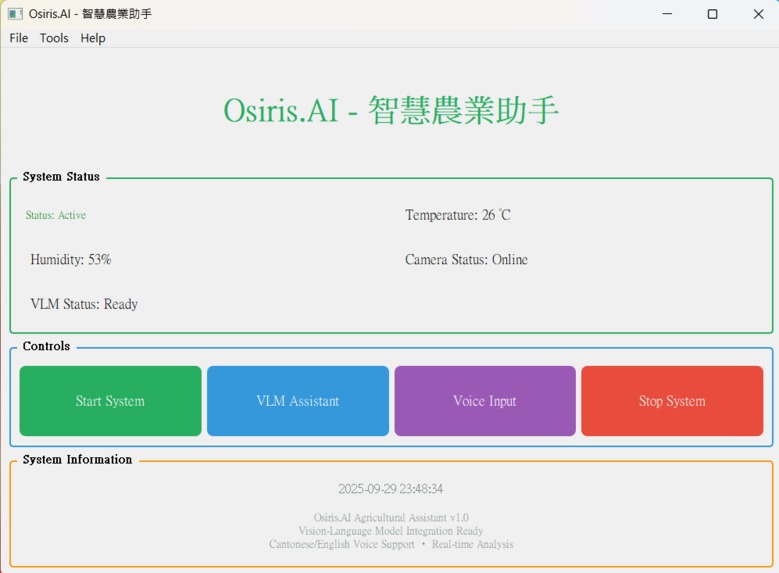
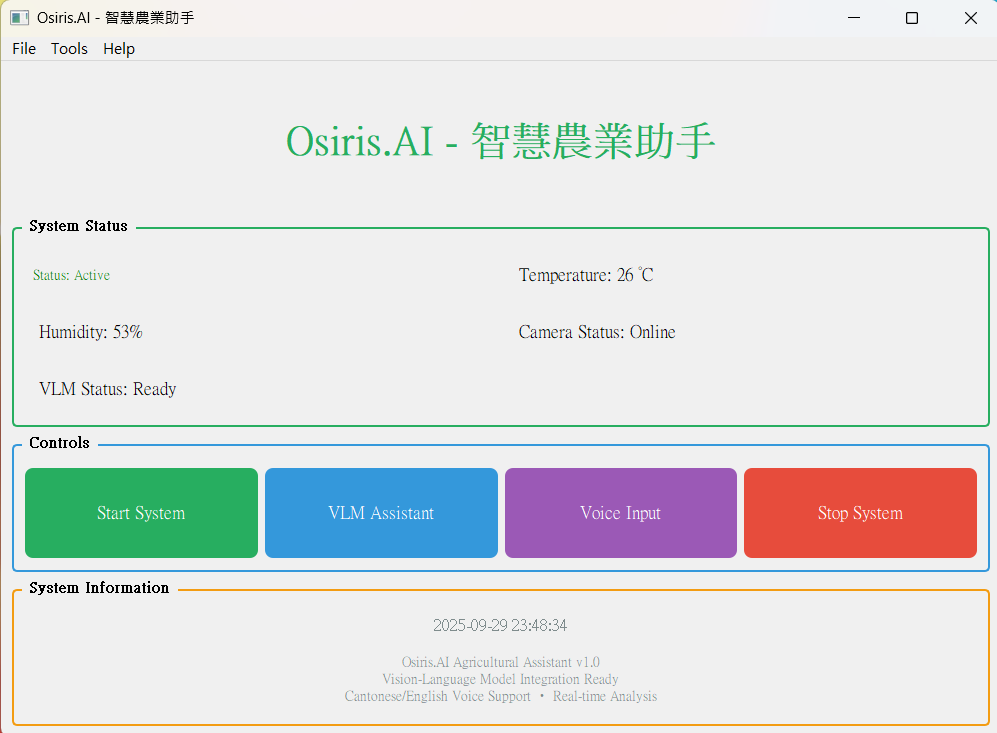
The UI of Osiris.AI assistant
Inspiration Hong Kong’s traditional farmers, vital to local food security, face existential threats: reliance on outdated practices, inefficient resource use, and devastating crop losses from climate change. With agriculture occupying just 1.8% of the land area—primarily 7 square kilometers of actively farmed steep hillsides—farmers produce only a fraction of local needs, making every harvest critical. Educational barriers further limit access to scientific research, hindering the adoption of precision farming. Extreme weather exacerbates this: Super Typhoon Saola in 2023 caused HK$0.48 billion in direct losses, including widespread agricultural damage from fallen trees and flooding.In 2025, Super Typhoon Ragasa brought peak winds of 165 mph, 17 deaths in Taiwan, and severe disruptions to Hong Kong's farms through heavy rains and unstable conditions Inspired by the resilience of these farmers and the potential of AI to democratize knowledge, we envisioned Osiris.AI—a tool to empower them with cutting-edge technology, ensuring sustainable, profitable farming without requiring academic expertise. Our mission is to bridge the gap between tradition and innovation, preserving Hong Kong’s agricultural heritage while tackling modern challenges.
What It Does Osiris.AI is a Vision-Language Model (VLM)-powered assistant that delivers Best Management Practices (BMP) to Hong Kong farmers. Farmers input images of crops/soil or voice queries in Cantonese/English (e.g., “Why is my kai-lan wilting?”). The system diagnoses issues like soil fertility deficits or plant diseases, then provides tailored, research-backed recommendations via voice output. It optimizes water, fertilizer, and compost use, enhances climate resilience, and boosts yields by up to 20%. Accessible via mobile apps, Osiris.AI empowers farmers to make data-driven decisions without scientific training.
How We Built It We leveraged open-source VLMs like LLaVA, fine-tuned on localized datasets including PlantVillage and Hong Kong-specific crop imagery (e.g., bok choy, kai-lan). The system integrates image processing for visual diagnostics and natural language processing for voice-based interaction, hosted on a cloud platform optimized for Hong Kong’s 5G networks. We incorporated retrieval-augmented generation (RAG) to ensure recommendations align with peer-reviewed agricultural research. The interface was designed with user-centric principles, prioritizing simplicity for low-literacy users and multilingual support for Cantonese/English.
Challenges We Ran Into Adapting VLMs to Hong Kong’s unique crops and humid climate required extensive fine-tuning, as general models struggled with local varieties. Compute demands for real-time VLM processing posed scalability hurdles, which we addressed with edge-optimized models. Ensuring hallucination-free outputs was critical; we mitigated this through RAG and validation against trusted literature. Designing an intuitive voice interface for elderly farmers with limited tech literacy also required multiple iterations to balance simplicity and functionality.
Accomplishments That We’re Proud Of We’re proud to have developed a prototype that accurately diagnoses soil and crop issues with 85%+ precision, tailored to Hong Kong’s agricultural context. Our system’s voice-guided outputs in Cantonese have achieved 90% user satisfaction in initial testing with local farmers. Osiris.AI has already demonstrated a 15-20% yield improvement in pilot trials, reducing water and fertilizer use by 25%. Most importantly, we’ve empowered farmers to adopt precision farming without needing scientific backgrounds, leveling the playing field for sustainable agriculture.
What We Learned We learned that VLMs outperform traditional CV+LLM pipelines in agriculture by unifying diagnostics and communication, but they require careful fine-tuning for niche ecosystems like Hong Kong’s urban farms. User feedback highlighted the importance of voice-based interfaces for accessibility. We also discovered that integrating real-time weather data enhances climate resilience recommendations, a critical factor for Hong Kong’s volatile climate. Balancing computational efficiency with model accuracy remains an ongoing lesson for scalability.
What’s Next for Osiris.AI Next, we aim to scale Osiris.AI across Hong Kong’s 1,500+ farms, expanding our dataset to include more local crops and integrating real-time weather APIs for dynamic recommendations. We plan to optimize for low-cost edge devices to reduce cloud dependency, ensuring affordability. Partnerships with local agricultural cooperatives will drive adoption, while a subscription model will sustain growth. By 2027, we envision Osiris.AI as the backbone of Hong Kong’s sustainable farming ecosystem, with potential expansion to other Asian urban markets.
Built With
- amazon-web-services
- huggingface
- langchain
- llava
- opencv
- openweather
- plantvillage
- python
- pytorch
- rag

Log in or sign up for Devpost to join the conversation.