-
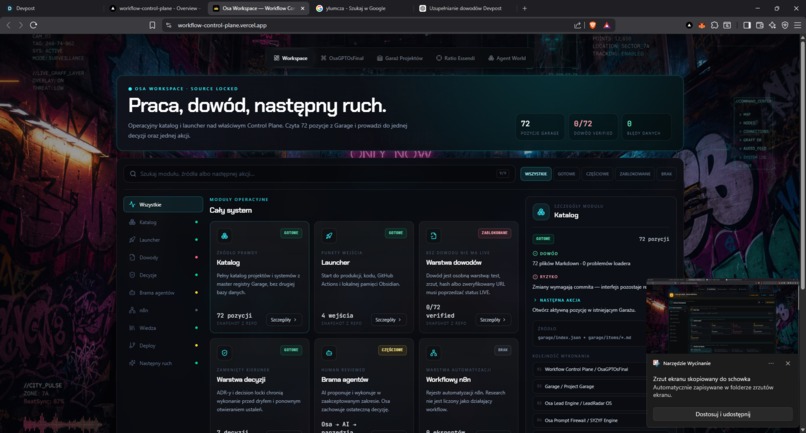
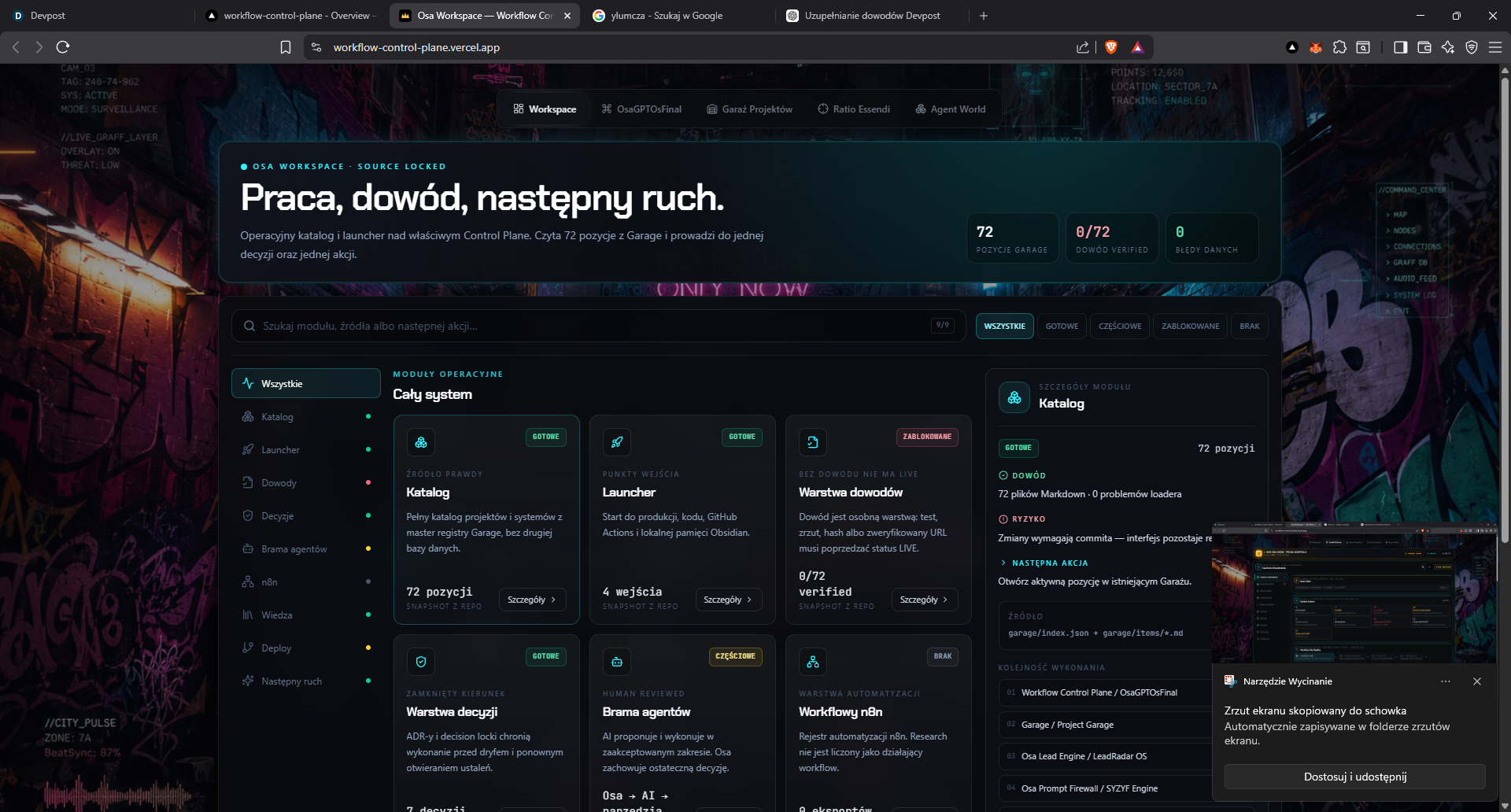
workspace
-
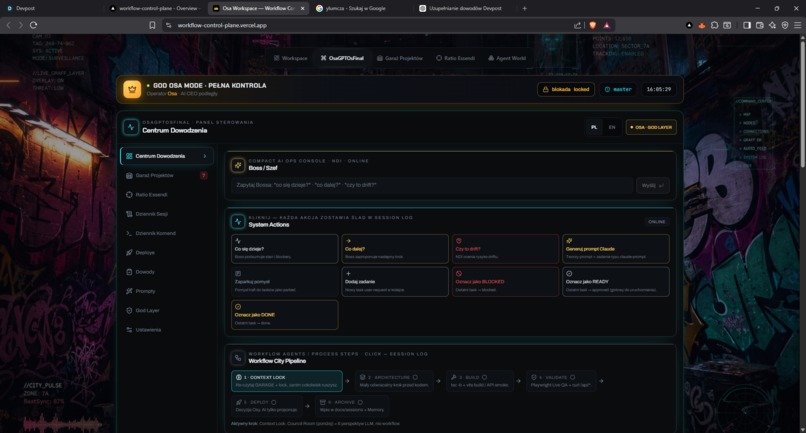
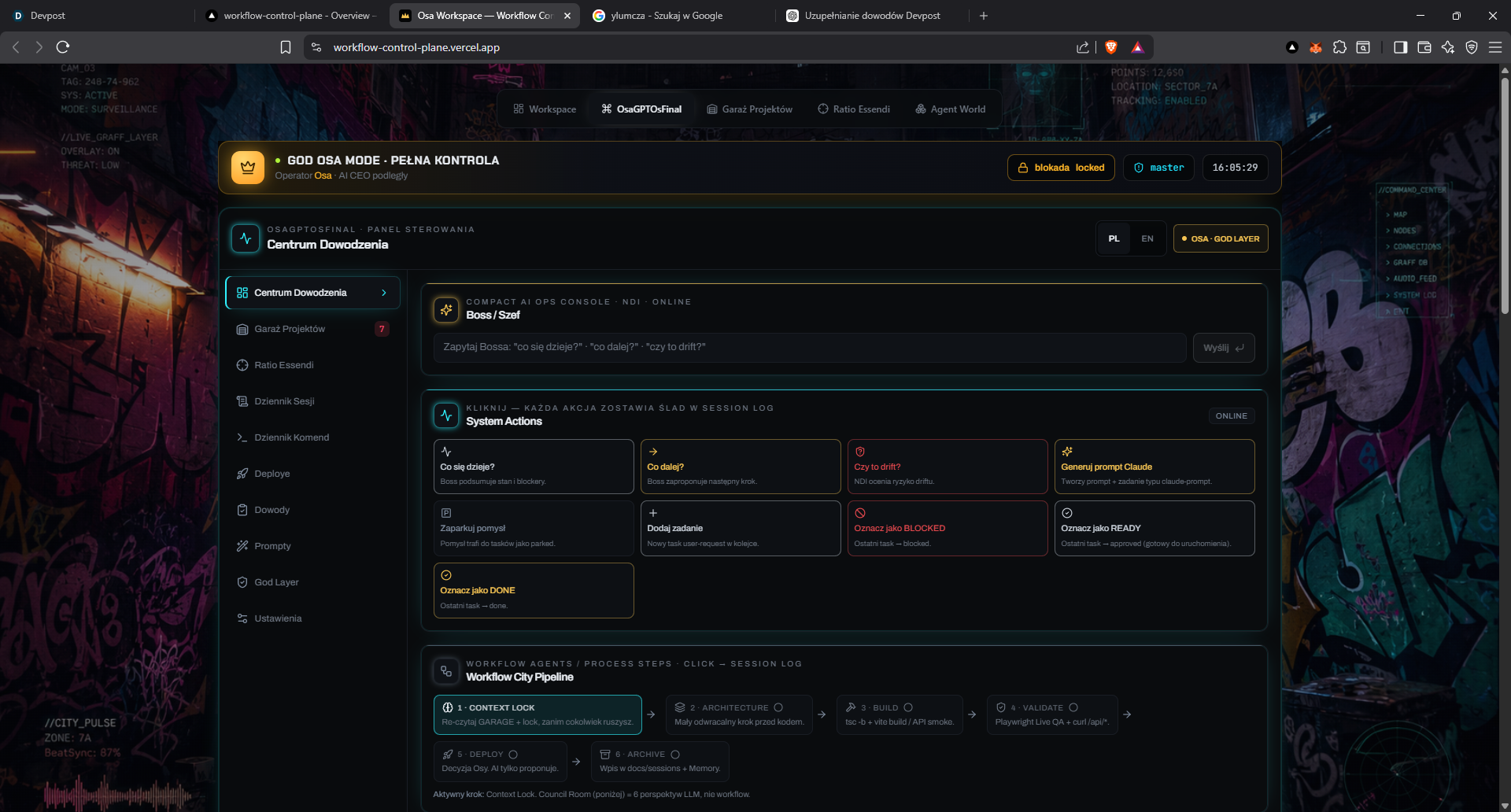
god osa mode
-
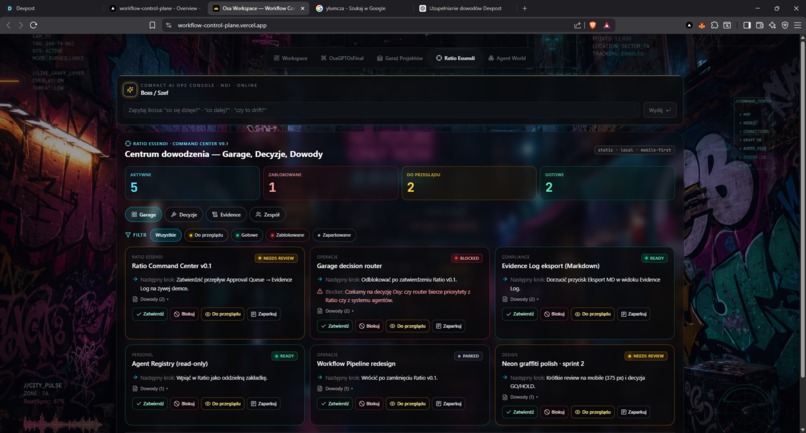
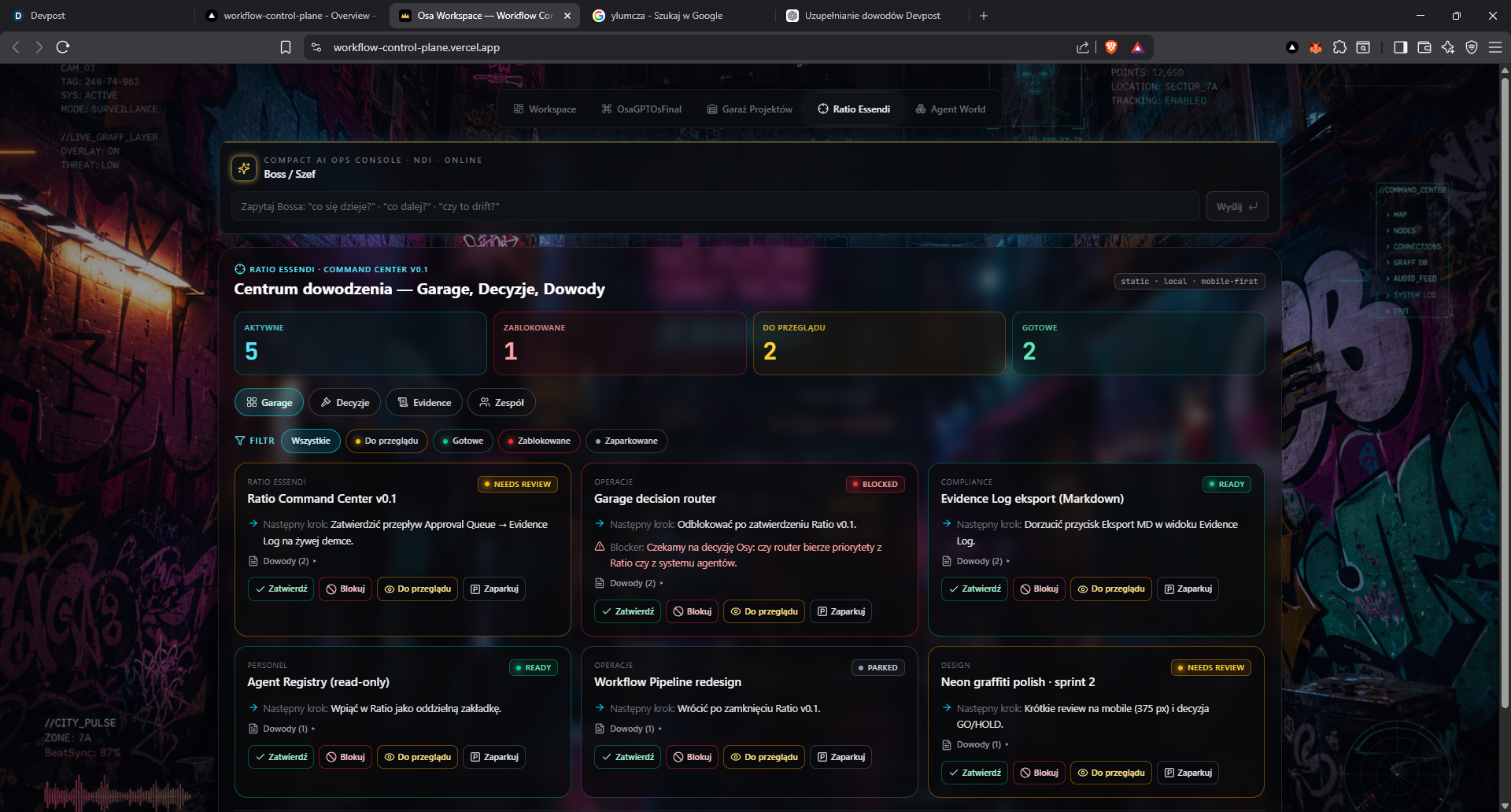
ratio essendi (company for digital selling cocpit)
-
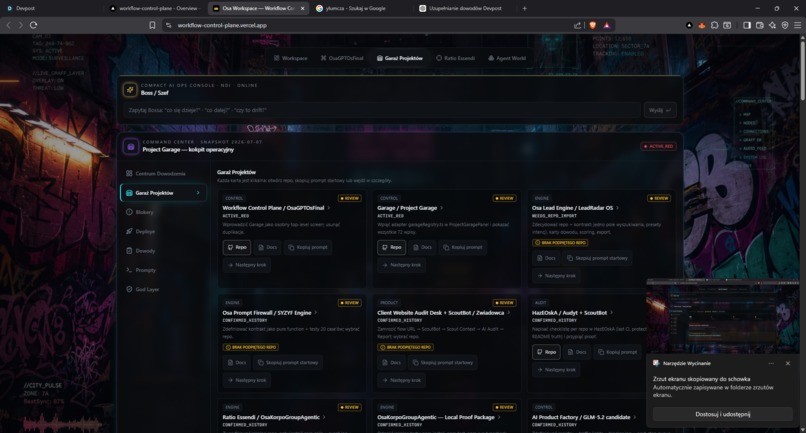
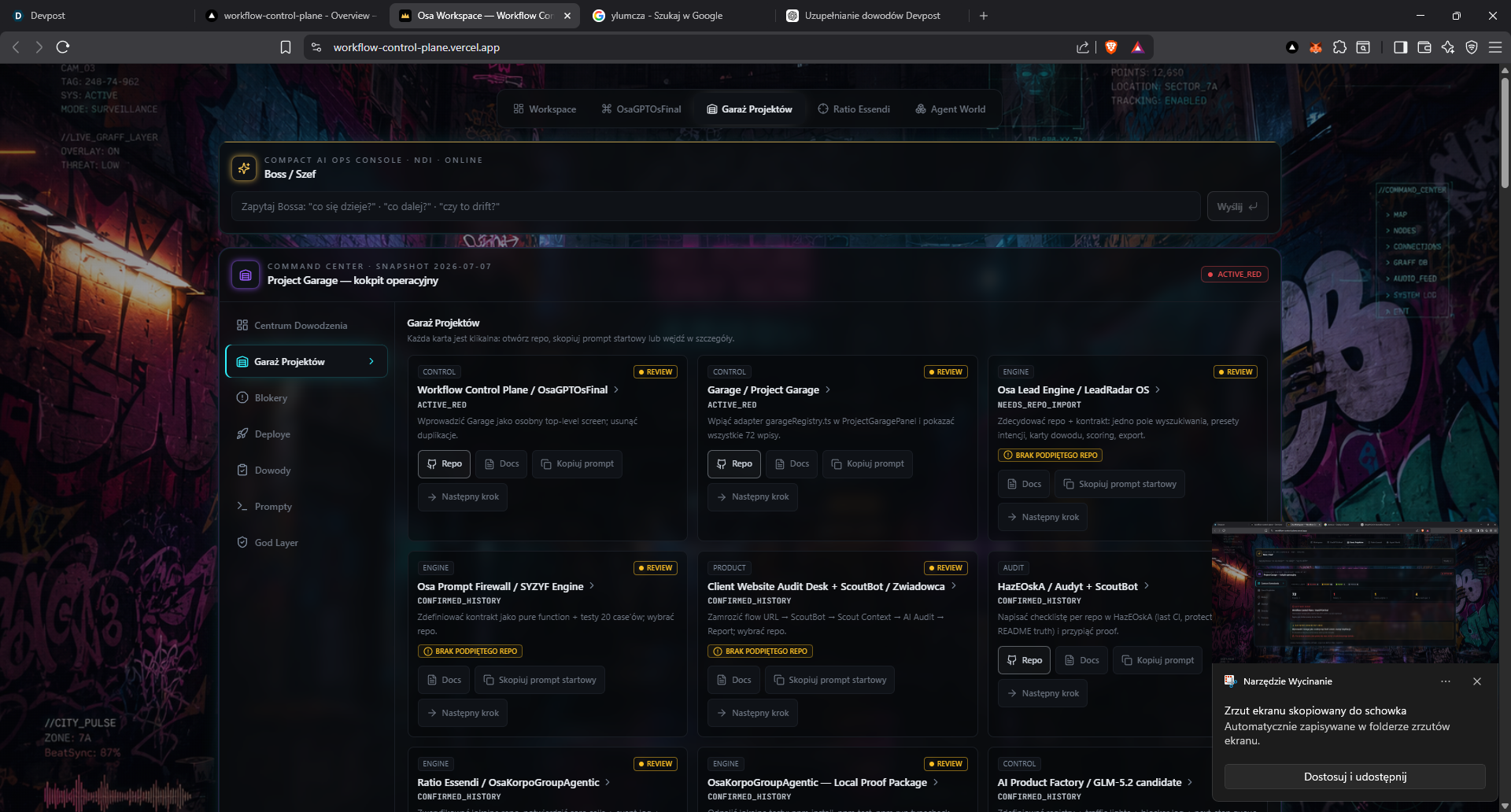
Project Garage
Inspiration
AI-assisted development is extremely powerful, but the biggest failures often do not come from weak models. They come from lost context, wrong repositories, invented paths, repeated decisions, unclear deployment targets, and agents executing before the architecture is locked.
I built Osa Workspace because I needed one operational command center that could preserve project truth across long AI-assisted building sessions.
The core authority rule is simple:
The AI CEO proposes. The human decides.
Instead of allowing an assistant or coding agent to act as an uncontrolled autonomous layer, Osa Workspace places AI execution underneath a clearly defined human control layer.
What it does
Osa Workspace is an AI workflow control plane for managing real product execution from idea to verified deployment.
It keeps the active project, repository, branch, mission, source of truth, deployment target, previous decisions, validation requirements, rollback path, and next concrete action visible in one interface.
The system supports a controlled execution flow:
Context Lock → Research Lock → Decision Lock → Task Plan → Execution → Validation → Deploy Check → Session Memory → Next Step
Its main responsibilities include:
- locking the active project context before execution,
- detecting possible assistant or agent drift,
- tracking repositories, branches, deployments, and project status,
- converting ideas into structured execution plans,
- routing work to the appropriate AI model or engineering tool,
- preserving architectural decisions and session memory,
- requiring validation before deployment,
- keeping rollback and recovery paths visible,
- presenting one clear next concrete step.
The interface also contains an AI CEO layer that coordinates work while remaining subordinate to the human operator.
How I built it
I first designed the operating rules as documentation, schemas, architectural decisions, recovery procedures, validation gates, and deployment checklists.
The UI was then built around those existing sources of truth instead of inventing project information inside the frontend.
The application uses:
- React 19
- TypeScript
- Vite
- Tailwind CSS
- Framer Motion
- Lucide React
- OpenAI API integration
- Playwright
- GitHub
- Vercel
The frontend is organized as a command-center interface containing project locks, the AI CEO console, tool routing, anti-drift monitoring, project maps, session outputs, and deployment state.
The current MVP can operate with grounded local routing, while an OpenAI API key can enable live AI CEO responses.
I also created structured repository documentation for context recovery, execution packs, decision records, validation, deployment, rollback, session closure, and prompt-to-deploy traceability.
The production version is deployed on Vercel from the main GitHub branch.
Challenges I ran into
The hardest challenge was translating an operational architecture into a visual interface without reducing it to another generic project dashboard.
The system needed to show not only tasks, but also authority, project truth, execution boundaries, validation requirements, and recovery state.
Another major challenge was preventing false confidence. An AI interface can easily appear operational while displaying invented repository paths, branches, deployment states, or project details. To avoid this, the dashboard data is grounded in explicit project documents and controlled source files.
I also had to clearly separate three different layers:
- the human authority layer,
- the AI coordination layer,
- the external execution tools and coding agents.
Maintaining that separation was essential because the AI CEO must coordinate execution without becoming the final authority.
Finally, I needed the MVP to remain useful without requiring a complex backend, authentication system, or database during the first implementation stage.
Accomplishments that I'm proud of
I am proud that Osa Workspace is not only a visual concept. It represents a complete operational workflow for AI-assisted product building.
The repository contains:
- a defined project-lock protocol,
- an anti-drift recovery checklist,
- architecture decision records,
- reusable execution packs,
- validation and deployment gates,
- rollback procedures,
- session memory standards,
- a prompt-to-deploy bridge,
- a production-deployed control-plane interface.
The workflow was also applied to a completed product pilot, demonstrating that the system can guide a real project through context recovery, planning, implementation, validation, recovery, and result logging.
I am especially proud of the authority model because it avoids the common pattern of allowing one language model to supervise another language model without a deterministic human-controlled boundary.
What I learned
I learned that reliable AI-assisted development depends less on generating more code and more on preserving context, authority, evidence, and execution boundaries.
A strong model still needs a precise operating environment.
I also learned that project memory must be treated as infrastructure. Repository state, architectural decisions, deployment targets, previous failures, and rollback paths cannot remain only inside a chat conversation.
Another important lesson was that stopping execution is sometimes the correct action. When the repository, branch, target, or rollback plan is unclear, the system should recover context instead of guessing.
The most valuable output of an AI development session is not only completed code. It is completed code together with validation, evidence, decisions, and a clearly defined next step.
What's next for Osa Workspace
The next phase is to evolve Osa Workspace from a control-plane MVP into a durable operational runtime.
Planned development includes:
- persistent project and session state,
- live GitHub repository synchronization,
- deployment status integration,
- approval gates for sensitive operations,
- automated evidence collection,
- durable task queues and execution history,
- Playwright-based live application validation,
- structured proof bundles for completed work,
- connectors for Vercel, Supabase, VPS infrastructure, and additional AI agents,
- mobile-first control and monitoring,
- a multi-model Council Room for structured technical analysis,
- recovery after interrupted or failed execution,
- stronger rollback and safety controls.
The long-term objective is a complete human-governed AI Product Factory where ideas can move through architecture, implementation, validation, deployment, and post-deployment verification without losing context or control.
Built With
- api
- css
- framer
- github
- motion
- openai
- playwright
- react
- tailwind
- typescript
- vercel
- vite

Log in or sign up for Devpost to join the conversation.