Inspiration
We are living through a shift that nobody fully prepared us for. In a post-AI world, the pressure is no longer just to learn, but it is to learn faster, retain more, and perform at a level that a machine can now replicate in mere seconds.
The result-oriented model of education and productivity that defined the last century and crossed over to the current one is collapsing. What now replaces this is something that we do not yet have the tools to navigate: a progress-oriented world, where the quality of one's thinking, the depth of one's understanding, and the resilience of one's mental state matter more than the outputs themselves.
However, the tools we use to understand our own minds have not kept up. We still rely on self-reported mood logs, weekly therapy sessions, sleep trackers that tell us the output but never the "why." In a world where AI can analyze millions of data points in milliseconds, we are still asking people to guess what is happening inside their own brains. Then, we automatically offer them generic advice when the guess turns out to be wrong.
The question that drove Oryn was simple:
If the world is demanding more from the human mind than ever before, why are we still measuring it with the least precise tools we have?
Mental health, motivation, focus, and learning are not soft concepts. They are neurological events happening in specific regions of your brain, driven by specific signals, along specific pathways. They have always been measurable in theory. We built Oryn to make them measurable in your life.
What it does
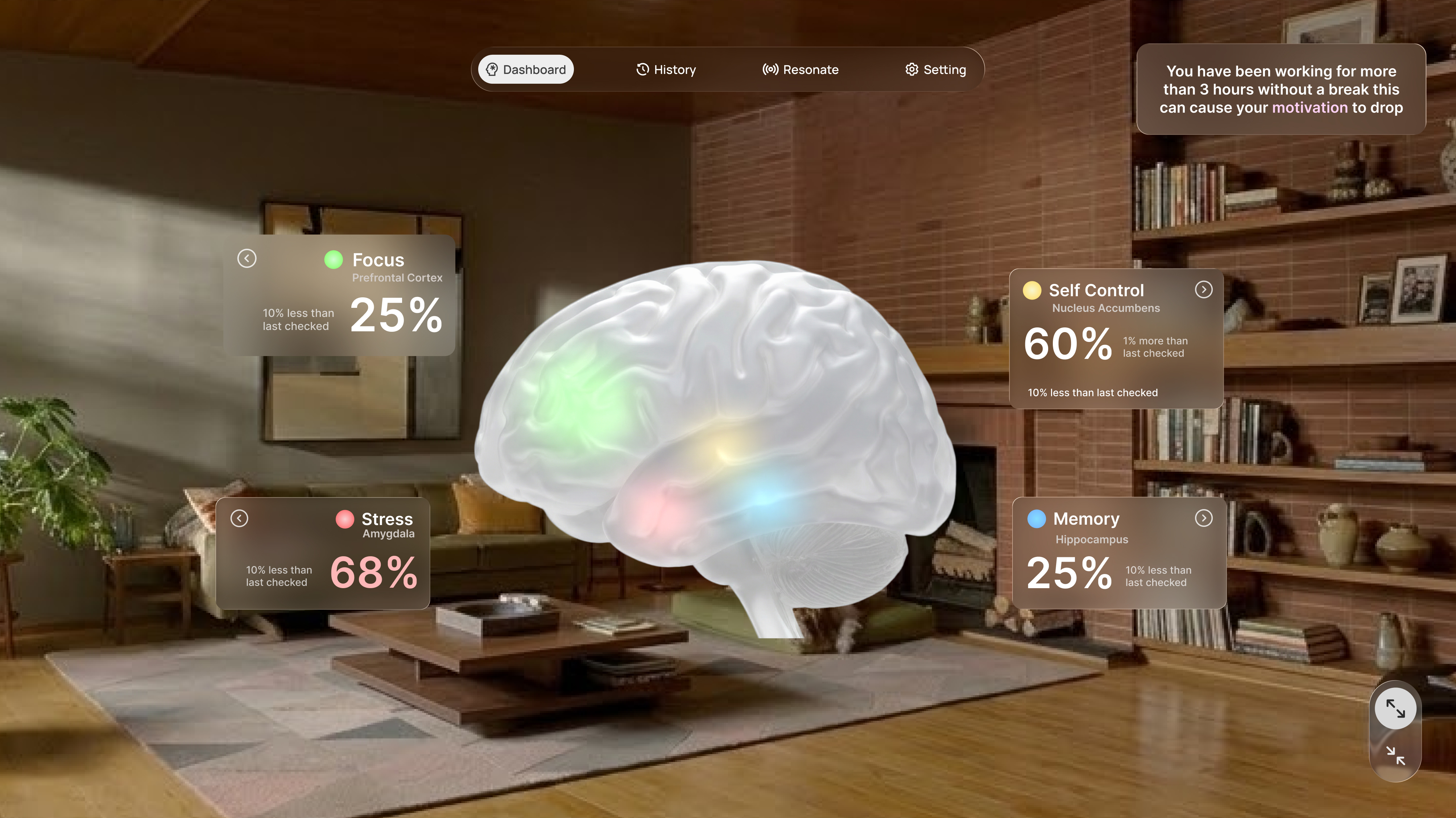
Oryn is a personalized AR-HUD (Augmented Reality Heads-Up Display) that is visible only to the user, as it is paired with a biocompatible neural sensor that the user will have installed in the initial setup.
It monitors four core dimensions of mental state in real time:
Cognitive Clarity: how sharply you are thinking right now
Knowledge Consolidation: how effectively you are learning
Incentive Health: how genuinely motivated you are
Social & Stress Authenticity: how your nervous system is reading the world around it
For long-term users, Oryn compares users' neural patterns, allowing them to view their current state vs. personal high-performance baselines. Essentially, this is your brain compared to itself, at its best.
Users can also utilize Resonate, which is Oryn's consented sharing ecosystem. The feature extends neural awareness beyond the user and into the relationships and environments that surround them. It operates across three tiers:
People: Users share a simplified, human-readable signal of their mental state across Focus, Self Control, and Stress with the people they trust most, like family, therapists, partners, and clinicians. The people who love you should not have to wait until you are falling apart to know you need them.
Items: Oryn establishes a real-time resonance with the user’s surroundings. By integrating with everyday items like lamps and audio systems, Oryn detects neural fluctuations and triggers contextual adjustments, ensuring the physical environment dynamically recalibrates to support the user’s psychological equilibrium.
EEG ID: Every Oryn user receives a unique EEG (Electroencephalogram) ID, which is the personal identifier that makes Resonate with other people possible. Connecting with someone requires explicit consent, meaning no one accesses your neural data without your full knowledge and approval. Your data on your terms, in your circle.
How we built it
Oryn sits at the intersection of four fields: neuroscience, bioengineering, artificial intelligence, and human-centered design.
We mapped four target brain regions and their corresponding neurotransmitter indicators:
| Dimension | Brain Region | Measured By |
|---|---|---|
| Cognitive Clarity | Prefrontal Cortex | Glutamate + GABA |
| Knowledge Consolidation | Hippocampus | Mushroom Spine Density + LTP Formation |
| Incentive Health | Nucleus Accumbens | Dopamine + Endorphins |
| Social & Stress Authenticity | Amygdala | Norepinephrine + GABA |
The AI layer translates raw neural signals into human-readable insights, like surfacing patterns, flagging anomalies, and delivering information at the exact moments they are actionable.
Challenges we ran into
The hardest problem our team found was not technical, but rather philosophical.
- How do you monitor the most private data a human being generates without it becoming surveillance?
- How do you give people visibility into their own suffering without making the tool a new source of anxiety?
- How do you design for someone in a crisis window, where a poorly timed notification could do real harm?
We also struggled with the gap between speculative design and scientific feasibility. Many of the materials and capabilities Oryn depends on are at the frontier of current research, which have not yet manifested into clinical reality. Holding this tension transparently and presenting the vision without overclaiming required us to stay deeply grounded in the actual neuroscience while imagining forward.
Accomplishments that we're proud of
We are proud that Oryn never lost its focus on human needs. Every technical decision made, from interface design to material philosophy, was considered to be in service of a real human being in a real moment.
- Jeremiah restructuring his study schedule around his own neural patterns and use this product to make his studying more efficient.
- Sam building a precise intervention within the 90-second window and understanding the ruminating thought loops did not define her identity.
- Tom's mother texting him before he had to find the words to explain his unexplainable feelings.
We ultimately built a concept that takes mental health seriously at the neurological level without reducing people to their data. This balance of being precise and scientific with personal and human is what we are proud of.
What we learned
We learned that the most important design question is not what can this tool do but what should this tool do in this moment for this person.
More data is not always better. The brain is not a dashboard to be optimized, but it is a seat of a person's entire experience of being alive and a part of society. Any tool that touches this aspect carries an enormous responsibility.
We also learned that neuroscience and storytelling are not opposites. The science gave us the precision to tell our stories with purpose. Oryn became real when we transitioned from learning how neural pathways worked to describing what users feel when they use this system in different personal contexts.
What's next for Oryn
The immediate next step is sensor validation. We would partner with bioengineering researchers to test the most promising organic substrates for long-term neural compatibility and signal fidelity, as interfacing with the brain at this level of precision is one of the most complex biological engineering challenges that exists.
Beyond that, Oryn's roadmap moves toward refining the sensor itself, moving away from the concept of a rigid implanted chip and toward something far more native to the brain's own architecture. The most promising direction is a soft, biodegradable neural interface: a material that can be introduced into the brain with minimal surgical disruption, conform to living tissue, and eventually dissolve once a more permanent biological integration has formed. The goal is a sensor that the brain does not recognize as foreign, possibly stemming from materials like silk fibroin, PEDOT conducting polymers, or neurotrophin-releasing hydrogels that the nervous system receives as its own. From there, the full ecosystem of neural tracking, Resonate, environment response, and personalized intervention becomes the platform that grows around it.
Built With
- claude
- figma
- flora
- gemini
- kling


Log in or sign up for Devpost to join the conversation.