-
-

ENA before entering a URL to audit
-
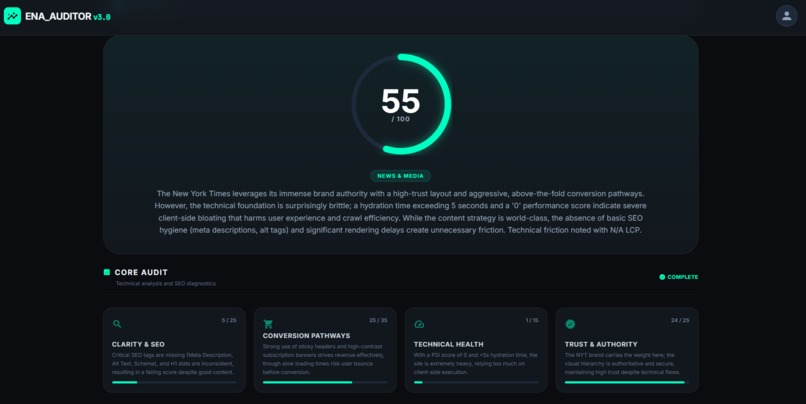
Website scored based on 4 criteria
-

Recommended Section added using the Rebuild Agent
-

User psychology showing buyer/user personas navigating the website
-

Market analysis compares the URL to its competitors
-
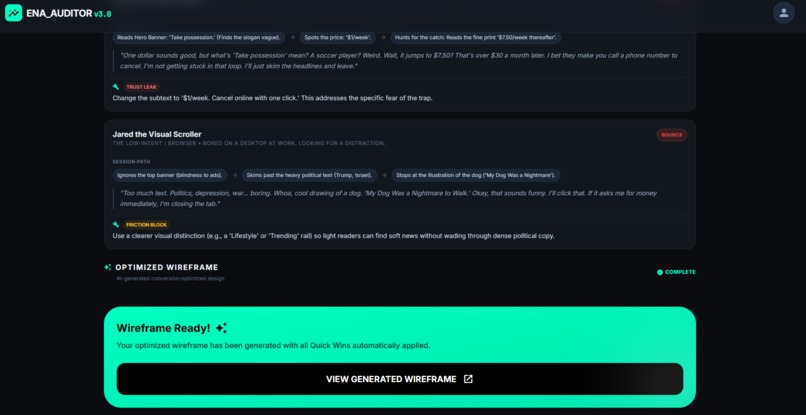
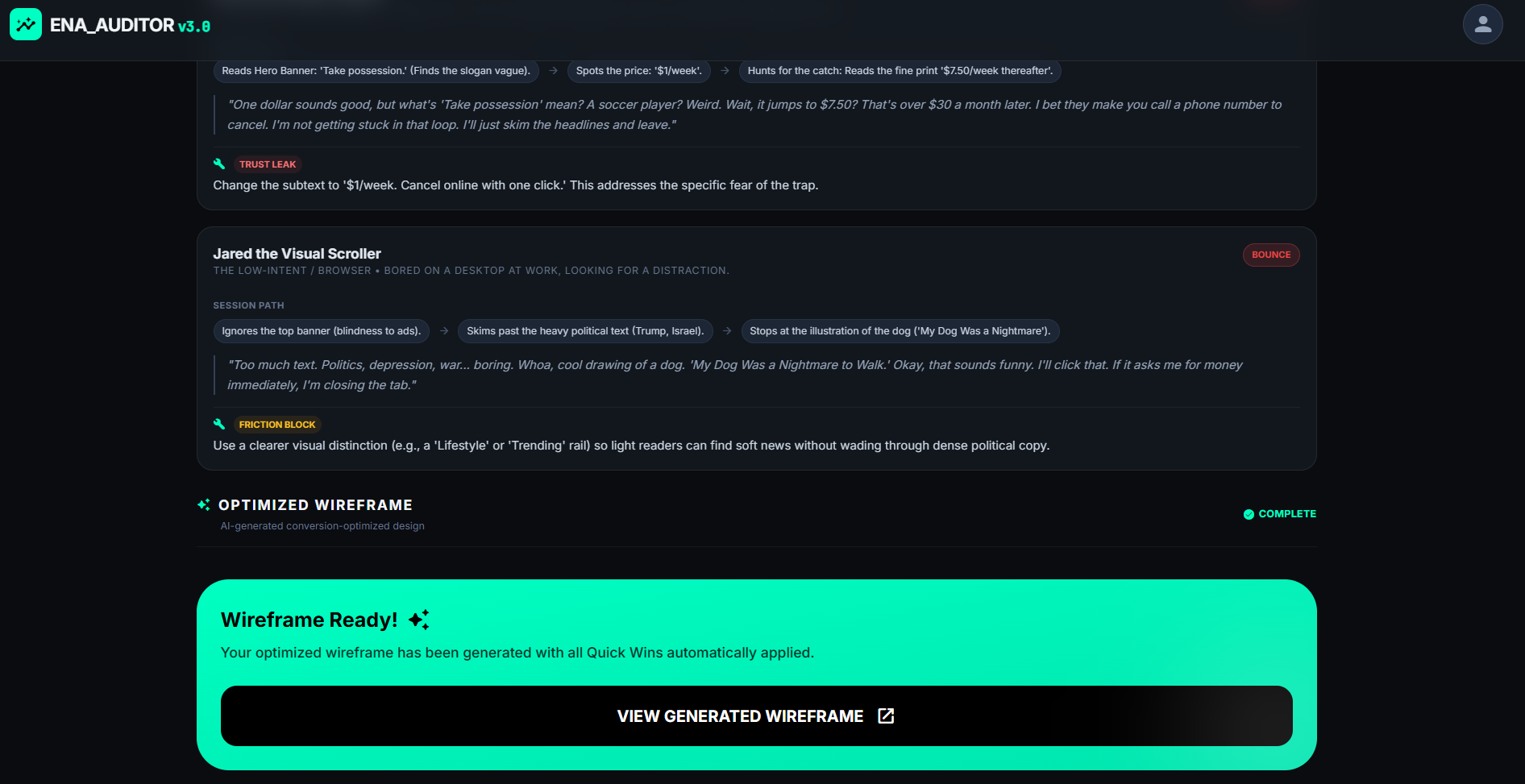
Rebuilder is done and the hi-fi wireframe can be viewed





Inspiration
We’ve all used standard SEO audit tools. They dump a list of 50 technical errors (like "minify CSS") but fail to answer the most important question: "Does this website actually convert humans?"
We realized that traditional bots are blind. They read code, but they don't "see" the user experience. We wanted to build an auditor that has eyes—one that can judge visual hierarchy, trust signals, and branding just like a human consultant would. And more importantly, we didn't just want to list problems; we wanted to build an agent swarm that could fix them.
What it does
ENA Auditor is an autonomous Multi-Agent Swarm powered by Gemini 3.0 Pro.
- The Auditor Agent: Crawls the site with Playwright, captures screenshots, and combines visual data with PageSpeed metrics to generate a "Friction Score."
- The Competitor Spy: Uses Google Search Grounding to identify top real-world competitors, analyze their strategies, and tell you exactly why they are outranking you.
- The Psychology Simulator: Uses Gemini to roleplay specific user personas (e.g., "The Skeptic" or "The Rush Buyer") to give qualitative, emotional feedback on your site's first impression.
- The Rebuilder (The Magic): Instead of just listing errors, ENA autonomously writes the code to fix them. It generates a clean, SEO-optimized React + Tailwind CSS component that solves the identified structural issues 1:1.
How we built it
We built ENA on a Next.js frontend deployed on Render, but the heavy lifting happens in a dedicated Agentic Worker running on Google Cloud Run.
- The Brain: We used Gemini 3.0 Pro via Vertex AI. Its multimodal vision capabilities analyze screenshots, while its reasoning engine manages the complex agent orchestration.
- The Tools: We utilized Google Search Grounding for competitor analysis and headless Chromium (Playwright) for visual data gathering.
- The Architecture: To handle multiple agents running in parallel without timeouts, we implemented an asynchronous "Fire-and-Forget" pattern. The frontend triggers a job, and the Cloud Run worker spins up the agent swarm, updating Firebase Firestore in real-time as each agent finishes its task.
Challenges we ran into
- Orchestrating the Swarm: Managing state between the Auditor, Spy, and Rebuilder was complex. We had to ensure the Rebuilder waited for the Audit data before generating code.
- The "Lazy AI" Problem: Early on, Gemini would summarize the website structure instead of listing every heading. We had to engineer a "Data Migration" prompt strategy to force it to map the content 1:1.
- Serverless Timeouts: Running a browser and multiple AI calls takes time. We optimized the Cloud Run worker with
no-cpu-throttlingto ensure the browser didn't hang during execution.
Accomplishments that we're proud of
- Successfully deploying a Multi-Agent System where agents share context (The Rebuilder "knows" what the Auditor found).
- Integrating Google Search Grounding to make the audit market-aware, not just code-aware.
- Building a Self-Healing Rebuilder that takes a live website and outputs working React code.
What we learned
We learned that Multimodality is the future of code generation. Passing just the HTML wasn't enough. But when we gave Gemini 3 both the visual context (Screenshot) and the code structure (HTML), its ability to refactor and improve the website became almost human-like.
What's next for ENA Auditor
- Auto-Commit via GitHub API: Allowing the Rebuilder to open a Pull Request directly to the user's repository with the fixed code.
- Video UX Analysis: Using Gemini 3's video capabilities to analyze screen recordings of user sessions for layout shifts and jank.
Built With
- firebase
- google-cloud-run
- google-gemini
- google-pagespeed-insights
- next.js
- playwright
- tailwind-css
- typescript
- vertex-ai

Log in or sign up for Devpost to join the conversation.