-
-
Agent Doctors
-
overview
-
Full Idea
Inspiration
Most medical AI today is a chatbot. It has no ward, no handoffs, and no senior physician watching. Real medicine doesn't work that way. A patient is triaged by a nurse, examined by a doctor, and checked by a pharmacist, lab scientist and radiologist. The attending physician then signs off and takes responsibility.
I wanted to build that whole loop, not one smart model. Each role would be a specialised agent. Each claim would be grounded in a textbook. A human doctor would stay in charge, and that doctor's judgment would teach the system.
The slogan became: an autonomous virtual hospital that thinks, deliberates, and learns from its physicians.
What it does
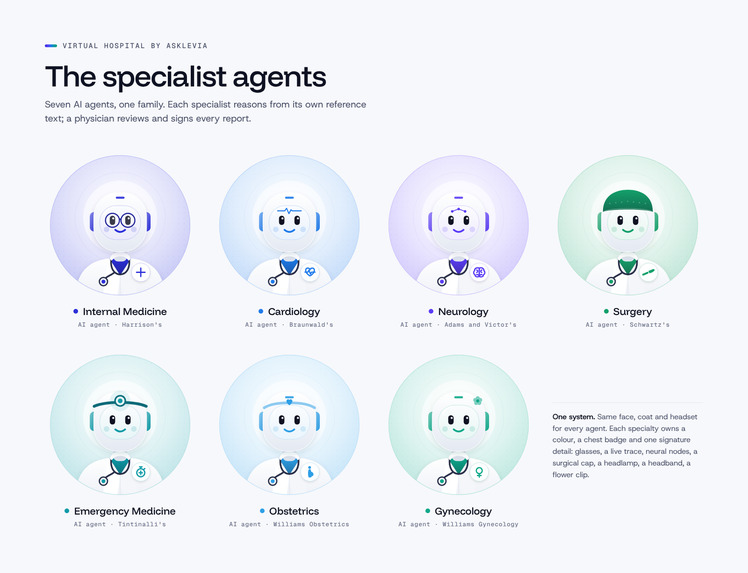
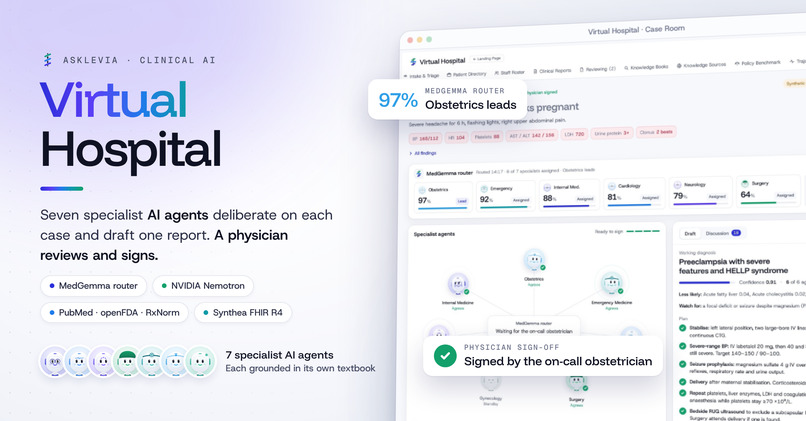
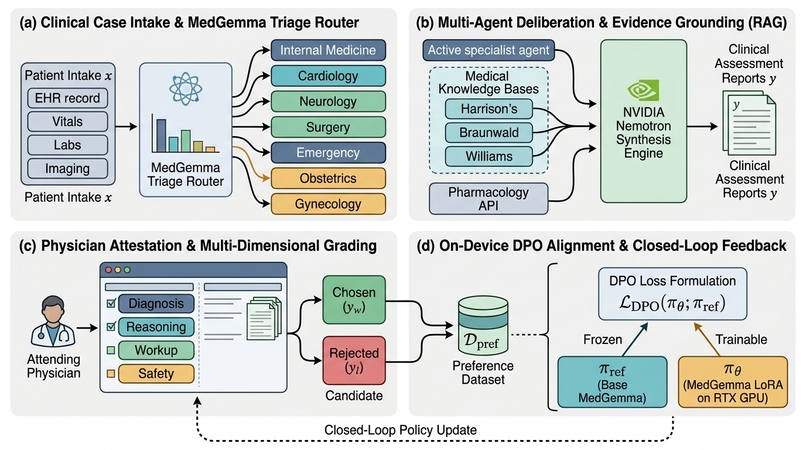
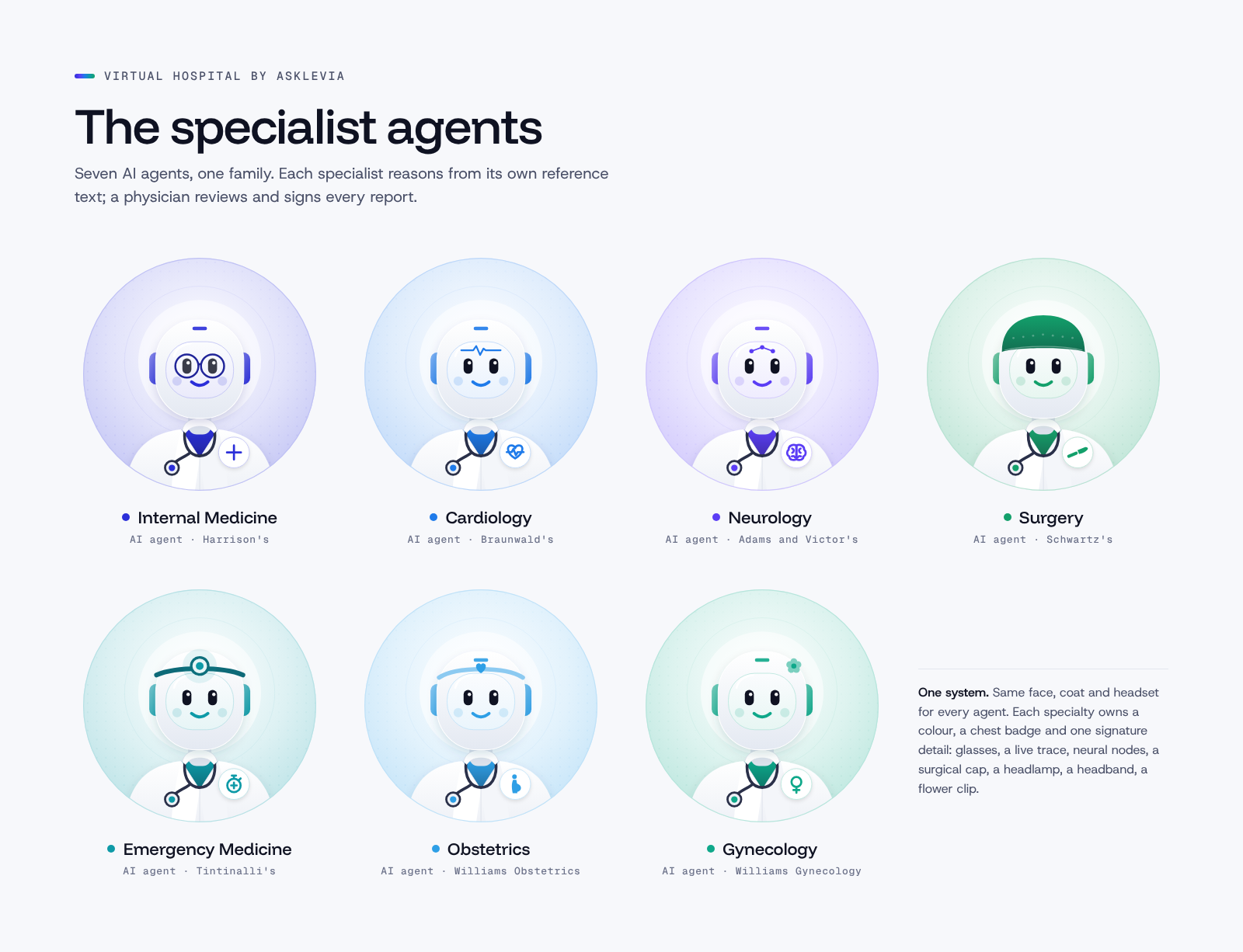
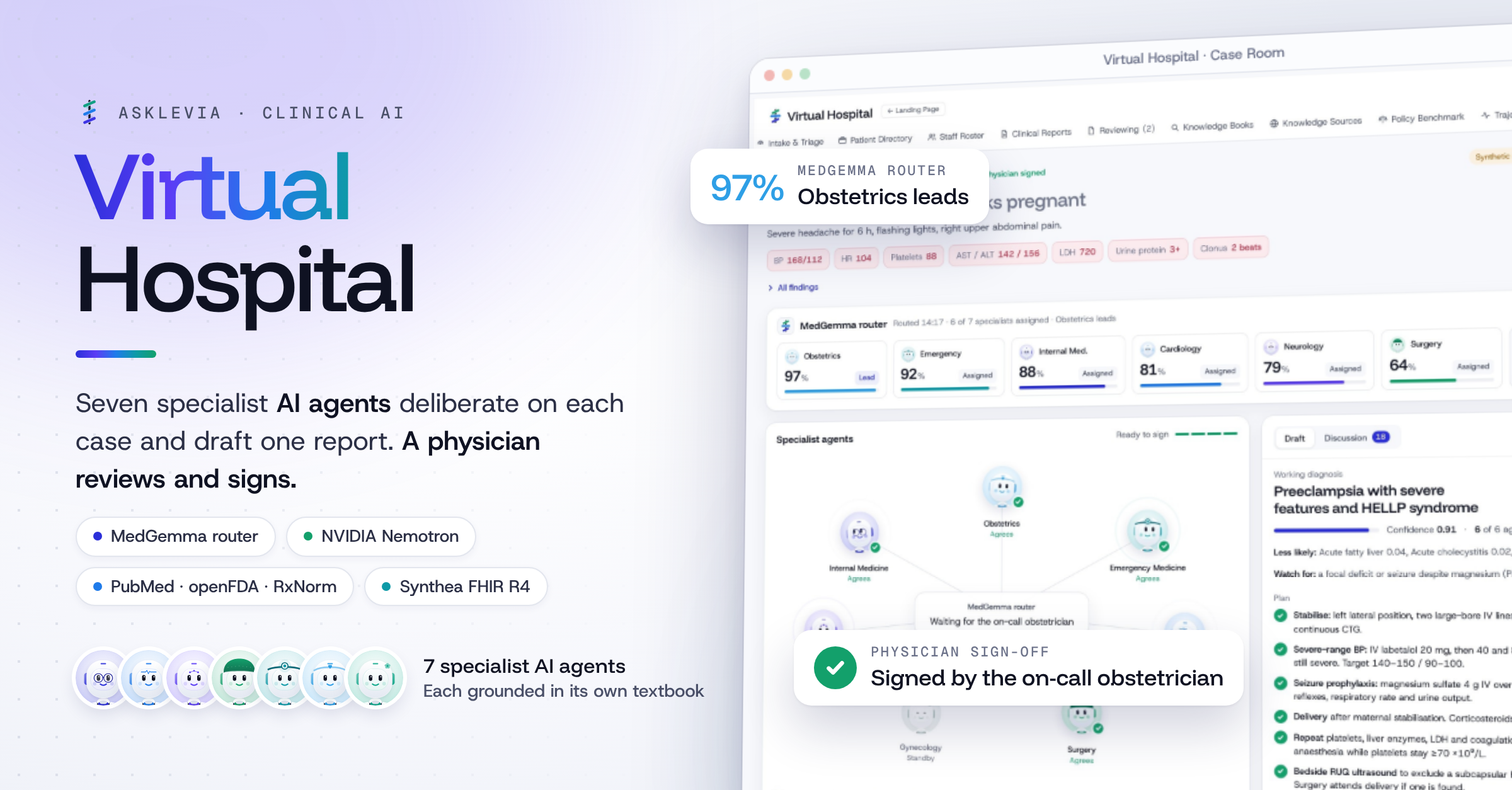
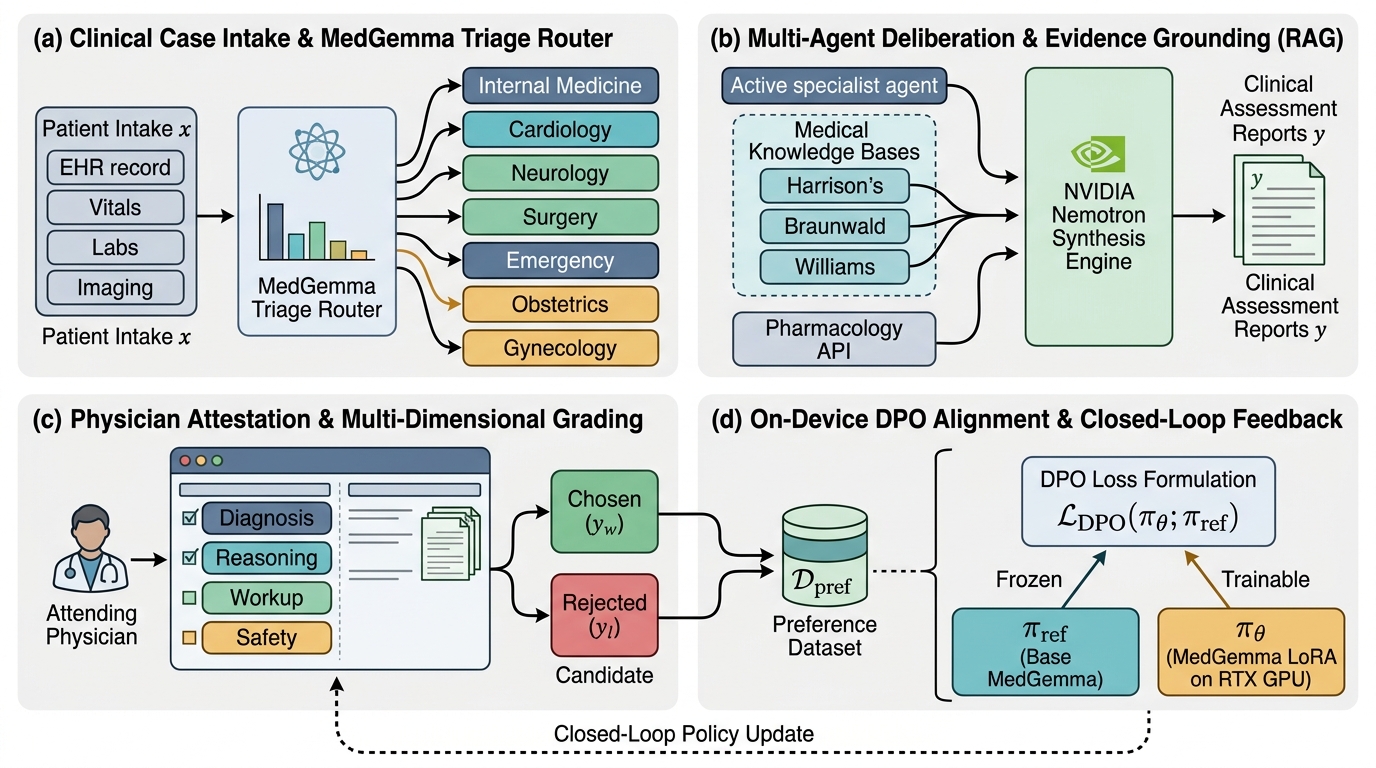
- Intake and triage. A synthetic patient arrives and gets an ESI acuity level (1–5). A MedGemma router sends the case to one of 7 departments (Internal Medicine, Cardiology, Neurology, Surgery, Emergency, Obstetrics, Gynecology).
- Multi-agent deliberation. Doctor, Nurse, Pharmacist, Lab, Radiology and Patient agents move through a 4-stage encounter state machine:
INTAKE_TRIAGE → EXAMINATION_WORKUP → INTERVENTION_TREATMENT → DISPOSITION_REVIEW
Specialists change from Standby to Ready when a handoff needs them. The pharmacist checks drug–allergy conflicts, contraindications and renal dosing.
- RAG grounding. About 47,800 chunks from Harrison's, Braunwald's, Williams, Schwartz's, Adams & Victor's and Tintinalli's give every claim a citation (book, chapter, page).
- Clinical report. The agents' discussion becomes a structured assessment with evidence snippets.
- Physician sign-off. An attending reviews, grades and signs in one click. Each rejection becomes a preference triplet $(x, y_w, y_l)$.
- On-device learning. Those triplets train a LoRA adapter on MedGemma 4B, on a laptop RTX 4060.
How I built it
- Model: MedGemma 4B, 4-bit NF4 quantised (bfloat16 compute), about 4.15 GB of 8 GB VRAM, plus a DPO LoRA adapter.
- Backend: FastAPI, Pydantic v2, WebSocket event bus, SQLite (7 tables).
- Knowledge: Textbook PDFs parsed into chapters and chunks, 768-d embeddings, cosine top-$k$ retrieval.
- Learning: Reward model, preference-pair generator, policy evaluator, TRL DPOTrainer + PEFT.
- Frontend: React 19, TypeScript, Vite, Tailwind 4, animated SVG particle "deliberation" view.
- Quality: 67 automated pytest tests.
Retrieval. For a query embedding $q$ and chunk embedding $d_i$, the system ranks by cosine similarity:
$$\text{sim}(q, d_i) = \frac{q \cdot d_i}{\lVert q \rVert , \lVert d_i \rVert}$$
It returns the top $k$ chunks as citations.
Clinical reward. Physician reviews are scored on a scale from $-5$ to $+10$. Diagnostic accuracy adds $+3$ and guideline adherence adds $+2$. A missed contraindication costs $-4$ and a dangerous intervention costs $-5$. Rejected cases become rejected answers and the physician's correction becomes the chosen answer.
Alignment. I used Direct Preference Optimization, so no separate reward network is needed at training time:
$$\mathcal{L}{\text{DPO}}(\pi\theta;\pi_{\text{ref}})=-\mathbb{E}{(x,y_w,y_l)\sim\mathcal{D}}\left[\log\sigma!\left(\beta\log\frac{\pi\theta(y_w\mid x)}{\pi_{\text{ref}}(y_w\mid x)}-\beta\log\frac{\pi_\theta(y_l\mid x)}{\pi_{\text{ref}}(y_l\mid x)}\right)\right]$$
On the project's benchmark vignettes, the DPO-aligned policy scored +107.6% higher in clinical score than the base model. That figure comes from a small synthetic benchmark, not a clinical trial.
I kept one rule throughout: each layer has one job.
- RAG supplies the medical knowledge.
- MedGemma generates.
- Verification checks.
- Physician feedback teaches.
- Fine-tuning improves format and reasoning style. It is not for memorising books.
What I learned
- Separation of concerns is a safety feature. If the model, the knowledge and the checking each have one job, a failure is easy to trace.
- Preference data beats instruction data for clinical judgment. A doctor saying "this answer is worse than that one, and here is why" is a much richer signal than another prompt–answer pair.
- Quantisation makes this practical. 4-bit NF4 plus LoRA let me train and serve a 4B medical model on an 8 GB laptop GPU. No cloud bill and no patient data leaves the machine.
- A demo is a product too. Judges and mobile users can't install a GPU stack. Graceful offline fallbacks mattered as much as the model.
- Honesty about scope. The audit showed that a planned external-API layer (RxNorm, openFDA, PubMed) did not exist yet, so I documented it instead of claiming it.
Challenges
- 8 GB of VRAM. Fitting MedGemma, the LoRA adapter and inference together meant 4-bit quantisation and careful lazy loading at server start. A deterministic heuristic engine takes over when CUDA is unavailable.
- Ingesting about 600 MB of textbook PDFs. Parsing noisy layouts into clean chapter, heading and page metadata was slow. It was also the only way to produce citations a doctor could check.
- Making agents deliberate, not chat. A state machine, an event bus and WebSocket streaming turn agent turns into something you can watch live in the UI.
- Static hosting broke the live demo. On GitHub Pages, absolute paths like /case-intake.html escaped the repo subpath and returned 404. I fixed it with relative ./ paths and base: './' in Vite. With no Python backend there, I added offline fallback datasets so every screen still works.
- Mentor feedback. The repo needed a visible open-source license and a clickable hosted demo. I added Apache 2.0, set the repository homepage, and added a submission-links table.
- Showing the video on GitHub. GitHub strips tags and blocks unmuted autoplay in READMEs. I used an optimised looping GIF that links to the full HD video.
- Safety. The data is synthetic only, with no real PHI. There are no hardcoded secrets, and a physician always makes the final decision.
What's next
Add the real external knowledge connectors, add a verification layer that fails closed on any claim without evidence_ids, and move from the 2D patient-journey view to a 3D hospital. The system is a research prototype, not a medical device. Sign-off stays with human doctors.


Log in or sign up for Devpost to join the conversation.