-
-
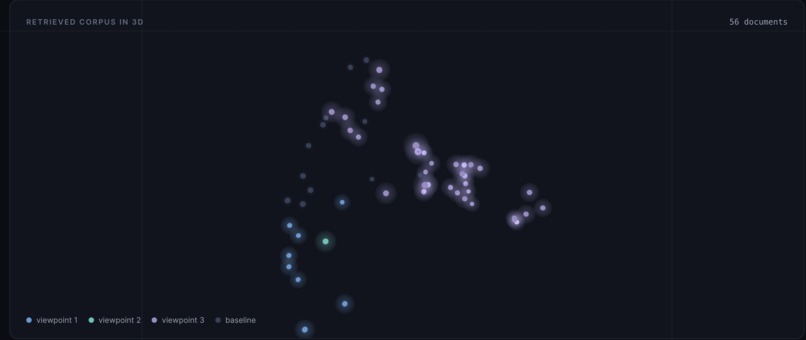
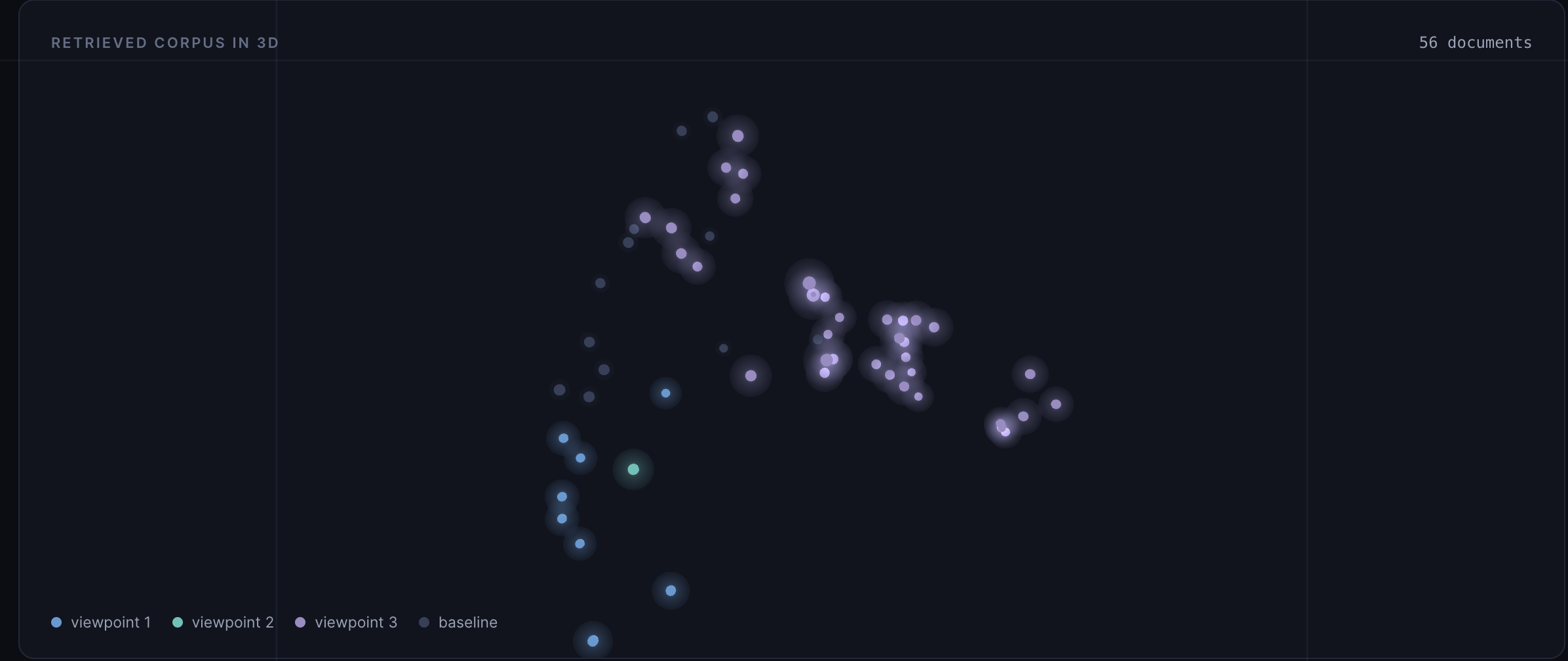
3D Corpus Analysis
-
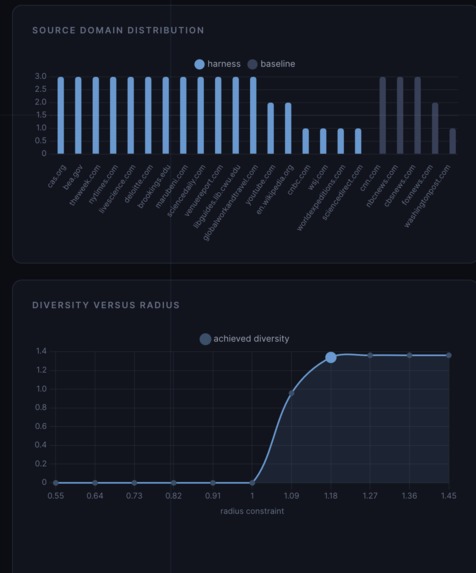
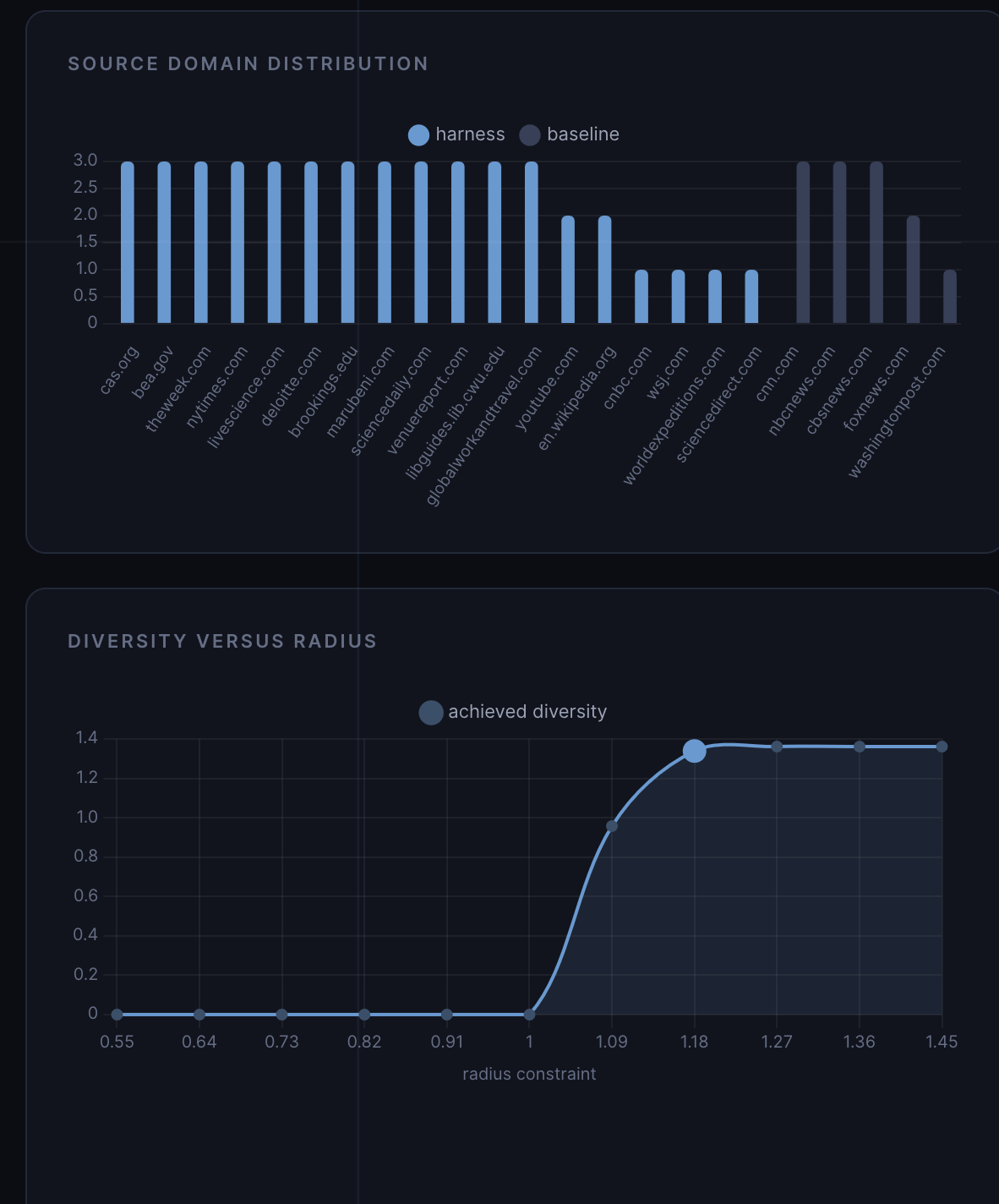
Analytics
Deployed Website: https://orthogonal-search-harness.onrender.com/
Inspiration
Inspired by Ground News, we want to bring bias-aware information consumption beyond curated news to any question an AI search agent can be asked. Where Ground News labels publishers after the fact, we detect what a query secretly presupposes, retrieve evidence from mathematical angles, and prove the result is balanced.
What it does
The Orthogonal Search Harness turns one biased query into a multi-perspective evidence repository. It detects the claim the question presupposes, recenters on the neutralized topic, and generates N maximally dispersed search queries. These execute concurrently on the live web, and every scraped document is embedded and stored in ClickHouse. ClickHouse computes semantic spread, source entropy, and frame balance in SQL against a single-query baseline. The dashboard then reveals differing viewpoints and the strongest conflict pair, along with statistics showing the corpus is more diverse and neutral than a normal search.
How we built it
The harness is a cyclic LangGraph state machine (ingress -> variance engine -> critic -> concurrent search -> ETL -> OLAP evaluation -> synthesis). Rejected query batches feed forward critic feedback. Every query/chunk is a unit vector, so we may normalize it by stripping presuppositions and embedding the neutralized topic as center \(c\). We then select \(n\) queries per $$\max \sum_{i<j}\Vert x_i-x_j\Vert ^2\text{ subject to } \Vert x_i-c\Vert <\varepsilon.$$ (Note that epsilon here is the radius in our project). For unit vectors, the objective collapses to \(n^2-\Vert\sum_i x_i\Vert^2\), so maximizing dispersion is just minimizing the resultant vector. \(\varepsilon\) is user-set or auto-tuned w.r.t. diversity-vs-\(\varepsilon\) curve. ClickHouse then judges the corpus in SQL against the semantic spread \(\tfrac{2}{K(K-1)}\sum_{i<j}(1-\cos(e_i,e_j))\), source entropy \(-\sum_x p(x)\log_2 p(x)\), and frame balance \(B=\tfrac{1}{K}\sum_i[\cos(e_i,a_+)-\cos(e_i,a_-)]\) w.r.t. affirm and refute anchors.
Challenges we ran into
Integrating all the sponsors into our project was a nontrivial task; however, we believe that each sponsor provided a crucial part in our infrastructure. We would like to thank them, as they made it possible. Sponsors: TrueFoundry handles the LLM calls; Composio runs the search fan-out; Airbyte handles ETL; ClickHouse computes the math; Render hosts the entire pipeline.
Accomplishments that we're proud of
We are proud to have proven numerical metrics demonstrating that our product works.
What we learned
In general, one should not trust a single agent search query. In fact, it is best to know all the perspectives when gathering information. By harnessing mathematics, we can bring the best information to help agents operate more aligned.
What's next for Parallax
Parallax will support more ways of analyzing the neutrality of data. This can be extended to a drop-in replacement for a search engine, not just an app.
Built With
- airbyte
- anthropic
- clickhouse
- composio
- math
- openai
- pca
- python
- render
- truefoundry


Log in or sign up for Devpost to join the conversation.