Inspiration
All of our teammates have encountered sports injuries and when given exercises for rehab, we just... didn't do them, or did them wrong. We kept thinking that doing heavier workouts with worsr form would help us get better. We were wrong. And we knew we weren’t the only people who felt this way, and it got us thinking; is there a solution to this problem?
What it does
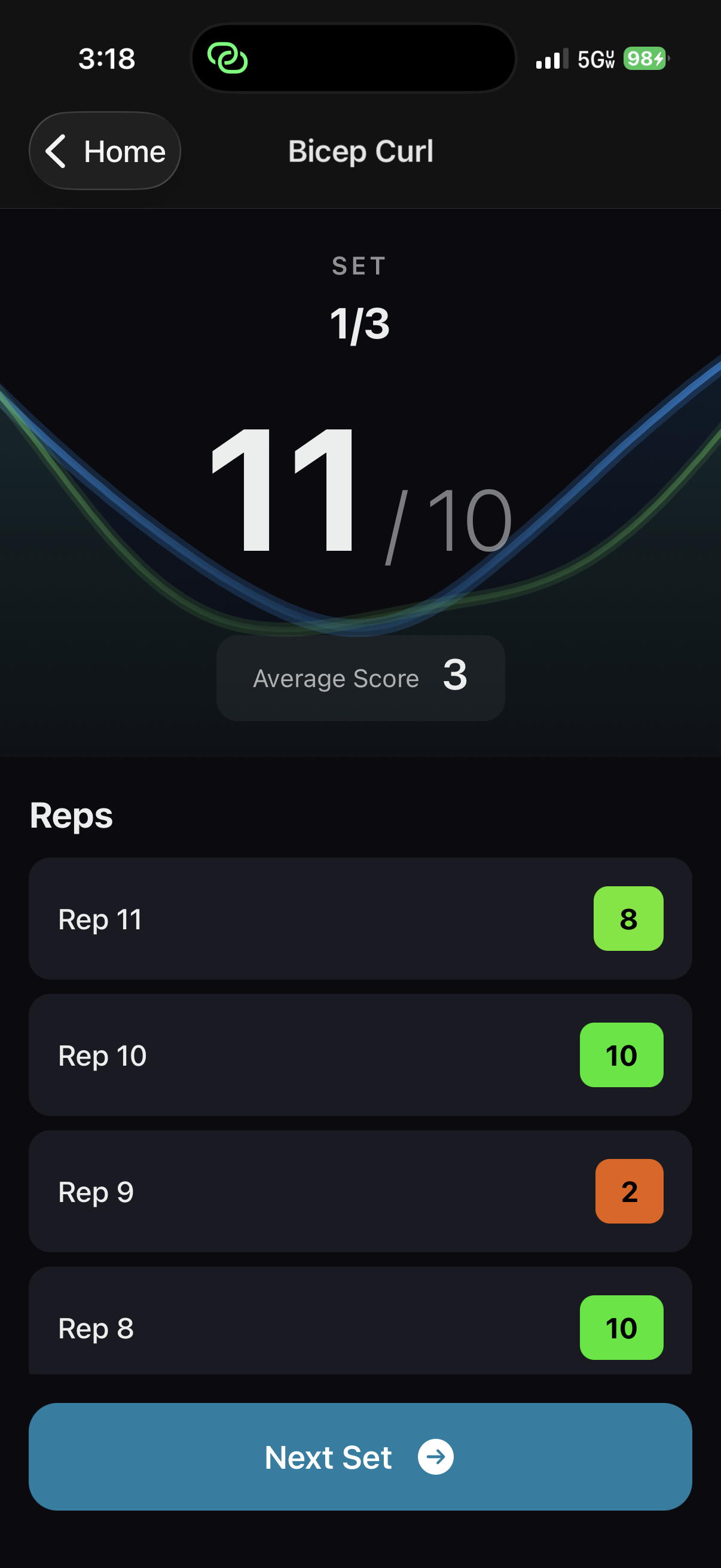
Our device can measure joint angles, and then use an app on your phone to interpret the data and compare it to a physical trainer's exercises. We have two sides to our product; the physical therapist portal and the patient app. The therapist assigns exercises to the patient, which gets transmitted to the patient’s app. The patient then does how many ever sets and reps is assigned. The patient’s exercise movement of each rep is then compared to the therapist’s example exercise, and a similarity score is produced. If the similarity score is low, the patient gets positive reinforcement to try and do better on the next one. If the patient does well, the app provides celebration confetti and haptic feedback to help the patient on the path to recovery. We did this so that the patient doesn’t chase the dopamine from lifting heavier weights, but rather the dopamine from getting a constructive exercise that will help them get better. We also employ an AI, which has two primary jobs at the moment. One of its job is to provide the range of motion of the user (if they ask), and the other is to provide an estimated length of recovery by looking at the patient’s exercise history.
How we built it
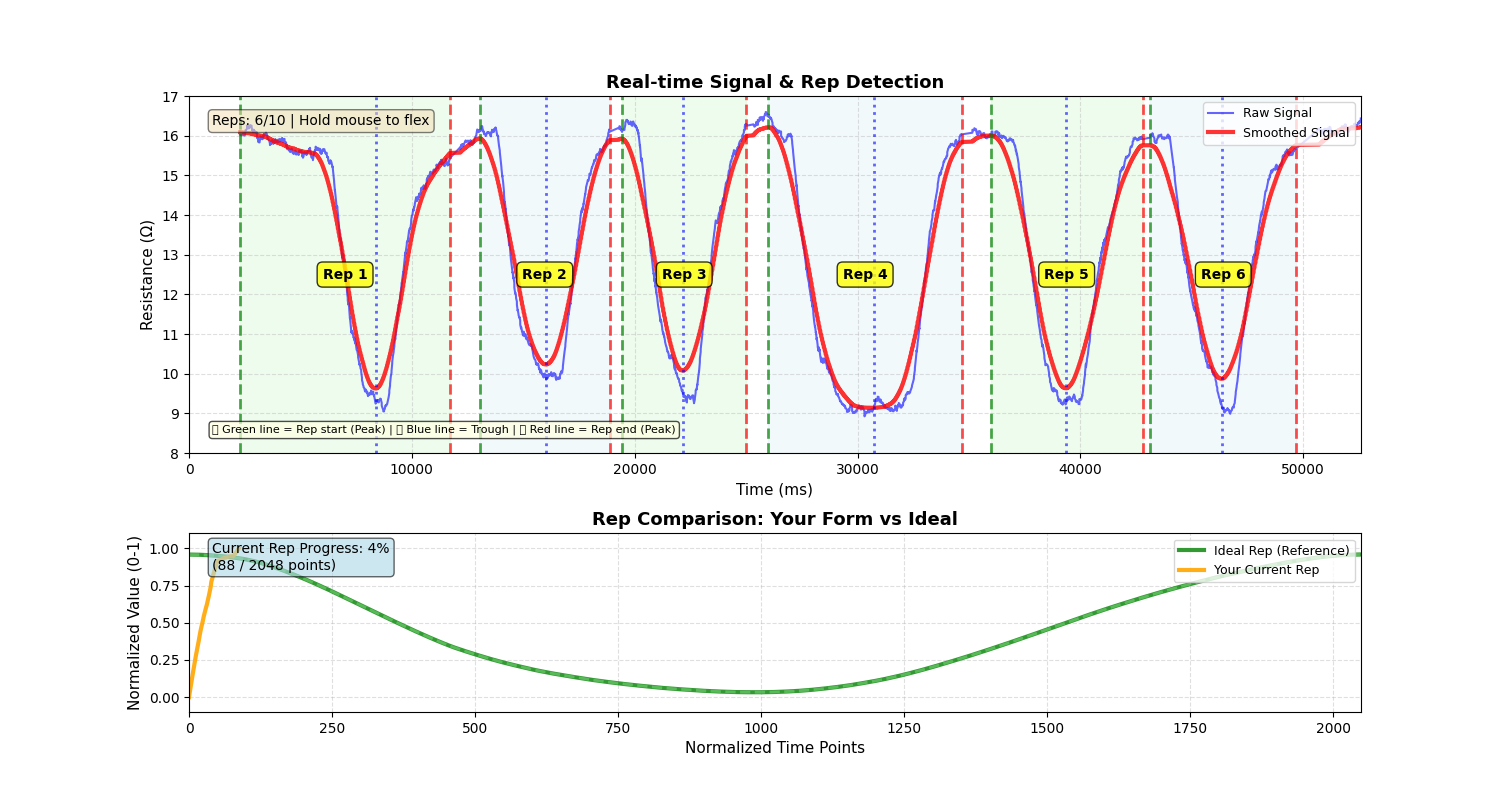
On the hardware side, it looks simple. We just used a joint sleeve and designed an electronic chip to attach to it. However, the deeper software is where the real magic (and most of our tears and cries of anger) went. We started by looking at sine waves to model the patient’s exercise motion. We then moved onto using sample data that we simulated to model the data. We then took this data and used a cos similarity to find the vector similarity between the patient and the therapist’s motions. Finally, we coded our AI to be able to recognize the patient’s range of motion and the estimated recovery time by looking at linear regression and patient history.
Challenges we ran into
We faced quite a few problems. One of our biggest problems was that our soldering iron did not work. We had to buy one from a store, so that was also inconvenient (it was a 2 hour walking trip to get one soldering iron), but when we arrived back, we learned that our iron was actively working against us; it wouldn’t heat up to the levels we needed it to. We had to just make do and hope our circuit didn’t break. Thrn we faced one of our biggest problems on the software side. The rep recognition software that we designed for the sin wave and the simulated data did not work on the real data collected from the chip. When we designed the algorithm for finding out when one rep ended and the next one started, it worked perfectly for the sin wave and the simulated data because they were perfect. But then we learned that not all exercises start immediately after one rep ends (as modeled by a sin wave so that plan went to scrap). So we added code that would enable flat sections to also be counted as a new rep. Then we faced ANOTHER problem. The algorithm started skipping reps. For almost 15 hours we slaved away at the problem. Then finally, after 8 red bulls and 4 ibuprofens split among our three members, at 3 a.m., we solved it. I nearly cried with joy.
Accomplishments that we're proud of
We have a full website, app, database, and physical product that are all fully interconnected. We managed to go beyond our original goals, and added new features beyond what we intended to. The AI was never meant to be a part of our product. We decided to add it when we realized that we want to be a part of our new feature, and to be able have a self learning machine that can help a patient recover in real time. Therapists get busy; AIs don’t.
What we learned
We learned that battery-powered soldering irons are NOT good. We learned so much that it’s hard to write about everything. But we learnt about how to not use perfect data, how coding an AI is really, REALLY hard.
What's next for OrthIQ
We want to evolve OrthIQ into a company and create a whole line of products that can assist with physical therapy and athletic training. In terms of our app, we want to increase the capabilities of our AI and have it recommend exercises to the patient based on the patient’s exercise history. We have talked with multiple orthopedic surgeons at the UofU hospital, and we are keen to propose talks to start developing official braces that can be used in real life settings.
Built With
- c++
- convex
- cursor
- expo.io
- nextjs
- python
- react
- react-native
- typescript

