Orquest -A Game for Your Future!
Inspiration
Choosing a career is one of the biggest decisions students make, but sometimes we don't even know where to start.
There are so many careers, degrees, and opportunities available that figuring out the right path can feel overwhelming. We wanted to create something that could help students explore those possibilities without making career planning feel like another stressful assignment.
The MDC North Campus Challenge gave us the opportunity to work on exactly that problem: helping students explore careers and build personalized educational and professional pathways, starting at Miami Dade College.
Our team took that idea and added something different.
What if planning your future felt like playing a game?
That's how Orquest was born.
The name comes from an orchestra, where different instruments work together to create something meaningful. We see career development in a similar way. Your interests, skills, education, and experiences all come together to help shape your future.
We wanted Orquest to help students discover those connections and create their own path forward.
What It Does
Orquest is an AI-powered career discovery game that helps students explore their interests, discover jobs, create learning pathways, and turn their goals into RPG-style missions.
Instead of starting by asking students which degree they want, Orquest focuses on helping them discover which jobs actually interest them first.
Here's how it works:
- Swipe to Discover: Students explore different interests and activities through interactive swipe cards.
- Career Matching: Orquest suggests possible careers based on their interests.
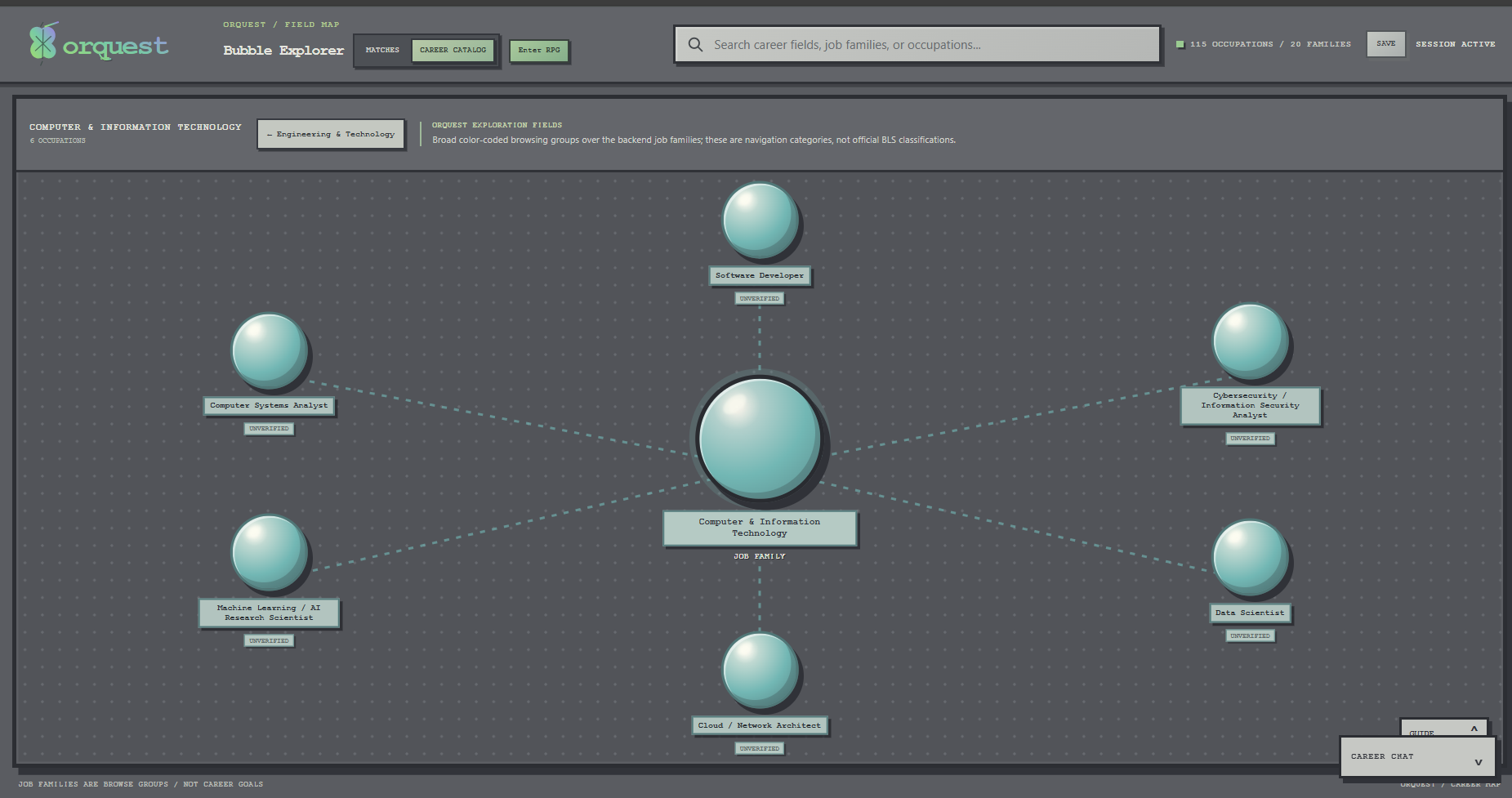
- Career Explorer: Students can explore 20 job families and 115 occupations.
- AI Career Conversation: Using Google Gemini, students can ask questions about careers, education, and professional skills.
- Learning Pathways: Orquest helps students explore educational steps toward a career, including available Miami Dade College programs and external learning opportunities.
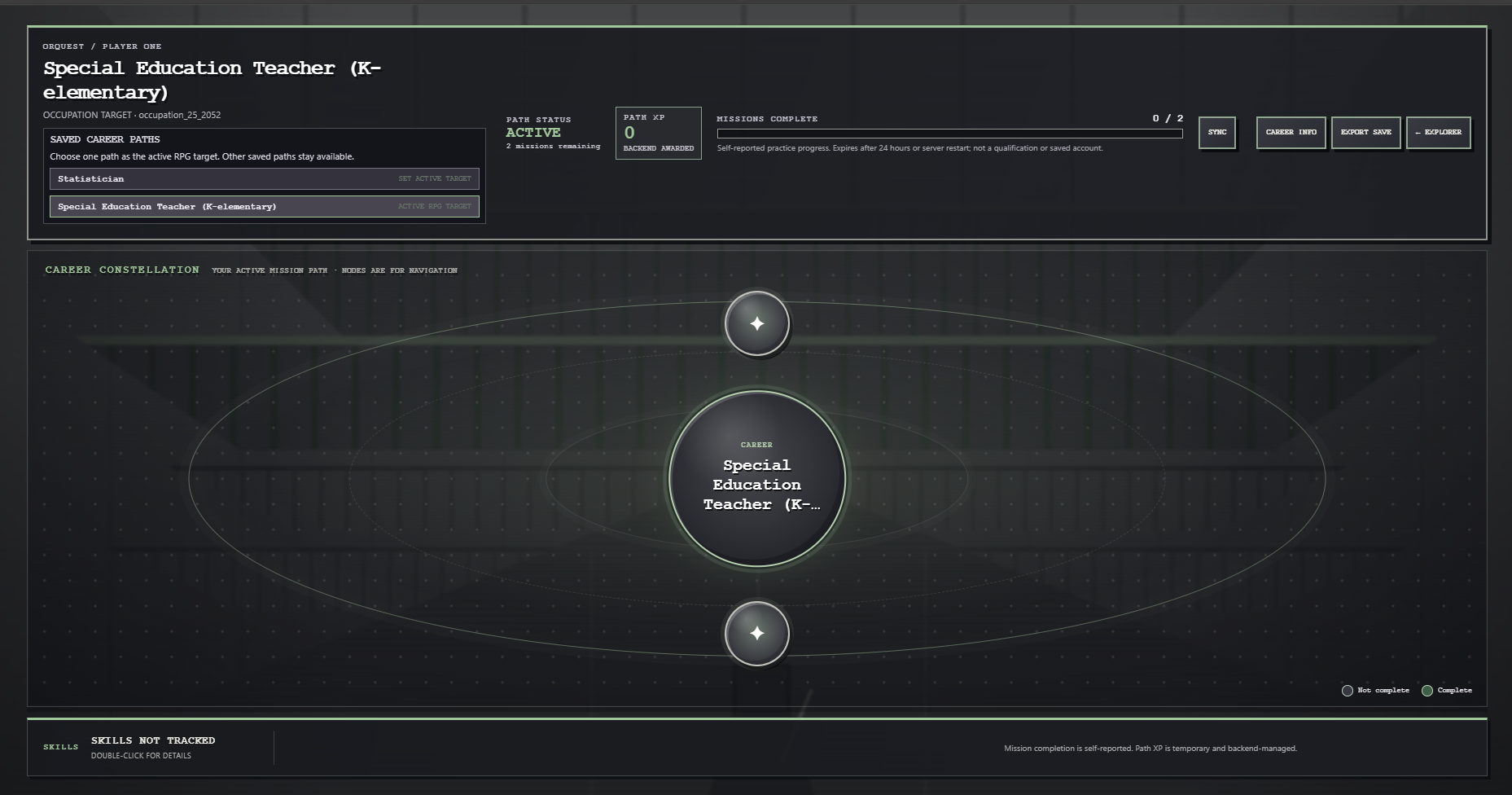
- RPG Missions: Students can complete learning missions, earn XP, and follow their progress toward their career goals.
We want students to feel like they're making progress instead of just reading information.
Most importantly, Orquest doesn't choose your future for you. It helps you discover what is possible and what steps you can take next.
How We Built It
We developed Orquest as a full-stack application using frontend development, Python programming, AI integration, and career research.
Frontend and UI/UX
We used React, JavaScript, and Vite to create the interactive application.
Our frontend includes swipe cards, a Bubble Explorer, career details, AI conversations, educational roadmaps, and RPG progression.
We used GitHub Copilot and OpenAI Codex during development to help us build, improve, and debug different parts of the application.
Later in the hackathon, our frontend teammate ran out of Codex credits. Instead of stopping development, he started working with Base44 to continue improving the UI/UX.
This also became a new integration challenge. We wanted to take advantage of Base44 while keeping our existing React application and Python backend instead of rebuilding everything from scratch.
Backend and AI
We built our backend using Python and FastAPI.
The backend handles career matching, occupation information, AI requests, educational roadmaps, and RPG missions.
For artificial intelligence, we integrated the Google Gemini API to generate personalized career guidance.
We didn't want to create a chatbot that simply produces random suggestions. We developed structured responses, validation, and catalog-based fallback features so Orquest can continue providing useful information even when AI is unavailable.
We also explored Swarms API, Prune API, and OpenRouter as part of our AI integration research and provider architecture.
Career and Educational Resources
We organized career information into a catalog of 20 job families and 115 occupations.
Our team researched careers, educational requirements, and professional opportunities using sources such as the U.S. Bureau of Labor Statistics and O*NET.
Because the MDC North Campus Challenge focuses on educational pathways, we also developed an initial Miami Dade College cybersecurity pathway demonstration.
Our goal is to connect students with educational opportunities that can help them prepare for their selected careers.
We also designed the application to distinguish AI-generated suggestions from catalog information and clearly identify details that still require verification.
Deployment and Collaboration
We used GitHub and Git to manage our code, branches, and team contributions.
We used Docker and Render to deploy Orquest as a public web application.
For testing, we used Pytest and Vitest to check our backend, frontend, and integrations.
Our team divided responsibilities across frontend development, backend and AI integration, career data, and educational resources.
Challenges We Faced
Getting Gemini to Work
One of our biggest challenges was getting real AI-generated responses working correctly.
At first, our Gemini API requests kept failing. We investigated different possibilities, including our Python environment, API key configuration, and response validation.
Eventually, we discovered an incompatible field in the JSON schema being sent to Gemini.
After fixing the schema, improving our error handling, and running more tests, we finally received a successful AI-generated career response.
Seeing Gemini work through our public Orquest website was one of the biggest moments of the hackathon.
Connecting Everything Together
Our teammates were working on different parts of the application, and integrating everything was more complicated than we expected.
We had to connect interest matching, job exploration, career conversations, educational roadmaps, and RPG progression.
At one point, our frontend couldn't load any swipe cards, even though the backend was working correctly.
After investigating the browser errors, we discovered it was a CORS configuration issue.
Fixing that taught us how important it is to understand how the frontend and backend communicate.
Switching From Codex to Base44
Another challenge was managing the limits of our development tools.
When our frontend teammate ran out of Codex credits, we had to find another way to keep improving the application.
We started using Base44, which allowed us to continue working on the frontend experience.
However, switching tools created another problem: making sure the changes would work with our existing backend, APIs, and React project.
We learned that AI development tools can help us move faster, but we still have to understand our architecture and carefully integrate the code.
Building With a $0 Budget
We also wanted to avoid unexpected expenses.
We researched different hosting providers, AI platforms, and database services while looking for options we could use during the hackathon.
We ended up deploying Orquest on Render and using Gemini's Free Tier.
We also implemented request limits and fallback responses because we wanted the application to remain usable even when AI services reached their limits.
Working Under Time Pressure
Like any hackathon, time was one of our biggest challenges.
We had four teammates working on different features, several GitHub branches, multiple integrations, and a submission deadline approaching quickly.
We learned how important communication, testing, and knowing when to stop adding features really are.
Sometimes the best decision wasn't to build something new. It was to make sure what we already had worked properly.
What We Learned
This hackathon taught us much more than programming.
We learned how to integrate real AI models into an application, build REST APIs, work with React and FastAPI, manage GitHub branches, and deploy a working website.
We also learned how to adapt when our original tools weren't available, especially when we transitioned part of our development workflow to Base44.
One of our biggest lessons was that building individual features is only half the work. Making them work together is what turns an idea into a real application.
We also learned the importance of handling career information responsibly. AI can provide helpful suggestions, but students should know when information needs to be verified.
Most importantly, we learned how much we could accomplish by combining our different skills and working as a team.
Hackathon Challenges
Orquest was built around the MDC North Campus Challenge: Designing a Smart Career and Education Pathway Navigator.
Our application addresses this challenge by helping students discover possible careers, choose their goals, and explore educational pathways beginning at Miami Dade College.
We're also using Google Gemini API to make career exploration more interactive and personalized, aligning with MLH's Best Use of Gemini API challenge.
During development, our team also adopted Base44 to continue improving the frontend and user experience, supporting our work on a tool that helps students access educational and career opportunities.
What's Next for Orquest?
We want Orquest to continue growing beyond SharkByte.
In the future, we would love to expand our verified Miami Dade College pathways, improve personalized career recommendations, and add more interactive RPG missions.
We also want to introduce persistent accounts so students can save their progress and return to their career journeys.
Our long-term vision is to make Orquest a place where students can explore their interests, discover opportunities, and understand what they can do next.
Because your future shouldn't feel like a guessing game. It should feel like an adventure you get to create.
*Orquest - A Game for Your Future! *
