-
-
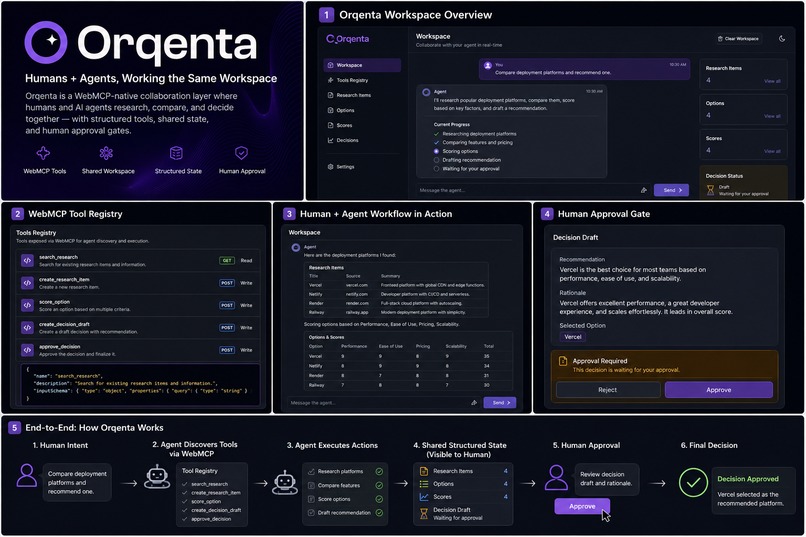
a detailed media overview
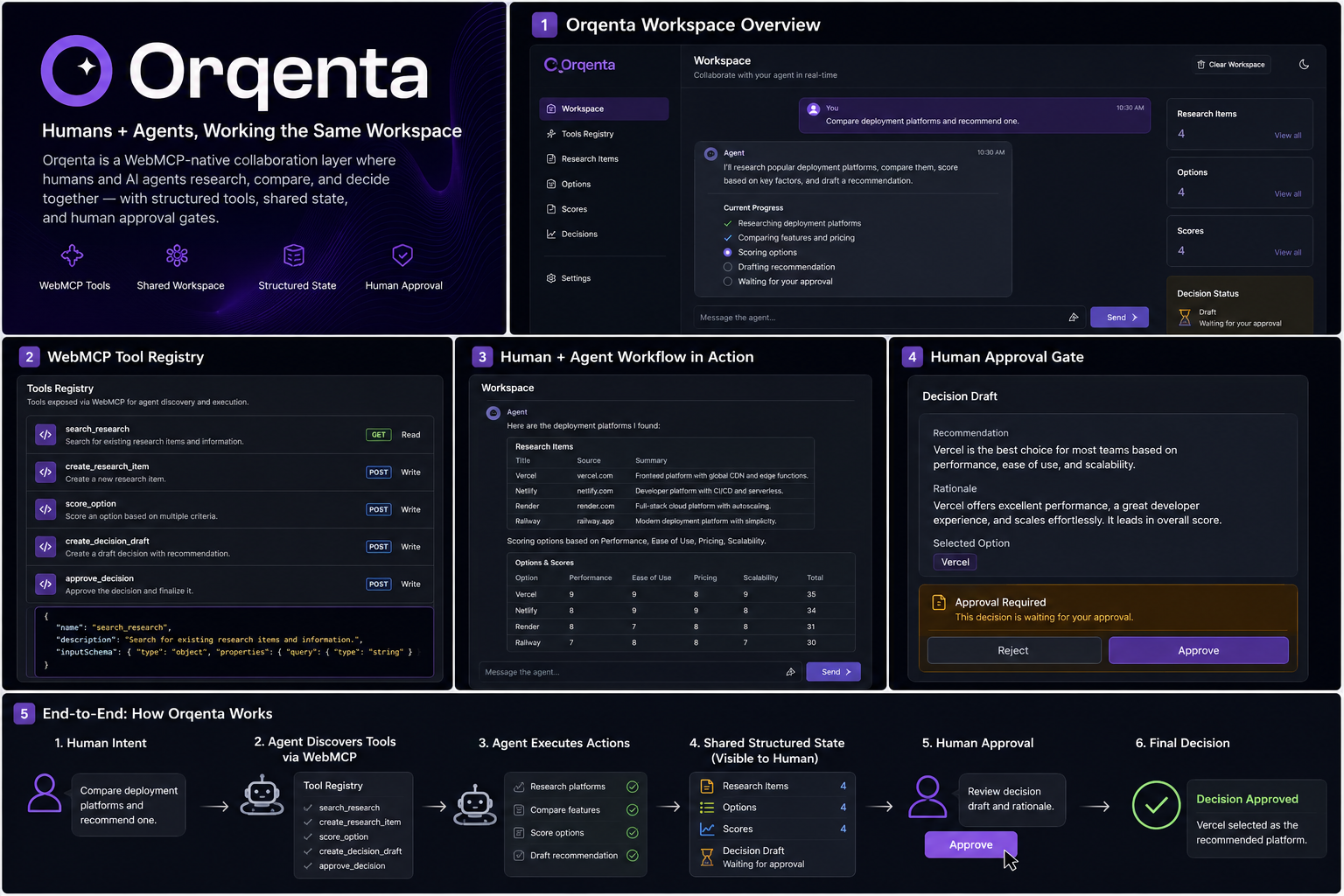
About Orqenta
We built "Orqenta" around a simple question: "What if the web was designed for both humans and AI agents from the start?"
Today, AI agents are increasingly good at understanding intent, but interacting with real websites can still be fragile. An agent may know 'what' a user wants but struggle with buttons, forms, page structure, and application-specific workflows. We were inspired by the idea behind "WebMCP": instead of forcing agents to interpret every interface visually, websites can expose their capabilities as structured tools that agents can understand and use.
That became the foundation of "Orqenta", a human–agent collaboration layer for the open web. Our goal was to explore a future where "websites expose capabilities, agents execute them, and humans remain in control".
What We Built
Orqenta connects human intent with agent-accessible web capabilities through WebMCP. A user can describe what they want to accomplish, while an AI agent can discover available tools, understand their schemas, perform structured actions, and return meaningful results.
Rather than treating an AI agent as an external chatbot, Orqenta treats it as a "participant in the web experience".
The core interaction looks like:
"Human intent → Agent discovers tools → Agent performs structured actions → Human reviews the result"
This creates a more reliable interaction model than asking an agent to independently guess how a webpage works.
How We Built It
We designed Orqenta around a modular web architecture so that the product remains useful even when WebMCP is unavailable.
At the application layer, we expose clearly defined capabilities through WebMCP tools using structured names, descriptions, input schemas, and executable functions. The frontend provides the human-facing interface, while the tool layer acts as the bridge between agent reasoning and application actions.
We focused heavily on making every tool:
- "Discoverable" — agents can understand what the tool does.
- "Structured" — inputs and outputs follow predictable schemas.
- "Controllable" — humans can remain involved in consequential actions.
- "Composable" — multiple tools can be combined into larger workflows.
- "Progressively enhanced" — the application still works as a normal web application without WebMCP support.
What We Learned
The biggest lesson was that "agent-native web design is different from traditional UI design".
A traditional interface is primarily designed for a human to visually interpret. An agent-facing interface needs something else: explicit capabilities, predictable inputs, clear outputs, validation, and well-defined boundaries.
We learned to think about application features not only as UI components, but also as "machine-actionable capabilities".
For example, instead of only building a "Search" interface, we ask:
What exactly should an agent be able to do with search?
That shift led us to define tools around intent and actions rather than around individual UI elements.
We also learned that human oversight remains critical. Giving agents more capability does not mean removing people from the workflow. In many cases, the better experience is agent-assisted execution with human control at the right moments.
Challenges We Faced
One of our biggest challenges was working with an emerging technology and designing around capabilities that are still evolving.
We had to make architectural decisions that would support WebMCP without making the entire application dependent on it. This led us to separate the core application logic from the agent interaction layer.
Another challenge was determining the right level of tool abstraction. Exposing every UI interaction as a tool creates noise and makes agents harder to use. Exposing too few tools makes useful workflows impossible. We therefore focused on high-value, task-oriented capabilities instead of exposing raw interface actions.
We also had to think carefully about security. An agent capable of taking actions on behalf of a user introduces questions around authorization, validation, sensitive operations, and human confirmation. We designed Orqenta so that agent capability does not automatically mean unrestricted authority.
Why Orqenta Matters
We believe the next evolution of the web will not be purely human-facing or purely agent-facing.
It will be "collaborative".
Humans bring goals, context, judgment, and creativity. Agents bring speed, automation, reasoning, and the ability to execute structured workflows.
"Orqenta explores what happens when the web becomes a shared environment for both."
Instead of AI merely reading the web, "Orqenta explores a web where agents can actually work with it—while people stay in control."
Built With
- css4
- eslint
- nanoid
- next.js
- playwright
- react
- tailwind
- typescript
- vercel
- vitest

Log in or sign up for Devpost to join the conversation.