-
-
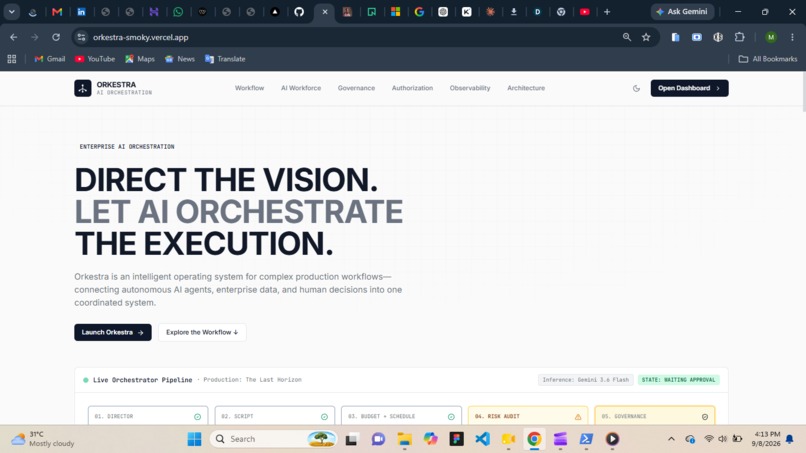
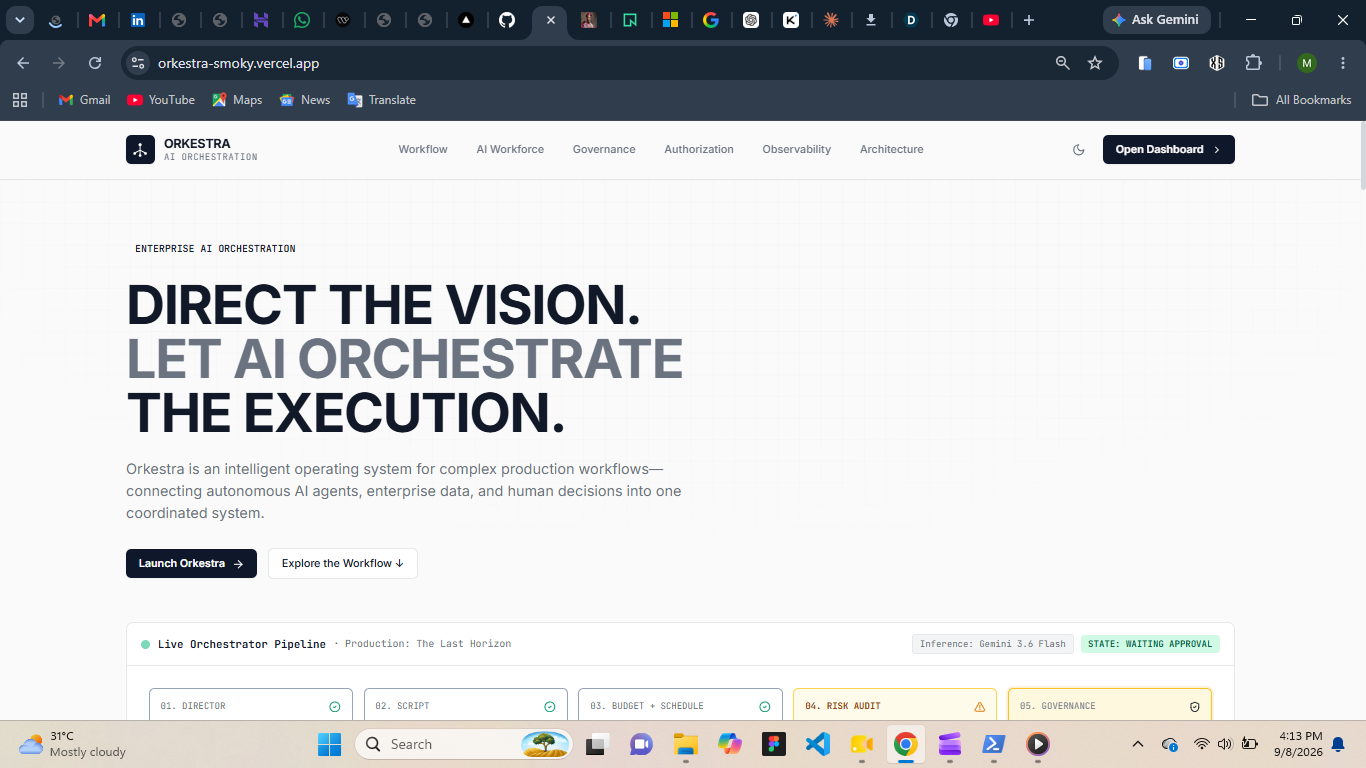
Landing Page
-
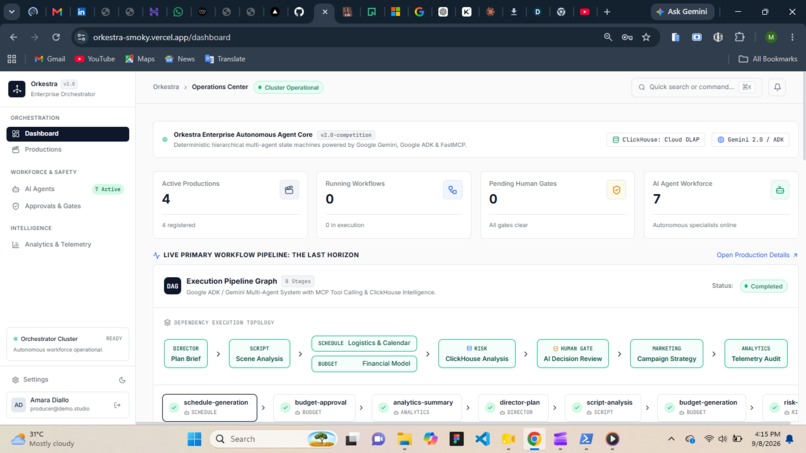
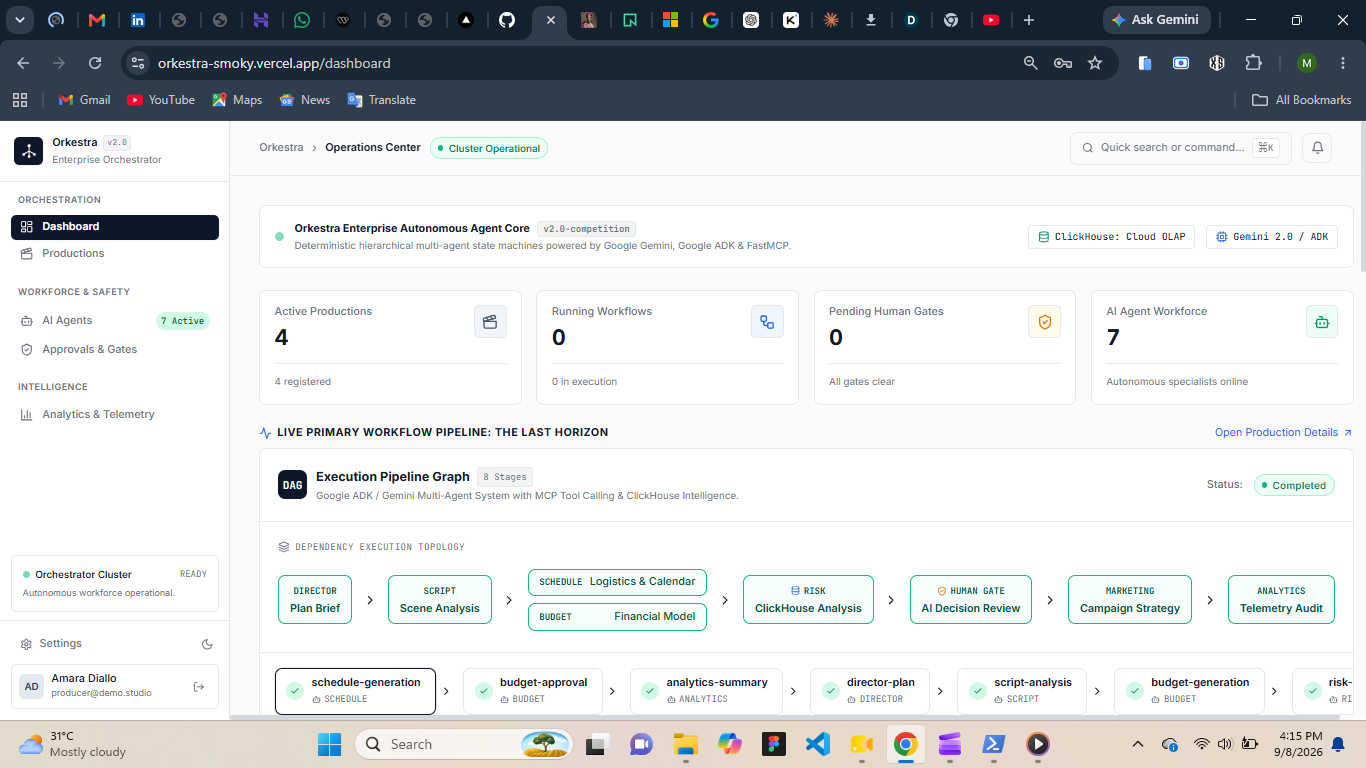
Dashboard
Inspiration
Modern media production is not a single task. It is a chain of interconnected decisions involving scripts, budgets, schedules, risk, marketing, and analytics.
I was inspired by the idea of asking:
What if an AI system could operate like an actual production team not just a chatbot?
Existing AI tools can generate scripts, analyze budgets, or create marketing ideas, but they often operate as isolated assistants. We wanted to explore what happens when specialized AI agents can coordinate with each other, use real production data, execute workflows, and involve humans when decisions become consequential.
That led me to Orkestra: an AI Operating System for modern media production.
What it does
Orkestra turns a media production workflow into a coordinated AI workforce.
A Director Agent orchestrates specialized agents for:
Script analysis Budget planning Scheduling Risk assessment Marketing Analytics
Instead of asking every agent to independently solve the entire problem, Orkestra gives them specific responsibilities and manages the dependencies between them.
For example:
Director → Script → Budget + Schedule → Risk → Human Approval → Marketing → Analytics
The agents can reason over production context and use controlled tools through MCP.
Orkestra also uses ClickHouse as its analytical memory, allowing agents such as the Risk Agent to use historical production data when making assessments rather than relying only on the current project's context.
Most importantly, Orkestra uses bounded autonomy. Agents can reason and execute within defined boundaries, while high-impact decisions can pause the workflow and require human approval.
How we built it
Orkestra combines several technologies into a single production workflow.
AI & Agent Layer
I use Google Gemini as the reasoning engine and Google ADK to build and coordinate the specialized agents.
The Director Agent delegates work to specialist agents, each with structured responsibilities and outputs.
Tool & Data Access
I use Model Context Protocol (MCP) as the controlled interface between agents and production capabilities.
Instead of giving agents unrestricted access to our databases, they interact through authorized tools.
Data Architecture
We use PostgreSQL for operational application state and ClickHouse for analytical and historical production data.
Production events can be captured and analyzed so that the system can derive intelligence from previous workflows.
Workflow Engine
A backend workflow engine manages:
Agent dependencies Task execution Workflow state Events Permissions Approval gates Failure handling Frontend
I built a real-time production control interface using Next.js, React, TypeScript and Tailwind CSS, allowing users to see agent activity, workflow progress, approvals, and production intelligence as the system operates.
The result is a system where:
Gemini provides the intelligence, while Orkestra provides the organizational structure and execution control.
Challenges we ran into
The hardest part wasn't getting an LLM to generate an answer.
It was figuring out how to make multiple AI agents behave like a reliable production system.
One major challenge was balancing agent autonomy with deterministic execution. I needed agents to reason dynamically while still ensuring that certain actions happened in the correct order and that critical decisions could not bypass human approval.
I also had to solve the problem of giving agents access to useful enterprise information without simply exposing the databases directly. This led me to use MCP as a controlled tool boundary.
Another challenge was making historical data genuinely useful rather than simply adding ClickHouse to our architecture because it was required by the hackathon. I designed the system so that analytical production data can actually influence agent reasoning, particularly during risk assessment.
Finally, building a real-time interface for an asynchronous multi-agent workflow required us to think carefully about events, state transitions, failures, and communicating agent activity clearly to the user.
Accomplishments that we're proud of
I am particularly proud that Orkestra goes beyond demonstrating isolated AI capabilities.
I built a working multi-agent production workflow where specialized agents coordinate through a Director Agent and follow explicit dependencies.
I am also proud of the integration between Gemini, Google ADK, MCP and ClickHouse.
The Risk Agent can use historical production intelligence through our MCP layer before producing its assessment, giving the system a path toward evidence-based agent reasoning.
Another accomplishment is the human-in-the-loop architecture. The system doesn't assume that more autonomy is always better. When a decision reaches a defined risk threshold, the workflow can pause for human review before continuing.
I also built the surrounding infrastructure needed to make the agents feel like part of a real product: real-time workflow visibility, structured agent outputs, authentication, authorization, event tracking, analytics, and production controls.
Most importantly, I am proud that Orkestra demonstrates a broader idea:
AI agents become significantly more useful when they are given organizational structure, tools, data, and governance—not just prompts.
What we learned
I learned that building an agent is relatively easy compared with building a system around agents.
The most important engineering problems were not simply prompt engineering. They were orchestration, state management, permissions, tool boundaries, failure handling, observability, and deciding where humans should remain in control.
I also learned that bounded autonomy is more practical than unrestricted autonomy for enterprise workflows.
An agent should be able to make decisions within its area of responsibility, but the surrounding system should determine what it is allowed to do and when a human must intervene.
Another important lesson was the value of separating operational and analytical workloads.
PostgreSQL gives Orkestra a reliable operational source of truth, while ClickHouse provides a foundation for analyzing the history of production activity.
Most importantly, I learned that the real opportunity with agentic AI isn't simply replacing individual tasks.
It's re-designing how entire workflows operate.
What's next for orketsra
My next step is to take Orkestra beyond a hackathon prototype and toward a production platform for real media teams.
We want to expand the agent workforce with additional specialists such as:
Casting Location scouting Legal & compliance VFX planning Distribution Revenue forecasting Audience intelligence
We also want Orkestra to become increasingly proactive.
Instead of waiting for a producer to ask what went wrong, the system should be able to detect emerging problems, explain why they matter, simulate possible outcomes, and recommend corrective actions.
Over time, we envision Orkestra building a production intelligence layer across projects, allowing teams to learn from their previous productions and continuously improve planning, budgeting, scheduling, and risk management.
The long-term vision is simple:
Give creative teams an AI workforce that can reason, coordinate, learn from production history, and execute—while keeping humans in control of the decisions that matter most.
Built With
- ai
- clickhouse
- docker
- gemini
- googleadk
- mcp
- nestjs
- nextjs
- postgresql
- prisma

Log in or sign up for Devpost to join the conversation.