-
-
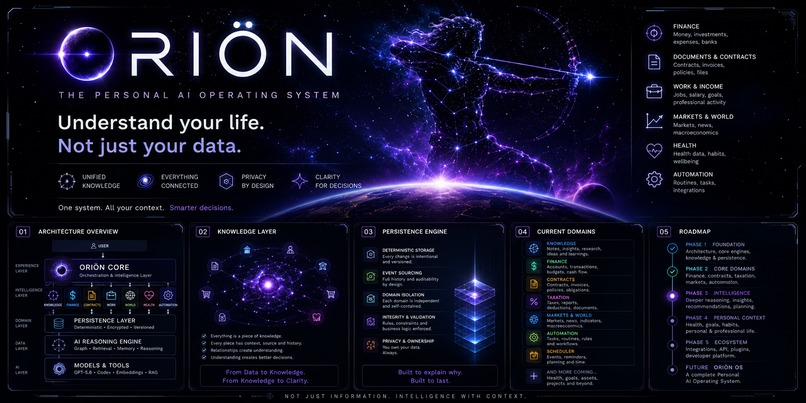
ORIÖN
I honestly can't remember the exact moment ORIÖN was born, because it didn't appear overnight. It started as a very small idea that gradually evolved into something much more ambitious.
It all began with something incredibly simple.
Like many people, I try to save part of what I earn and invest it as wisely as I can. I'm not managing millions—I'm just someone with an ordinary salary trying to make thoughtful financial decisions in the hope of building a more secure future and, one day, reaching the kind of financial freedom where money is no longer a constant source of concern.
Very quickly, though, I realized that even the simplest investment decision required navigating an endless maze.
If I wanted to decide whether I should invest that month, I'd open TradingView to understand the markets. Then I'd check my exchange to review my positions. I'd log into my bank to see how much cash I actually had available. I'd download my payslips to calculate how much I could realistically save. I'd review contracts, recurring expenses, receipts, financial news and anything else that might influence the decision.
Every application solved a small part of the problem.
None of them understood the whole picture.
Eventually I realized that analyzing the information wasn't what consumed most of my time.
The exhausting part was rebuilding the context from scratch every single time.
I was the one responsible for connecting all the pieces before I could even begin making a decision.
Then one question changed everything.
Why am I the one rebuilding the context every time I need to make an important decision?
That question made me realize that the problem had never been a lack of data.
We're surrounded by information.
We have apps for banking, investing, work, documents, taxes, news, budgeting and almost every aspect of our lives.
The real problem is that none of those applications actually understand the person behind the data.
Each one knows a small part of who we are.
One knows how much money we have.
Another knows our investments.
Another stores our contracts.
Another manages our documents.
Another tracks our professional life.
Another follows what's happening in the markets.
But none of them understands how all those pieces relate to one another.
That was the moment I stopped thinking about building a finance app.
I started thinking about something completely different.
What if there were a system capable of understanding a person's complete context?
Not to replace human decisions.
Not to tell people what they should do.
But to do something far more difficult:
To genuinely understand their situation before trying to help.
That's how ORIÖN was born.
Not as another AI assistant.
Not as another chatbot.
Not as another investment app.
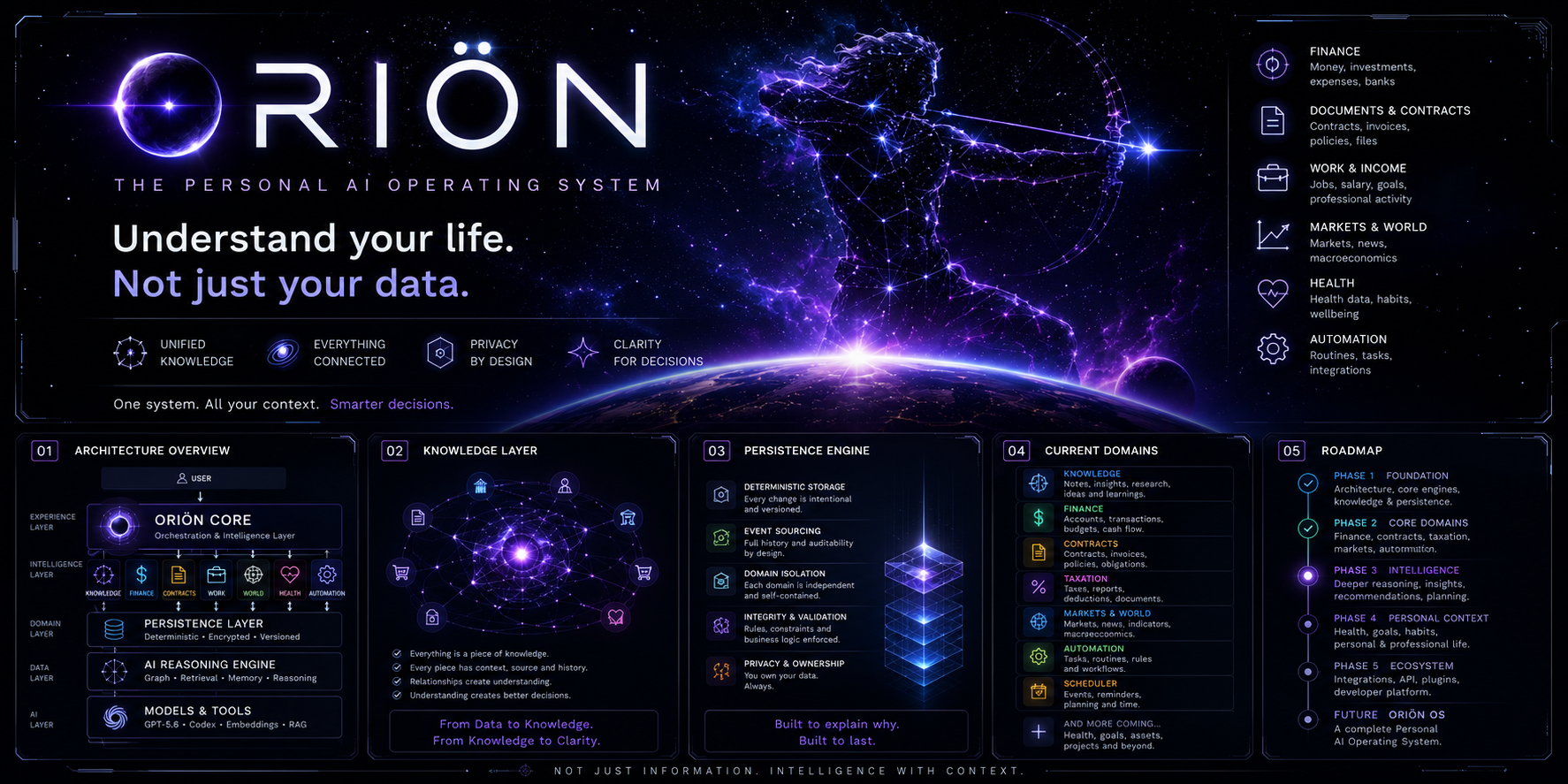
ORIÖN was created as a Personal Knowledge Infrastructure.
A place where every piece of information that shapes a person's life can coexist while preserving its origin, context, history and relationships with every other piece of knowledge.
Because spending two euros on a coffee, by itself, means almost nothing.
But that same purchase, combined with your income, expenses, investments, contracts, market conditions, inflation, your bank's lending environment or even a change in your job, begins to describe an entirely different reality.
Once information stops living in isolation and starts forming relationships, it ceases to be just data.
It becomes knowledge.
That was when I understood that the real challenge wasn't building artificial intelligence.
Today's models are already remarkably good at reasoning.
The real challenge was building the knowledge those models could reason about.
For that reason, I made a decision that probably slowed development considerably, but made the project far stronger.
Before building features, I decided to build architecture.
Every ORIÖN domain is designed, audited, implemented and certified independently.
Each one maintains its own identity, history, traceability, integrity rules and explicit policies for privacy, consent and data retention.
Not because it's the fastest way to build software, but because I want the system to be able to explain—ten years from now—why it knows something, where that knowledge came from and why it reached a particular conclusion.
During development I also learned an important lesson.
Software can compile perfectly.
It can pass every automated test.
It can even look finished.
And still contain architectural flaws that will eventually limit everything built on top of it.
That's why I introduced an independent audit and certification process for every major subsystem.
I'd rather discover a structural problem early than build ten new features on top of the wrong foundation.
That philosophy has forced me to stop development more than once and redesign significant parts of the system from scratch.
It has never been the fastest path.
But I'm convinced it has been the right one.
Today, ORIÖN is still far from the vision I ultimately have for it.
And honestly, that excites me more than it worries me.
Because my goal has never been to build another AI that answers questions.
There are already plenty of those.
Nor do I want to create another personal finance or investment application.
There are plenty of those as well.
I want to build something different.
I want to build a system capable of genuinely understanding a person's context.
A system that can bring together every piece of information influencing someone's life—financial today, and eventually personal and professional as well—to help them make better decisions based on knowledge, context and evidence.
I don't believe the future needs another artificial intelligence.
I believe it needs systems that understand people before attempting to answer them.
That's why ORIÖN exists.

Log in or sign up for Devpost to join the conversation.