-

-
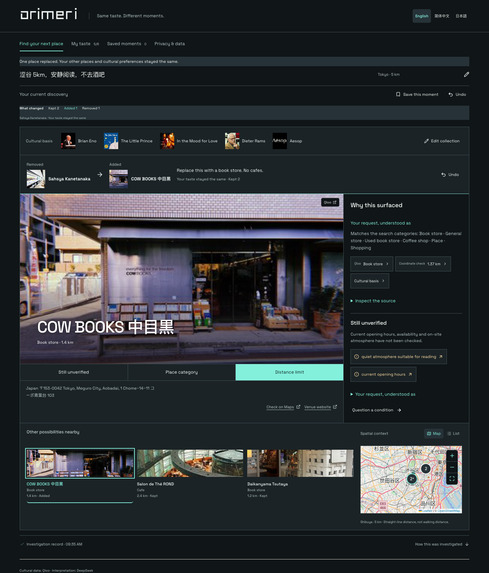
-
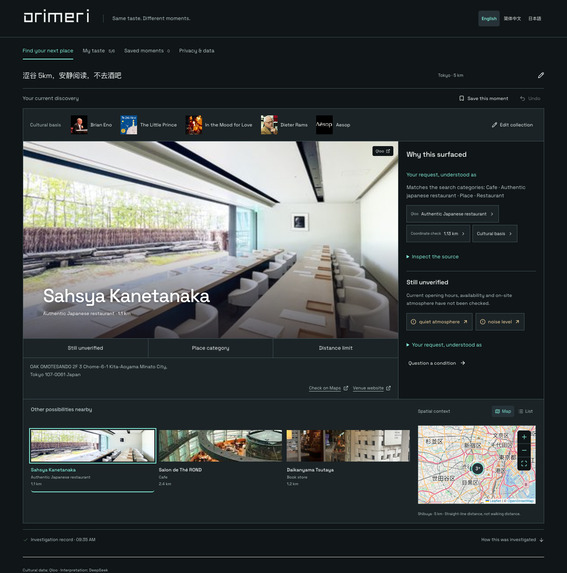
-
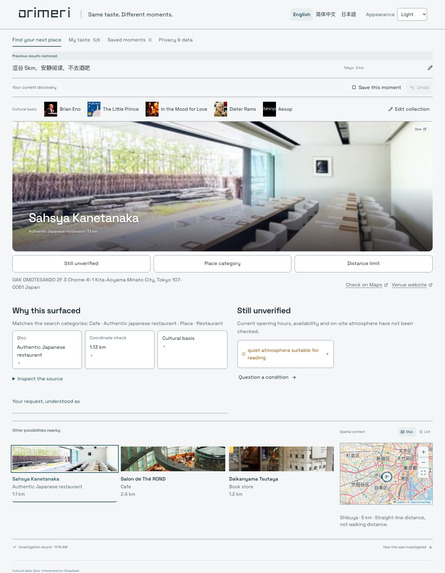
Live Qloo discovery: a real place, cultural references, source evidence and explicitly unverified conditions.
-
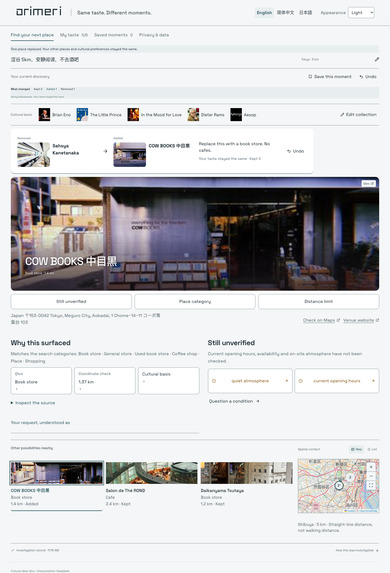
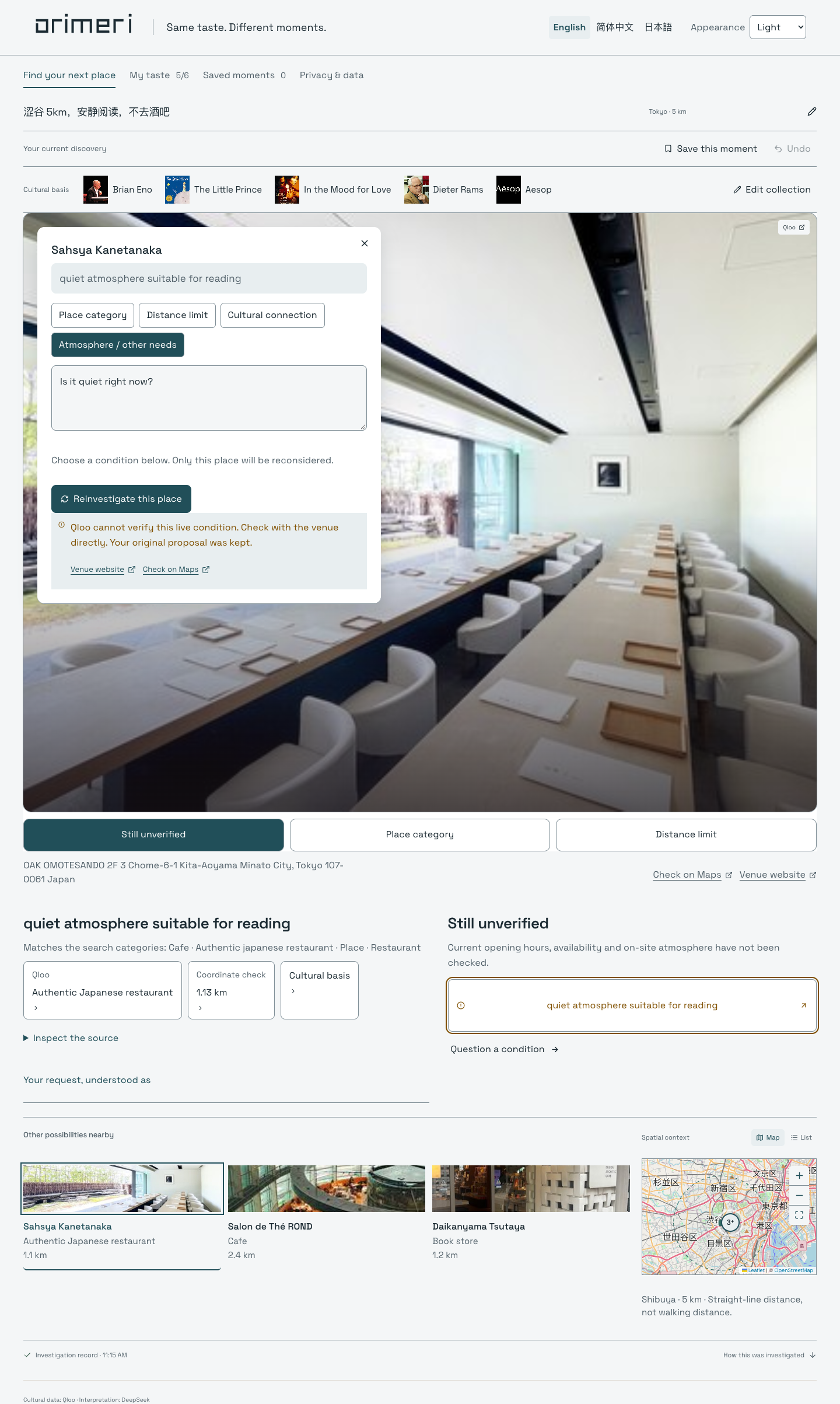
Question a specific condition in context. Cultural relevance is not proof of quietness or current opening hours.
-
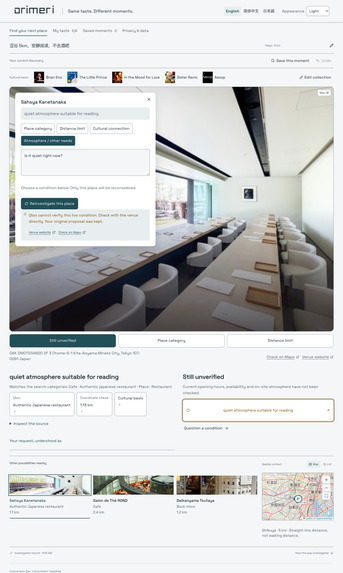
A local revision preserves cultural preferences and other candidates. Undo restores the preceding proposal.

Inspiration
ORIMERI helps people keep their cultural taste while adapting discoveries to changing moments.
Same taste. Different moments.
A person can love the same music, films, books and design yet want a different kind of place tonight. We built Moment Space around that distinction: enduring taste belongs to the person; a proposal should remain open to question.
What it does
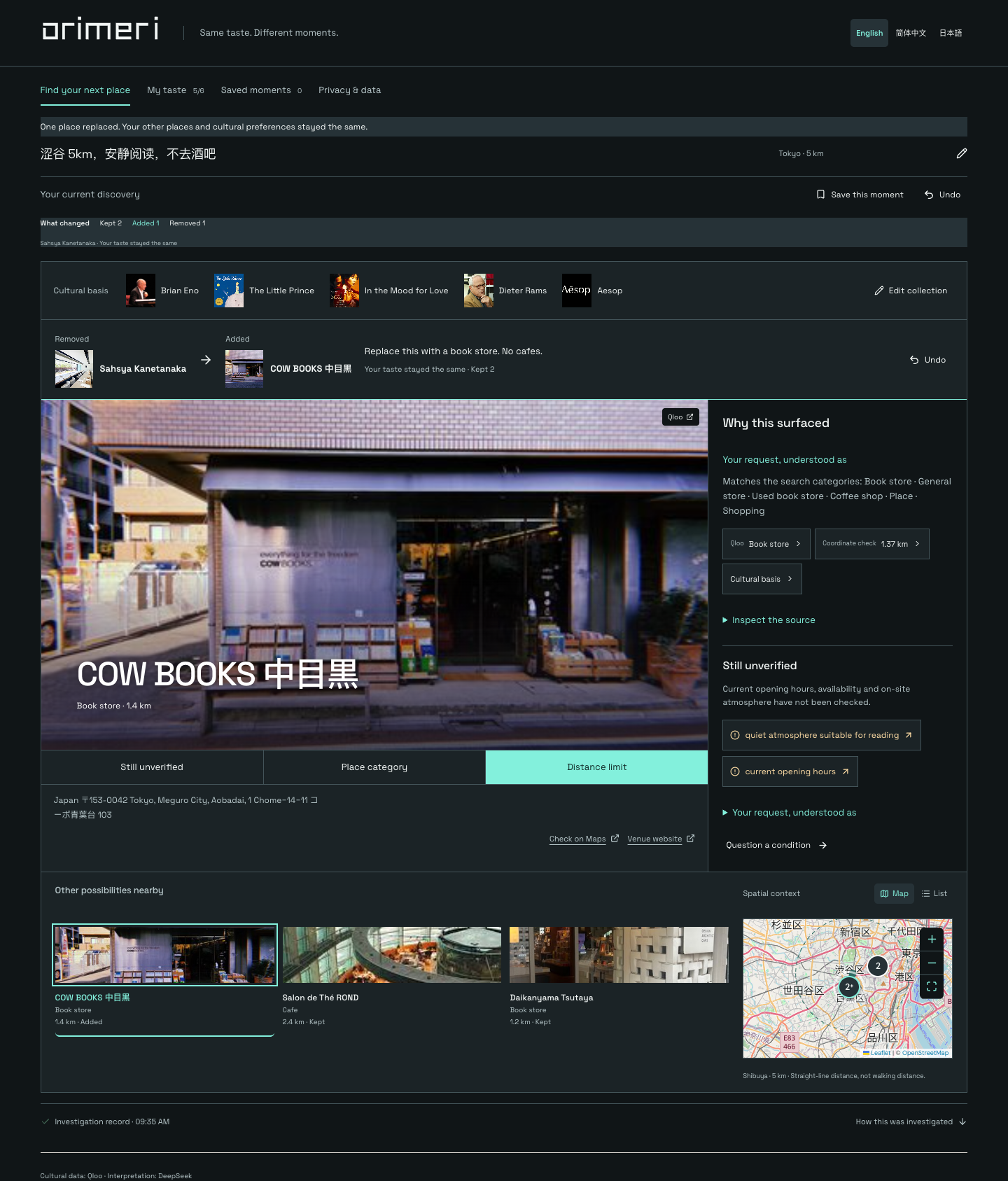
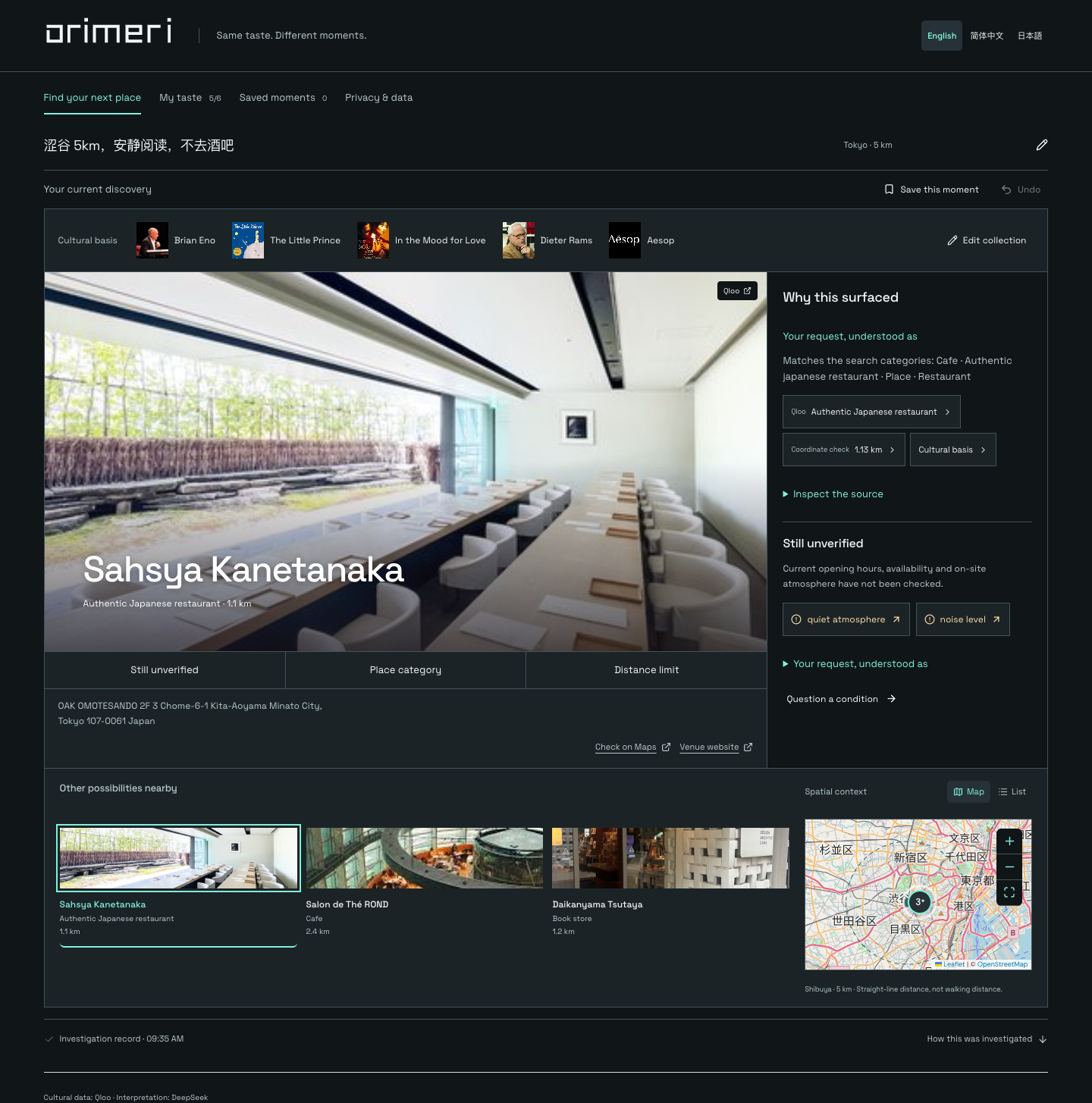
Five connected objects share one workspace: Taste, Moment, Proposal, Evidence and Revision. Confirm real cultural entities, describe your current intention, and choose a search area and radius. A real place becomes the focus, with cultural references, source evidence, unresolved conditions and nearby alternatives. Click a specific condition to question it in place. A successful reinvestigation replaces only that proposal; other candidates and long-term preferences stay intact. Undo restores the preceding state.
Why Qloo matters
Qloo Search resolves cultural identities. Qloo Tags resolves place categories. Qloo Insights supplies taste-conditioned place candidates using the confirmed entity IDs. The language model does not invent venues or cultural links. Without Qloo, this implementation loses its cultural candidate-generation step; generic language reasoning cannot substitute for those provider results. We have not yet run a controlled user study proving superiority over generic recommendations.
How we built it
Next.js, React and TypeScript power the interface and server API. DeepSeek translates natural-language intent into a schema-validated plan. Server-side Qloo calls apply hard geography and category filters. Independent coordinate checks reject missing or out-of-radius locations and excluded categories. Leaflet and OpenStreetMap show actual coordinates. Keys stay server-side.
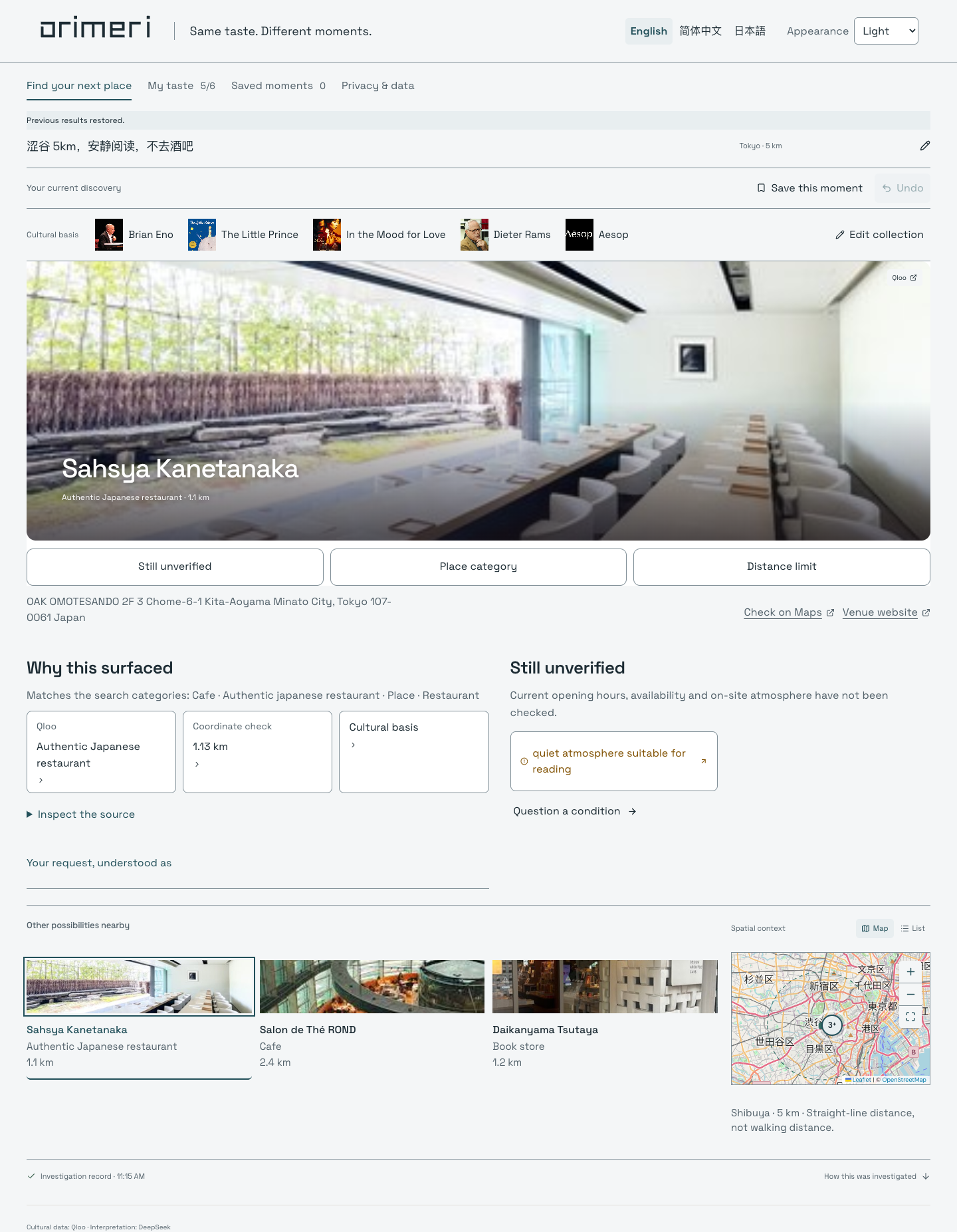
Culture focus, contextual questions and before/after revisions remain in one continuous interface, with interruptible transitions and reduced-motion support. English, Chinese and Japanese switching preserves state. Guest users can save complete snapshots locally, including the selected place, local revisions and Undo history. Restored results are explicitly historical, not a fresh verification.
What we tested
A real production browser run selected Brian Eno, The Little Prince, In the Mood for Love, Dieter Rams and Aesop, then requested quiet reading within 5 km of Shibuya without bars. Qloo returned Sahsya Kanetanaka, Salon de The ROND and Daikanyama Tsutaya at 1,132 m, 2,382 m and 1,191 m respectively. Distances are straight-line from the search anchor, not walking routes.
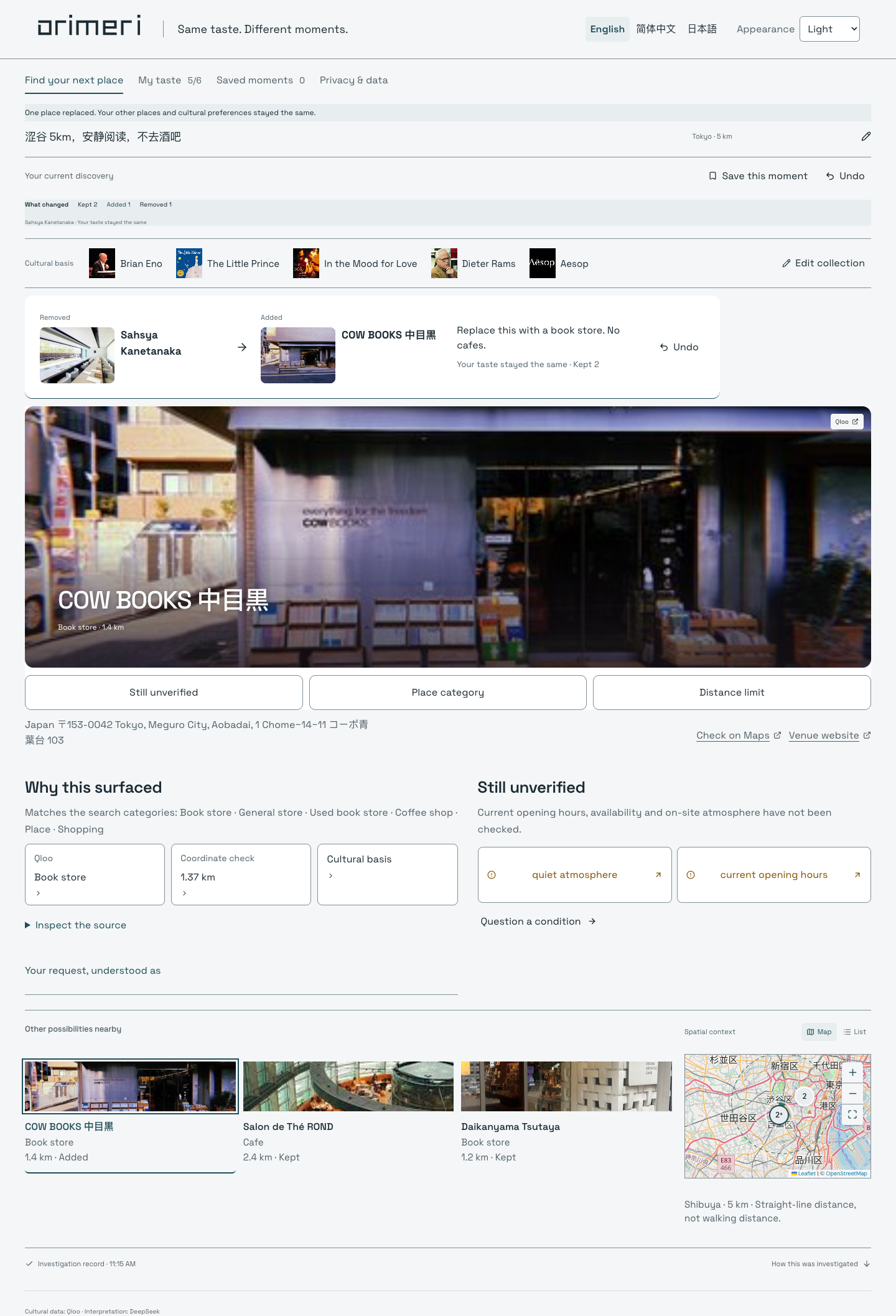
The plan excluded bars and marked quietness/noise as unverified. A contextual quietness question returned an explicit inability to verify; a category change returned a real local replacement; Undo restored the original proposal with all five references preserved. Seventeen browser regression tests cover state, languages, storage failures, ambiguity, empty results and errors. Desktop and mobile-sized browser runs exercised real map loading and tile-failure recovery. These are internal tests, not independent usability validation.
Challenges and limitations
Cultural relevance is not proof of quietness, current opening hours or available seating. Those properties remain explicitly unverified, with venue/map links for further checking. Per-reference contribution appears only when returned by Qloo; we do not invent relationships or probabilities. Venue and cultural images are provider-supplied; underlying rights remain with their sources, outside the code MIT license. The homepage uses an explicitly labeled AI-generated atmospheric illustration, not a real venue or recommendation.
A production entity lookup timed out once before a successful complete retry. External API availability remains a dependency. There is no cloud account or cross-device sync; saved data stays in the current browser. Commercial demand, retention and brand clearance remain unvalidated.
Try it
No login required: https://orimeri.vercel.app/
- Select cultural references or use the Brian Eno example.
- Choose Tokyo/Shibuya, 5 km; ask for a quiet cafe to read, avoiding bars.
- Select a place and inspect culture, evidence and unknowns.
- Click Place category and ask: Replace this with a book store. No cafes.
- Inspect the local change, then Undo. Ask about current quietness to see an honest unsupported response.
- Switch languages or save and reopen the moment without losing the proposal history.
Public MIT source and setup instructions: https://github.com/MinusPlus2025/orimeri
What we learned and what is next
The hard problem is preserving a person's preferences while changing one decision without overstating evidence. Next steps are independent task testing, a controlled cultural-relevance comparison and stronger service-cost controls—not replacing uncertainty with confident prose.
Built With
- qloo
