OriginX: An Explainable Multimodal Deepfake Detection System
💡 Inspiration
With AI-generated content becoming increasingly realistic, it is getting harder to distinguish genuine media from manipulated images, cloned audio, and deepfake videos. Such content can contribute to misinformation, identity theft, financial fraud, and reputational damage.
We were inspired to explore a key problem with existing detection systems: identifying a deepfake is useful, but understanding why it was flagged is equally important. A simple Real/Fake label does not always give users enough information to judge the result.
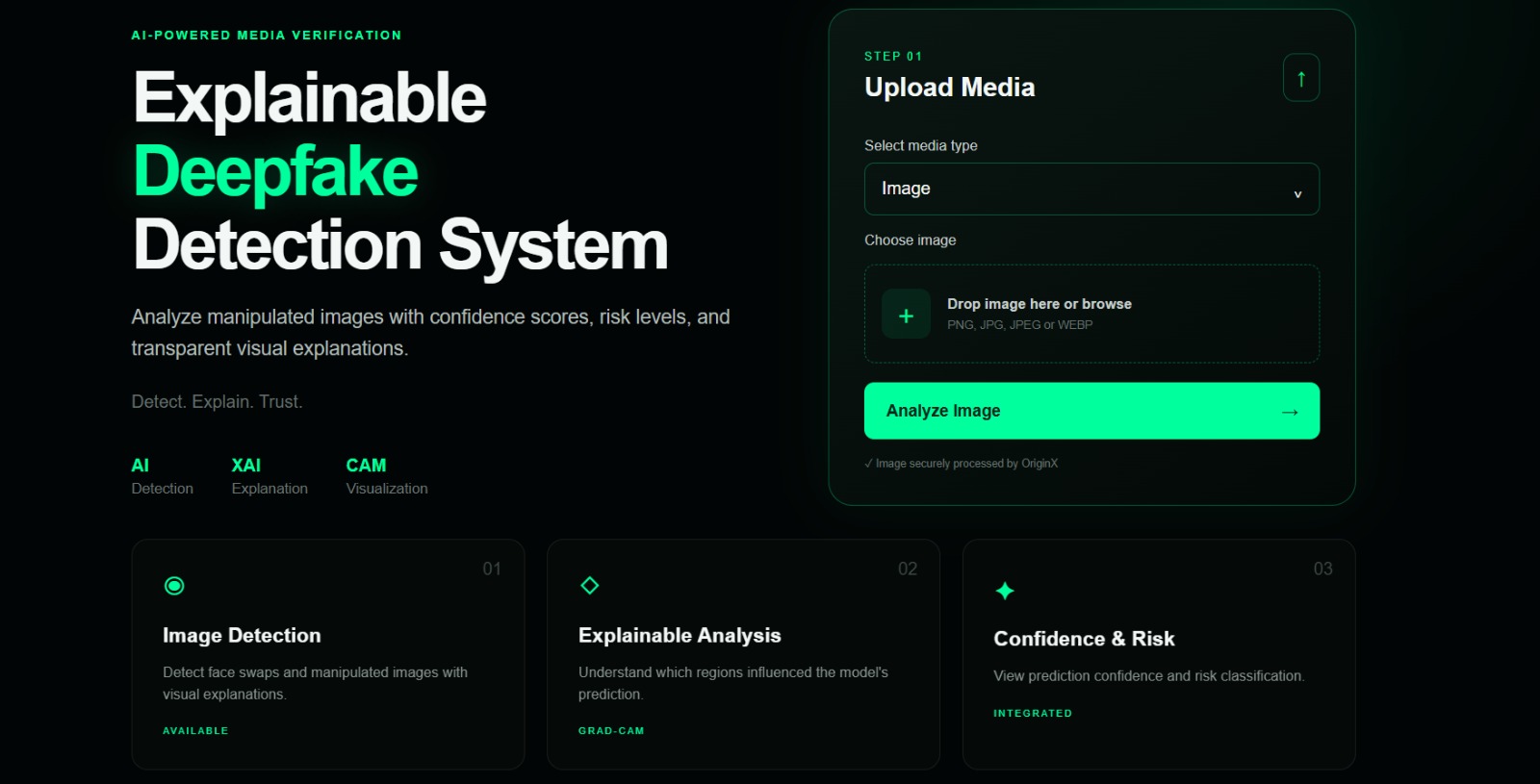
This motivated us to build OriginX, an explainable multimodal system that analyzes images, audio, and videos while providing confidence information and visual or temporal evidence to help users better understand its predictions.
🛠️ How We Built It
We developed OriginX as a web application using Python, PyTorch, Flask, HTML, CSS, and JavaScript, with separate detection pipelines for each media type.
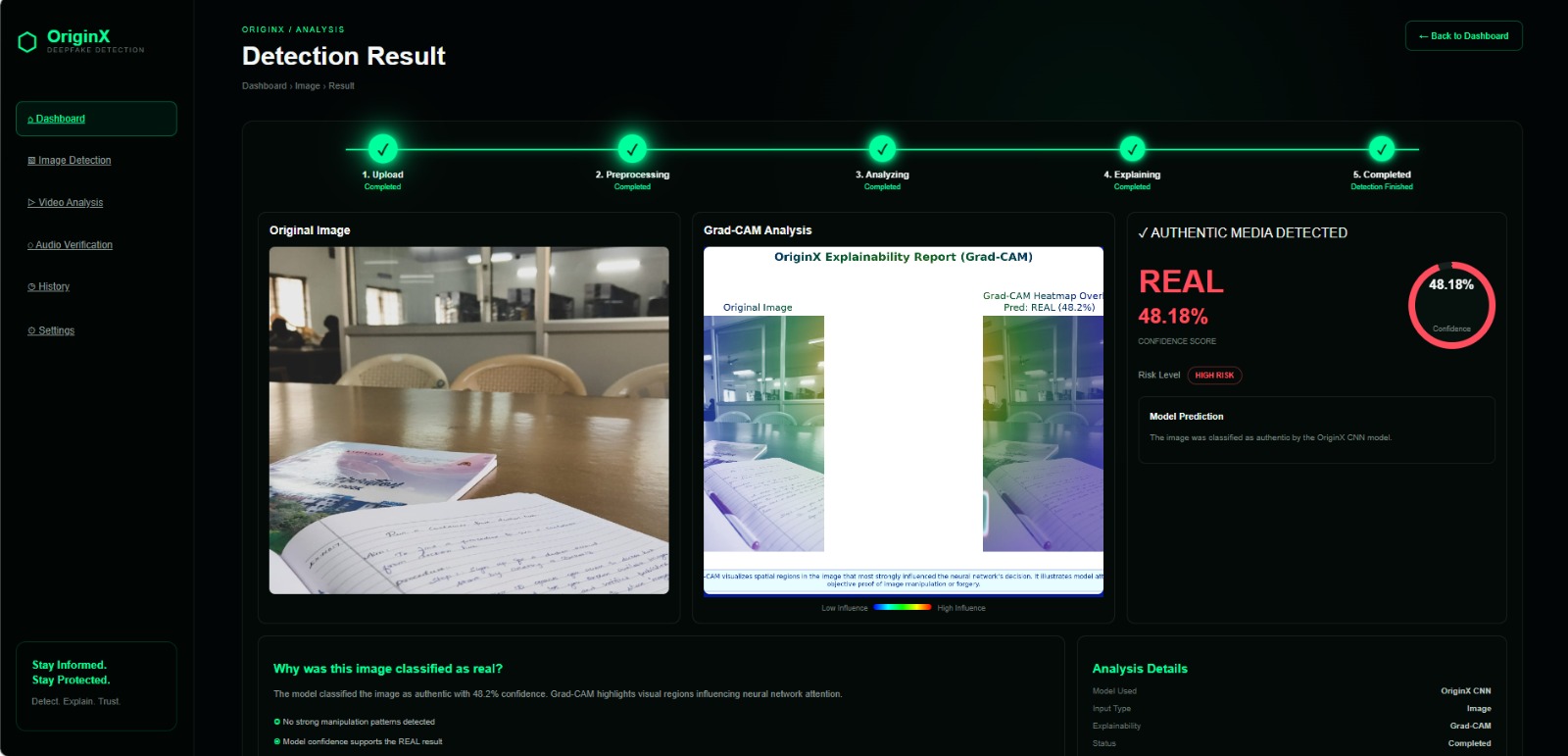
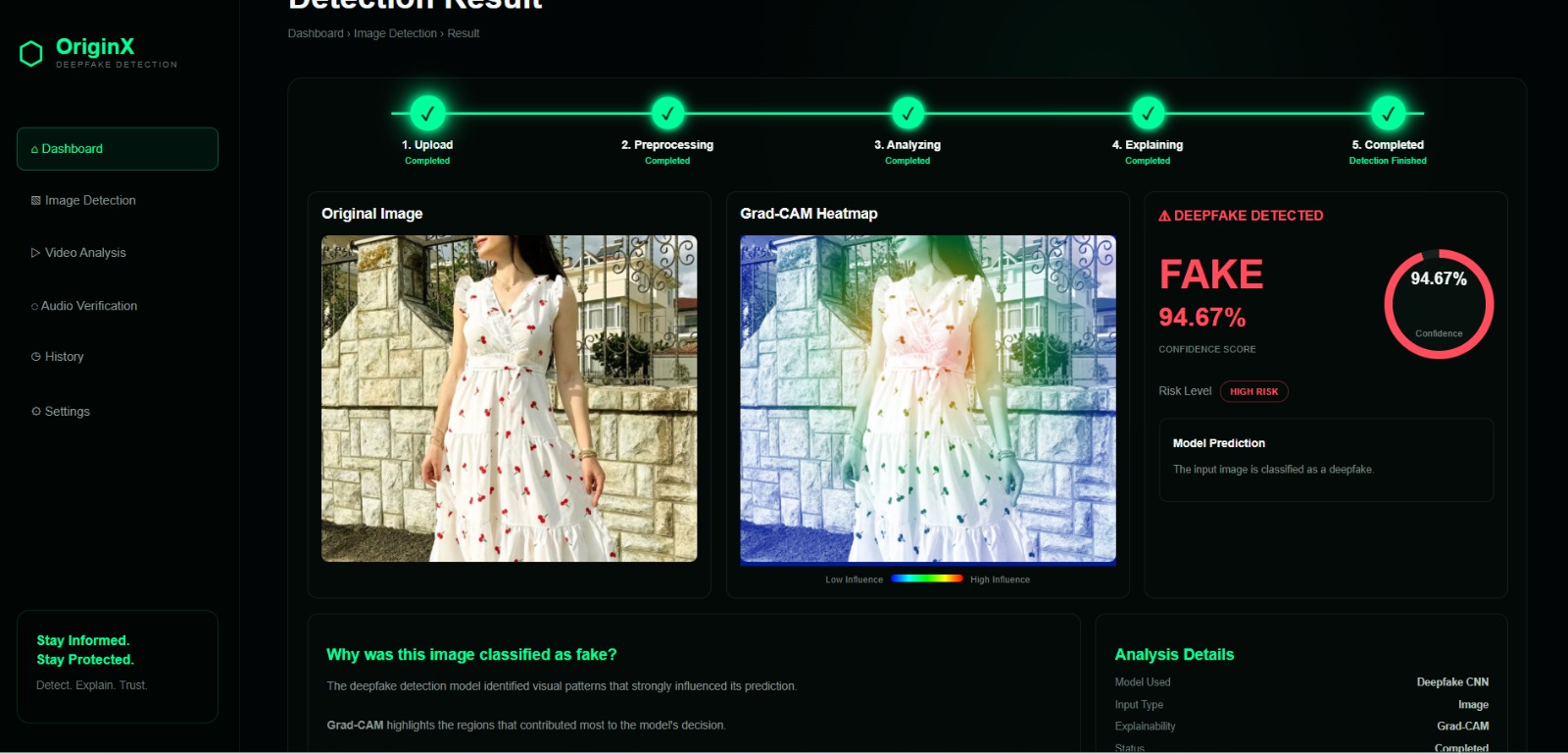
- Image Detection: We trained a custom four-block CNN from scratch to classify images as Real, Manipulated, or AI-Generated. Grad-CAM heatmaps help visualize image regions that influence predictions.
- Audio Detection: We trained a custom CNN from scratch using Mel-spectrogram representations of audio to classify samples as Real or Fake.
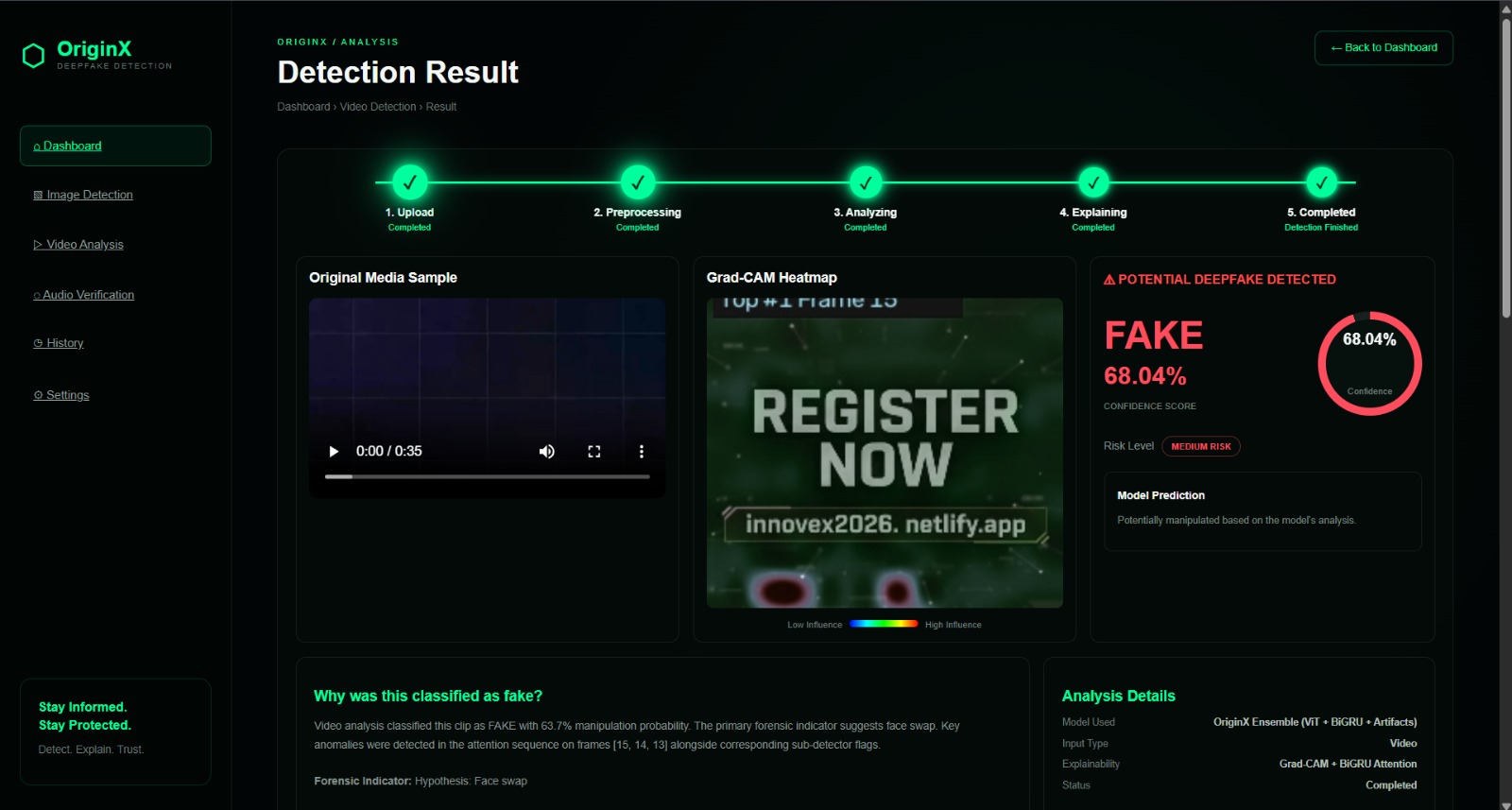
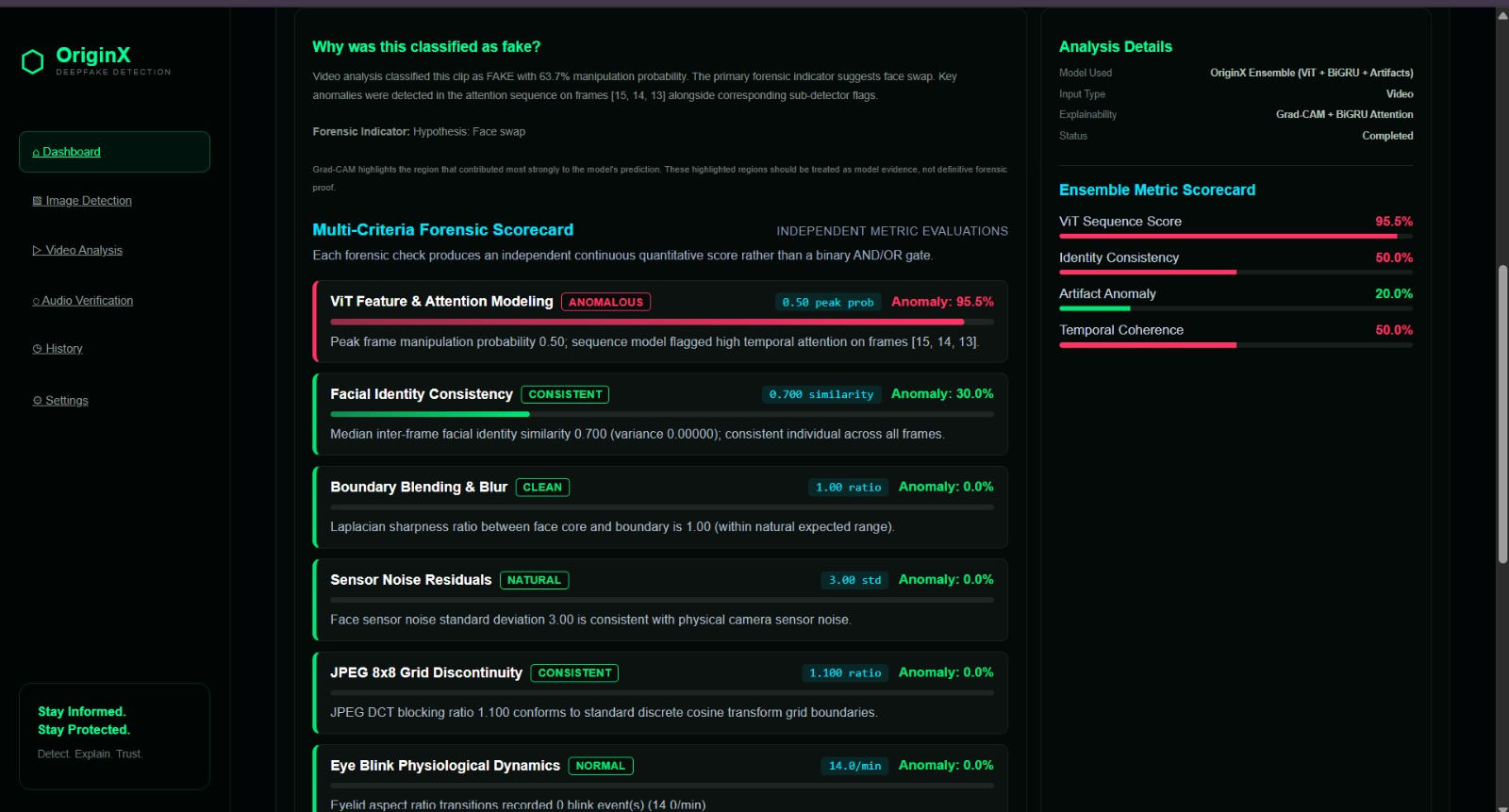
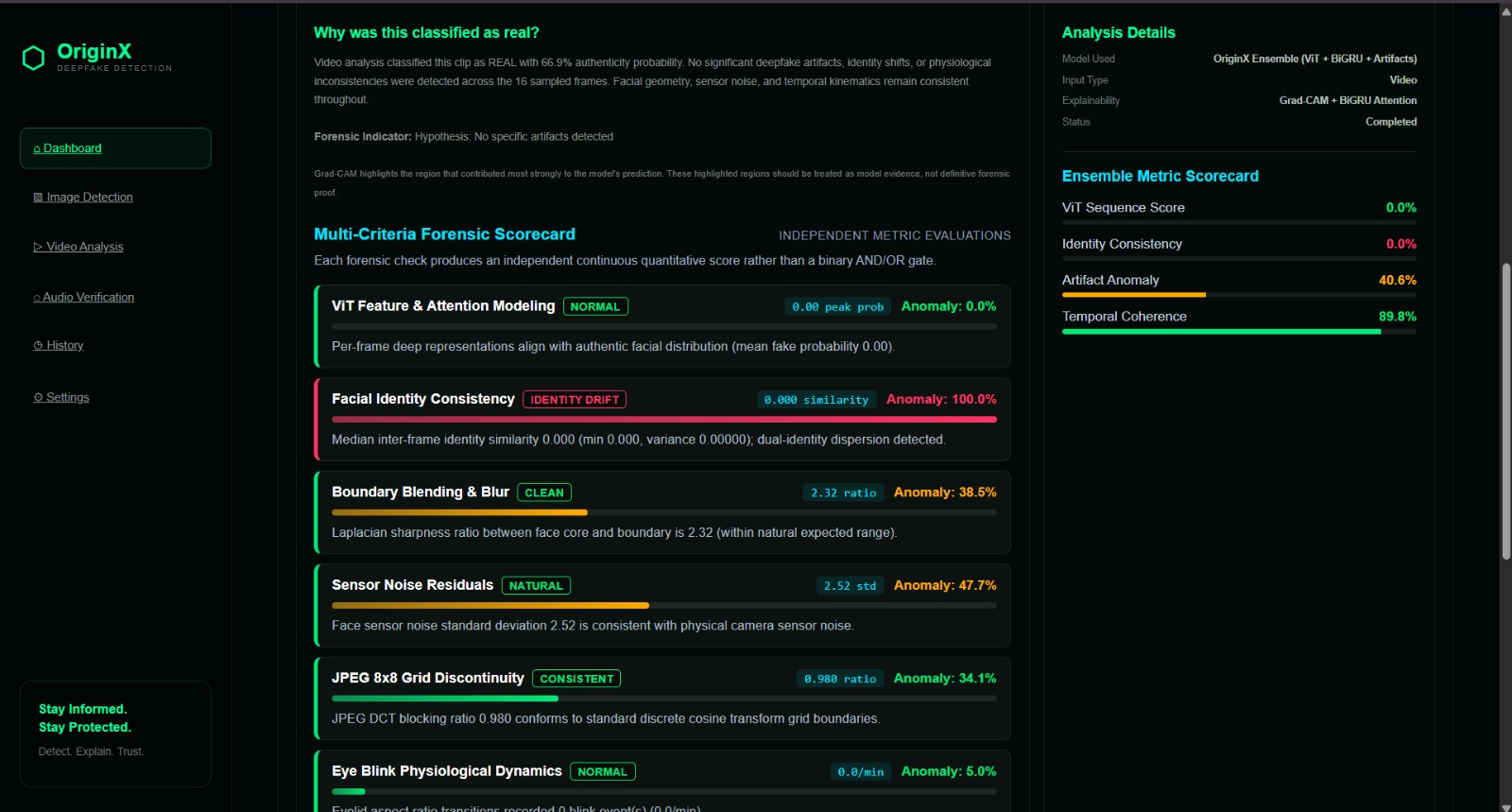
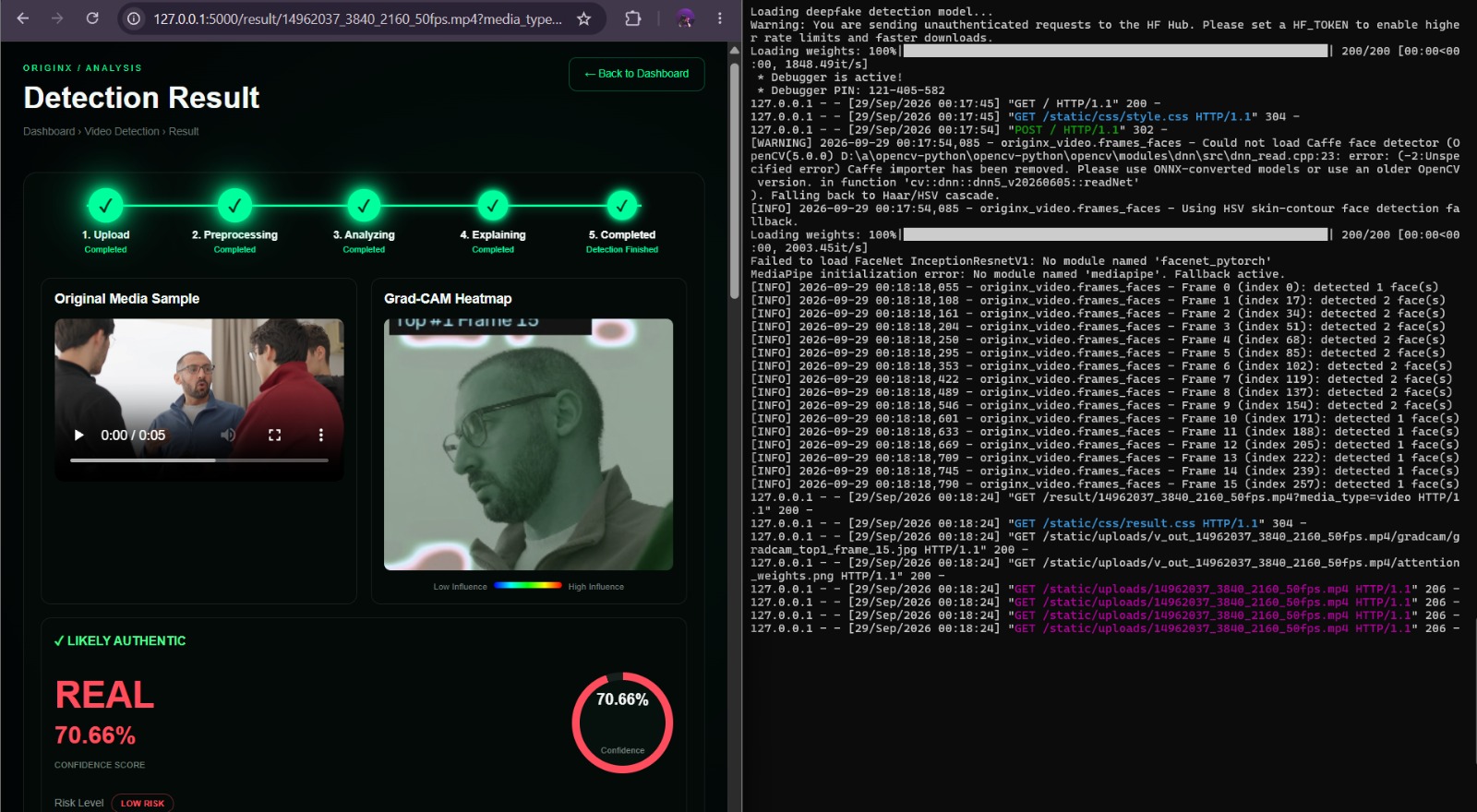
- Video Detection: We built a temporal analysis pipeline that samples 16 frames, extracts frame features using a frozen pretrained ViT-Base, and passes them to a trained BiGRU with masked attention. Additional checks use FaceNet for identity consistency, MediaPipe FaceMesh for facial landmark analysis, and pixel-level forensic signals.
- Explainability and Risk Assessment: We integrated Grad-CAM explanations, a video attention timeline, confidence scores, and risk assessment. The video pipeline combines detector outputs using a weighted fusion mechanism and can return an UNCERTAIN result when evidence falls between the decision thresholds.
The Flask backend connects the detection pipelines to the web interface, allowing users to upload media and inspect the resulting predictions and explanations.
📚 What We Learned
Building OriginX helped us understand how different deep learning architectures can address different forms of media manipulation. We gained practical experience in CNN training, audio feature extraction, vision transformers, recurrent neural networks, attention mechanisms, model integration, and explainable AI.
We also learned that a prediction score alone is not enough to establish whether media is authentic. Confidence, supporting evidence, data quality, and the limitations of the evaluation dataset all matter when interpreting a model's output.
⚙️ Challenges We Faced
One of our main challenges was integrating three distinct detection pipelines into a single application. Images, audio, and videos require different preprocessing methods, model architectures, and forms of evidence.
Video detection was especially challenging because individual frames may not reveal temporal inconsistencies. We addressed this by combining frozen ViT-Base feature extraction with a trained BiGRU attention head and additional facial and pixel-level checks.
Working with limited datasets also required careful attention to generalization and evaluation. A model's performance on familiar benchmark data does not guarantee the same performance on unseen deepfake methods or heavily compressed media. We therefore treat explainability and the UNCERTAIN outcome as important parts of responsible detection rather than assuming every prediction is definitive.
🌟 What Makes OriginX Different?
OriginX brings image, audio, and video deepfake detection together in one explainable web application. Instead of returning only a label, it combines predictions with confidence information, Grad-CAM heatmaps, temporal attention visualization, and risk assessment where supported by the detection pipeline.
Our goal is to make deepfake analysis more transparent and accessible, helping users investigate potentially manipulated media with a clearer understanding of what the system detects and where its limitations remain.
OriginX is a step toward more understandable and responsible AI-assisted media verification.
Built With
- ai
- attention
- audio
- bigru
- convolutional
- css
- explainable
- faceforensics++
- facenet
- flask
- grad-cam
- html
- javascript
- librosa
- mechanism
- mediapipe
- network
- neural
- numpy
- opencv
- pillow
- scikit-learn
- transformer
- vision

Log in or sign up for Devpost to join the conversation.