Inspiration
In Dan Brown’s Origin, a futurist answers humanity’s oldest question, “Where do we come from?”, with a simulation that fast-forwards nature until life emerges from physics. The hackathon theme was time, and we wanted to build an honest version of that idea. It is grounded in a real scientific hypothesis: Jeremy England’s dissipation-driven adaptation, which says that matter constantly driven by energy tends to organise itself into structures that absorb and dissipate that energy. Almost every origin story humans have told begins in chaos. We wanted to test that claim with a time machine.
What it does
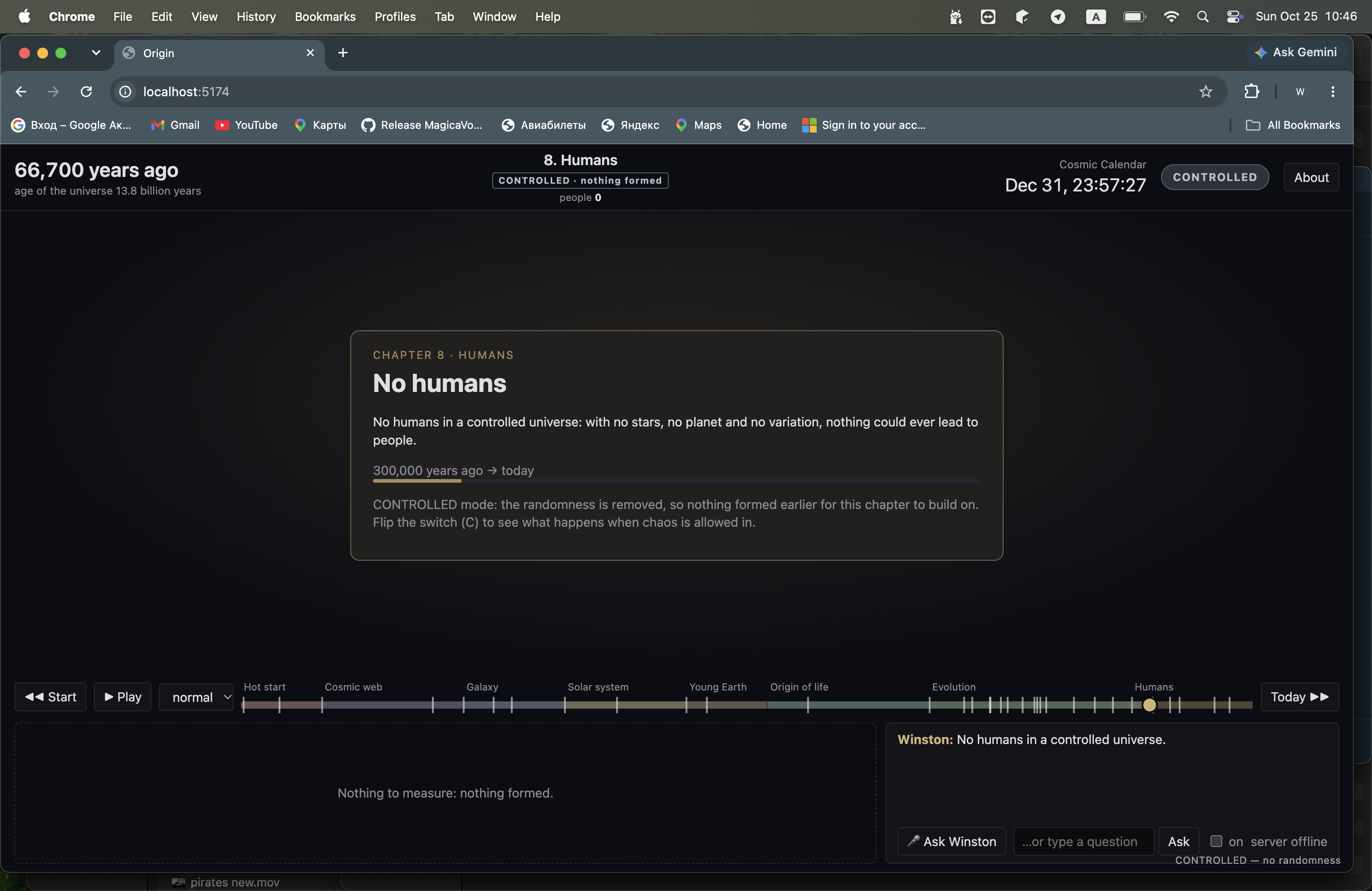
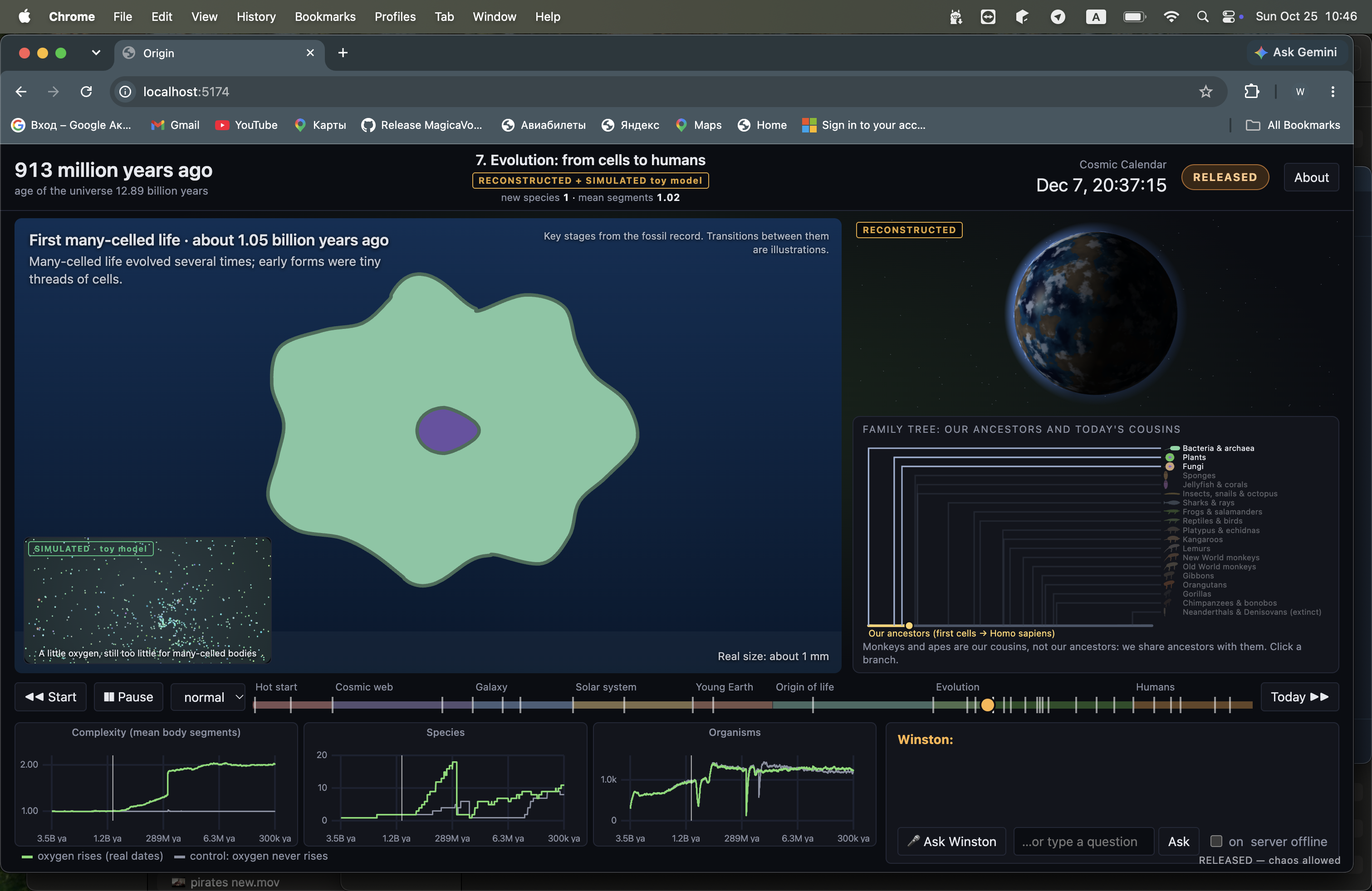
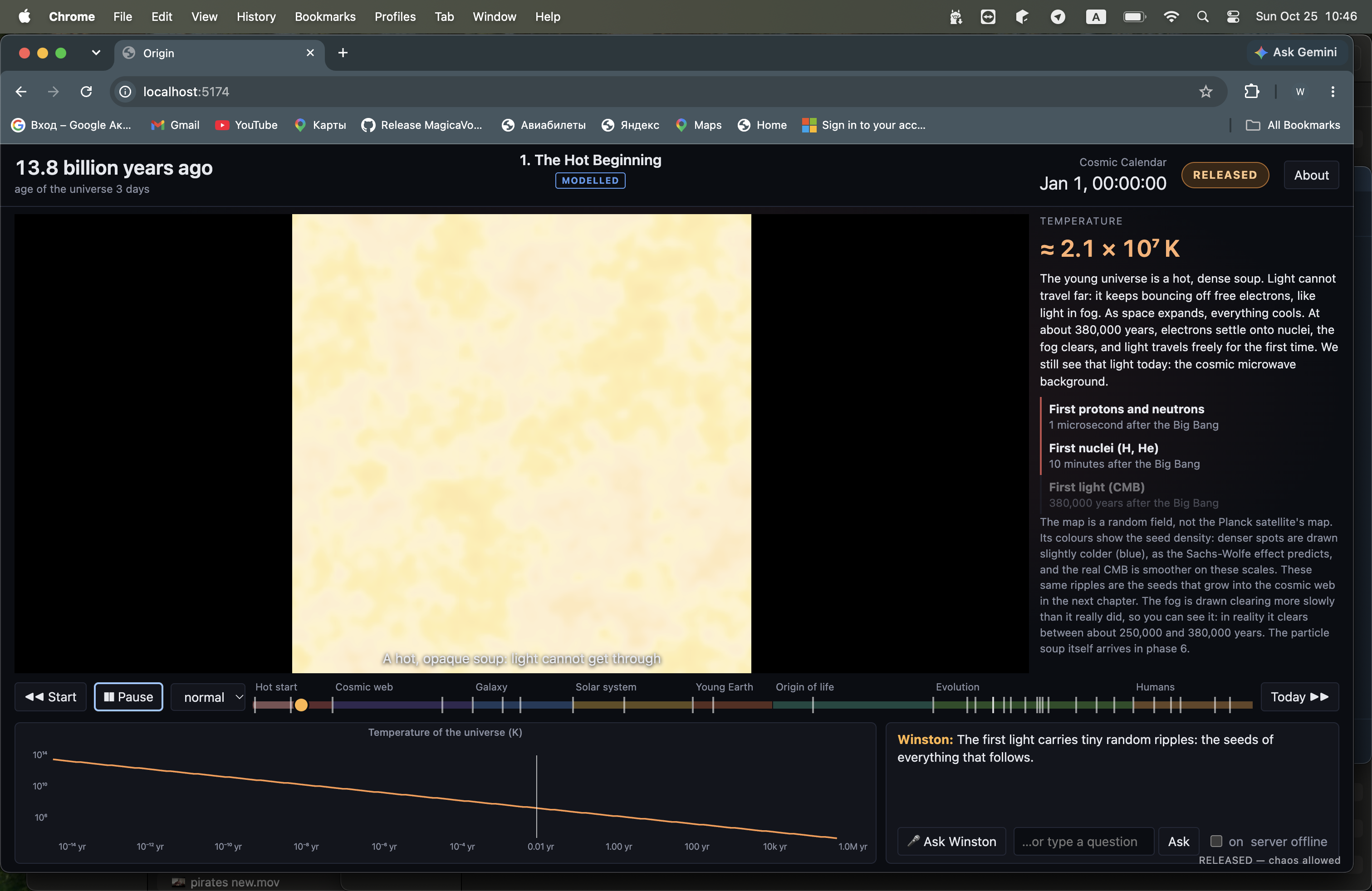
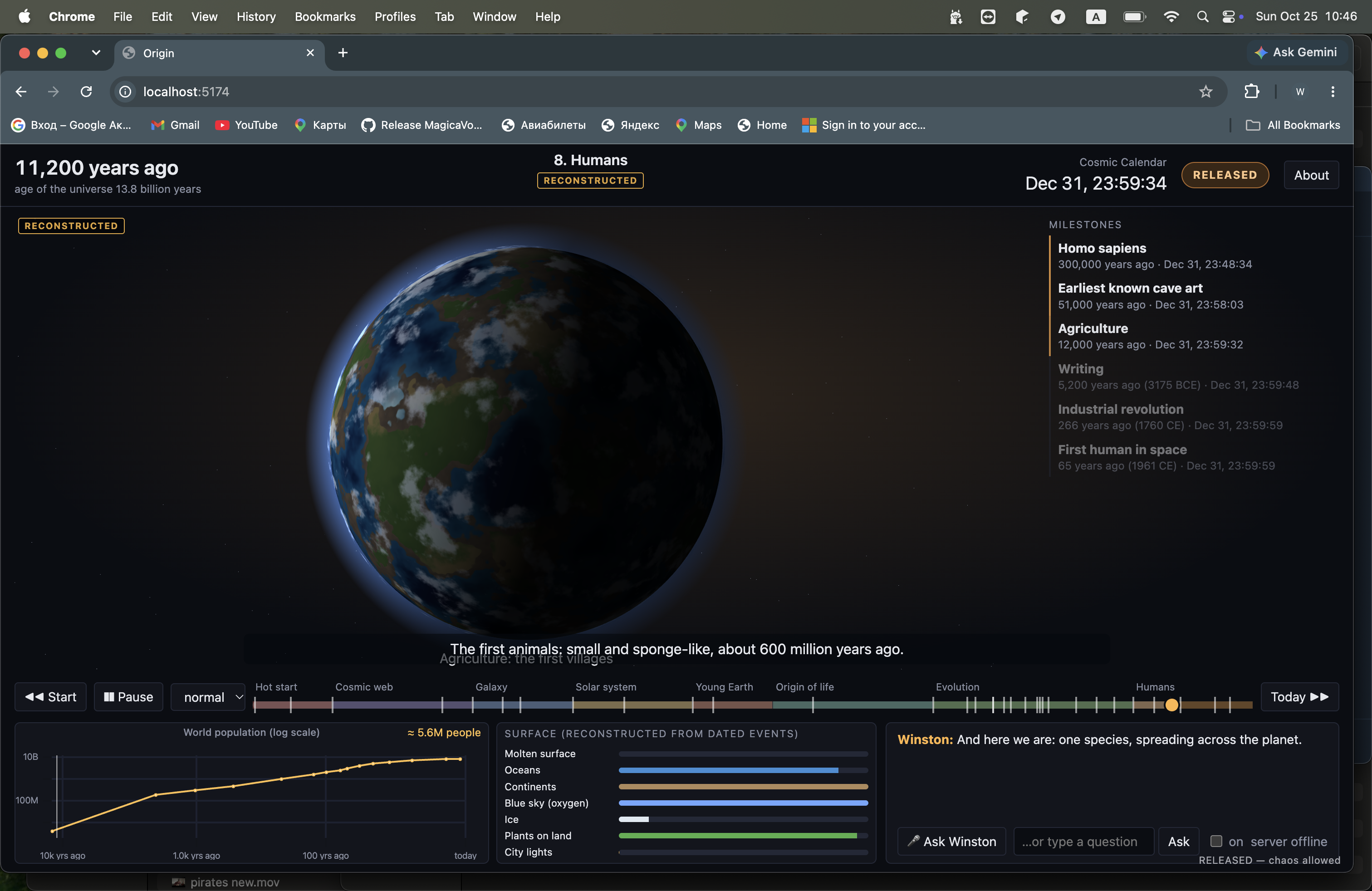
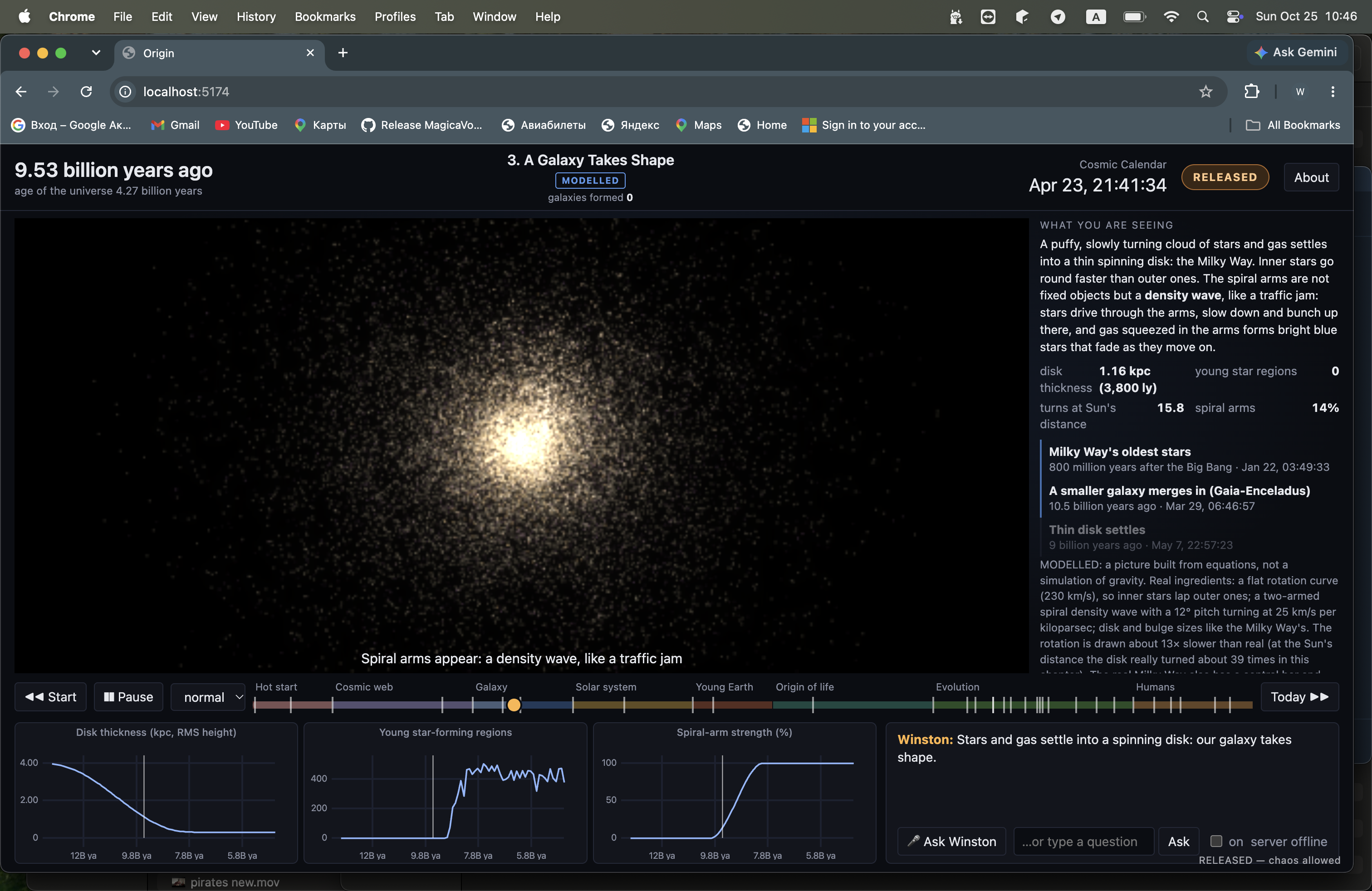
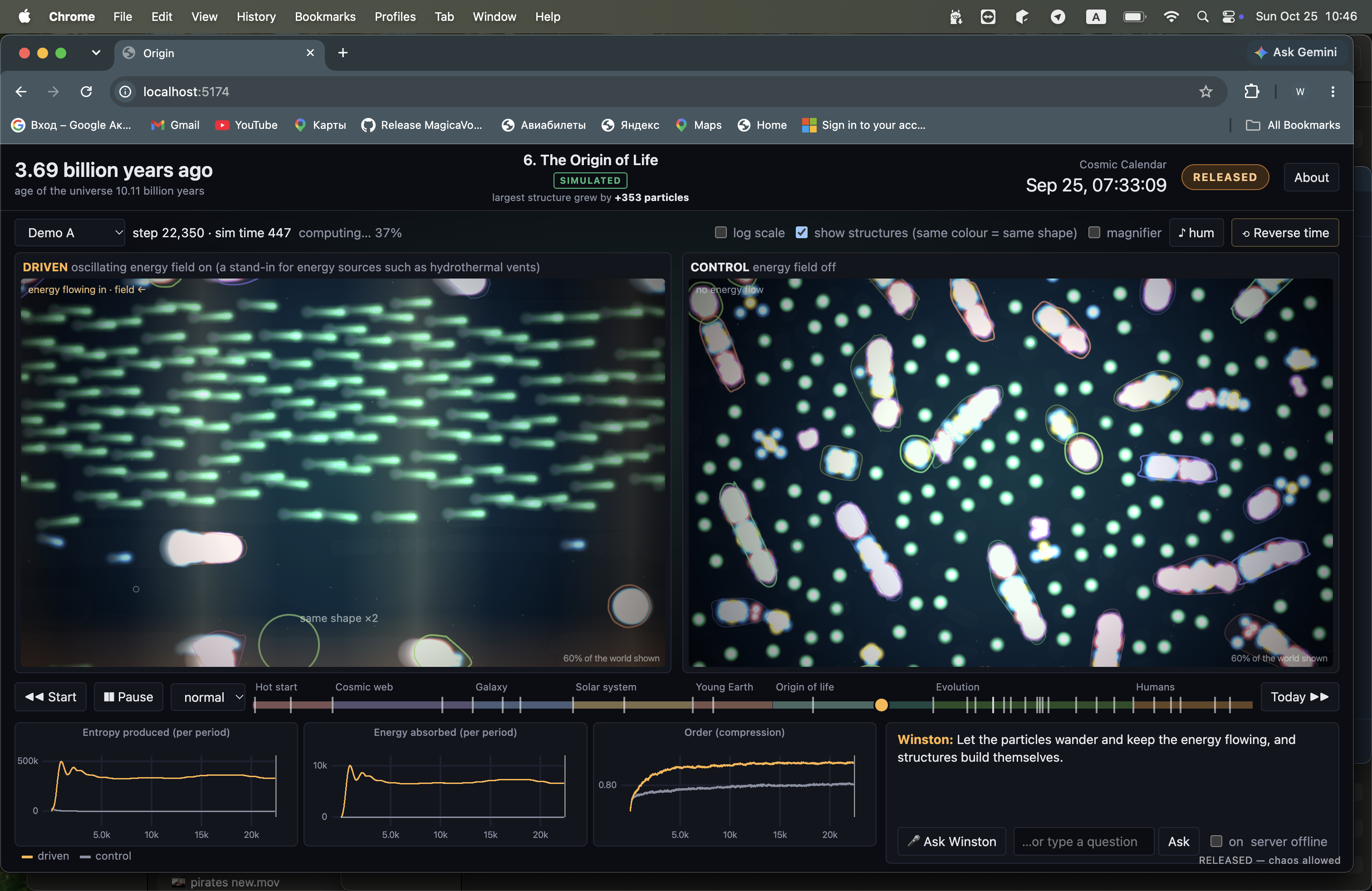
Origin squeezes 13.8 billion years, from the Big Bang to today, into a few minutes on one master time slider. You can play it, scrub forward, or rewind. Along the way you see the first light, the cosmic web, a galaxy, a solar system, the young Earth, the origin of life, evolution from single cells to humans, and finally us. One switch drives the whole story: CONTROLLED: we remove all randomness and arrange everything neatly ourselves. Nothing forms: no stars, no planets, no life. RELEASED: we let chaos in, with energy flowing through it. The same physics builds everything on its own. At the centre is a live particle simulation of England’s hypothesis. A driven run sits next to a control run with no energy, and on-screen metrics track disorder (Shannon entropy), entropy produced, energy absorbed and repeated structures. A “Reverse time” button shows why time has a direction: flip every velocity, and with real friction and noise the system never returns to chaos. Winston, an AI narrator named after the AI in the book, guides the audience by voice and answers questions live. Every chapter carries a badge: SIMULATED, MODELLED or RECONSTRUCTED. That way the audience always knows what is real physics and what is an illustration of scientific dates.
How we built it
Frontend: TypeScript and Vite. Three.js for the Earth globe and space scenes, Canvas/WebGL for the particle simulations, Chart.js for live metrics. Simulations: these run in Web Workers and are fully deterministic from a seed, which is what makes rewinding possible. We save snapshots and re-simulate forward to any moment. Origin of life: Particle Life interactions, Langevin dynamics with friction and noise, and an oscillating external energy field. Cosmic web: a 2D particle-mesh N-body gravity solver using FFTs and Zel’dovich initial conditions in an expanding universe. Solar system: N-body planetesimal accretion with merging collisions. Evolution: an agent-based model with mutation, selection, predation and real Earth events (oxygen rise, Snowball Earth, mass extinctions). Our lineage, from cells to Homo sapiens, is shown as morphing key frames based on the fossil record. Science checks: a headless parameter sweep across seeds and energy settings, so we could report honestly how often the driven run beats the control.
Challenges we ran into
Our own metric disagreed with our story. Early on, the control run scored more “repeated structures” than the driven run, because it was counting many tiny, trivially identical clumps. We tightened the definition and re-ran the sweep rather than hiding the chart. Making 13.8 billion years scrubbable. All of human history is the last few seconds of Carl Sagan’s Cosmic Calendar, so a linear slider was useless. We built a piecewise, log-scaled timeline. Rewinding chaos. Scrubbing backwards through a chaotic system only works with bit-exact determinism, so we use seeded RNG and snapshots throughout. Staying honest. No computer can evolve particles into people. We had to decide, chapter by chapter, what we could truly simulate and what we could only reconstruct, and label it. Evolution without the myth. Humans didn’t evolve from monkeys; we share ancestors with them. Our family tree shows monkeys and apes as side branches, not steps on a ladder.
Accomplishments that we're proud of
A single switch that turns an abstract idea into a visible experiment: control produces nothing, while chaos plus energy produces structure. Real physics running live in the browser, from cosmic-scale gravity to self-organising particles. A measurable “chaos meter”, tested against shuffled random states, rather than just claiming the start is random. Every number on screen traces back to a source, and every visual is labelled for what it is.
What we learned
Chaos alone isn’t enough. In our models, order appeared only when randomness and a flow of energy came together. Local order always has a cost: structure grows while total entropy produced keeps rising. Determinism is what makes time travel possible in software. Being upfront about limitations makes a demo more convincing, not less.
What's next for Origin
Move the key simulations to 3D and WebGPU for larger, more realistic runs. Add a “Where are we going?” act built on real data: human-made mass overtook all living biomass around 2020 (Elhacham et al., Nature, 2020), followed by a Monte Carlo projection with uncertainty bands. A classroom mode where students flip the switch and change the physics themselves. Talk to researchers working on non-equilibrium thermodynamics, to make the origin-of-life model more faithful.


Log in or sign up for Devpost to join the conversation.