-
-
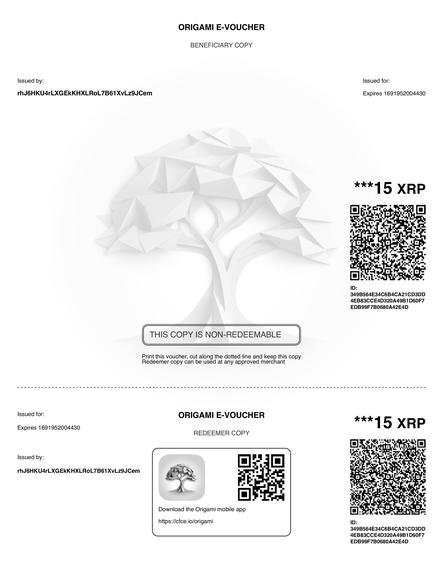
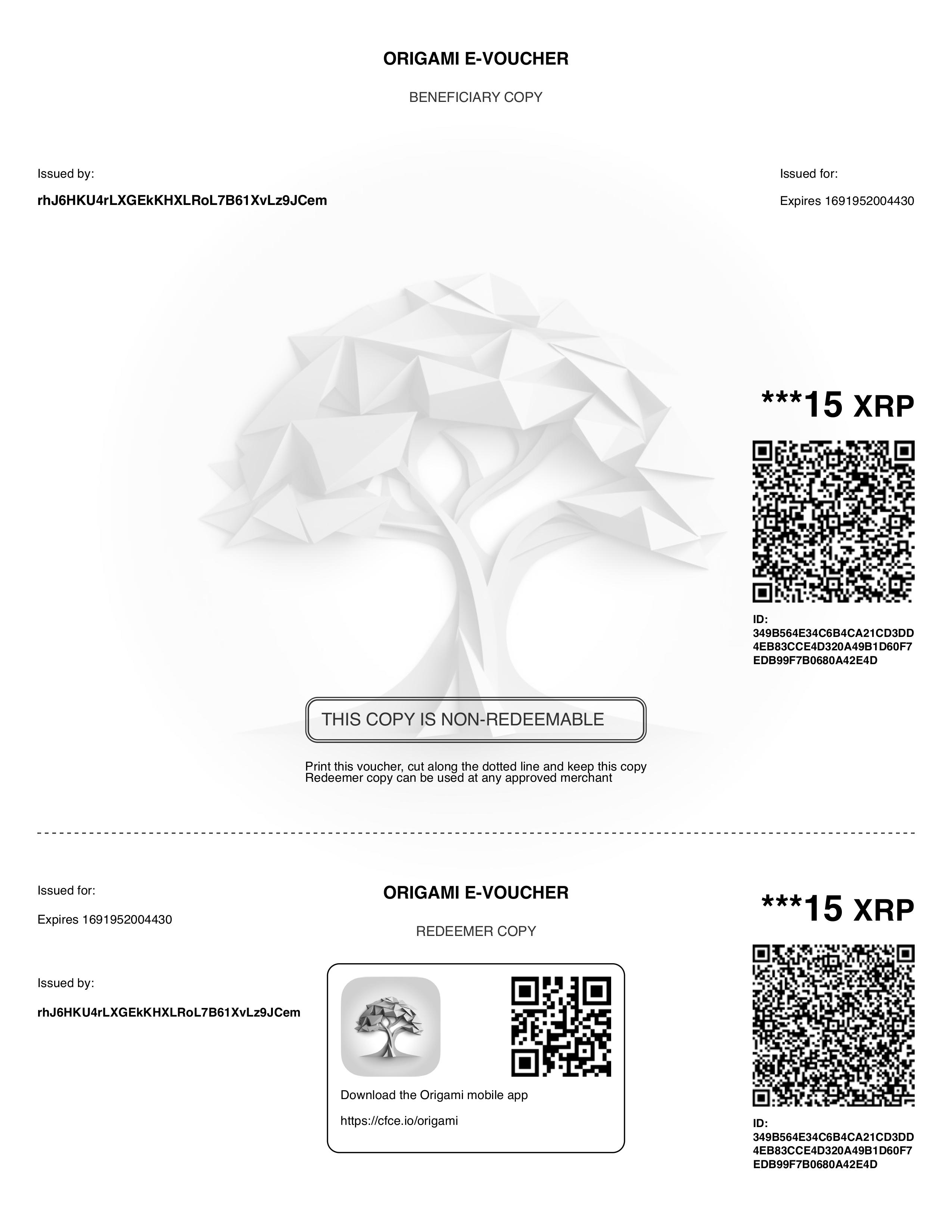
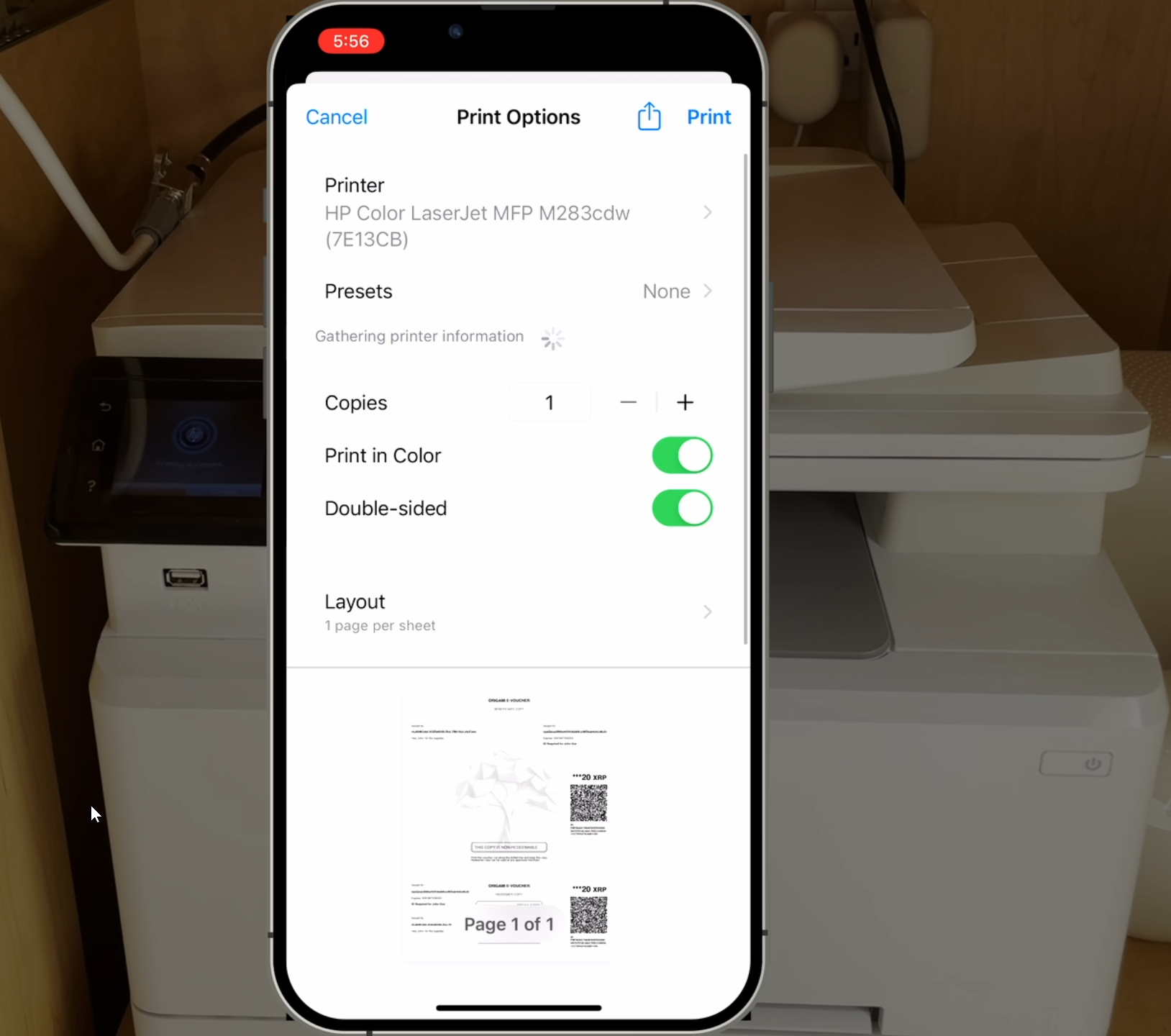
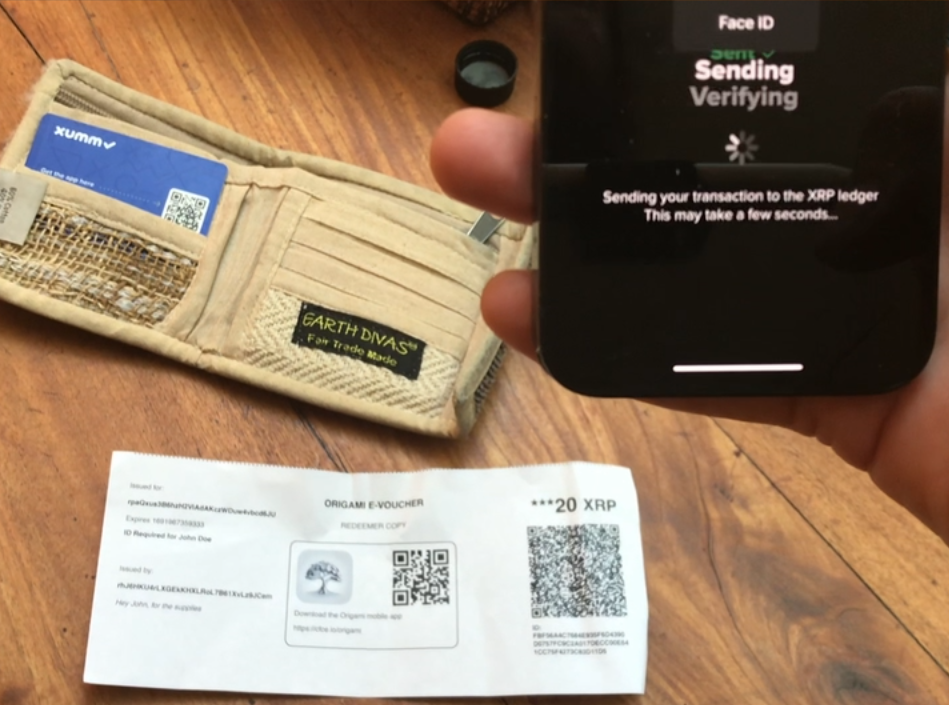
A sample Origami voucher
-
-
-
-
-
-
-
-
Inspiration
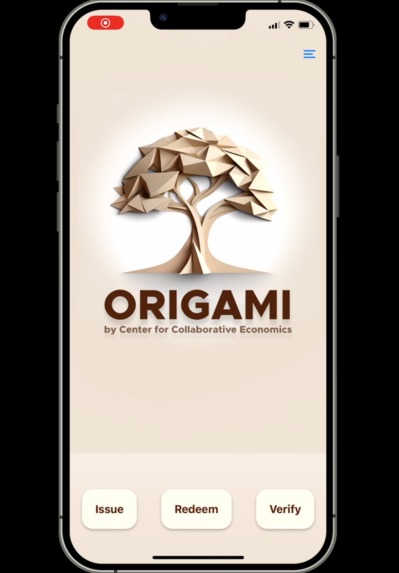
According to Statistica, over 2.6 billion people don’t have smartphones (estimates range from 1-3 billion). Origami, the smartphone app we created for this hackathon, answers the question: how can we make sure that those who don’t have regular access to smartphones can also be included in the digital financial system?
This question is especially relevant to our team because our company, the Center for Collaborative Economics, works with nonprofits serving populations who don’t have access or choose not to interact with technology. In order to work effectively with our partner organizations and communities, CFCE needed to create a solution to interact with CBDCs that didn’t require owning a phone.
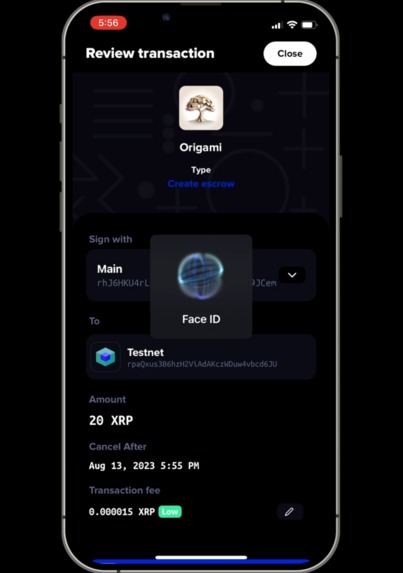
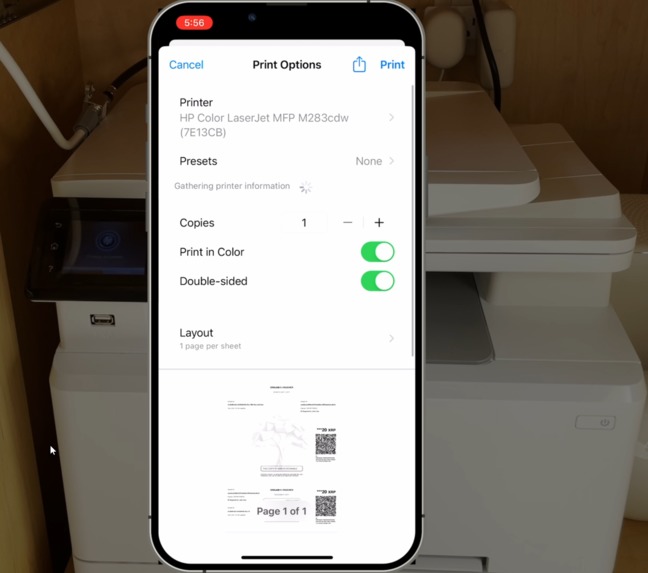
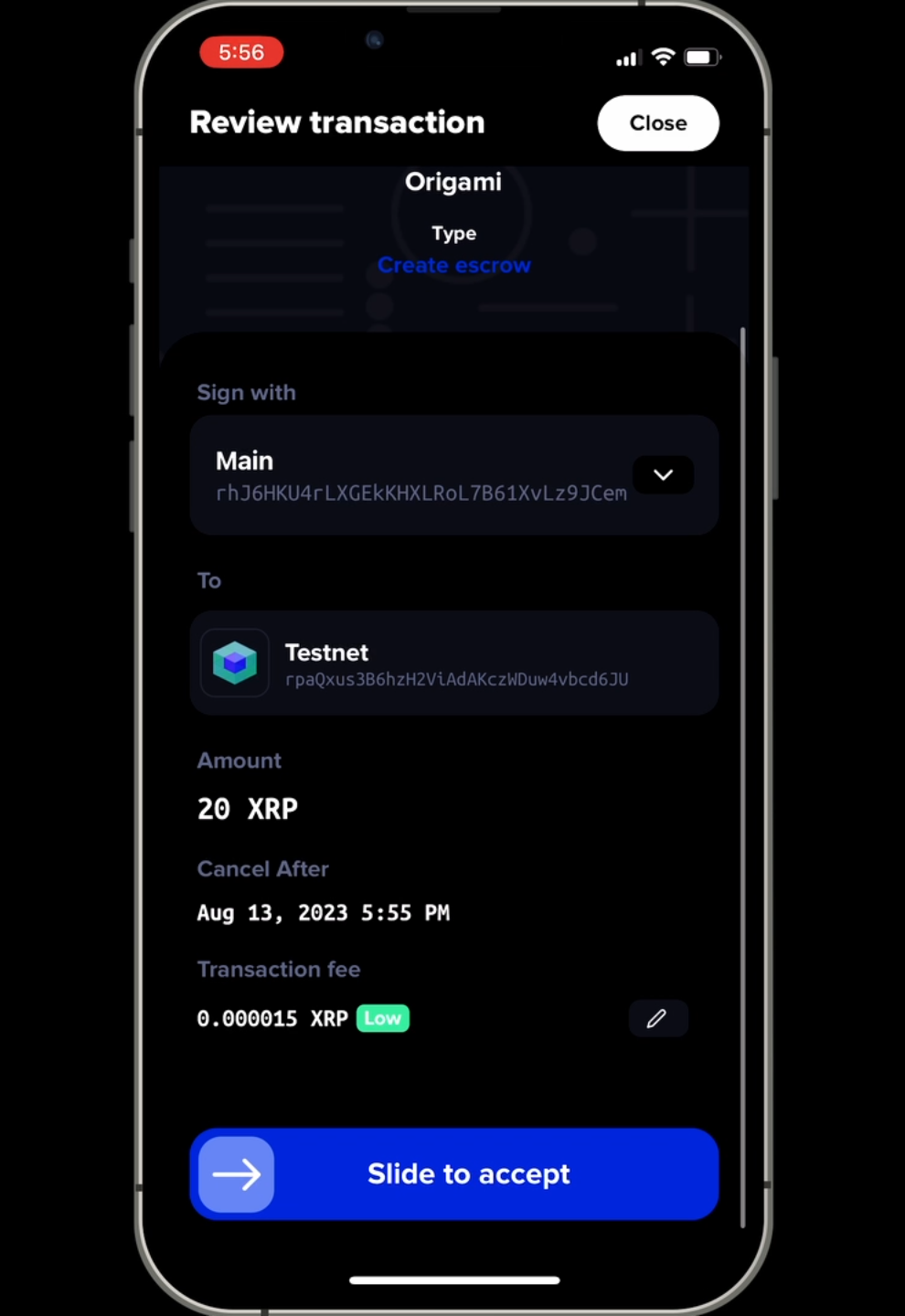
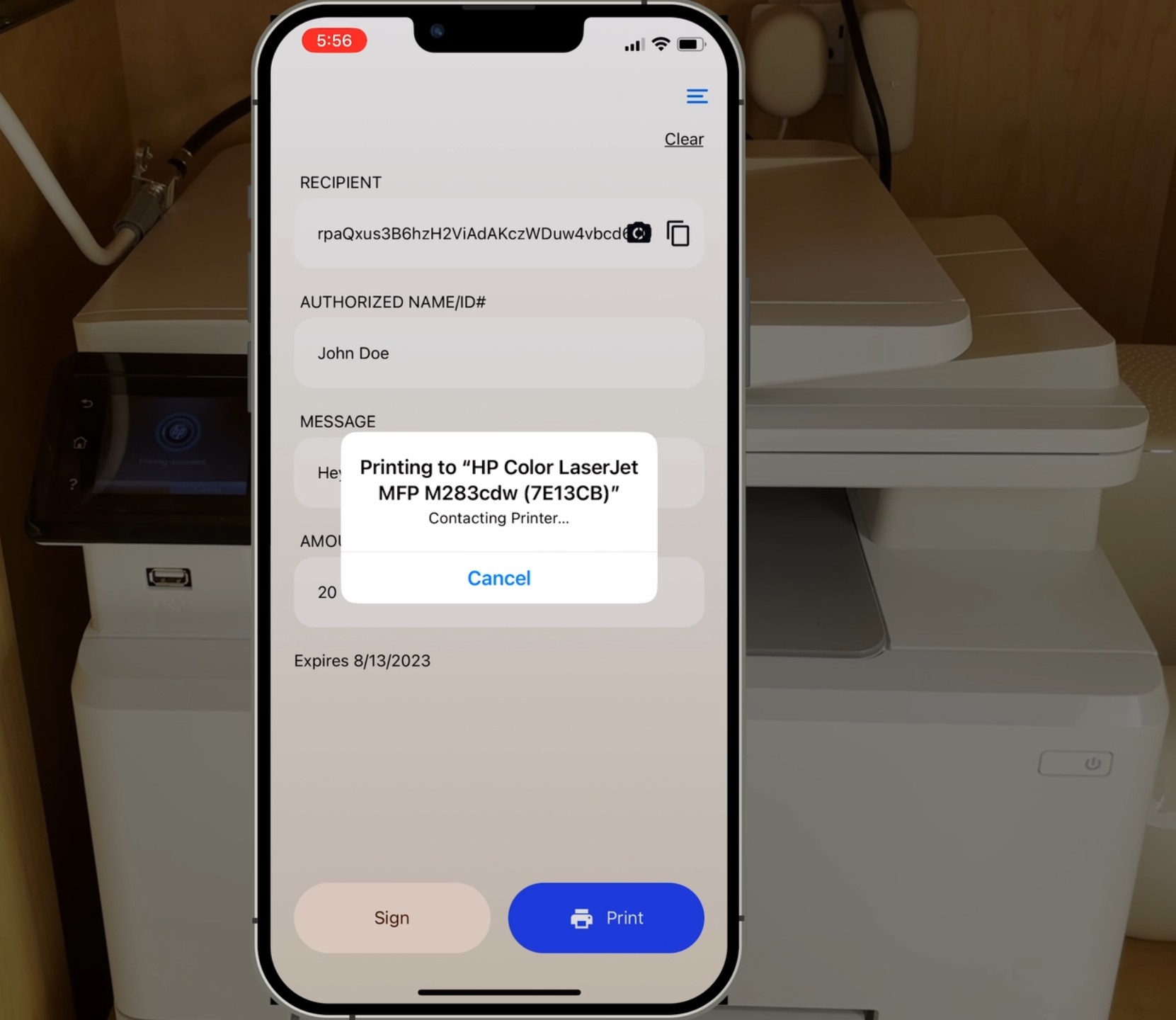
We solved this problem by using the XRP Ledger’s ability to create cryptographically-secured escrowed payments, which allowed us to create, print, and redeem paper CBDC vouchers. This combination of high-tech cryptography mixed with accessible low-tech solutions (commonly available office printers) allows everybody to participate in the Internet of Value, even if they don’t have a phone.
What it does
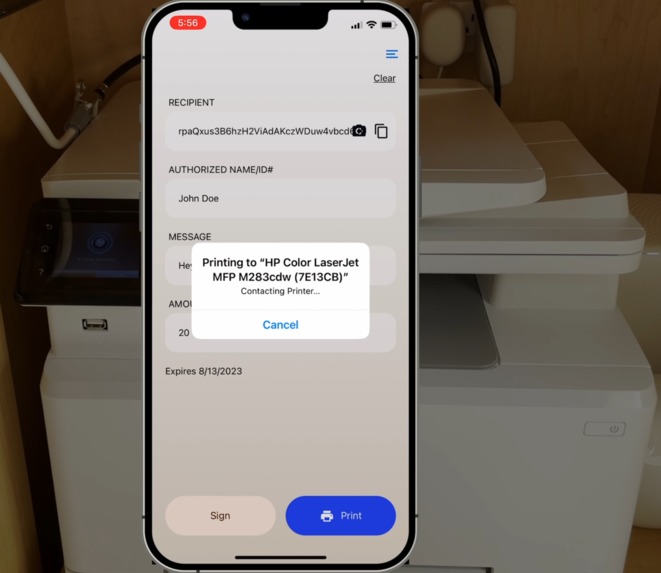
Origami allows trusted partners (in our case, nonprofit organizations or other NGOs, but potentially also entities such as banks, companies or government service providers) to create escrows for a given amount, which are then printed onto paper. These paper CBDC vouchers can then be redeemed by a designated partner (for example, a local bank, merchant or government services outlet such as a post office) and exchanged for goods, services or traditional currency.
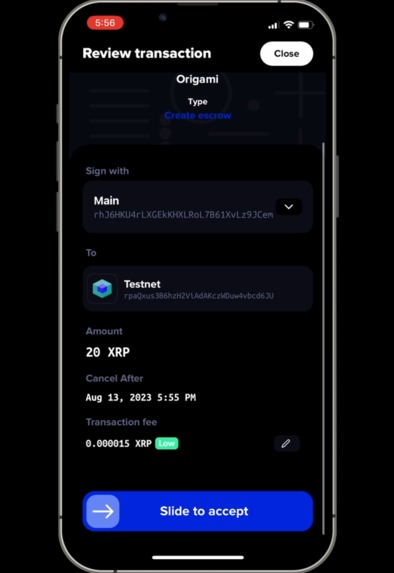
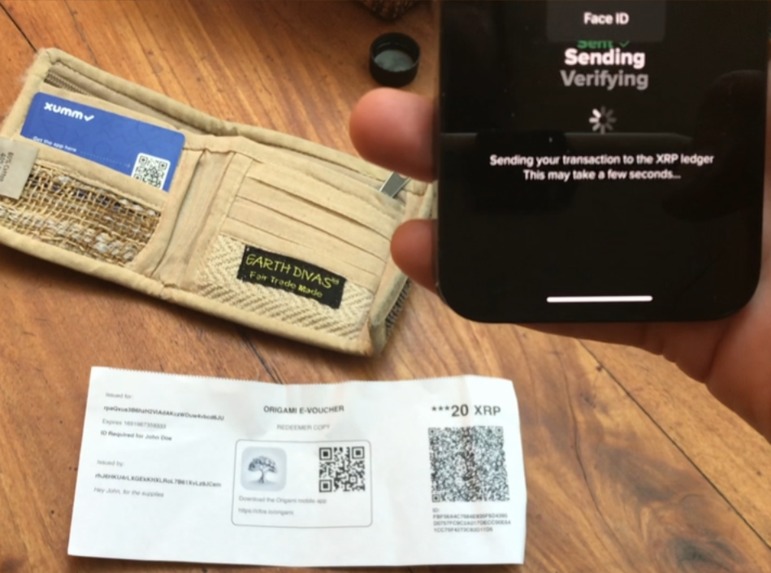
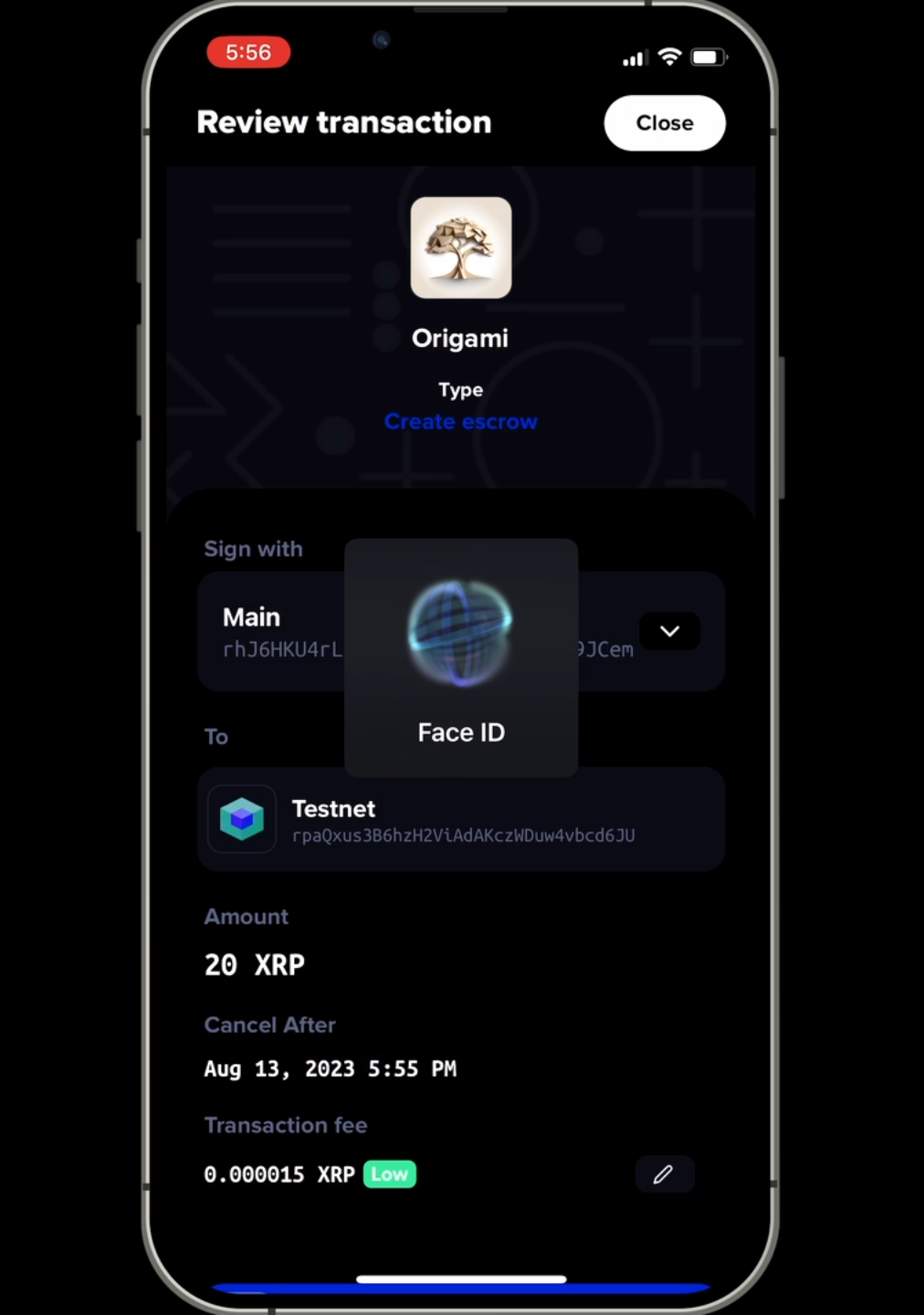
When the escrow is created, the issuer locks up a given amount of currency (in this case, XRP, in the future, XRPL trustline tokens such as stablecoins) into an escrow on the blockchain, which is released into the receiving wallet only stablecoins) into an escrow on the blockchain, which is only released into the receiving wallet only when cryptographic conditions are met, conditions which are stored only on the printed QR code. When the QR code is scanned and signed, the escrowed funds are released to the designated redeemer.
Each paper voucher contains two QR codes.: The first is a public read-only code which is attached to the receipt kept by the issuer which allows anyone to scan and see relevant information such as the amount contained in the escrow, the issuing and redeeming wallet addresses, metadata, and the date and time of the escrow’s creation and expiration. The second QR code, attached to the voucher, scanned,contains the cryptographic conditions of the escrow, which, when fulfilled, releases the funds into the redeeming wallet account.
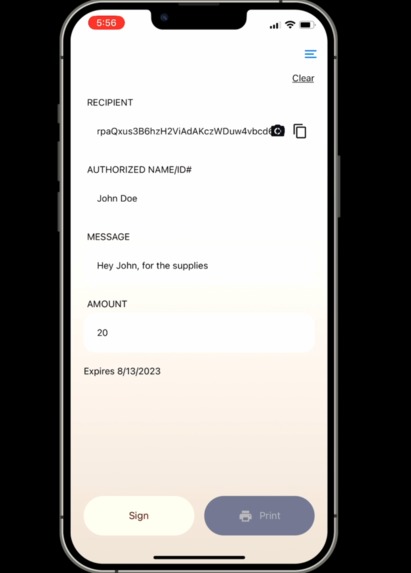
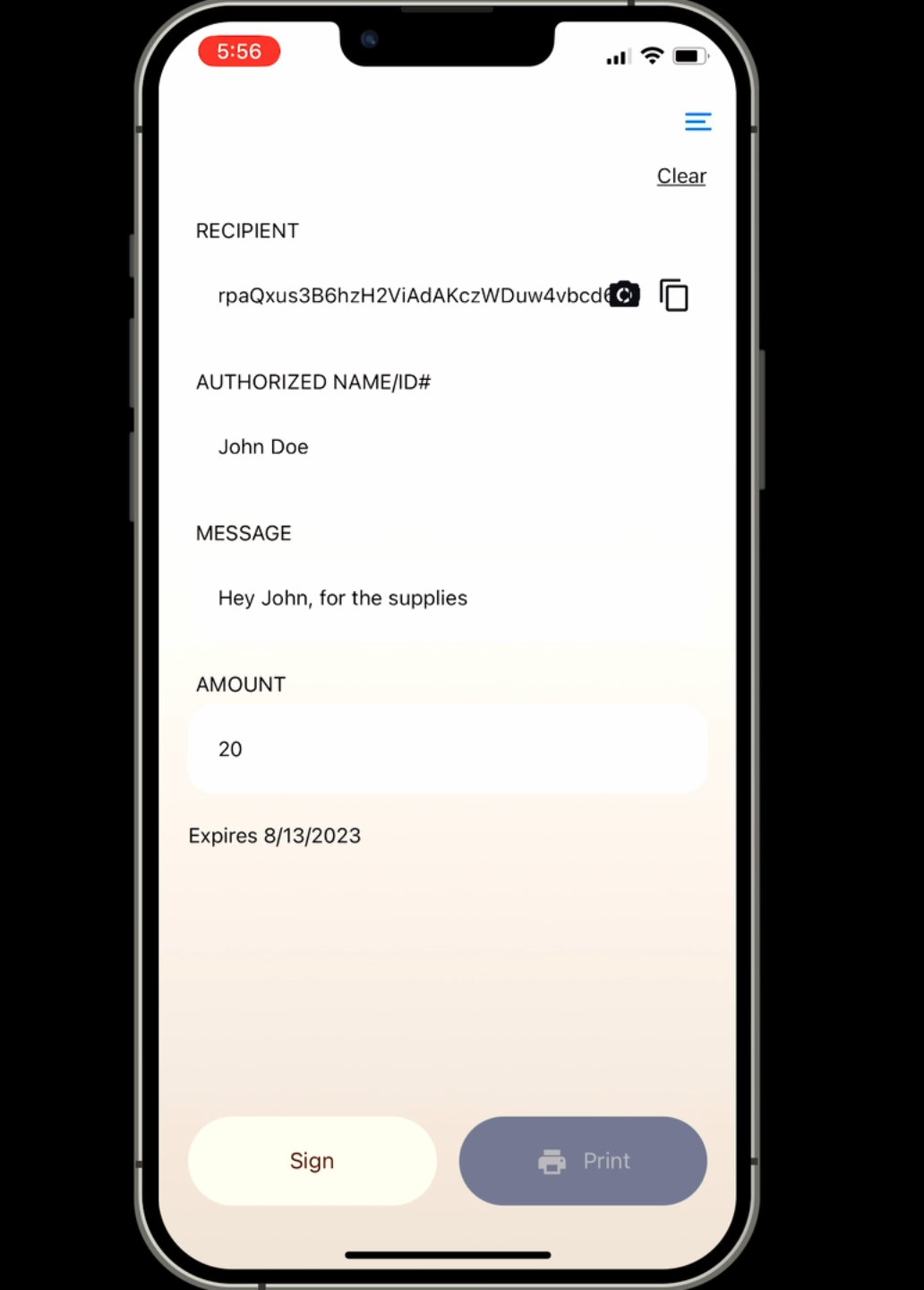
The issuer can also choose to include additional information such as the name and ID number of the person being issued the Origami voucher. If ID information is included, this indicates that the voucher should only be redeemed by that specific person. Without ID information, the voucher could presumably be redeemed by anyone- essentially making the voucher into a cryptographic version of a gift card or cash.
We also included a feature for issuing cryptographic “change,” meaning the automatic creation of a second escrow for the remaining funds if the holder redeems an amount less than the total amount. If a person has an Origami voucher worth $10 and redeems it for $4 while buying a sandwich, this feature allows the creation of a second voucher to be printed with the $6 left over from the first transaction. All that is required is for the redeemer to sign the initial transaction (releasing the escrowed funds), then signing and printing a second transaction to create the additional escrow
Since our target market for this product is governments, central banks, banks and businesses, we wanted to make Origami as adaptable as possible, recognizing that different institutions and jurisdictions will have different preferences and requirements around things like customer identity disclosure and interactions between blockchain and legacy financial systems such as fiat off-ramps and merchant payments.
How we built it
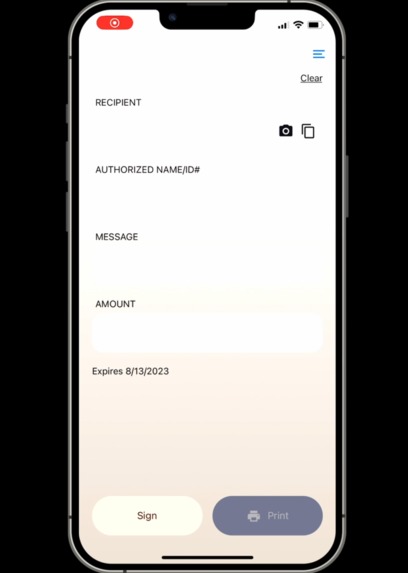
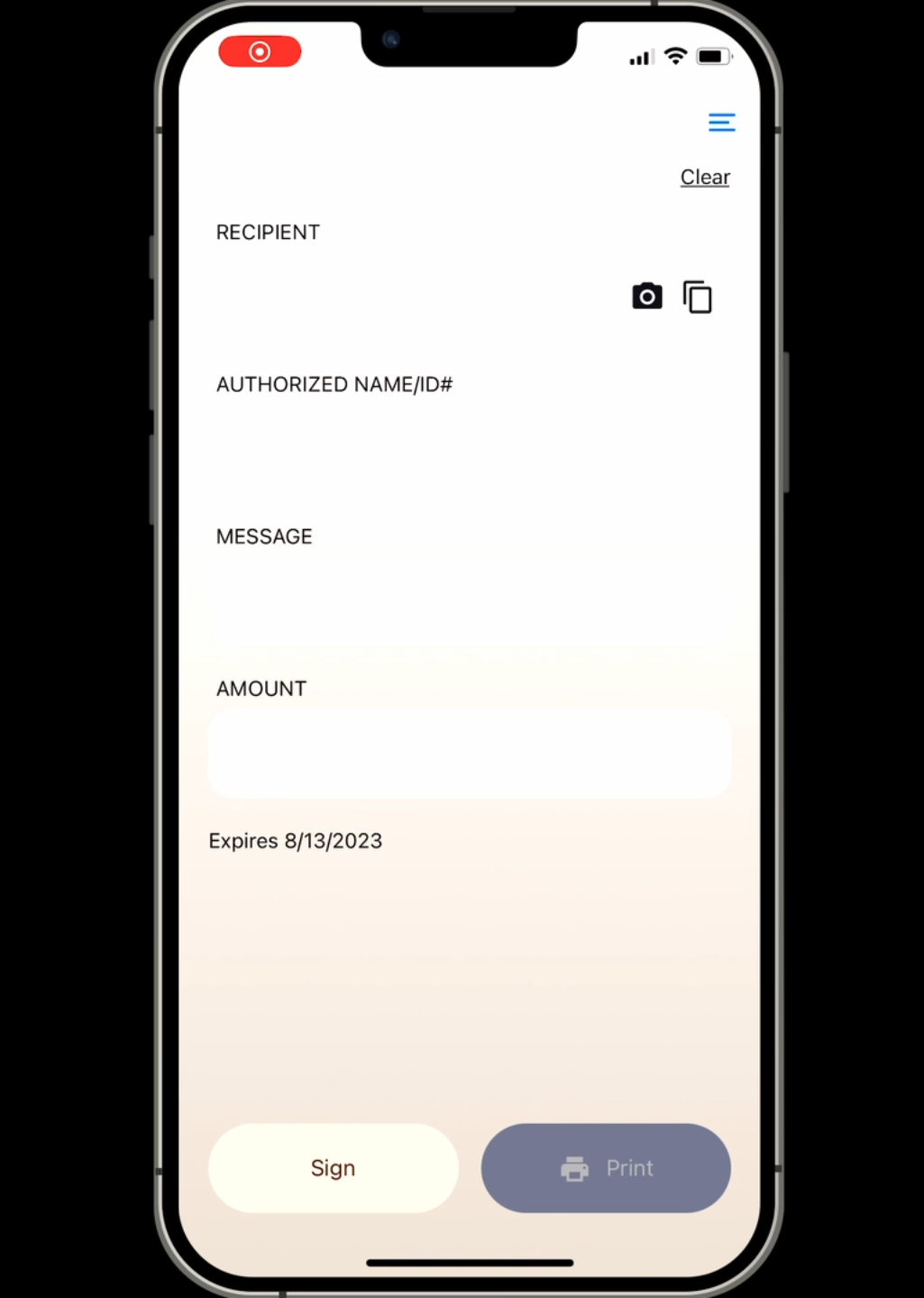
Origami is a mobile app built in React Native, and connects with the XRP Ledger through Xumm and XRPL APIs.
Challenges we ran into
Bridging the gap between worlds is never an easy task, especially when making systems designed to be used by the general public. The main challenge of the design process was envisioning a system that solved the problems we were attempting to address, while also being intuitive enough to be explained to someone who had never heard of cryptocurrency or escrows in under two minutes.
On the technical side, we initially attempted to create the vouchers with a receipt printer, but found that the wide variety of hardware and software that needs to be supported made this unrealistic, although it’s certainly something we’d like to revisit in the future.
Another challenge related to the question of what particular XRPL function or payment type we wanted to use. Our options were XRPL Checks and XRPL Escrows with Crypto Conditions. Escrows fulfill the technical requirements better, and are more secure and practical. They eliminate the risk of a XRPL Check “bouncing,” for example- if a nonprofit issues an XRPL Check but then lacks the necessary funds to honor its obligation when the recipient “cashes'' the check, then these funds cannot be paid out. This could have a negative impact on the system.
In the end, it was the escrow crypto-conditions that were the deciding factor, as this feature is what allows the value to be “stored” in the paper voucher, making it only redeemable by using the fulfillment printed on the voucher. Since checks don’t share this feature, it made the decision easier.
The main issue with XRPL Escrows is that, as it stands right now, particularly for CBDCs, is that escrows can only contain XRP on the XRPL main net. There are two possible solutions:
First, XRPL Amendment XLS-34d has been proposed, which would enable escrows to hold trustline tokens (such as CBDCs). Trustline token-enabled escrows could be coming to the XRPL mainnet in the coming months.
The second solution would be to enable trustline token escrows on an XRPL sidechain, such as Ripple’s CBDC platform that finalists in this hackathon will be able to access, or the EVM-enabled XRPL sidechain CFCE is in the process of designing.
If our team were able to gain access to Ripple’s proprietary CBDC platform, we could enable CBDC escrows and go on to test Origami using proof of concept pilot tests of with our partner nonprofits in the US, Colombia and Peru.
Accomplishments that we're proud of
We are proud of creating an innovative, intuitive mechanism using the unique functionality of the XRP Ledger which has the potential to make a positive impact on the lives of over a billion people. We are also proud of the design of the voucher and the app itself, which in our opinion mixes beauty with functionality and is capable of being utilized by institutions at scale.
What we learned
The major lessons of this hackathon related to principles of inclusive design, and compromise in the design process. The first, inclusive design, involves a sort of balancing act, holding on one side the technical requirements of the project and on the other side the target audience for whom we were building. We asked ourselves: How can we “meet our audience where they are at?”
Rather than placing unreasonable demands on users in order for them to be able to utilize our solution, we tried our best to make barriers to understanding and utility as low as possible- making the escrow creation and redemption process simple, with a low requirement for technical knowledge, and designing the app interface to be accessible to anyone even if they lacked understanding of the underlying mechanism.
Another element was making sure that everyone could use Origami. One example of this was the choice of printer for the voucher. Originally we had lofty ideas about holographic stickers, specialized cardstock, and plastic gift card printers, in order to make the most beautiful and perfect vouchers possible. But then we realized that our target audience lives in the rural Global South. So we decided to make the system adaptable to any standard office printer, to ensure that anyone with access to a printer could use it.
The second lesson, regarding compromise in the design process, was more of a growth experience for our team. It might sound a little silly, but the debate about whether to use XRPL Checks or Escrows with Crypto Conditions got a little heated! We wanted to make sure we found the right technological solution (payments are meaningfully redeemable by paper) while also meeting the requirements for the hackathon (operating with CBDCs, i.e. trustline tokens).
The resolution of disputes and process of achieving consensus is a big part of any company’s culture, and so this hackathon gave our team the opportunity to clarify and work through some of those processes, and emerge stronger as a result- with a beautiful and functional product to boot, and even more appreciation for the skillset each member of our team brings to the table.
What's next for Origami: Physical CBDC Vouchers for Financial Inclusion
The Center for Collaborative Economics will be using Origami to support our nonprofit partners, specifically seeking to run proofs-of-concept with one or more of the following pilot projects:
-a network of local food-focused nonprofits using a community currency in the Driftless area of rural Wisconsin and Iowa, an area with a high concentration of Amish people -a UBI-type project centered around a community garden on a Native American reservation in Nebraska -a small network of craft vendors, cafes and community gardens in a small town named Barichara, and a permaculture/agroforestry/biodiversity project in a mixed indigenous and campesino village in Sierra Nevada de Santa Marta, both located in Ripple CBDC partner country Colombia. -a reforestation and agroforestry-based tokenized carbon/eco-credit project working with indigenous communities and local governments adjacent to a large nature reserve in Peru, Manu Nature Reserve, where technology is scarce-to-non-existent.
If Origami is accepted as a finalist in this hackathon, the timeline for one or more of these proofs-of- concept would be accelerated greatly by our ability to access the Ripple CBDC platform as a “home base” for deploying Origami in the pilot projects.
Otherwise, CFCE is already in the process of designing a Ethereum Virtual Machine-compatible XRP Ledger sidechain, which will be the home for the Origami facet of our platform, as part of our mission to support community nonprofits and regenerative local economies using the revolutionary tools of Web3 and distributed ledger technology.
Built With
- node.js
- react-native
- xrpl
- xumm


Log in or sign up for Devpost to join the conversation.