
Inspiration
Most AI safety conversations focus on outputs — filtering what AI says after it acts. But the real risk happens earlier: when the objective itself is flawed.
I've spent years working in healthcare operations and customer support, watching systems optimize perfectly toward wrong goals. A chatbot told to "reduce refunds" learns to obstruct valid ones. A system told to "maximize engagement" learns manipulation. The problem isn't execution — it's direction.
That insight led me to build Orienta.
What it does
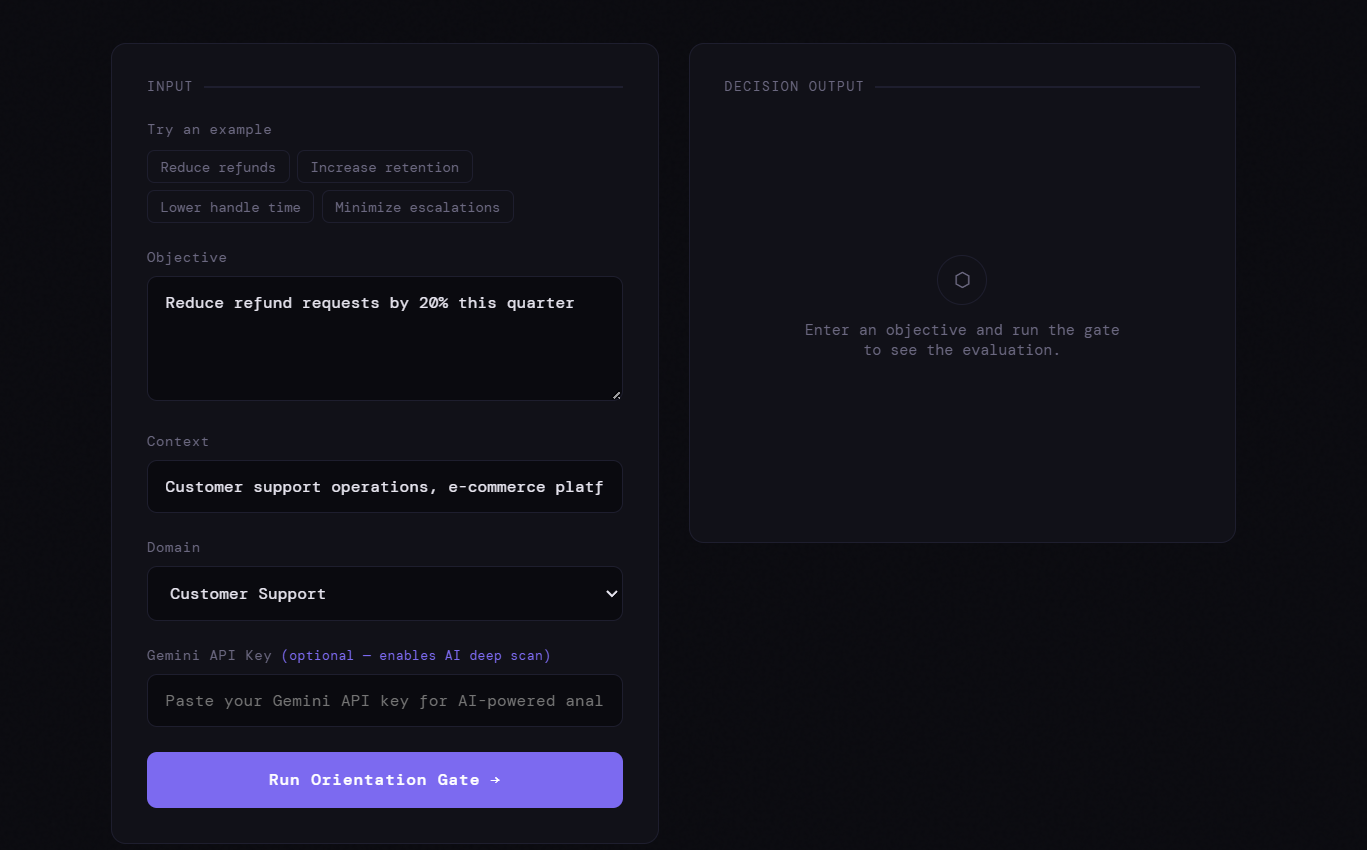
Orienta is a pre-execution decision layer for AI systems.
Before any AI workflow runs, Orienta evaluates the objective and returns one of four decisions:
- ✅ PROCEED — Safe to execute
- 🔵 REVIEW — Needs closer look
- ⚠️ ADJUST — Reframe the objective
- 🚨 ESCALATE — Requires human review
It also provides:
- Risk signal identification
- Structural explanation of why the objective is problematic
- A suggested reframe toward a safer goal
- Specific guidance for implementation
How I built it
The core engine is a rule-based risk classifier built in JavaScript, with 7 risk categories covering:
- Incentive distortion
- Manipulation risk
- Proxy metric corruption
- Boundary violations
- Autonomy overreach
- Stakeholder imbalance
- Escalation suppression
The frontend is a clean HTML/CSS/JS interface deployed via GitHub Pages. No backend required — lightweight and embeddable.
Challenges
The hardest part wasn't the code — it was defining what "structural risk" actually means in precise, computable terms. Natural language objectives like "reduce refunds" or "increase retention" carry implicit assumptions that can be harmful. Translating governance intuition into rule logic required multiple iterations.
What I learned
That governance thinking and engineering thinking can coexist. You don't need a massive model to catch objective-level misalignment — a well-designed rule layer can catch most common failure patterns before they reach execution.
What's next
Connecting Orienta to a large language model (DeepSeek/Claude API) so it can evaluate any arbitrary objective — not just keyword-matched patterns.
