Oriclus
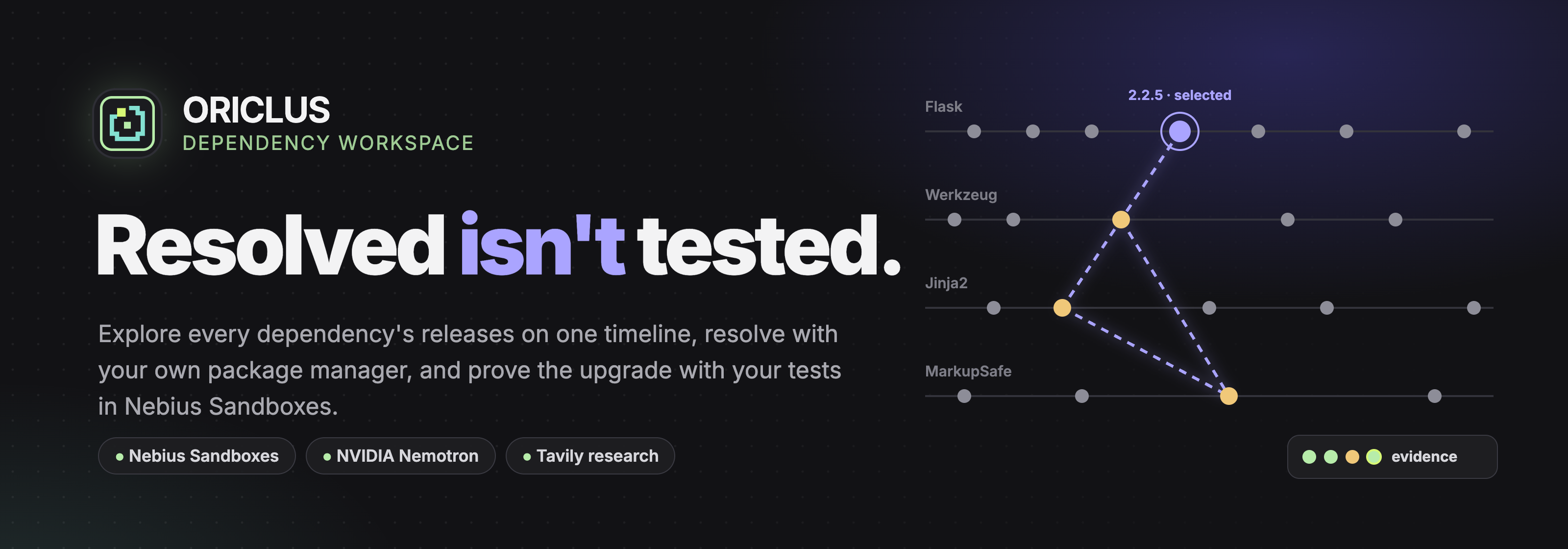
Resolved isn't tested.
Every team has a dependency it's afraid to upgrade. The bot's pull request is green. The lockfile resolves. And nobody wants to click merge, because "it installs" has never meant "it works." So the security fix waits, the versions drift, and one day a s imple bump has quietly become a migration.
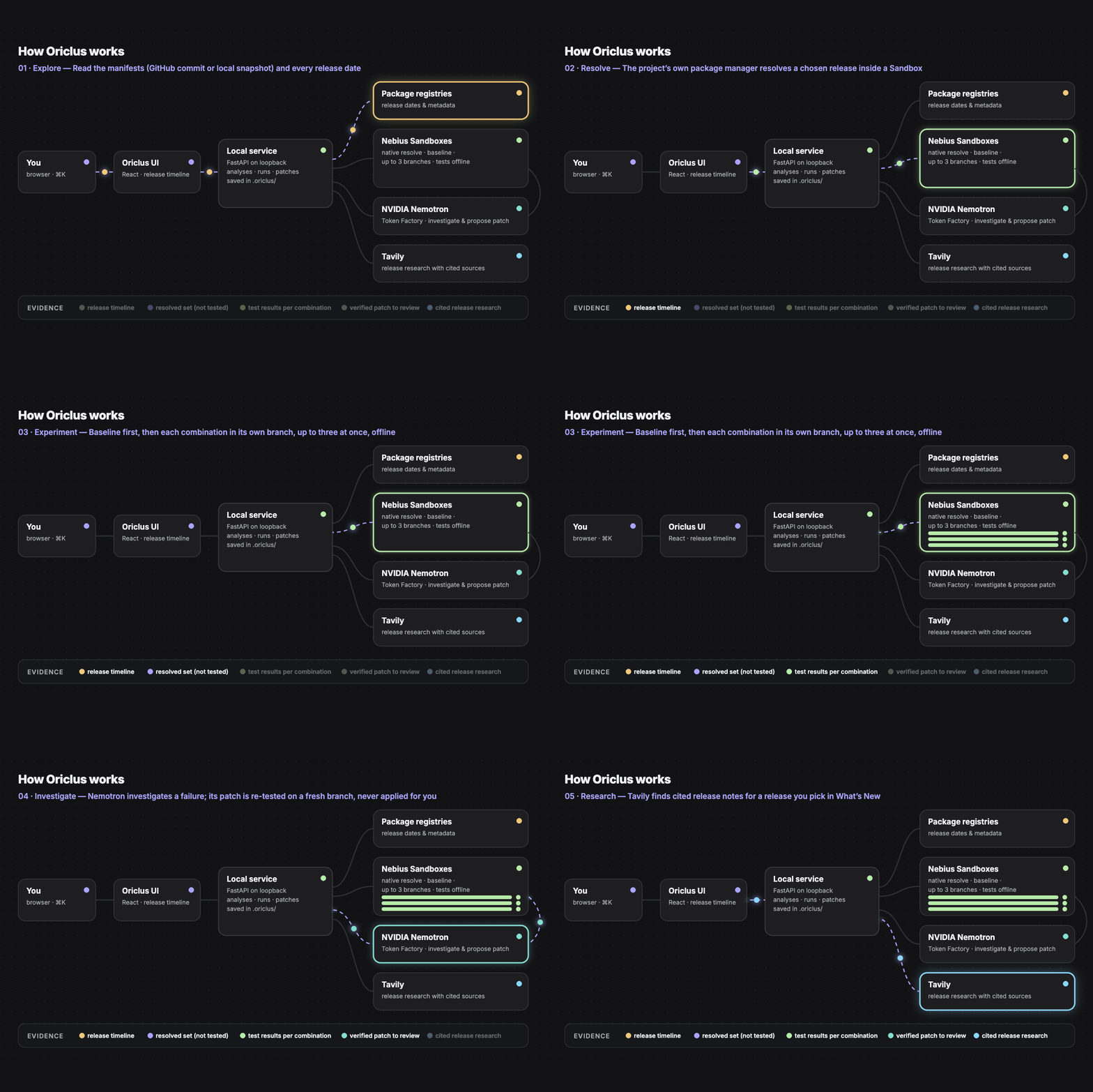
Oriclus turns "will this upgrade break us?" into an answer with evidence, before you merge. It lines up every dependency's releases on one shared timeline, lets your own package manager resolve a candidate in a Nebius Sandbox, then runs your tests against every combination you choose, each in its own isolated branch. When a combination fails, NVIDIA Nemotron investigates inside the Sandb ox and proposes a patch, and Oriclus re-runs your original tests on a fresh branch to prove it. Nothing is ever applied to your project for you.
Why "Oriclus"?
Oriclus = origo + cyclus. In Latin, origo is the origin, the point where something begins, and cyclus is a cycle, a wheel that keeps turning. Every upgrade starts from an origin, the versions your project runs today, and moves through a cycle: explore → resolve → test → repair → verify, turning again until you find the combination that truly works. Oriclus is that loop, made visible and kept as evidence. Even the logo is drawn from it: a cycle path that sets out from a small origin square and comes back around.





🚀 Try it live: https://3t3h4y5hhclp2y2u3fwu5tfkky0mwnqm.lambda-url.us-east-1.on.aws/
Public GitHub projects only · shared lifetime quota of 250 operations · up to four combinations per experiment
Inspiration
You bump one version. pip install -U flask says Successfully installed flask-2.3.3. Then your tests disagree:
AttributeError: 'Flask' object has no attribute 'before_first_request'
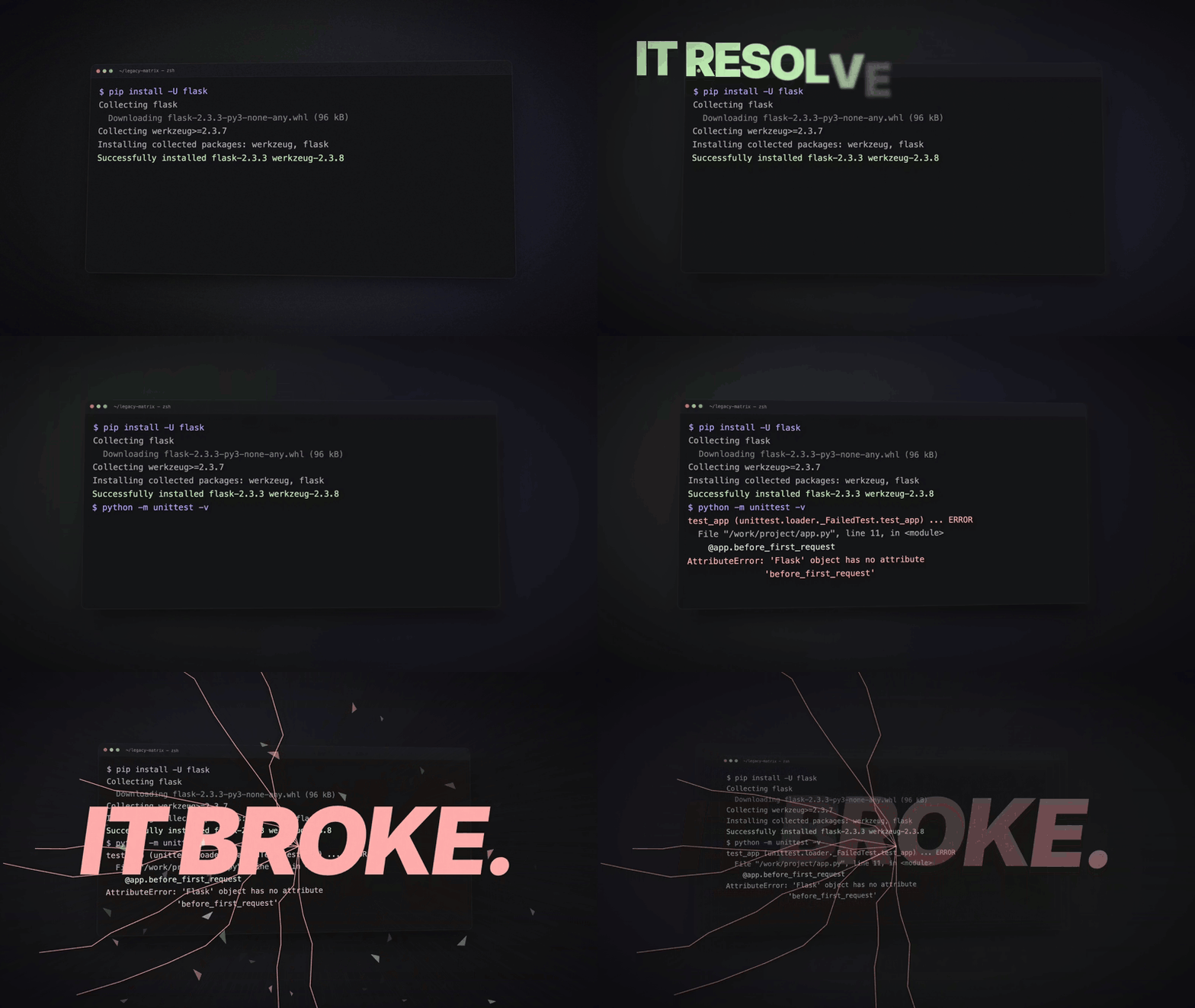
A package manager answers one question very well: can these declared requirements be satisfied? It cannot answer the one you actually care about: which versions of my dependencies work with my code and my tests? Today that answer costs an afternoon of branches, rollbacks and changelog reading, and the evidence disappears with the terminal.
We wanted a place where an upgrade is treated like a hypothesis: explored on a timeline, resolved honestly, tested in isolation, repaired with evidence, and remembered.
What it does
| Oriclus capability | What it does | Why it matters |
|---|---|---|
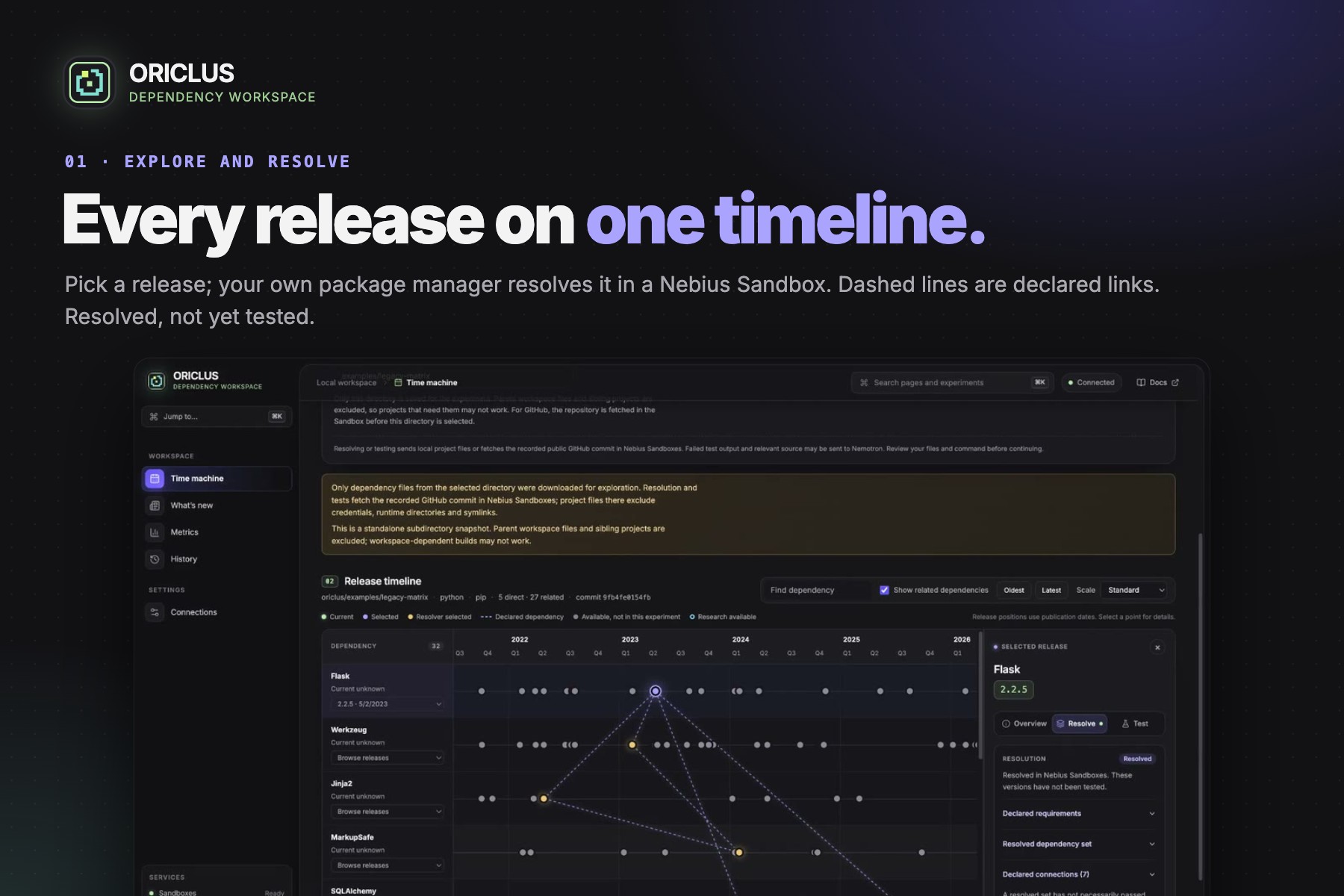
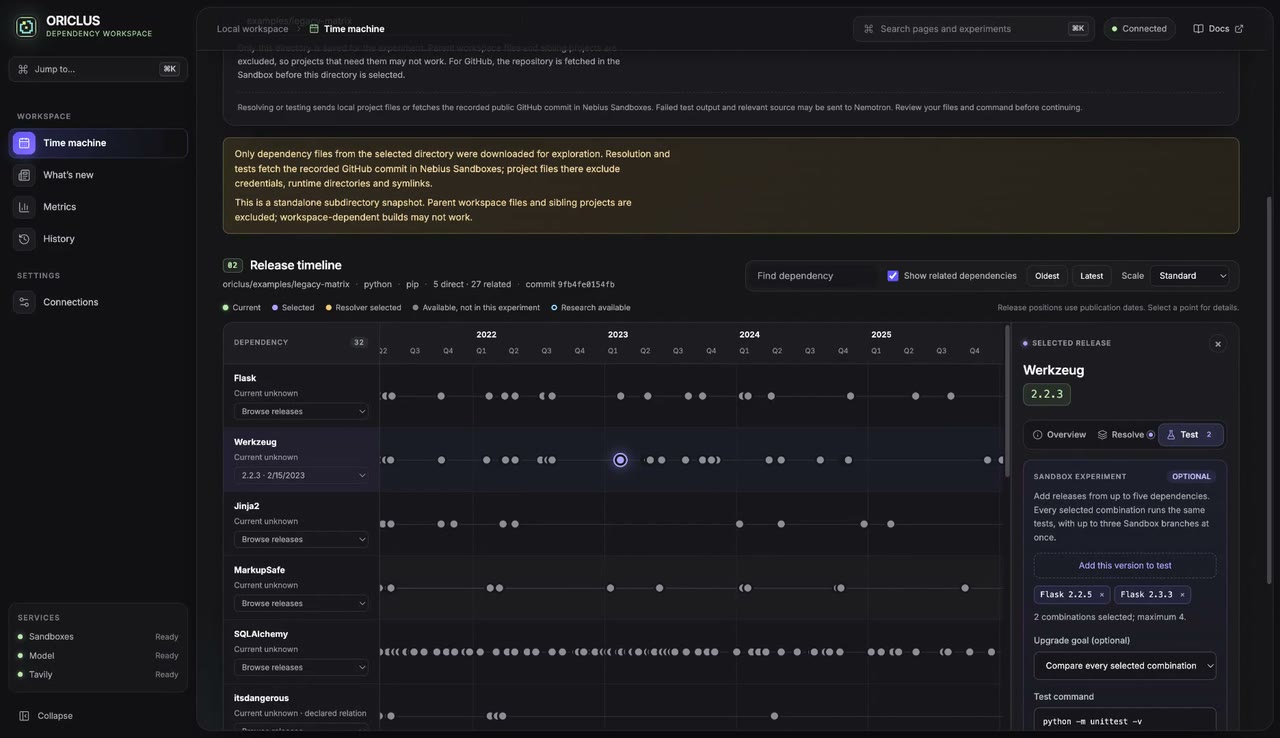
| 1 · Explore | Point it at a public GitHub repo or a local folder (optionally one subdirectory). Every direct and related dependency appears on one publication-date timeline: zoom, search, page, jump to any release. | You see what shipped, and when, for everything at once. |
| 2 · Resolve | Pick a release. The project's native package manager (pip, uv, Poetry, npm, Yarn, pnpm, Bun; Go and Cargo experimental) resolves it inside a Nebius Sandbox. Declared links are drawn on the timeline. | A real resolver answer, clearly labelled not tested. |
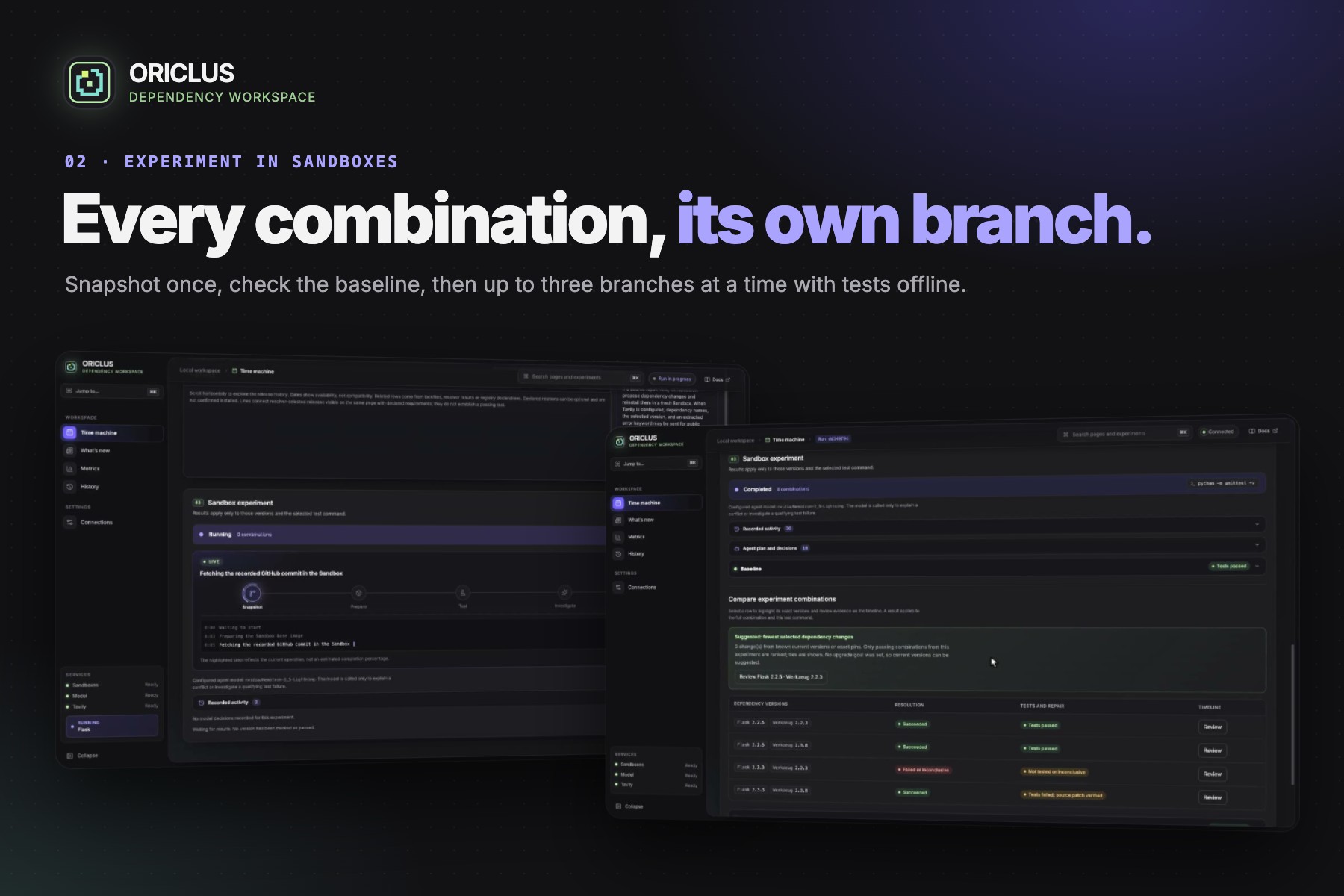
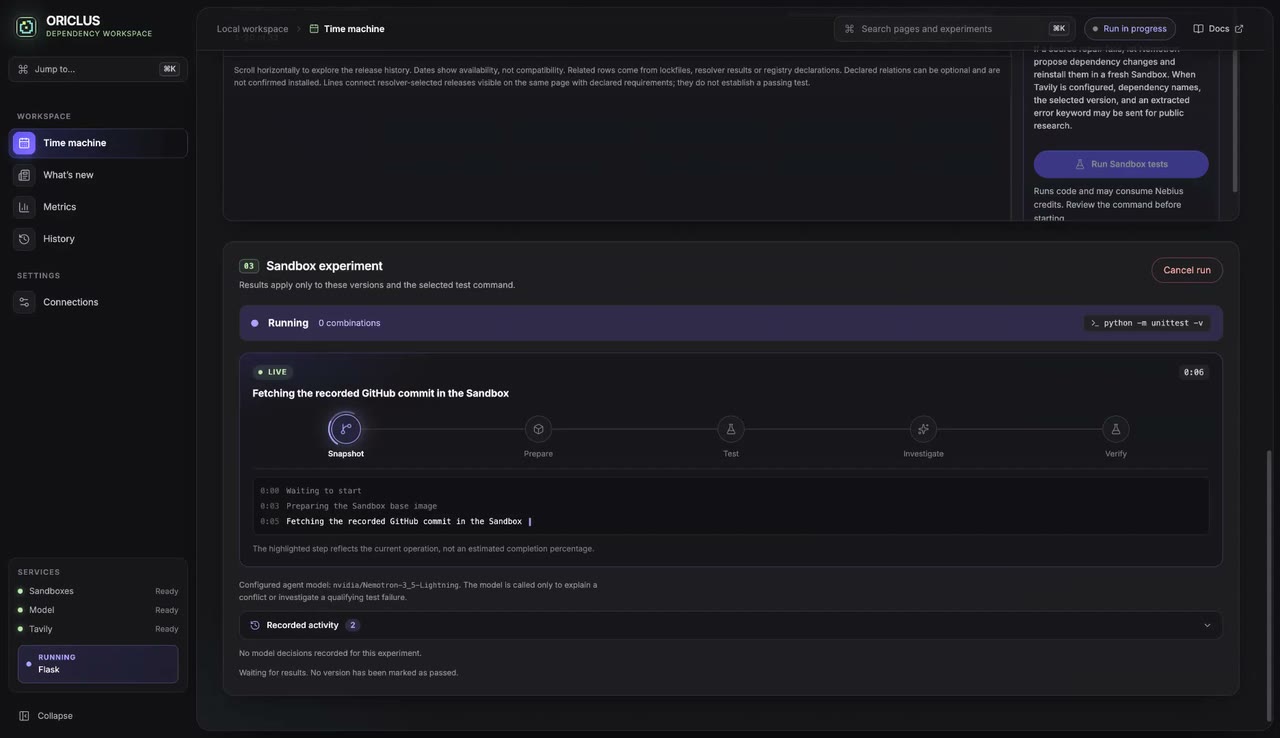
| 3 · Experiment | Queue releases from up to five dependencies (up to 12 combinations). Oriclus snapshots the project once, checks the baseline, then runs each combination in its own branch, three at a time, tests offline. | Every combination gets the same tests in a clean, isolated environment. |
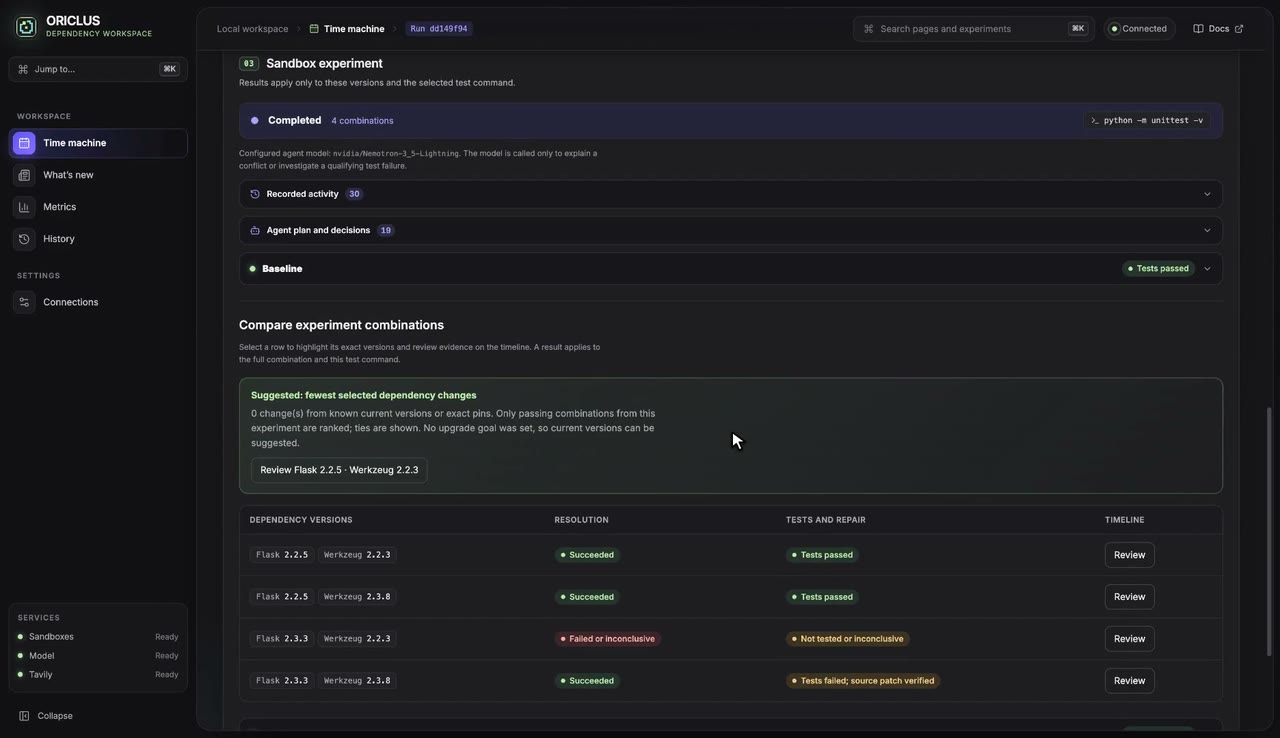
| 4 · Compare and guide | Each combination shows resolution, test and repair outcomes. Review focuses its exact versions on the timeline; a completed run suggests the passing options with the fewest changes. | Decide from evidence, not from a changelog. |
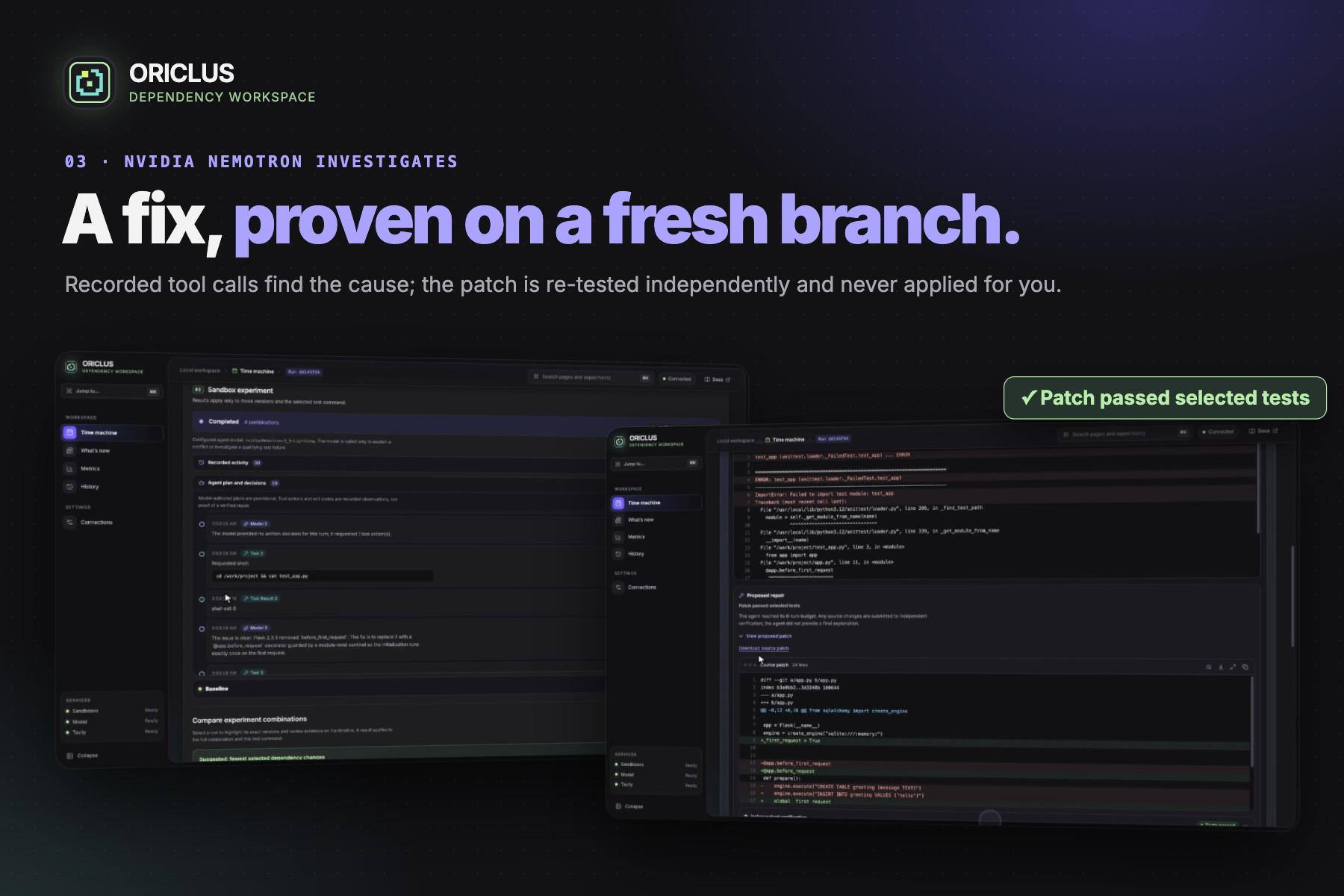
| 5 · Investigate and repair | On a qualifying failure, NVIDIA Nemotron plans, reads code and runs commands in the Sandbox, then proposes a source or dependency-file patch. Oriclus re-runs the original tests on a fresh branch. | A fix you can review and download, with proof it passed your selected tests. |
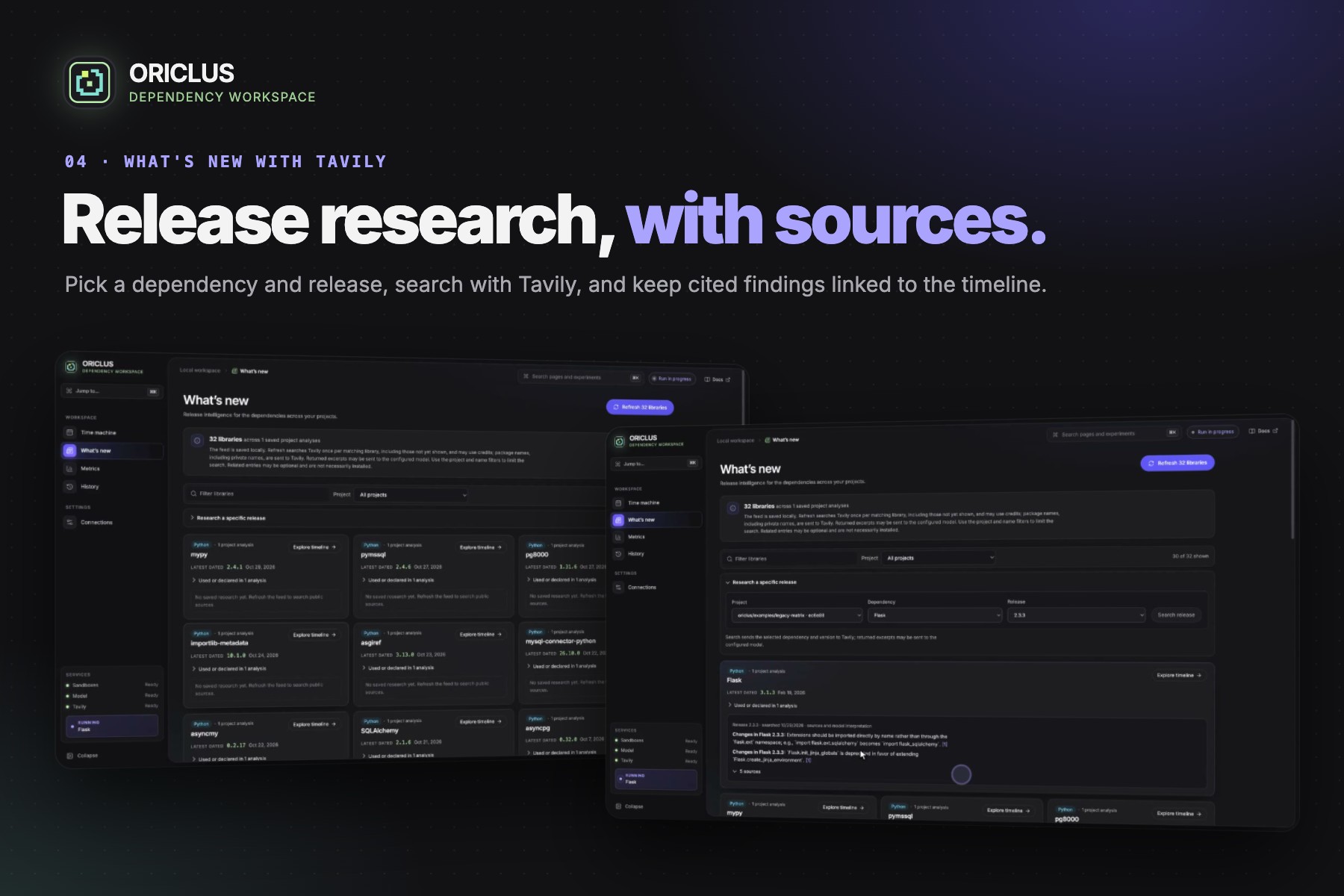
| 6 · Research and revisit | What's New keeps a feed of every library across your projects, with Tavily release research and cited sources. History reopens any experiment; ⌘K jumps anywhere. | The evidence stays, and so does the context. |
Product walkthrough
Every clip below is cut from our showreel, which is built from a screen recording of the real app running the constructed examples/legacy-matrix project (Flask, Werkzeug, Jinja2, MarkupSafe, SQLAlchemy).
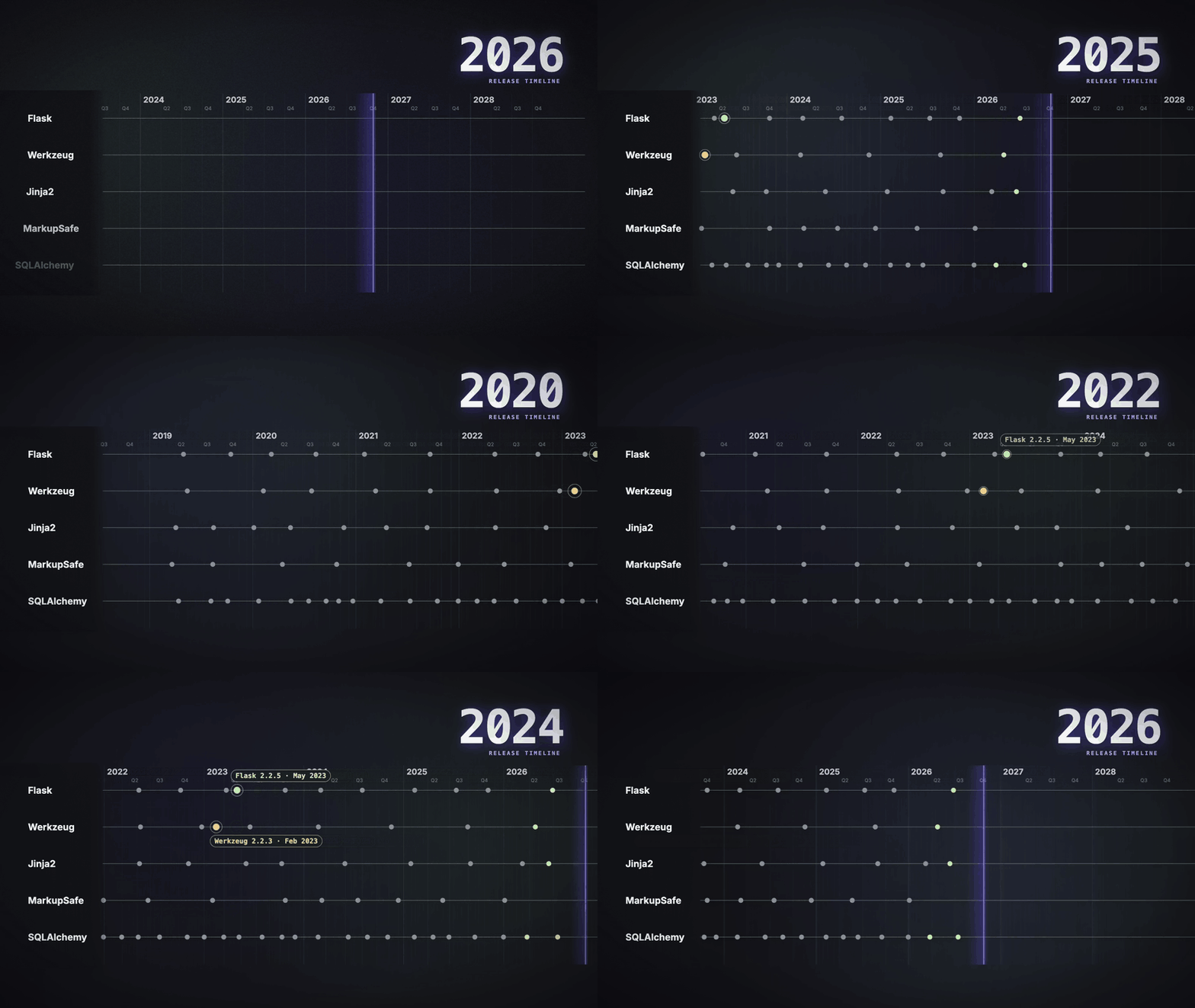 Explore. Every dependency on one shared release timeline. Travel back, jump forward. |
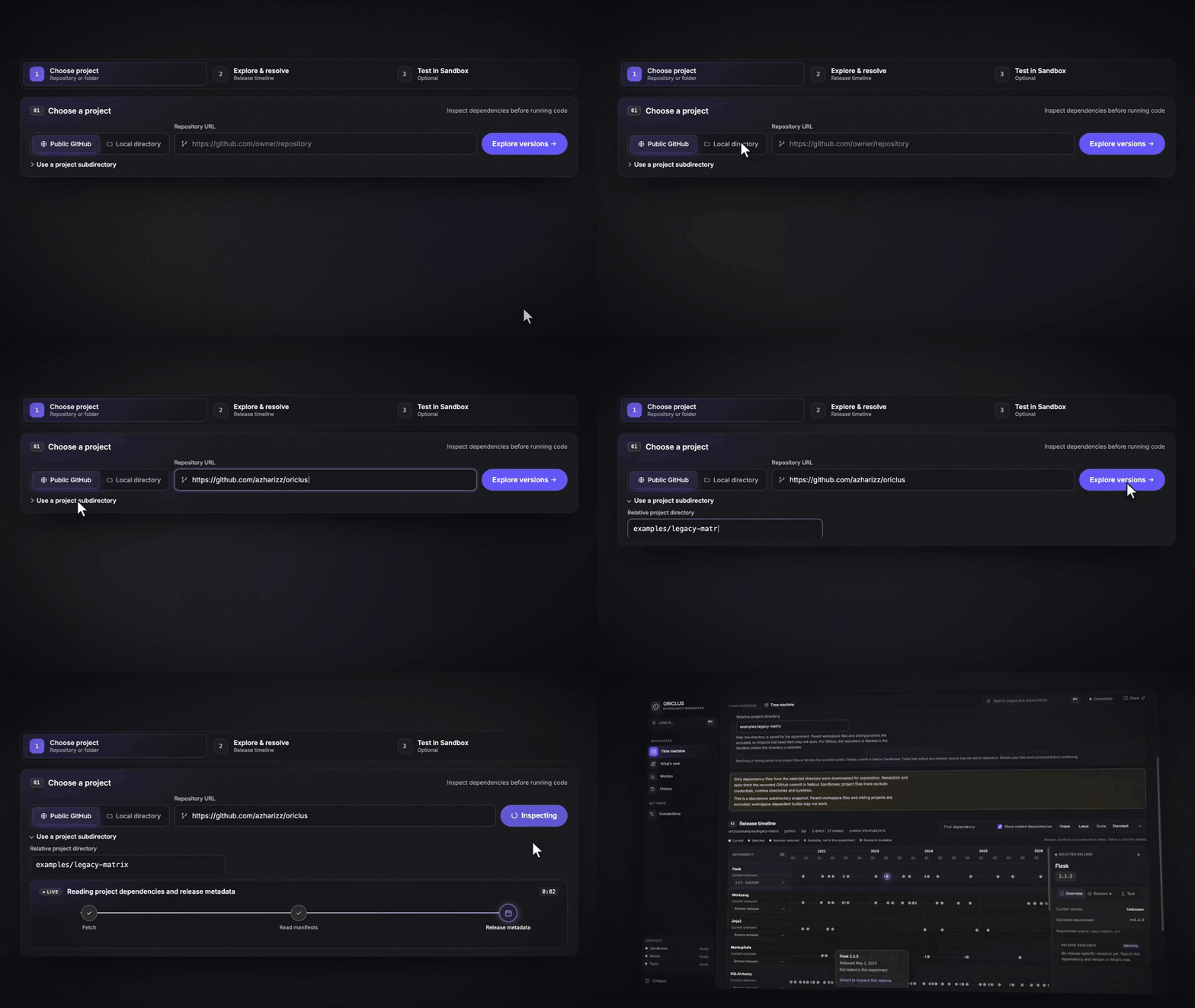 Choose a project. Public GitHub or a local folder, an optional subdirectory, then Explore versions. |
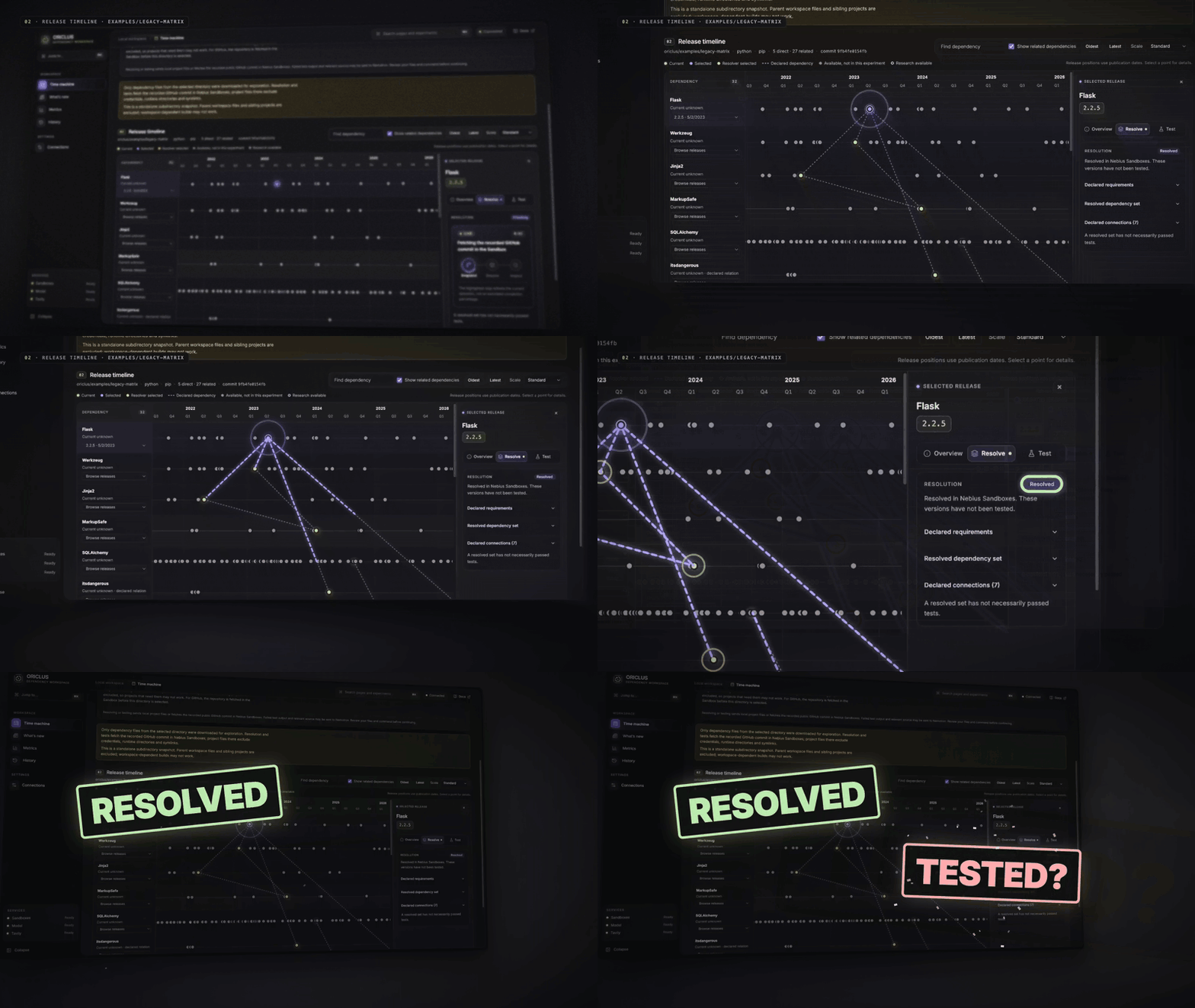 Resolve. Flask 2.2.5 resolved by pip in a Nebius Sandbox. The lines are declared links. Resolved? Yes. Tested? Not yet. |
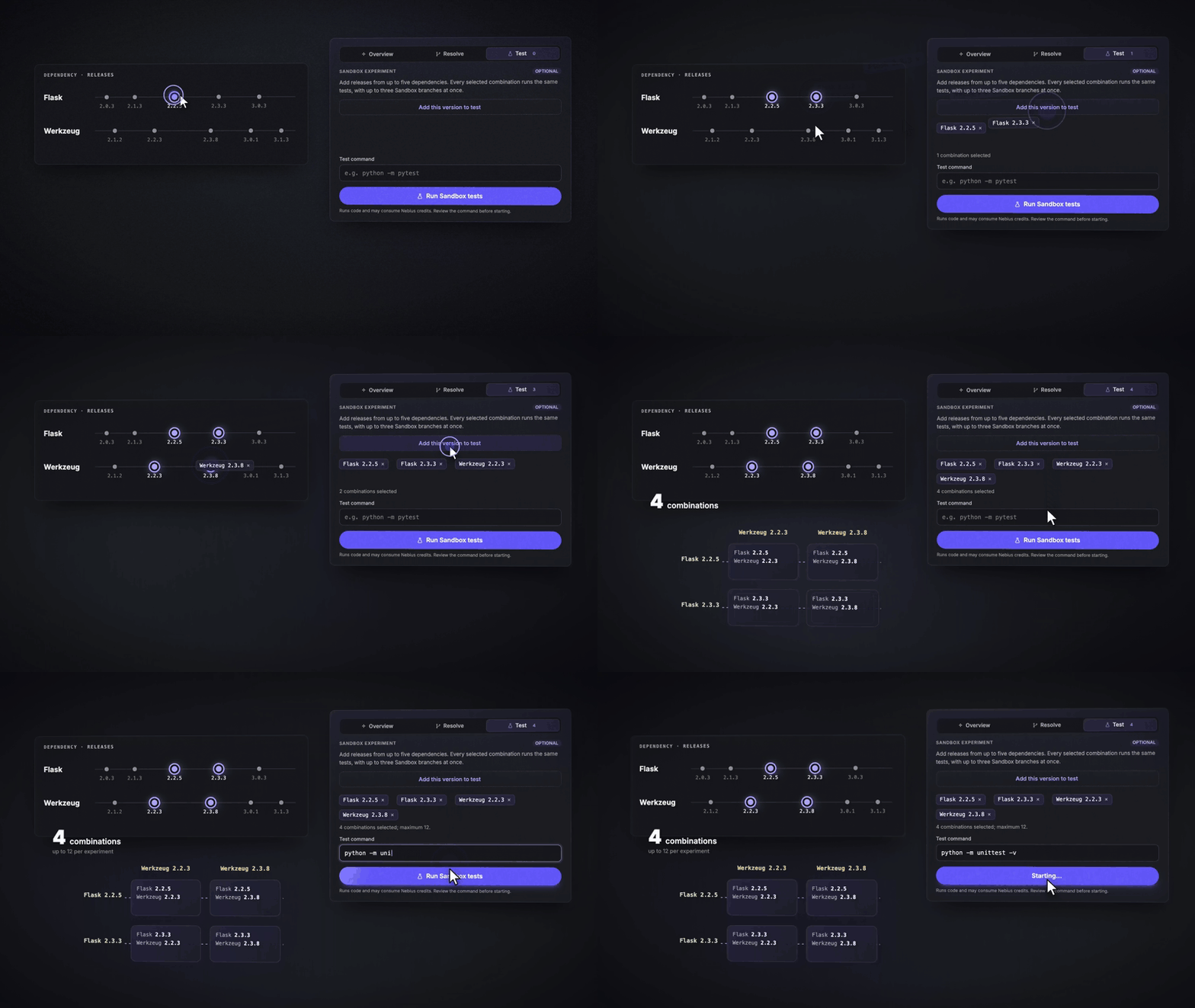 Experiment. Flask 2.2.5 / 2.3.3 × Werkzeug 2.2.3 / 2.3.8 = 4 combinations, one test command. |
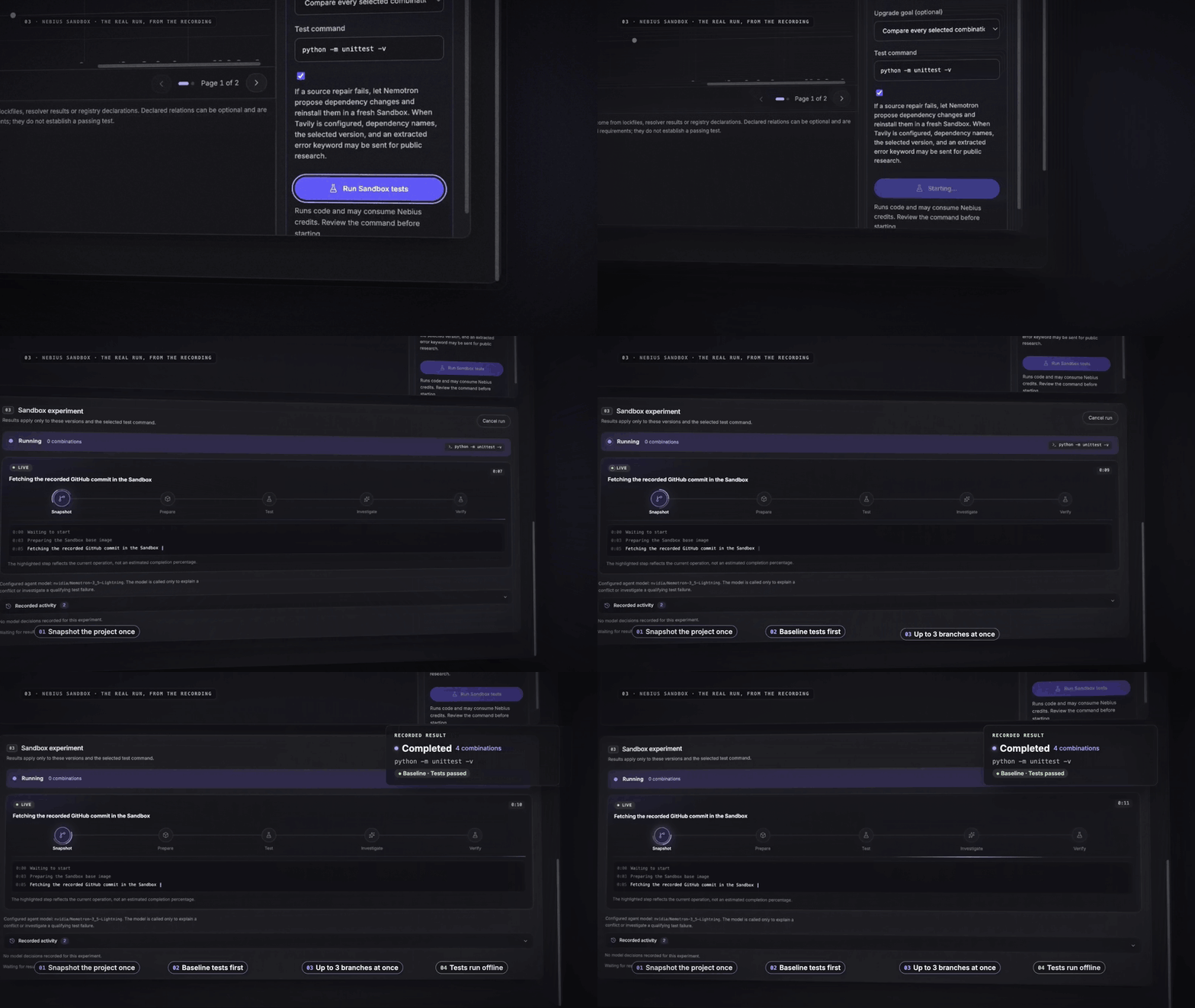 The real run. The recorded Run Sandbox tests click and the live Running panel, with the recorded result. |
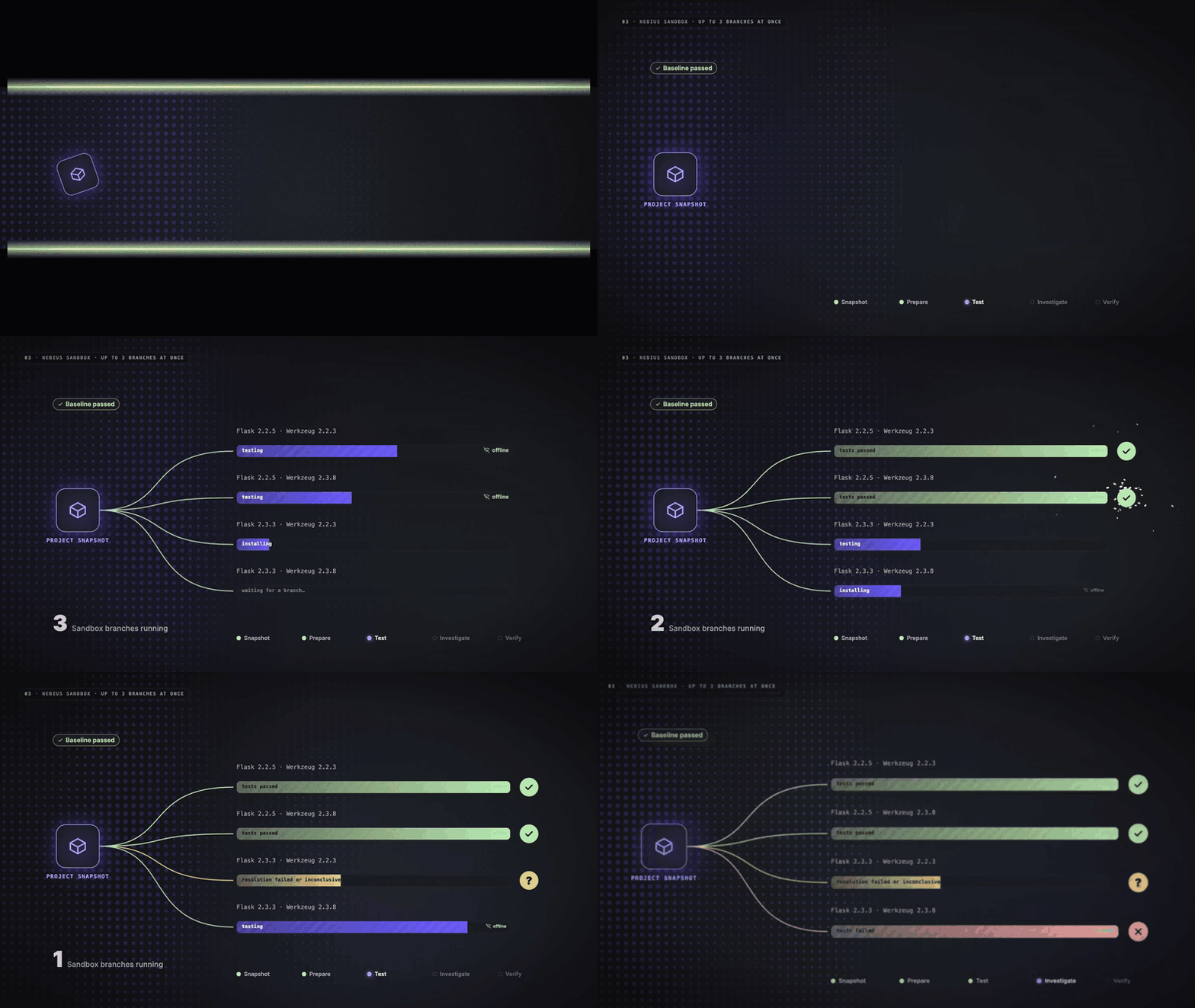 Inside the Sandbox. One snapshot, a baseline check, then branches, three at a time, tests offline. |
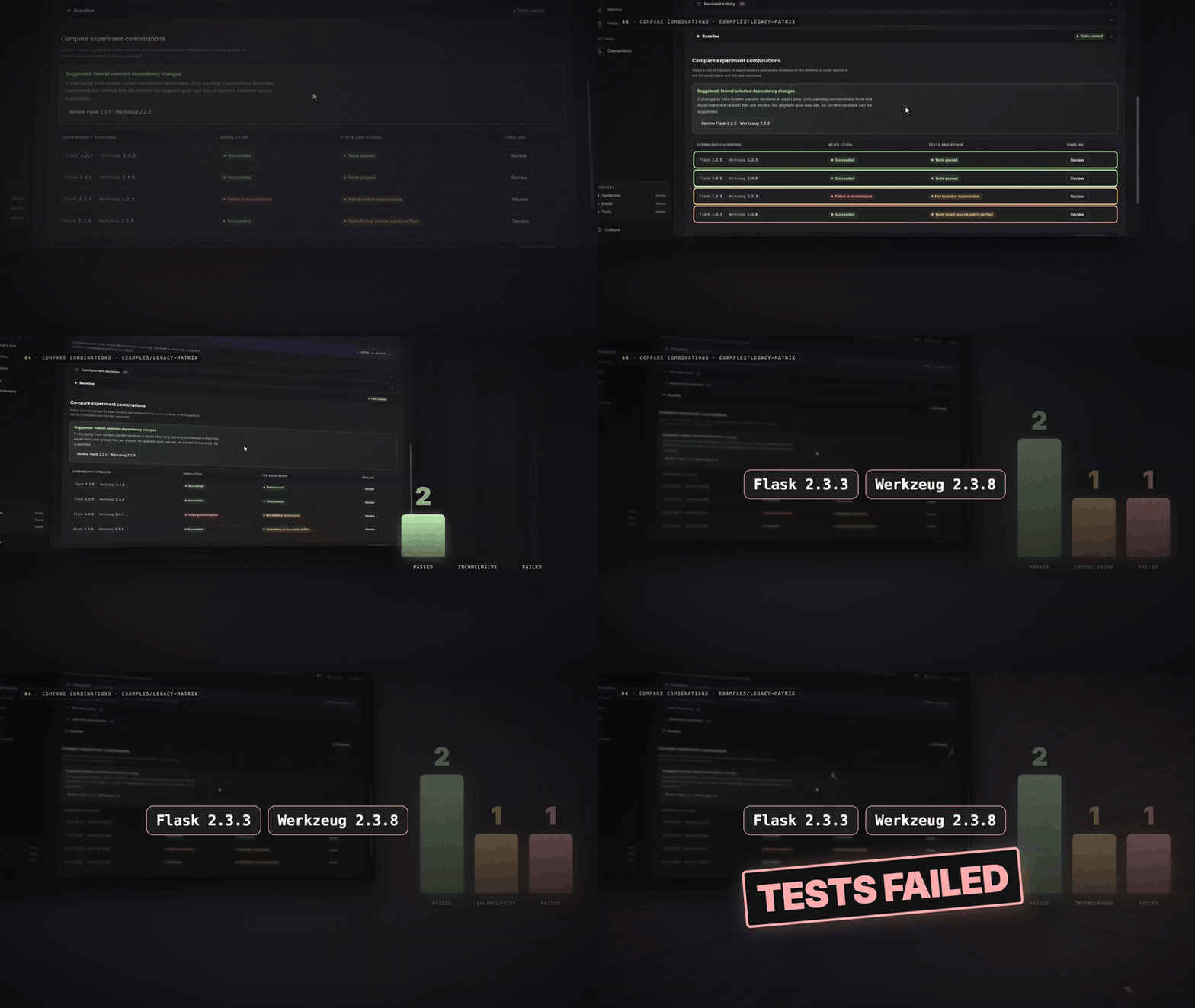 Compare. Two combinations pass, one stays inconclusive, Flask 2.3.3 with Werkzeug 2.3.8 fails. |
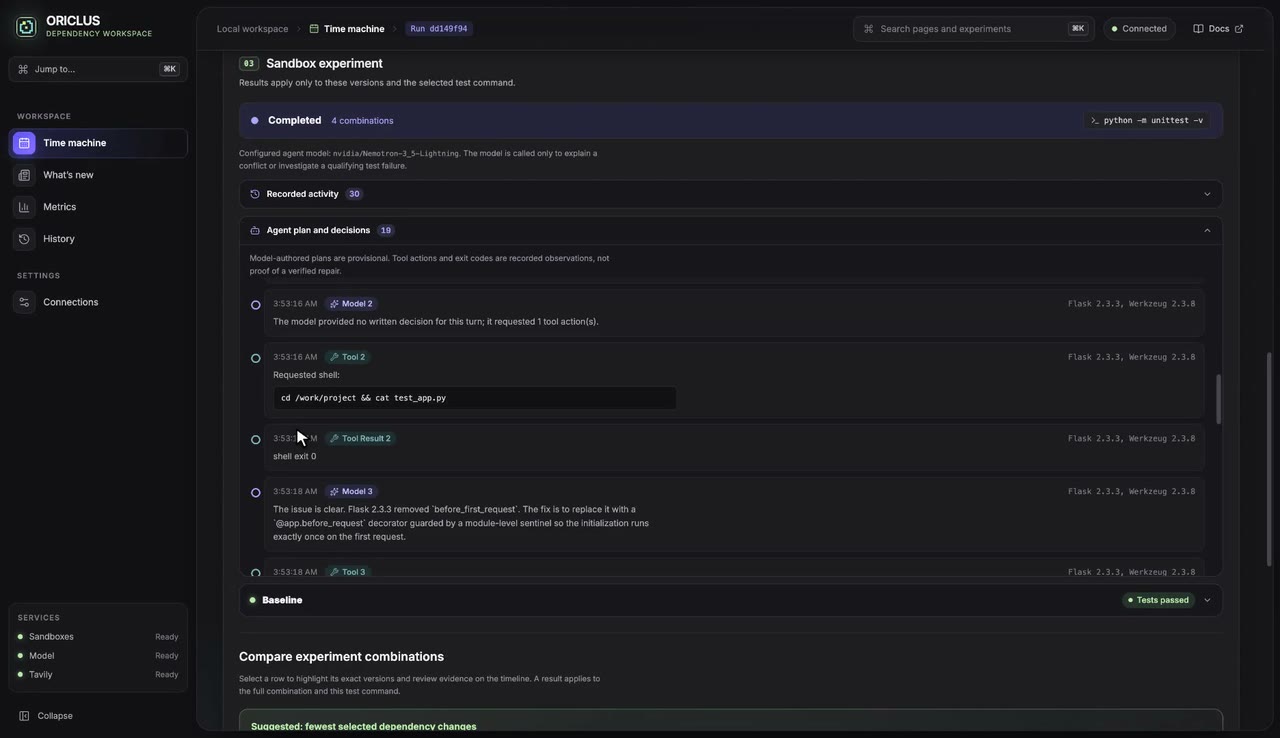
 Investigate. The real agent decisions: tool calls in the Sandbox, then “Flask 2.3.3 removed before_first_request.” |
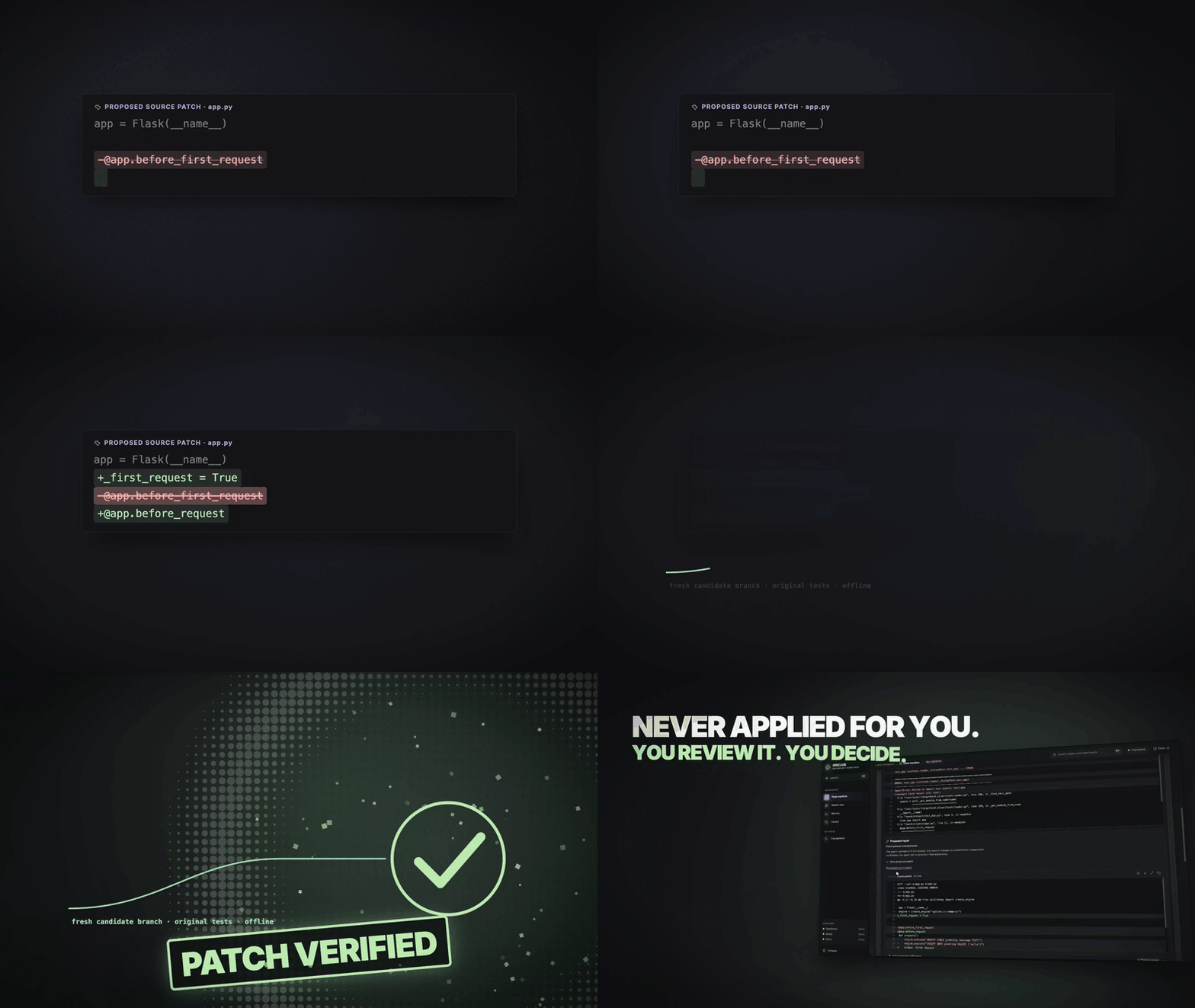 Verify. The patch is re-tested on a fresh branch: verified, and never applied for you. |
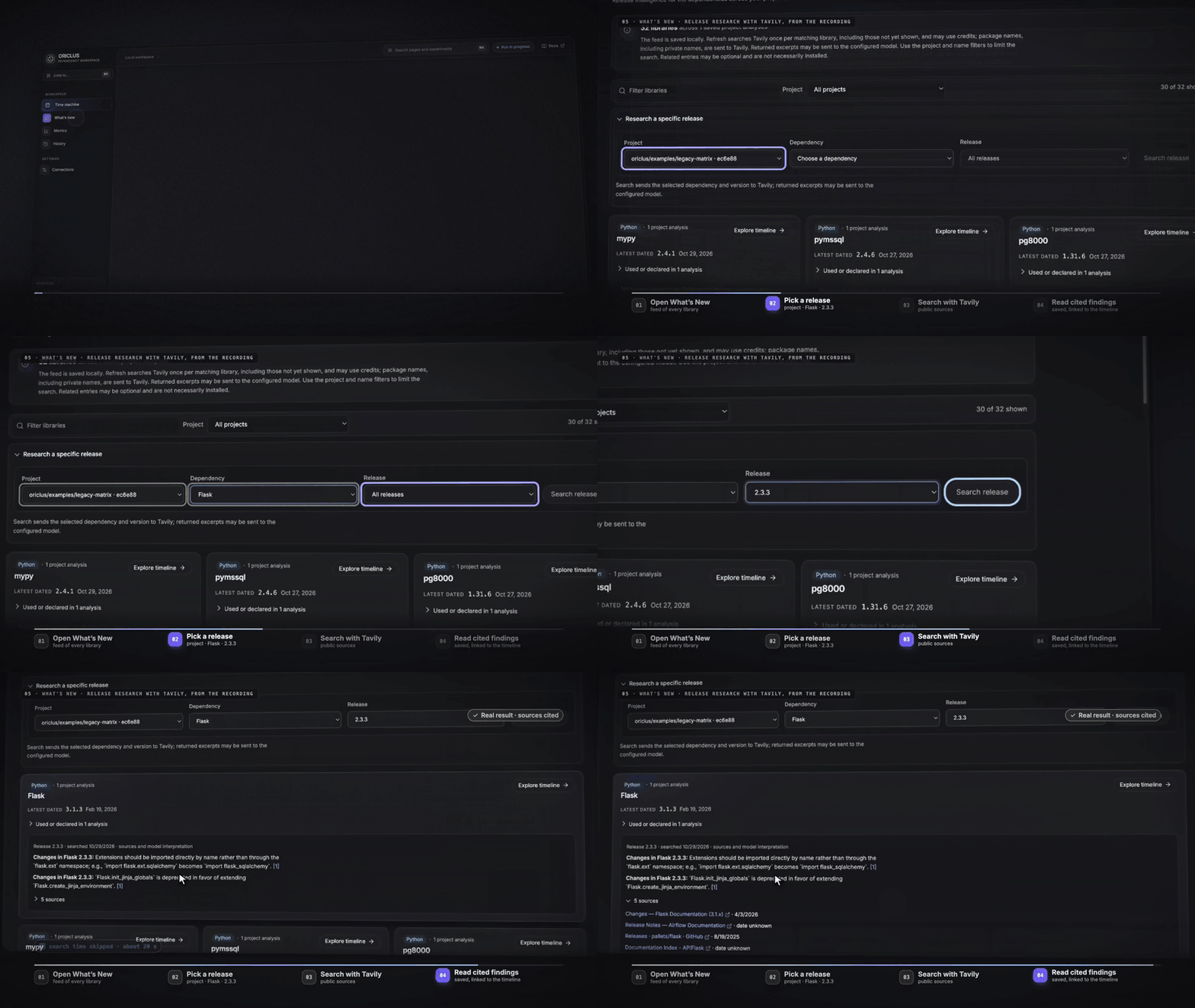 Research. Pick a release, search with Tavily, read cited findings, saved and linked to the timeline. |
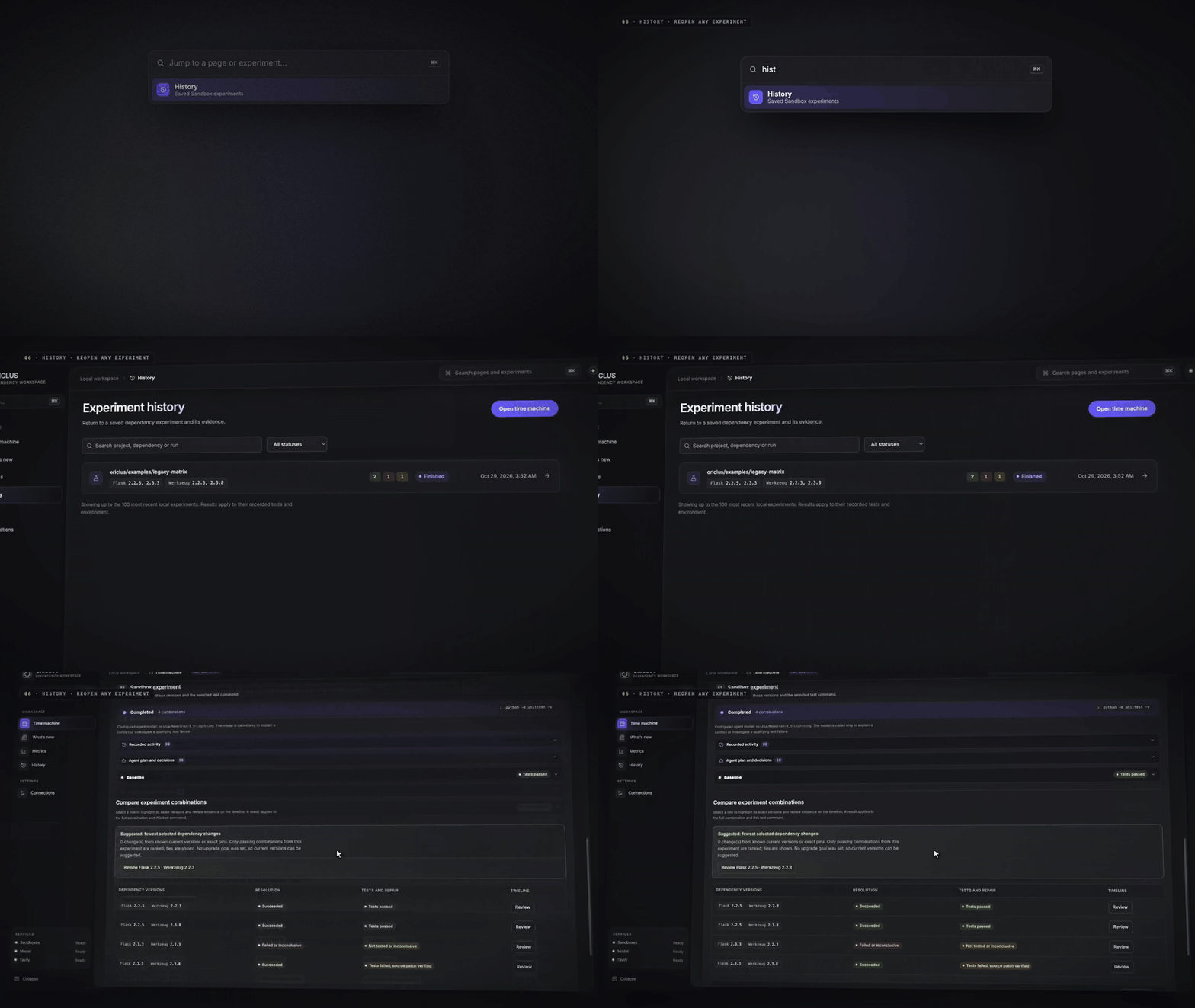
Revisit. ⌘K → History → reopen the experiment with every result intact.
Real screens
| Choose a project | Release timeline and resolution | Queue versions to test |
|---|---|---|
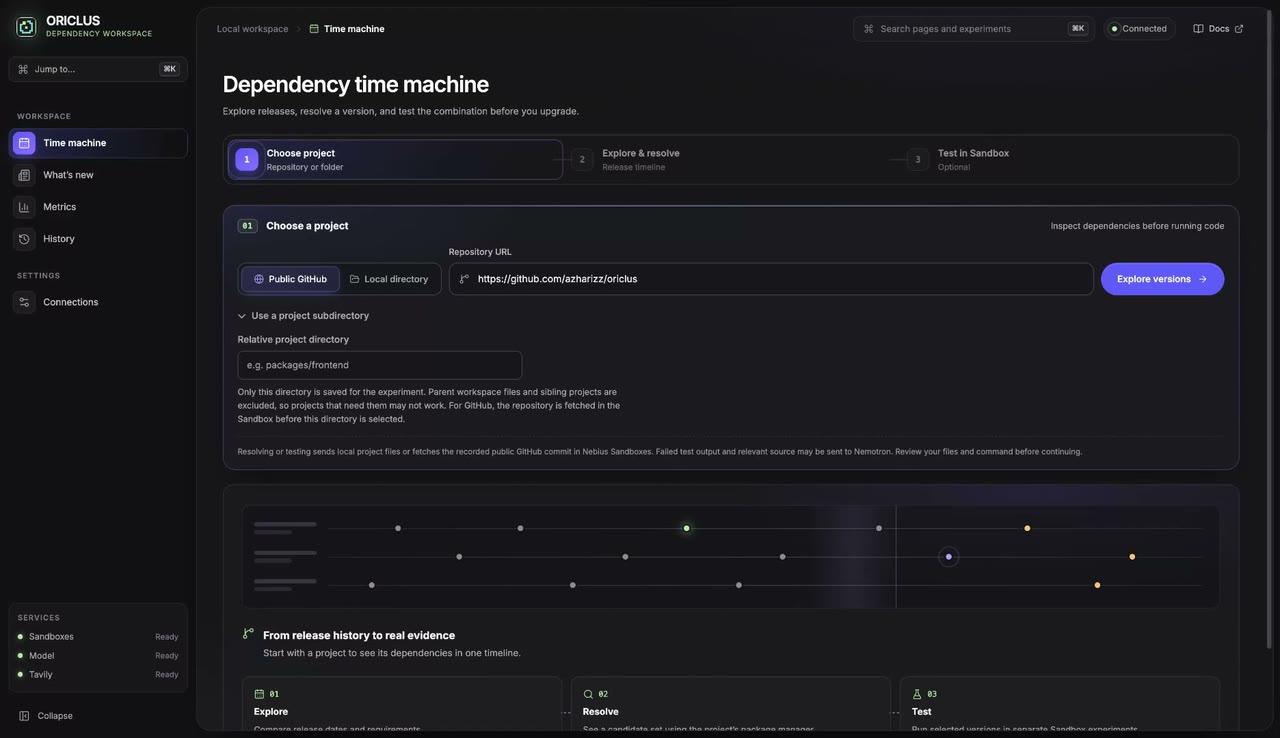 |
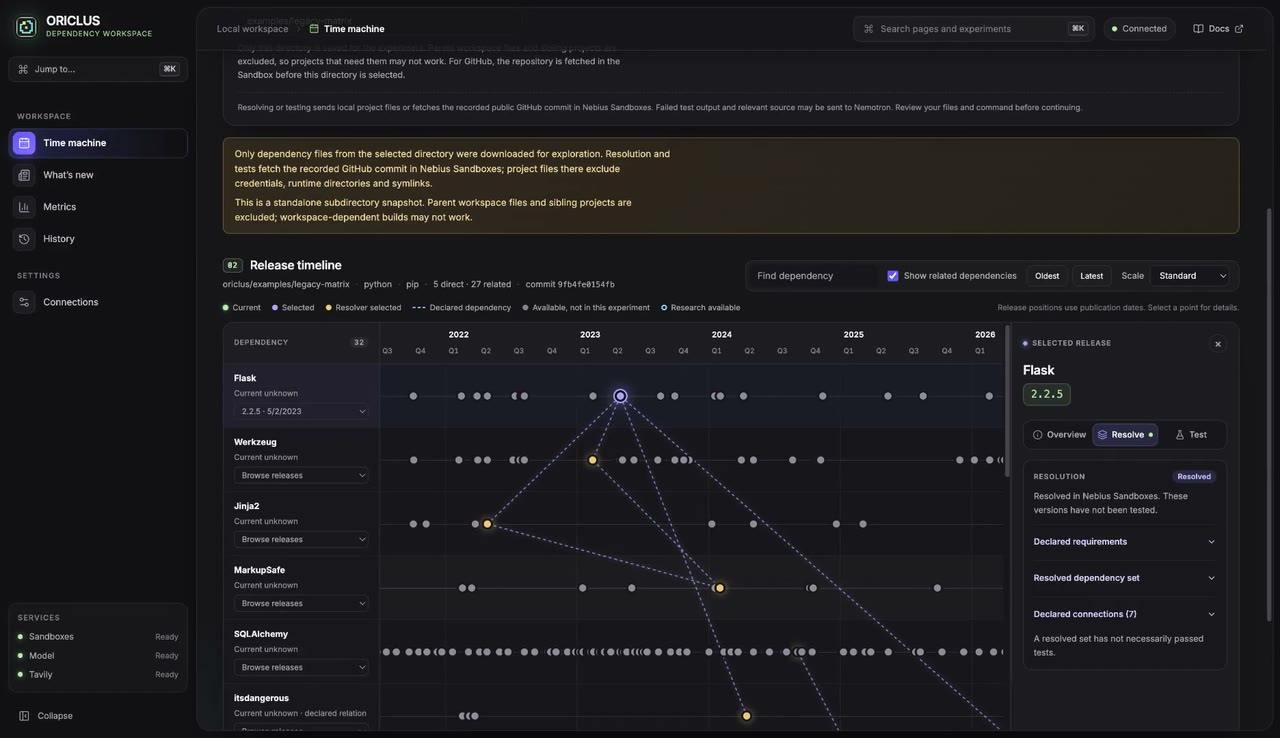 |
 |
| Sandbox experiment running | Compare combinations | Agent plan and decisions |
|---|---|---|
 |
 |
 |
| Verified source patch | What's New feed | Cited release research |
|---|---|---|
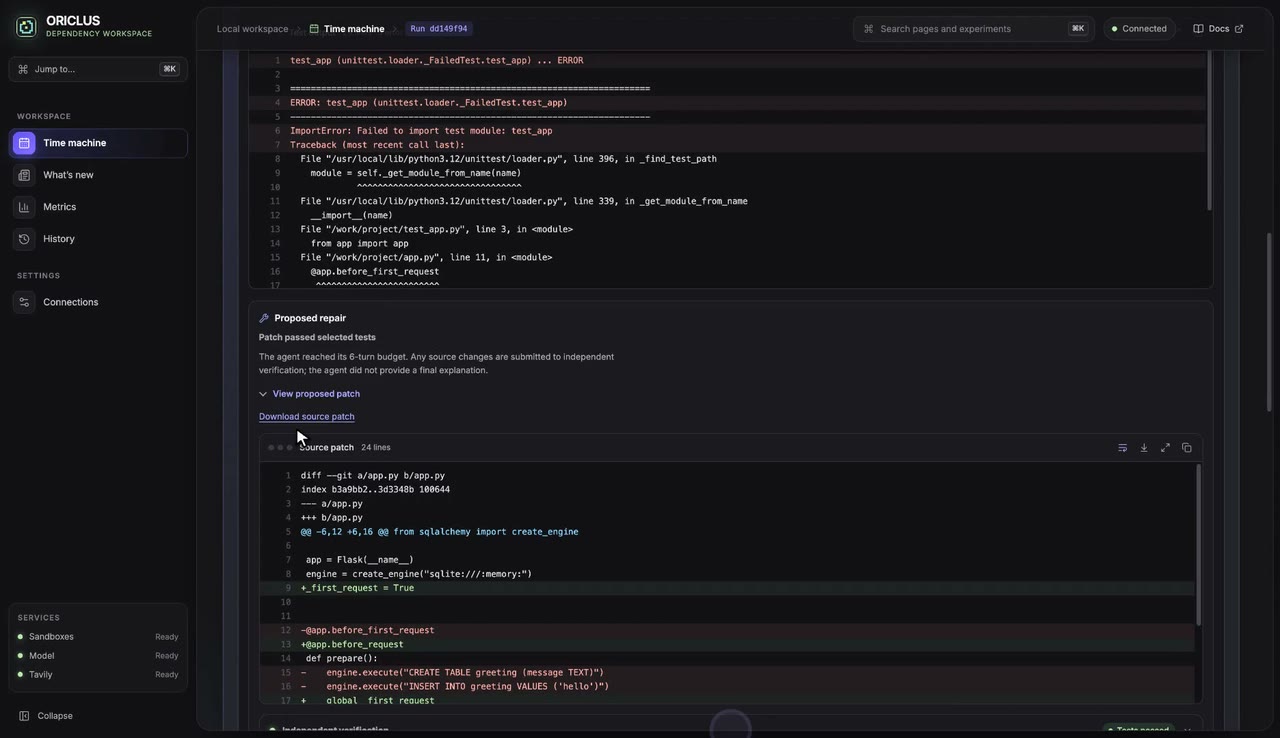 |
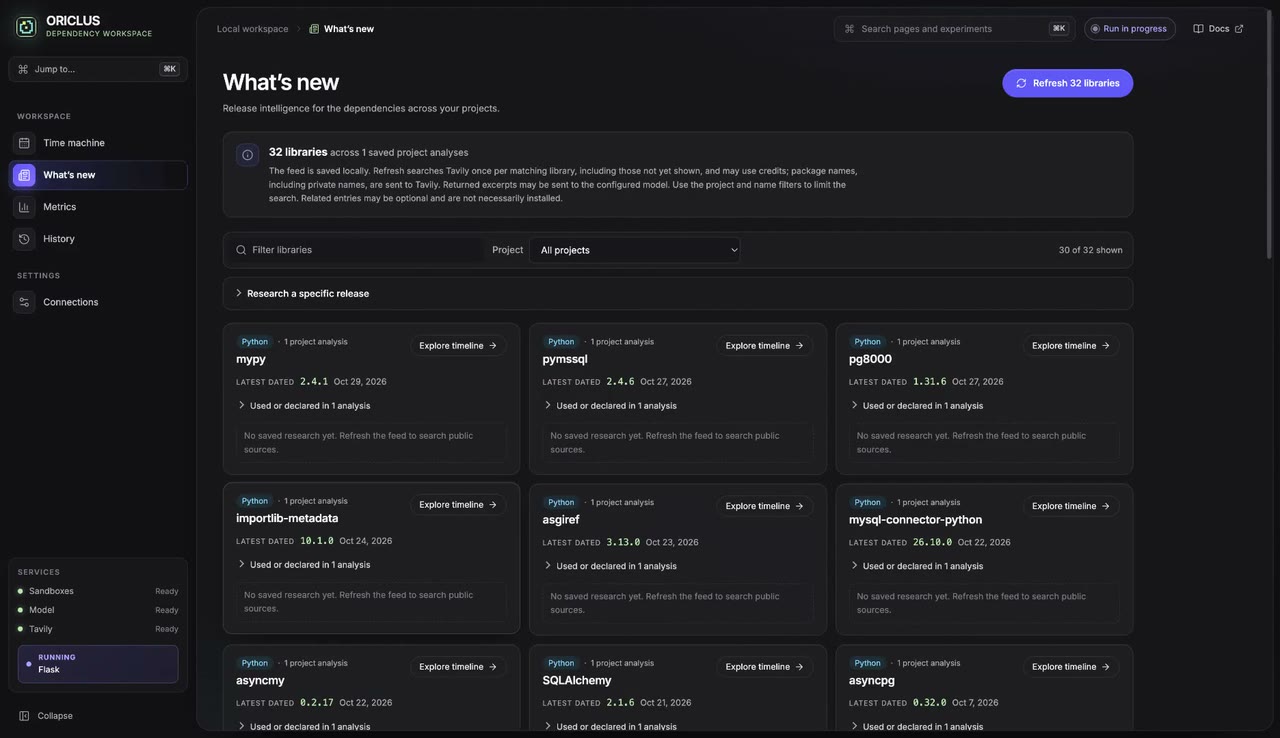 |
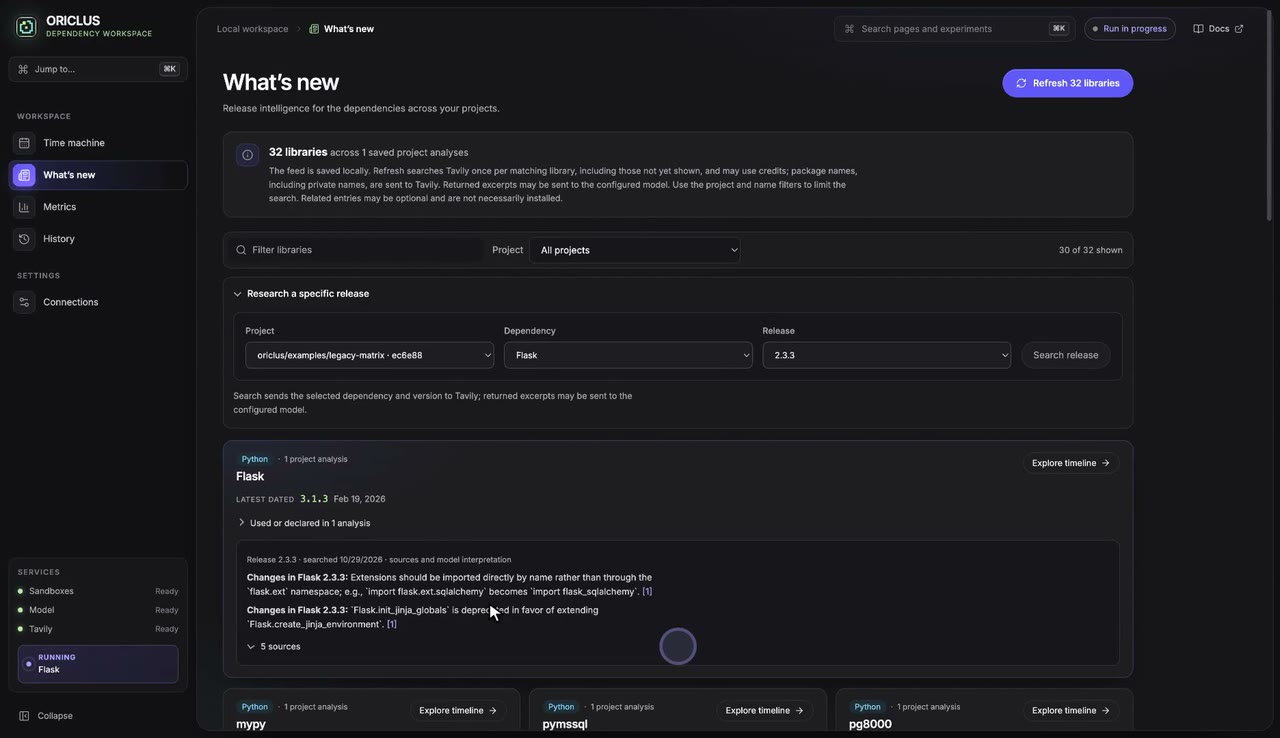 |
How the agent works
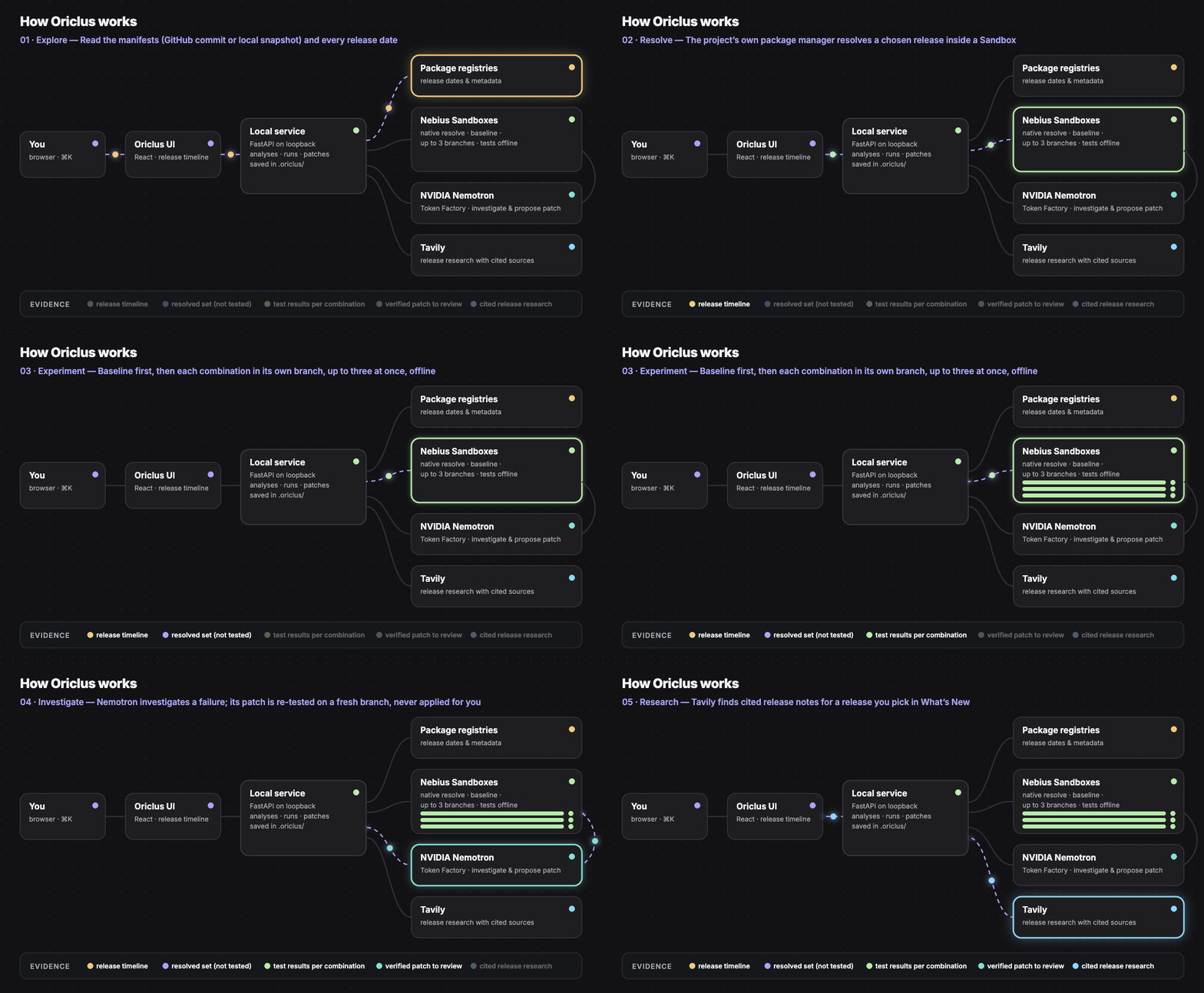
- Snapshot once. Oriclus prepares the project (a recorded GitHub commit or a local snapshot with credential, dependency and Git exclusions) in a Nebius Sandbox and checks the baseline with your test command.
- Branch per combination. Each selected combination installs with the native package manager in its own branch, up to three concurrently. Tests and verification request networking disabled.
- Investigate a qualifying failure. NVIDIA Nemotron gets the failing output and a bounded set of offline tools. It writes a provisional plan, reads files and runs commands; every model message, tool request and exit code is recorded.
- Propose, then prove. A proposed source patch (or, if enabled, a bounded dependency-file change produced by the native manager) is applied to a fresh branch and the original tests are re-run. Only then is it marked verified.
- Hand it back. The patch is shown with its verification evidence and can be downloaded. Oriclus never applies it to your project.
| The agent can | The agent cannot |
|---|---|
| Read code and run offline commands inside an isolated Sandbox branch. | Touch your checkout or your credentials; tests and its tools request networking disabled. |
| Propose a source patch or up to two dependency-version changes. | Mark its own patch as passing: only an independent re-run can. |
| Use saved Tavily research for the same dependency and release as evidence. | Change the tests, configuration or the primary version under test. |
How Nebius, Nemotron and Tavily are used at runtime
| Service | Runtime role in Oriclus |
|---|---|
| Nebius Token Factory Sandboxes | Isolated, branchable execution for every resolution, baseline, candidate and verification. Project snapshots, native installs with network, tests with networking disabled, concurrent branches, cancellation. |
NVIDIA Nemotron (via Nebius Token Factory, nvidia/Nemotron-3_5-Lightning) |
Explains resolver conflicts, investigates qualifying test failures with recorded tool use, and proposes source or dependency-file patches. Advisory until verified. |
| Tavily | User-initiated release research for What's New and a chosen release: public sources, optional model summaries with citations, linked on the timeline and available to the repair agent. |
| Public registries and GitHub | Release dates and metadata for the timeline; manifests at a recorded commit. |
A real result, end to end
On the constructed examples/legacy-matrix project, with python -m unittest -v:
| Combination | Resolution | Tests and repair |
|---|---|---|
| Flask 2.2.5 · Werkzeug 2.2.3 | ✅ Succeeded | ✅ Tests passed |
| Flask 2.2.5 · Werkzeug 2.3.8 | ✅ Succeeded | ✅ Tests passed |
| Flask 2.3.3 · Werkzeug 2.2.3 | ⚠️ Failed or inconclusive | ⚠️ Not tested or inconclusive |
| Flask 2.3.3 · Werkzeug 2.3.8 | ✅ Succeeded | ❌ Tests failed → 🔧 source patch verified on a fresh branch |
The baseline passed. Nemotron found that Flask 2.3.3 removed before_first_request and proposed replacing it with before_request guarded by a module-level sentinel; the independent re-run passed the selected tests. Oriclus then suggested the passing combinations with the fewest changes.
How we built it
flowchart LR
  U([You]) --> UI[Oriclus UI<br/>React · Vite]
  UI --> API[Local service<br/>FastAPI · .oriclus/]
  API --> REG[(Registries<br/>& GitHub)]
  API --> SBX[[Nebius Sandboxes<br/>snapshot · baseline · branches]]
  SBX -- failing output --> NEM{{NVIDIA Nemotron}}
  NEM -- proposed patch --> SBX
  API --> TAV[(Tavily<br/>release research)]
  SBX -- evidence --> UI
| Technology | Role in Oriclus |
|---|---|
| React 19.3 · Vite 8.3 · TypeScript 7.0 | The workspace: release timeline, inspector, experiments, comparison, What's New, History, Metrics. |
| TanStack Query · Lucide | Live run polling and progress; consistent outline icons. |
| Python 3.12 · FastAPI · uv | The local service: analyses, resolution, experiments, agent loop, research feed. |
Nebius Token Factory Sandboxes (contree-sdk) |
Branchable, isolated execution for every install and test. |
| NVIDIA Nemotron | Investigation and repair with recorded plans, tool calls and outcomes. |
| Tavily | Release research with citations. |
| AWS Lambda · SQS · S3 · DynamoDB | The optional hosted demo with a shared, persistent operation quota. |
Challenges we ran into
- Real isolation without real cost. Snapshotting once and branching per combination keeps experiments fast and identical, while three-at-a-time concurrency and a 12-combination cap keep Sandbox credits predictable.
- An agent that can't grade itself. Nemotron's patches are only marked verified after an independent re-run of the original tests on a fresh branch; failed, rejected and unavailable repairs stay visible.
- Many package managers, one timeline. pip, uv, Poetry, npm, Yarn, pnpm and Bun each resolve differently; Oriclus always defers to the native manager and labels unknowns instead of guessing.
Accomplishments we're proud of
- A full loop from "which version?" to a verified, reviewable patch, all inside isolated Nebius Sandboxes.
- Real Sandbox evaluations across pip, uv, Poetry, npm, Yarn and pnpm, plus passing Bun, Go and Cargo examples; a real JavaScript repository matrix with an independently verified repair.
- Agent transparency: every recorded plan, model message, tool request and exit code is visible and saved with the run.
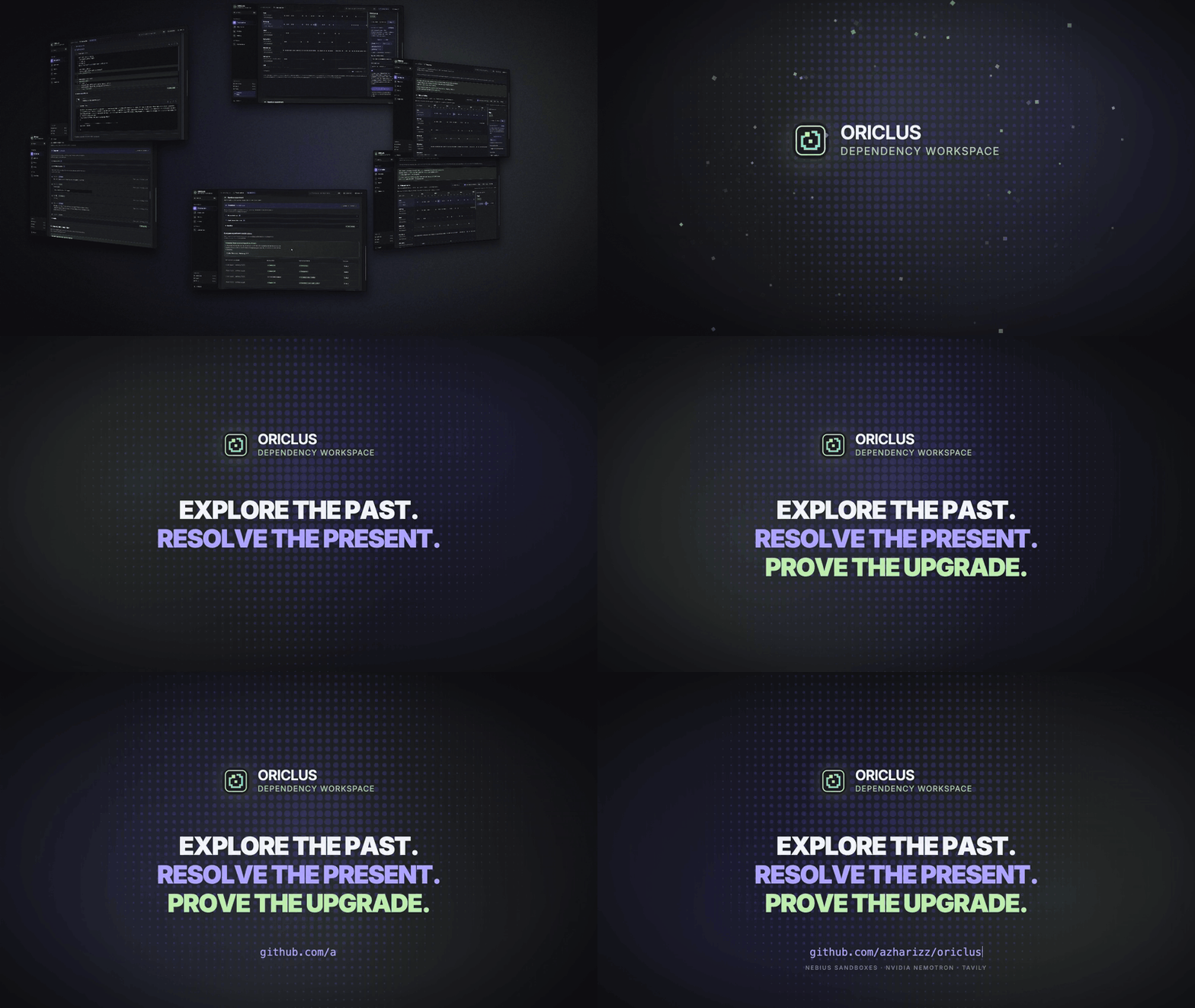
- A 2:58 showreel built from the real recordings, with an original orchestral score and a generated narrator.
What we learned
Most of the value is in the boundaries. A resolver answer, a test result, a model suggestion and a verified patch are four different kinds of evidence, and the product is only trustworthy if it never blurs them. Giving the agent real tools in a real Sandbox made it useful; refusing to let it grade its own work made it believable.
What's next
- One-click "bump these together" for many dependencies in a single combination, keeping the 12-combination cost guard.
- Private repository access, full monorepo workspaces and custom registries.
- A repeatable multi-dependency comparison against CI and uv, and real maintainer feedback.
- Scheduled What's New refresh with alerts for releases that touch your pinned versions.
Honest limits
- A pass is evidence for that command and environment only, not general compatibility. Oriclus does not infer outcomes for untested releases or identify the first breaking release automatically.
- Go and Cargo are experimental; dependency-file repair does not support Bun, Go or Cargo, and Rust source repair is disabled.
Try it
- Source: github.com/azharizz/oriclus
- Hosted app: https://3t3h4y5hhclp2y2u3fwu5tfkky0mwnqm.lambda-url.us-east-1.on.aws/ (public GitHub projects only; a shared lifetime quota of 250 operations, up to four combinations per experiment)
- Run it locally:
uv sync --frozen && npm ci && npm run build && cp .env.example .env, add your Nebius (and optional Tavily) keys, thenuv run uvicorn server.app:app --host 127.0.0.1 --port 8787and open http://127.0.0.1:8787 - Product decisions: PRODUCT.md · Design: DESIGN.md · Evaluation cases: docs/evaluation-cases.md
Built With
- agentic-ai
- ai-agents
- automated-repair
- aws-lambda
- dependency-management
- dependency-upgrades
- developer-tools
- fastapi
- llm
- nebius
- nebius-sandboxes
- nebius-token-factory
- nemotron
- npm
- nvidia
- package-manager
- pip
- python
- react
- software-testing
- tavily
- tool-calling
- typescript
- vite

Log in or sign up for Devpost to join the conversation.