-
-
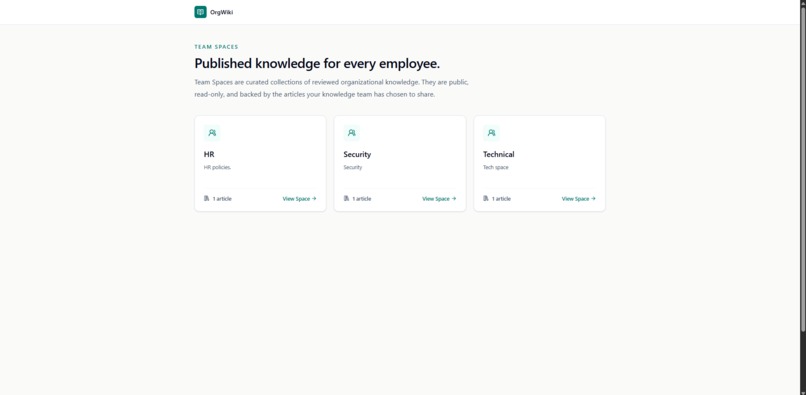
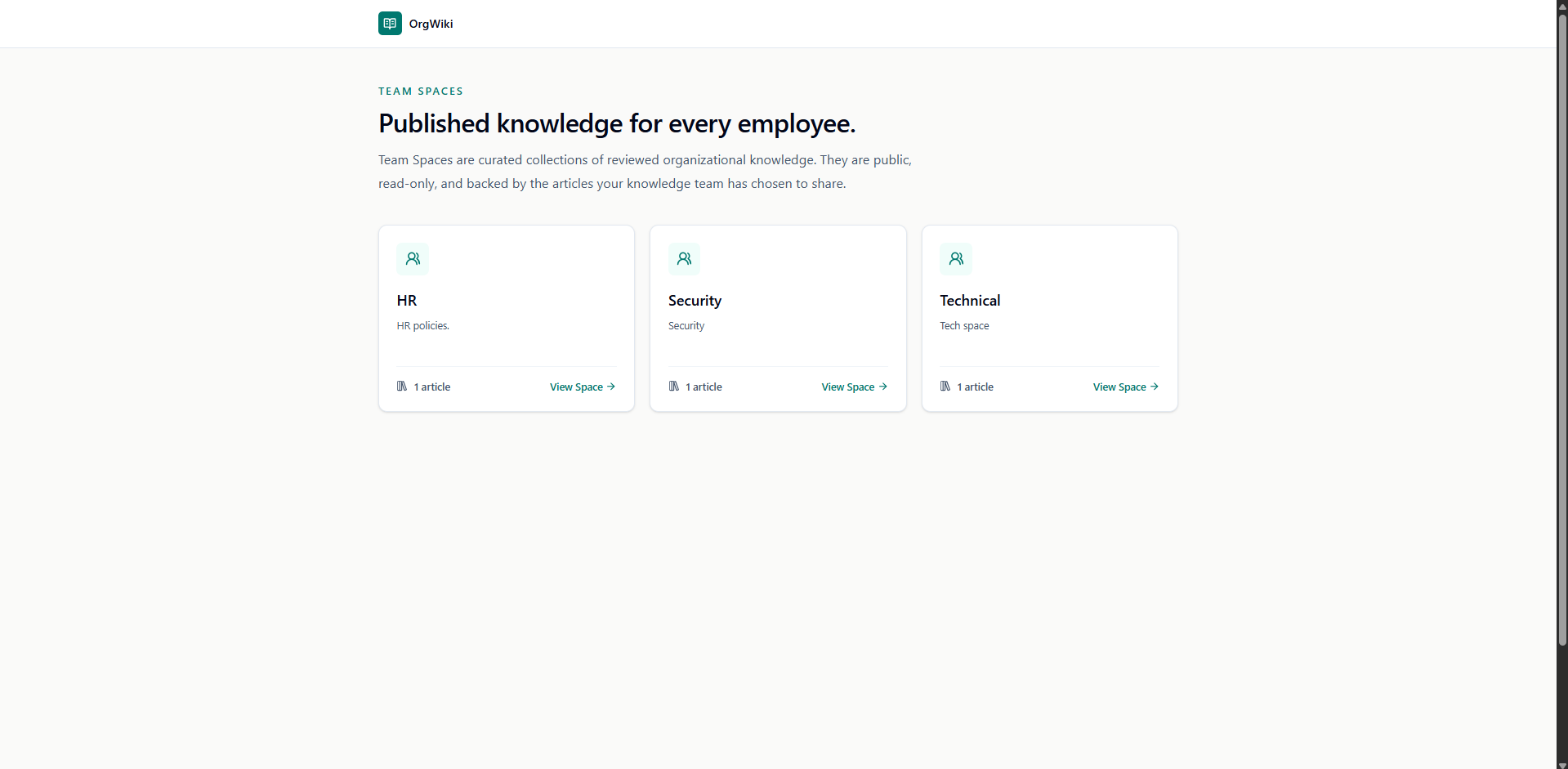
Team_Spaces
-
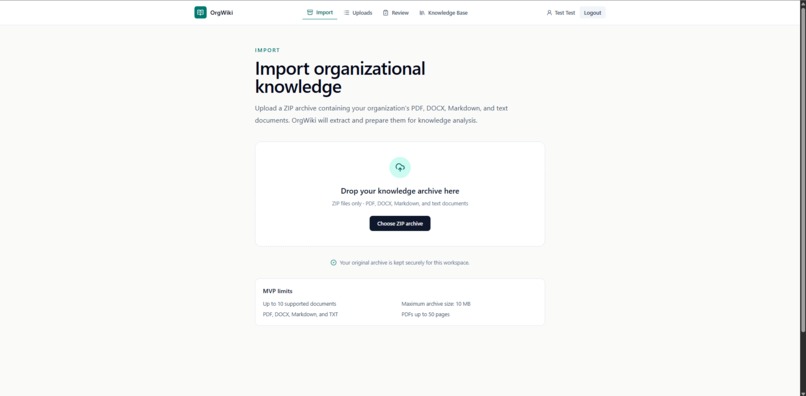
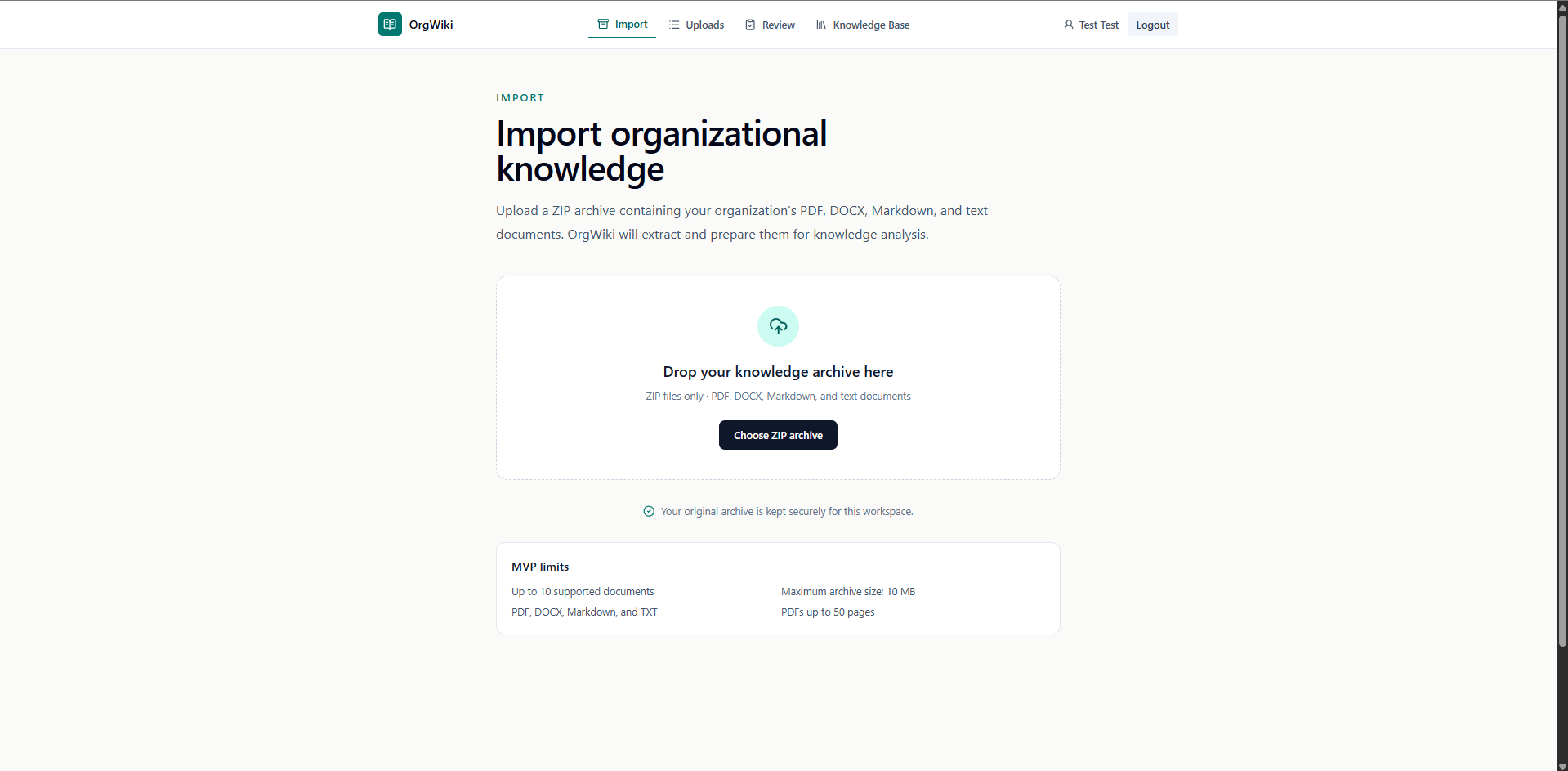
Import_Page
-
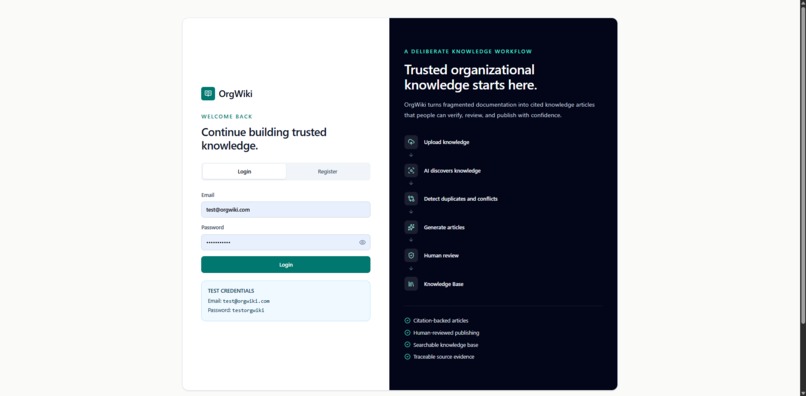
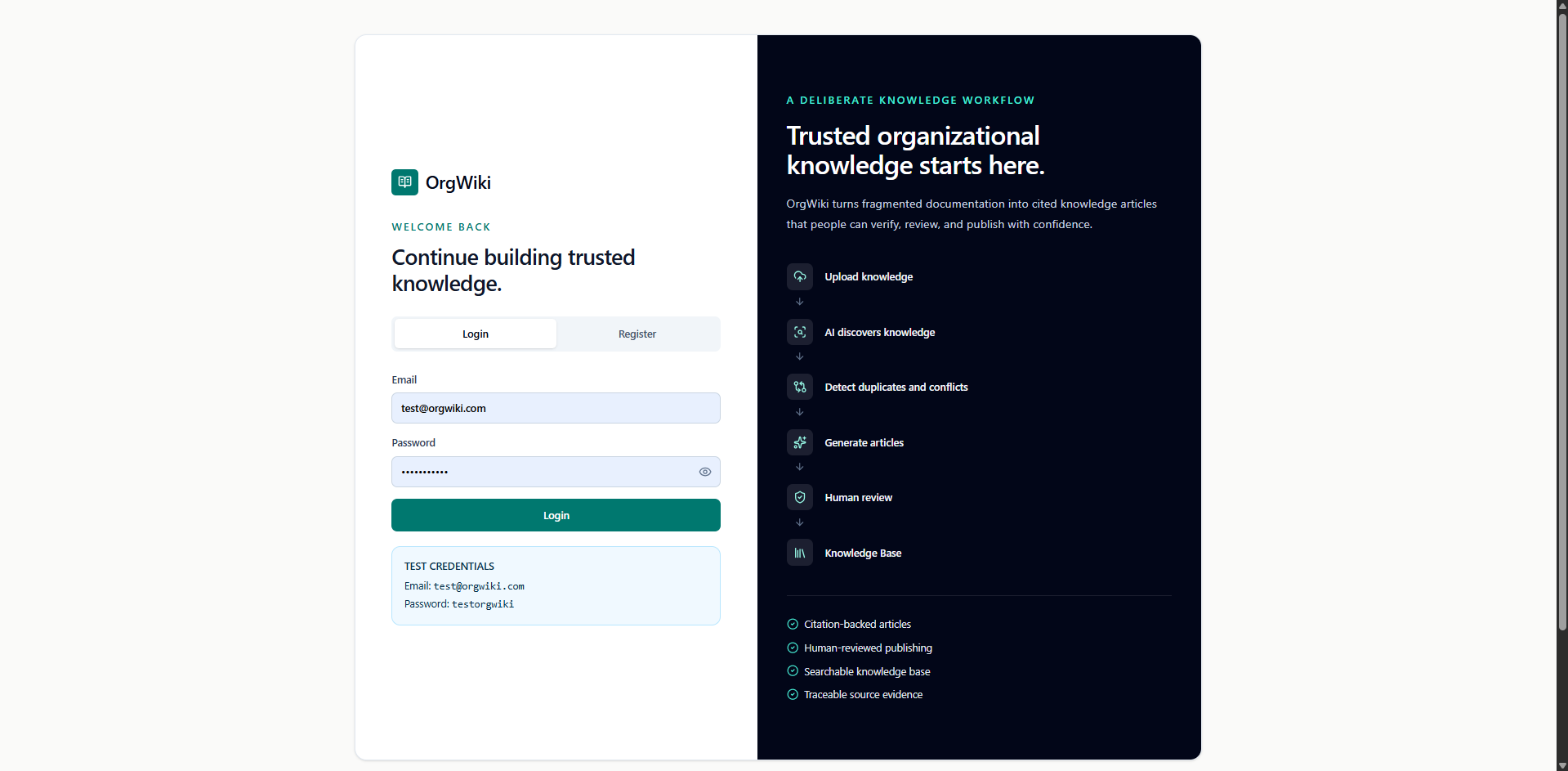
Auth_Page
-
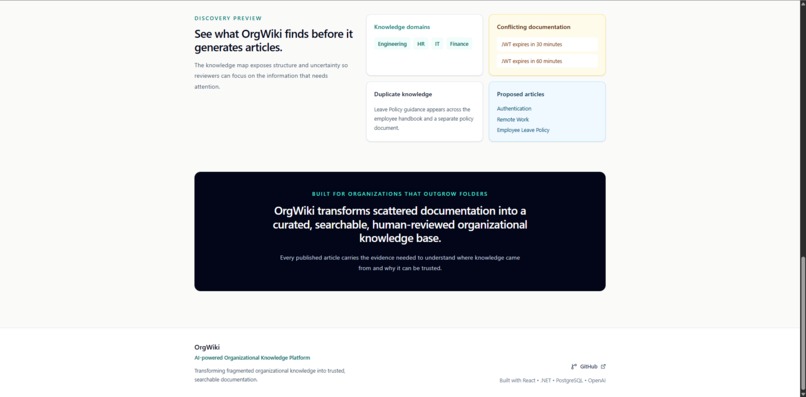
Landing_Page_3
-
Review_Page
-
Landing_Page_2
-
Landing_Page_1
-
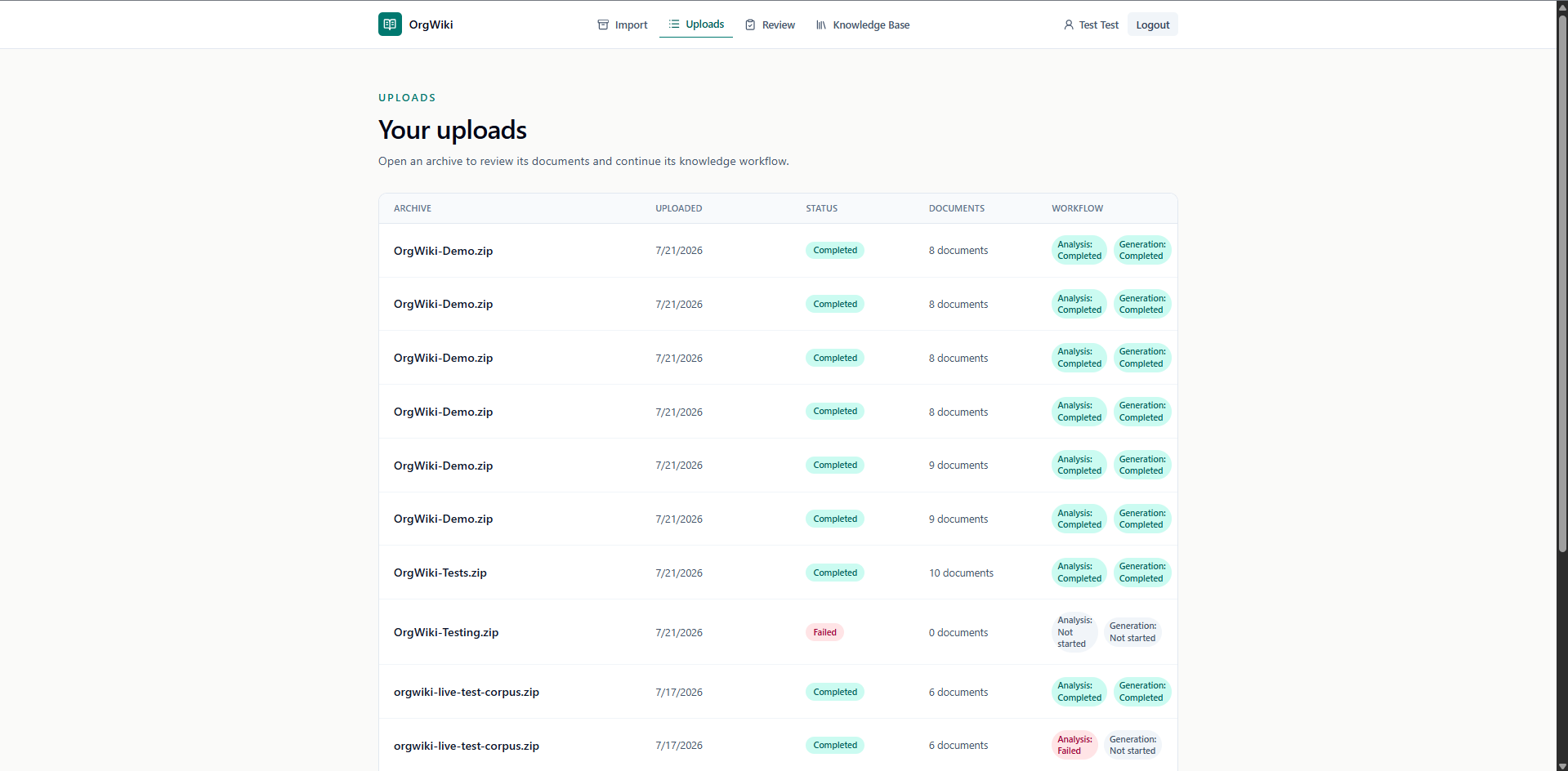
Uploads_Page
-
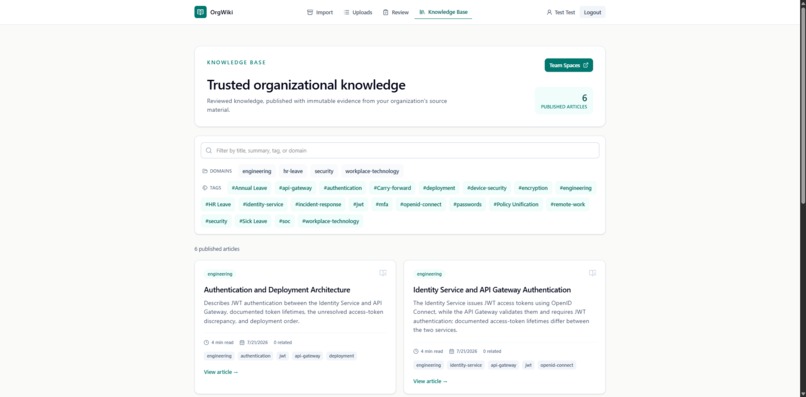
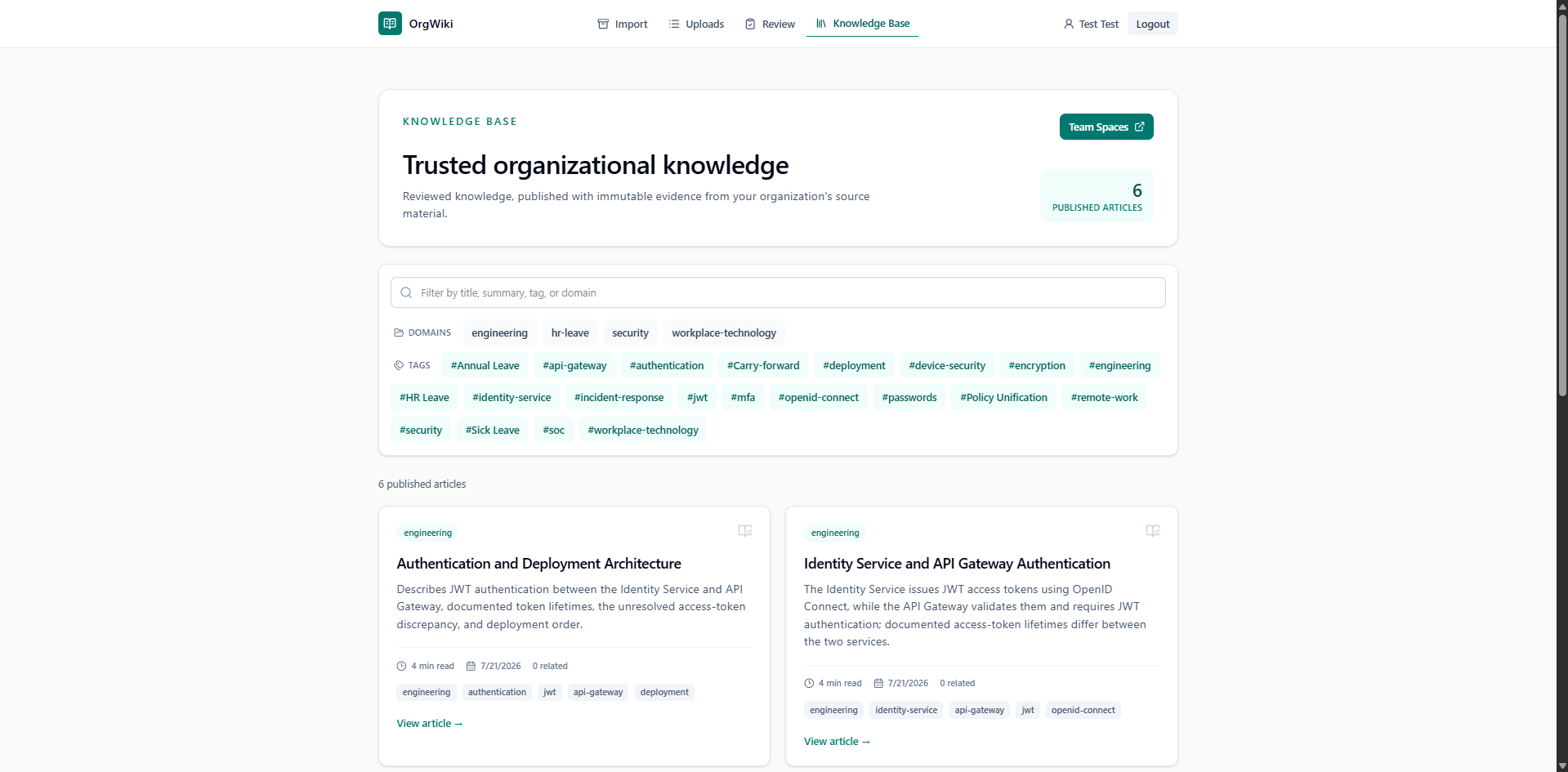
Knowledge_Page
About OrgWiki
Inspiration
Every organization accumulates years of documentation across PDFs, Word documents, Markdown files, shared drives, and internal repositories. Over time, this knowledge becomes duplicated, contradictory, outdated, and difficult to trust. Employees often spend significant time searching for information, only to find multiple versions of the same document with no clear indication of which one is correct.
Most AI-powered documentation tools focus on retrieving existing information. I wanted to explore a different approach: what if AI could transform fragmented organizational documentation into a structured, trusted knowledge base before anyone even searched for it?
That idea became OrgWiki.
What it does
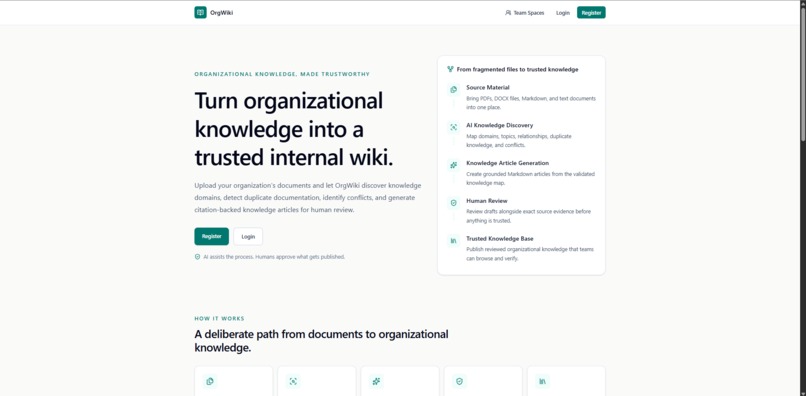
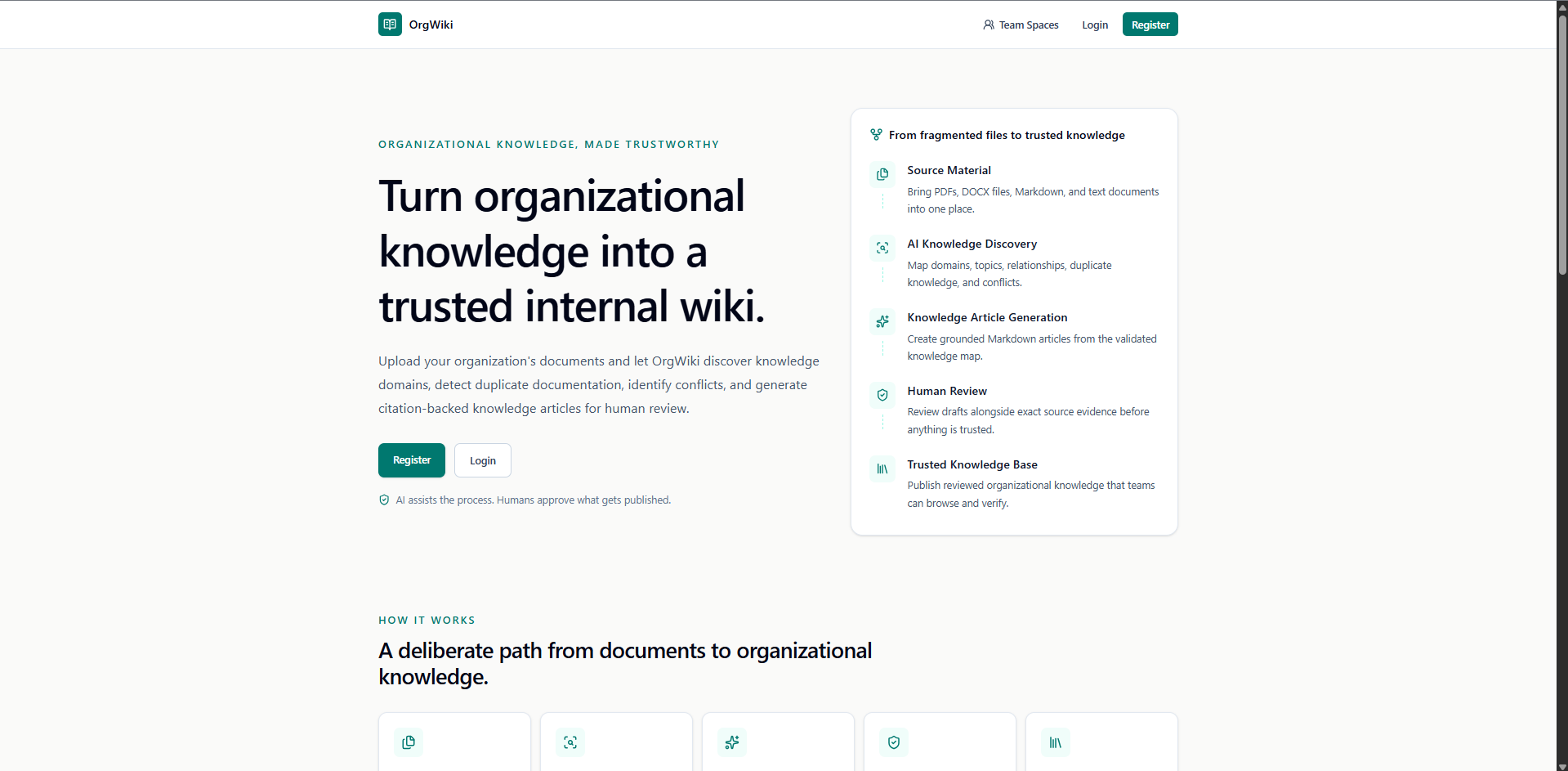
OrgWiki is an AI-powered organizational knowledge platform that converts collections of unstructured documents into curated organizational knowledge.
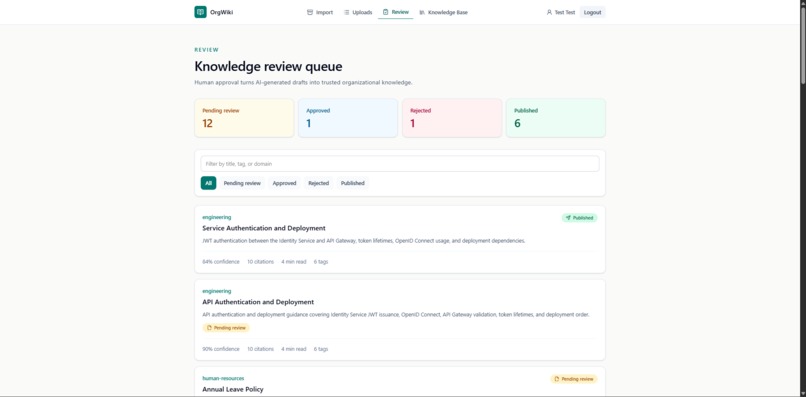
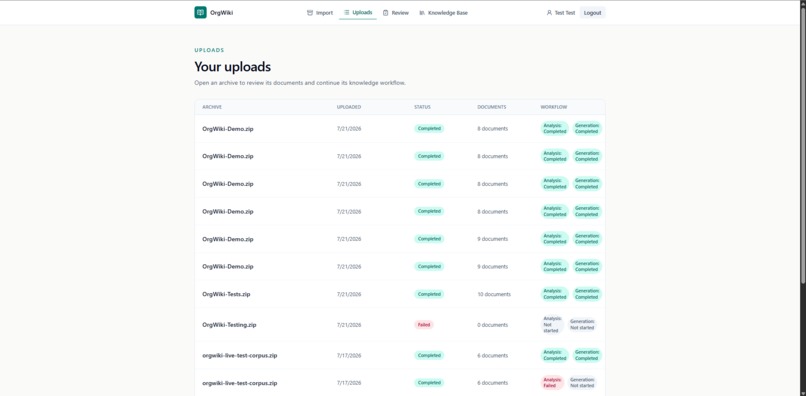
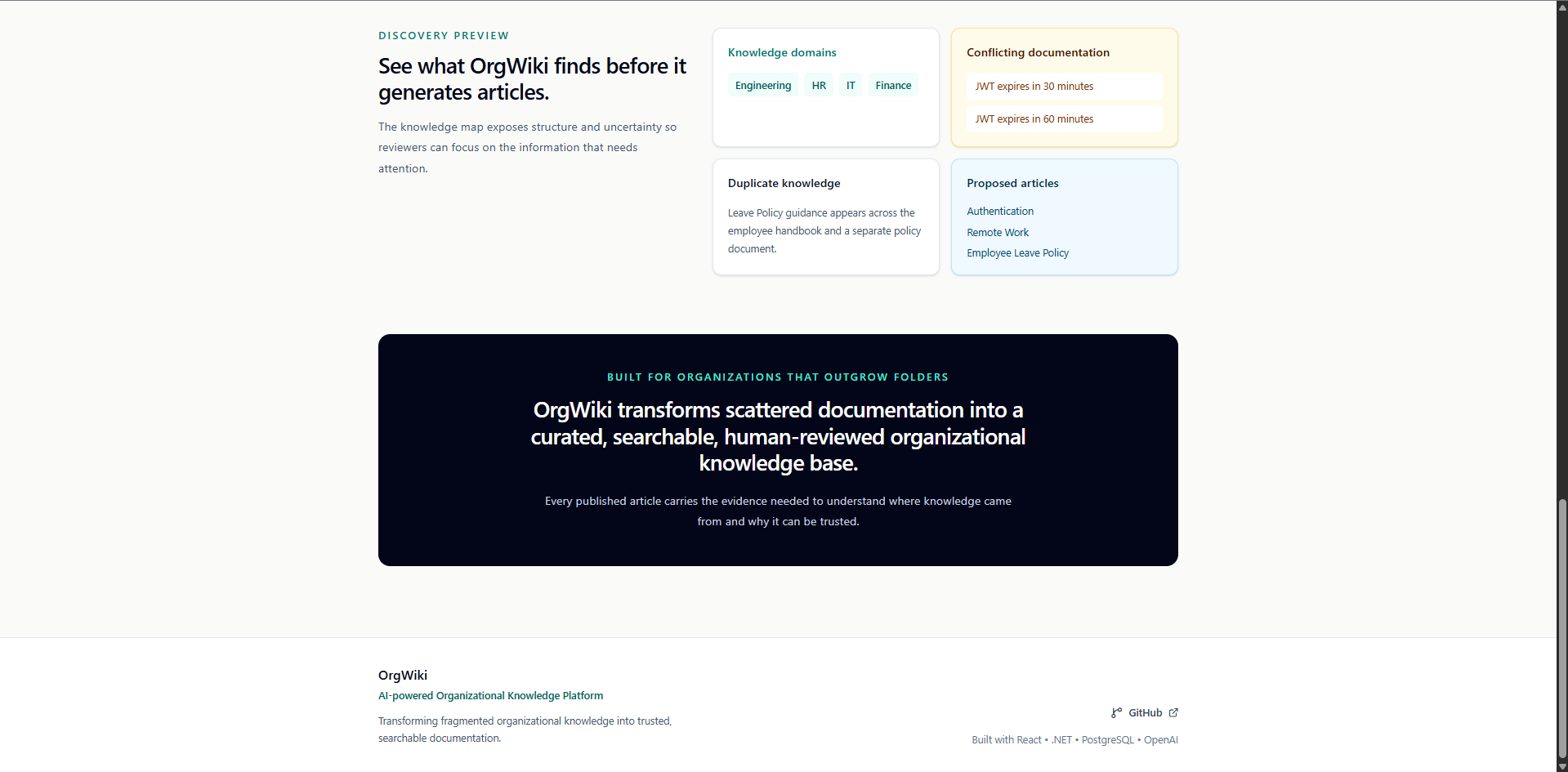
A user uploads a ZIP containing company documentation. GPT-5.6 analyzes the entire document collection, discovers knowledge domains, identifies duplicate and conflicting information, and proposes a structured set of knowledge articles. It then generates evidence-backed articles with citations that can be reviewed by a human before publication.
Published articles can be organized into Team Spaces, such as Technical, HR, Security, or Leave Policy, making trusted organizational knowledge accessible to employees through simple public links. Every published article can also be downloaded as Markdown for portability and version control.
The complete workflow is:
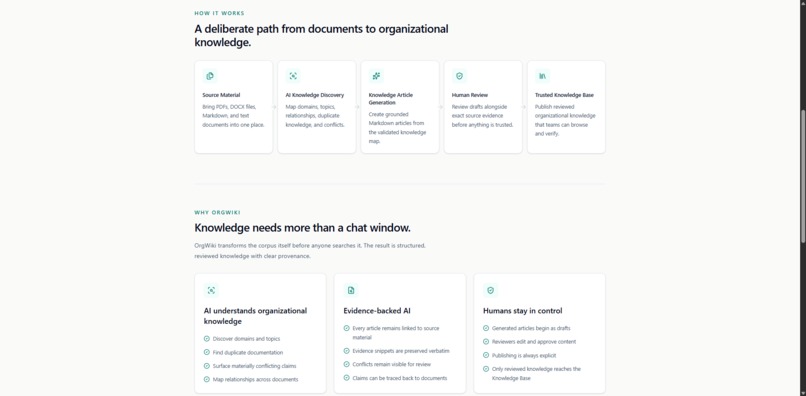
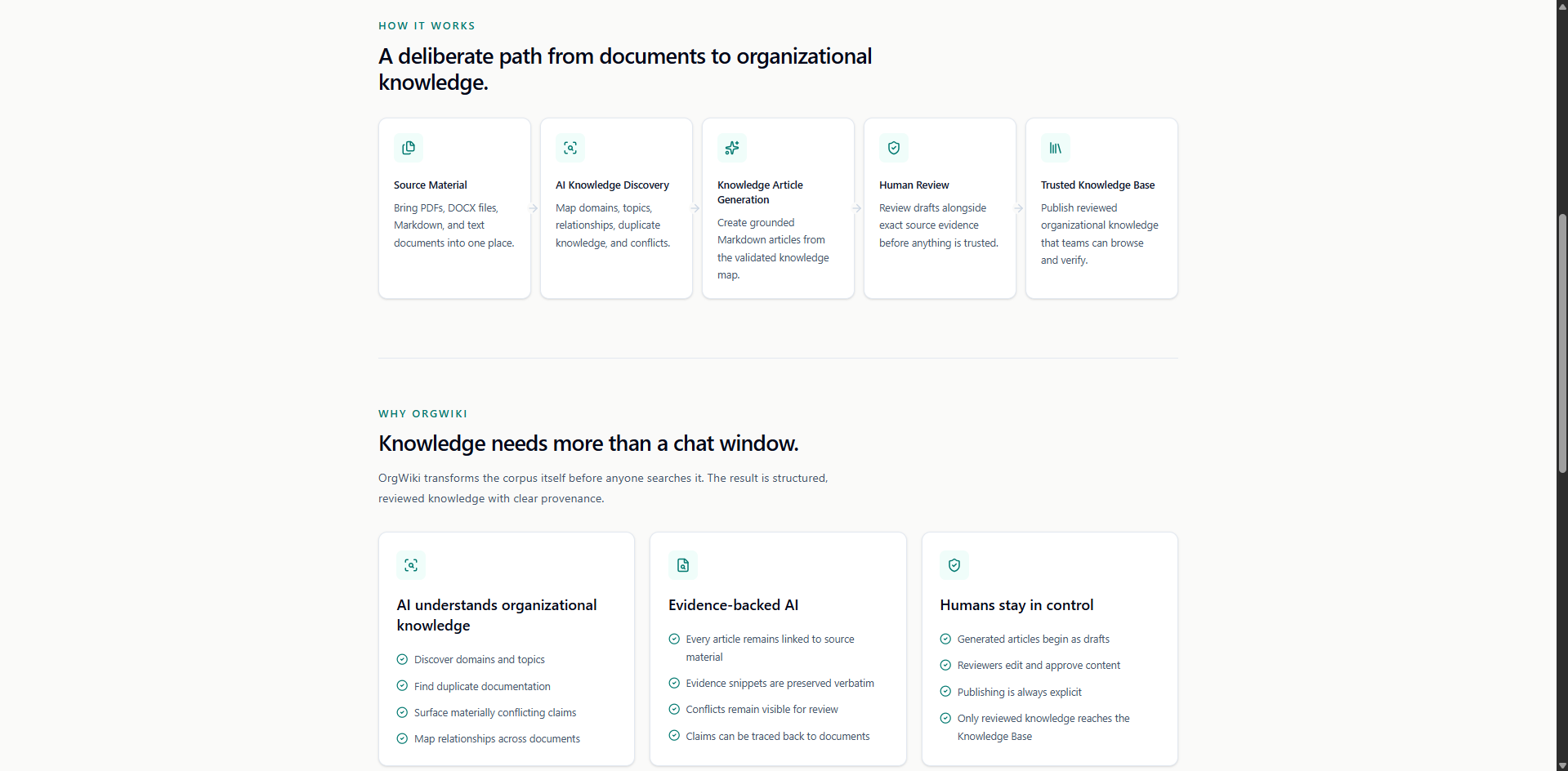
Upload → AI Discovery → AI Generation → Human Review → Publish → Team Spaces
How I built it
OrgWiki was built using a React frontend, an ASP.NET Core (.NET 9) backend, and PostgreSQL for persistence.
The application follows a layered architecture with dedicated services for document ingestion, AI orchestration, review workflows, publishing, and public knowledge distribution.
The AI pipeline intentionally separates two responsibilities:
Knowledge Discovery – GPT-5.6 analyzes the uploaded document collection as a whole to identify topics, relationships, duplicate content, conflicts, and candidate knowledge articles.
Knowledge Generation – GPT-5.6 generates structured Markdown articles with summaries, metadata, related articles, confidence scores, and evidence-backed citations.
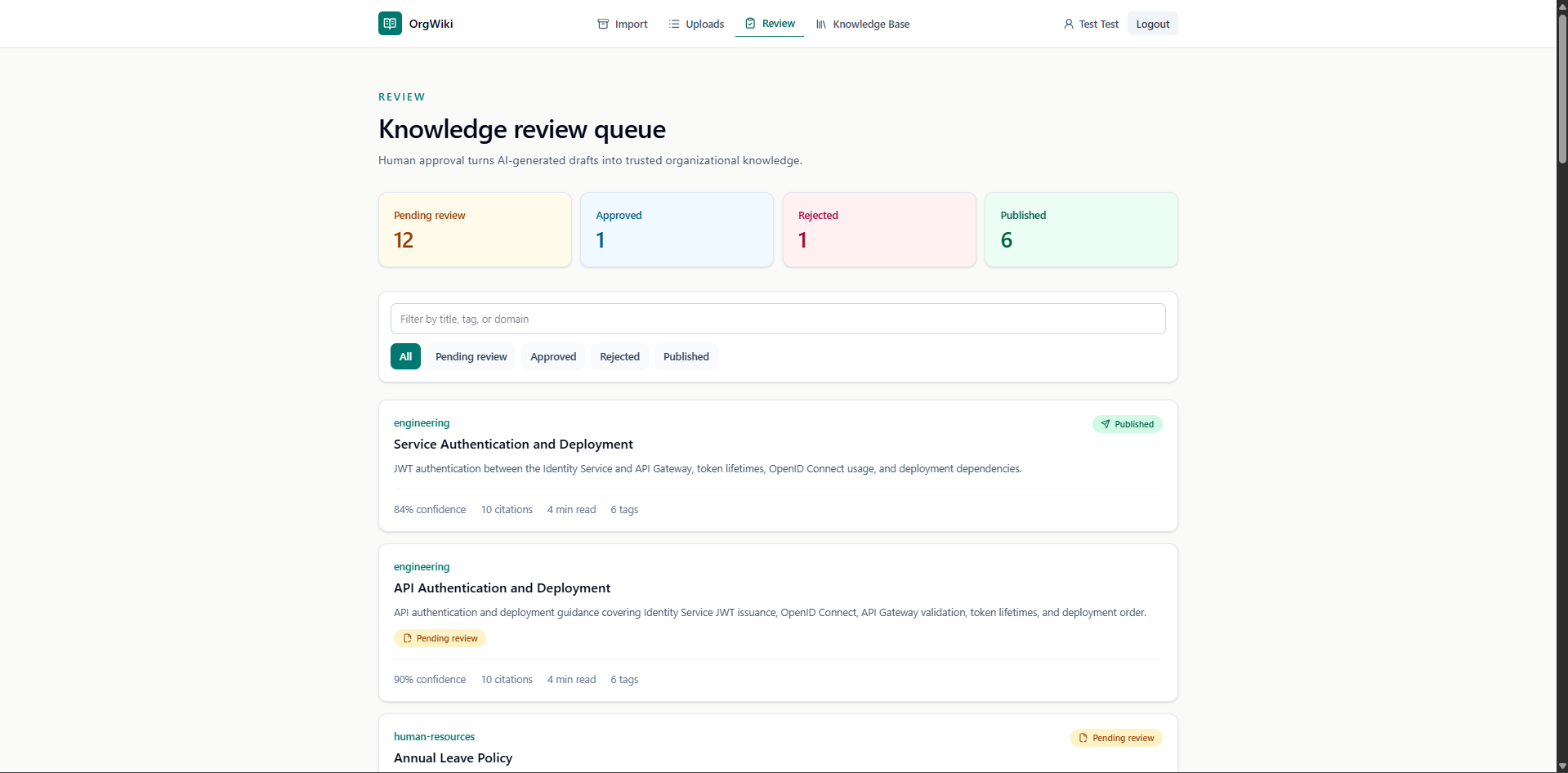
Every generated article enters a human review workflow before publication, ensuring AI assists knowledge creation without becoming the final decision maker.
How GPT-5.6 was used
GPT-5.6 powers the core intelligence of OrgWiki.
Rather than acting as a chatbot, it performs structured knowledge transformation by:
- Discovering organizational knowledge across an entire document collection
- Identifying duplicate and conflicting documentation
- Generating structured knowledge articles
- Producing evidence-backed citations
- Suggesting relationships between articles
Using GPT-5.6 as the reasoning engine allowed the application to move beyond document search into AI-assisted knowledge management.
How Codex was used
Codex significantly accelerated development throughout the project.
It was used to implement and refine backend APIs, database models, authentication, frontend workflows, AI pipeline integration, review workflows, public Team Spaces, and Markdown export while preserving the overall architecture.
This allowed me to spend more time designing the product, refining the AI workflow, and improving the end-to-end user experience instead of writing repetitive implementation code.
Challenges
One of the biggest challenges was balancing AI capability with trust.
Generating articles is relatively straightforward; generating articles that people can confidently rely on is much harder. That led to several design decisions:
- Separating knowledge discovery from knowledge generation
- Requiring human review before publication
- Including evidence-backed citations for every generated article
- Keeping published knowledge as the only public source of truth
Another challenge was designing prompts that consistently produced structured JSON outputs suitable for automated processing while remaining efficient enough to keep API usage practical.
What I learned
Building OrgWiki reinforced that successful AI applications require much more than connecting an LLM to a user interface.
Designing reliable AI systems involves prompt engineering, validation, structured outputs, workflow orchestration, human oversight, and thoughtful product design.
The project also deepened my understanding of building scalable backend architectures with ASP.NET Core, designing AI-assisted workflows, and creating products where AI augments human decision-making instead of replacing it.
What's next
Future development will focus on enterprise deployment and integrations, including SharePoint, Google Drive, Confluence, incremental synchronization, organization workspaces, role-based access control, knowledge graph visualization, and support for self-hosted local language models for organizations with strict security requirements.
The long-term vision is for OrgWiki to become an AI-powered organizational knowledge platform that helps companies preserve, organize, and continuously improve their collective knowledge while keeping humans in control.
Built With
- .net
- ai
- api
- asp.net
- codex
- ef
- enterprise
- git
- gpt-5.6
- jwt
- llm
- openai
- postgresql
- react
- rest
- supabase
- tailwind
- typescript
- vite
- workflow

Log in or sign up for Devpost to join the conversation.