-
-
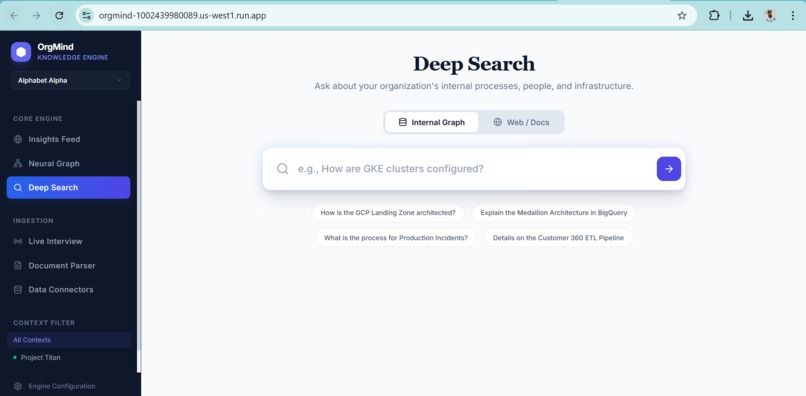
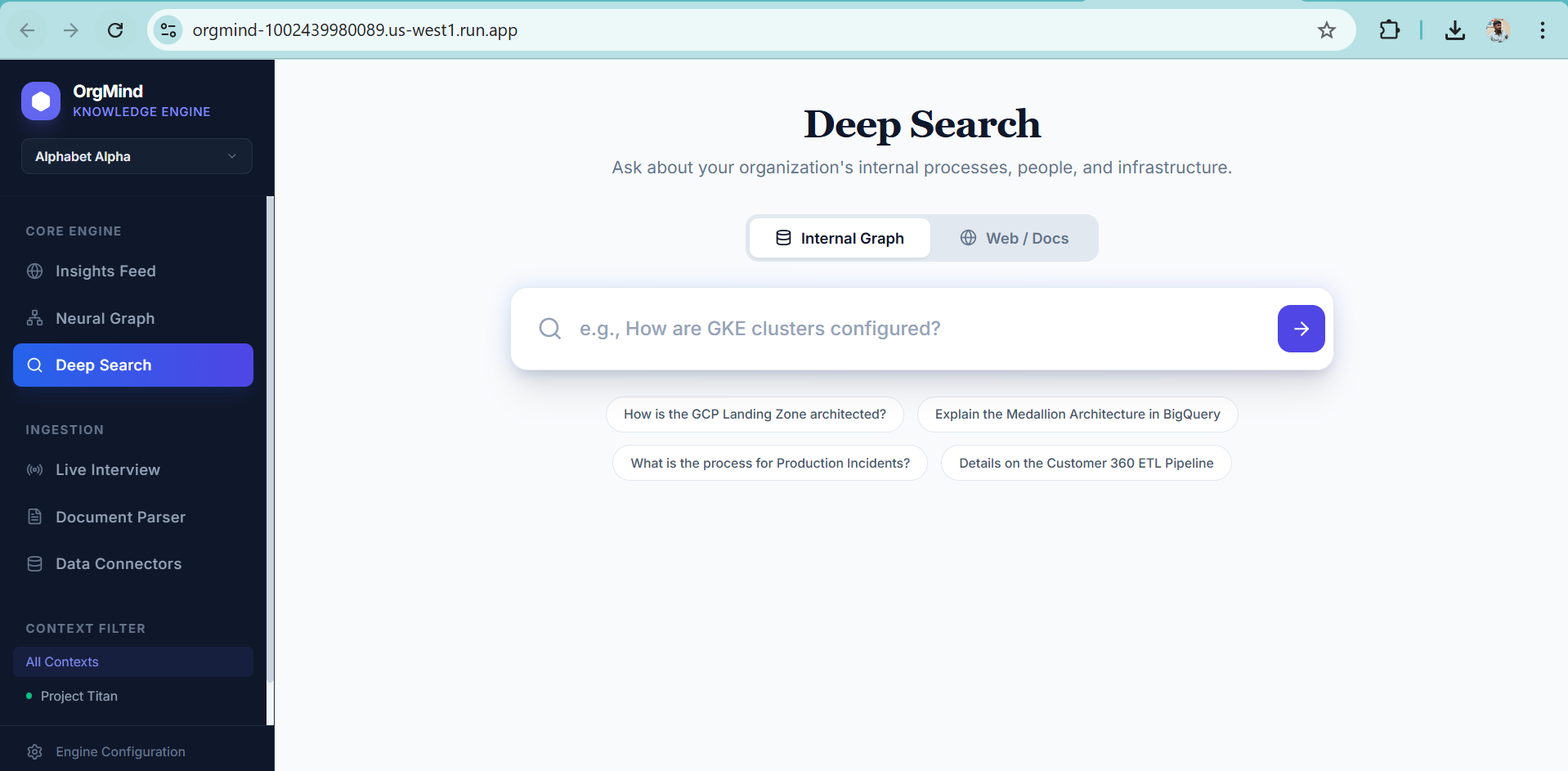
Deep Search Knowledge Engine
-
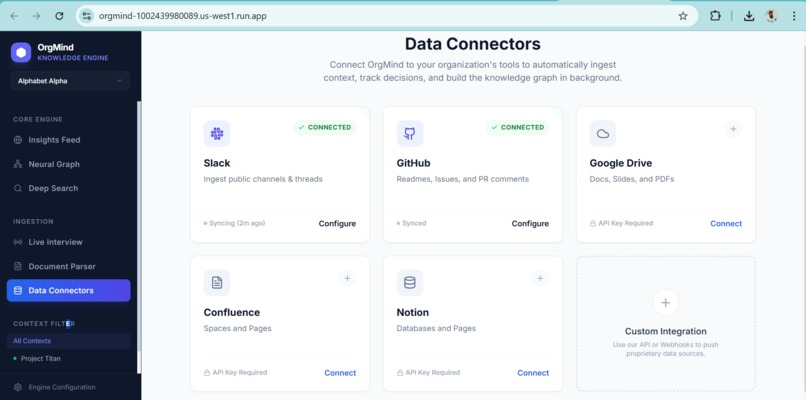
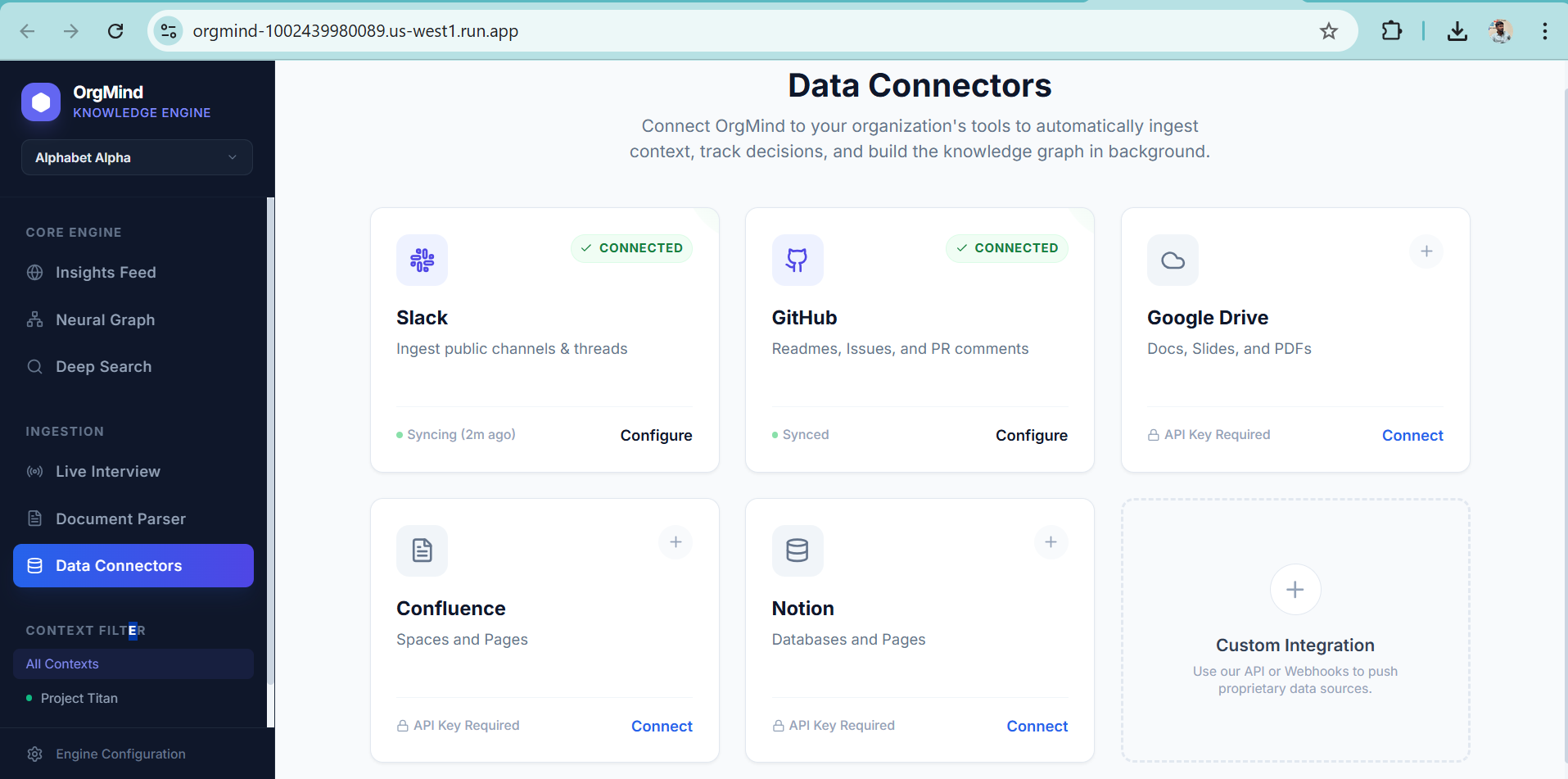
Data Connector for Third Party systems
-
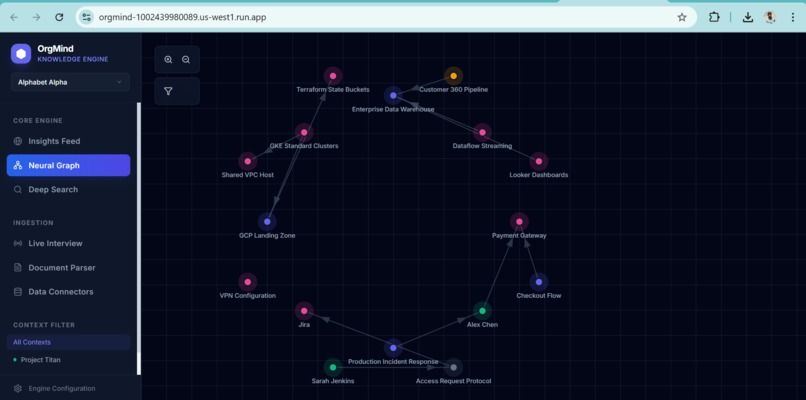
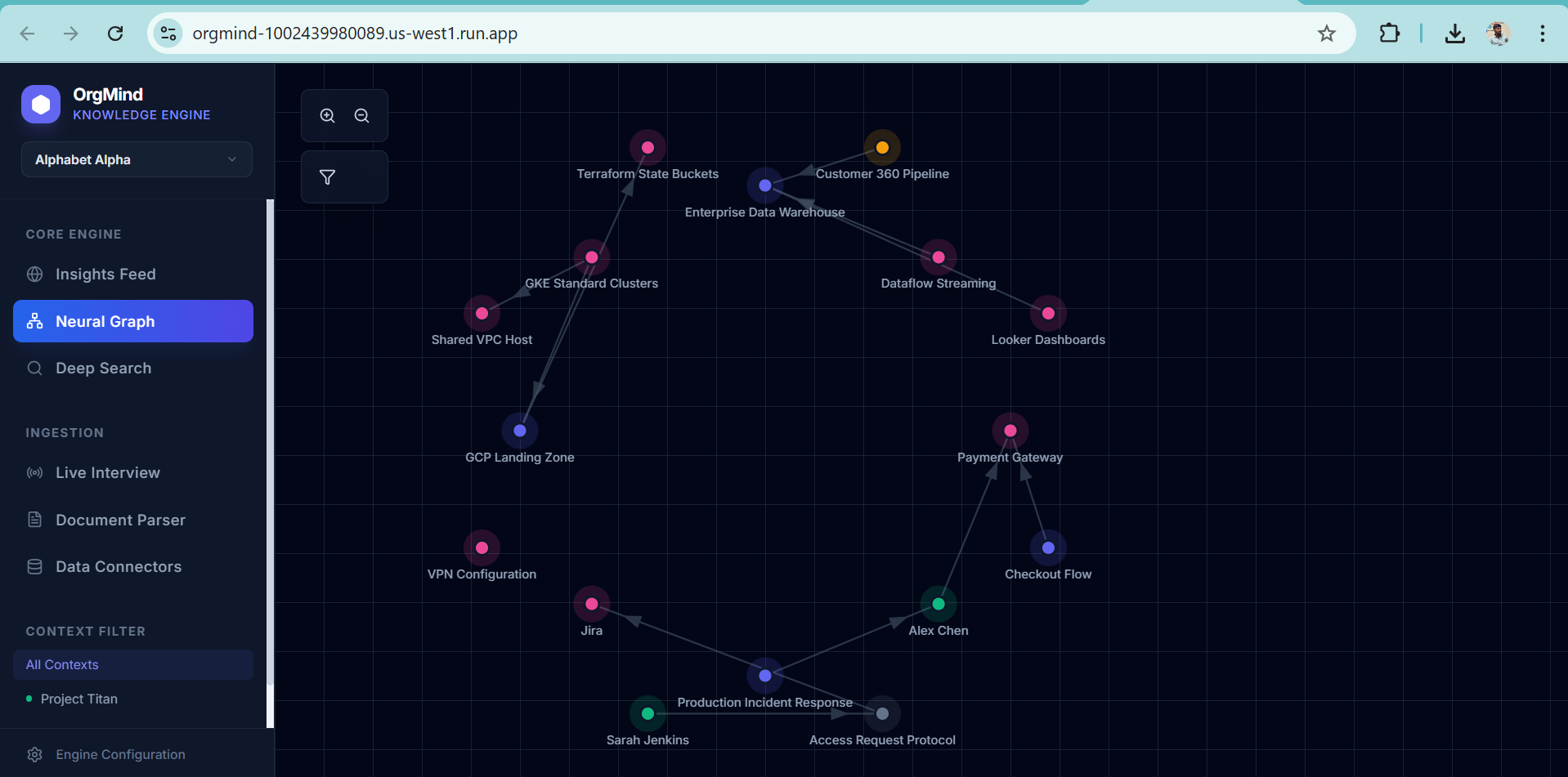
Knowledge Graph
-
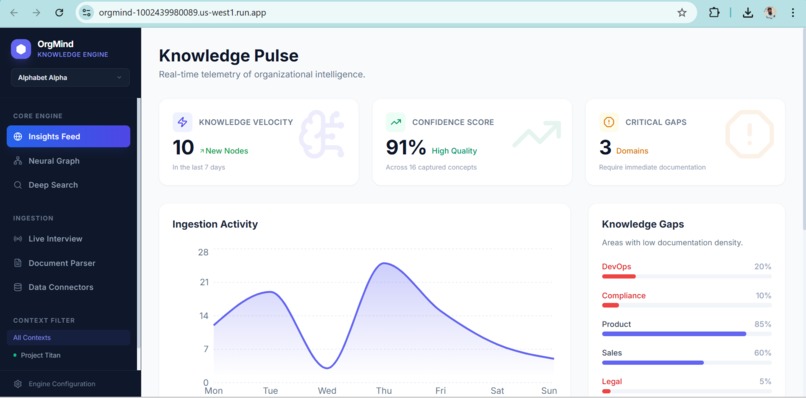
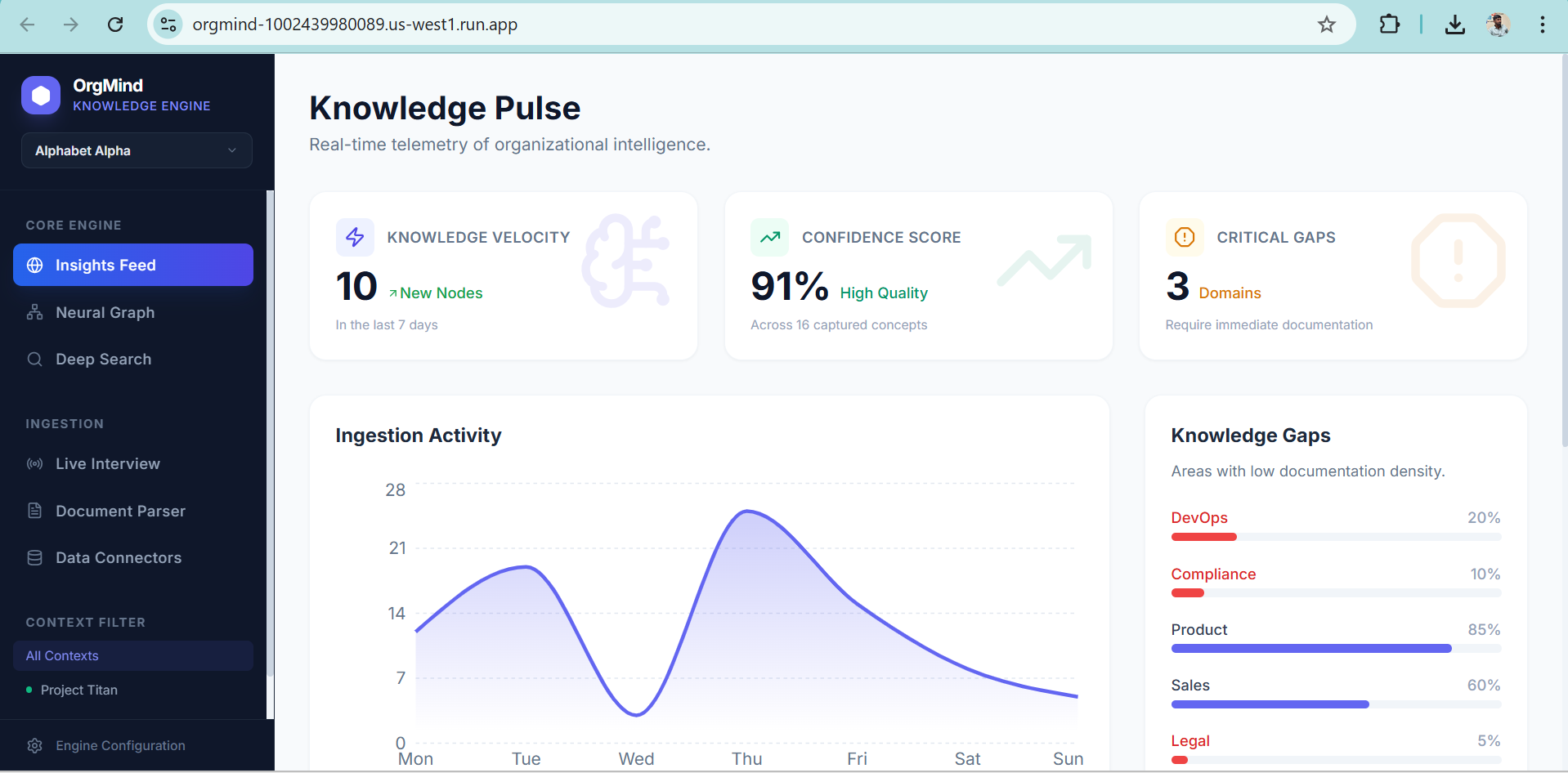
Knowledge Transfer Dashboard
-
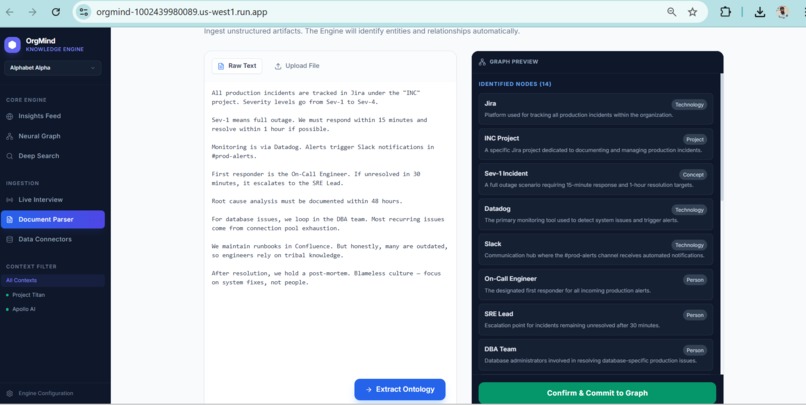
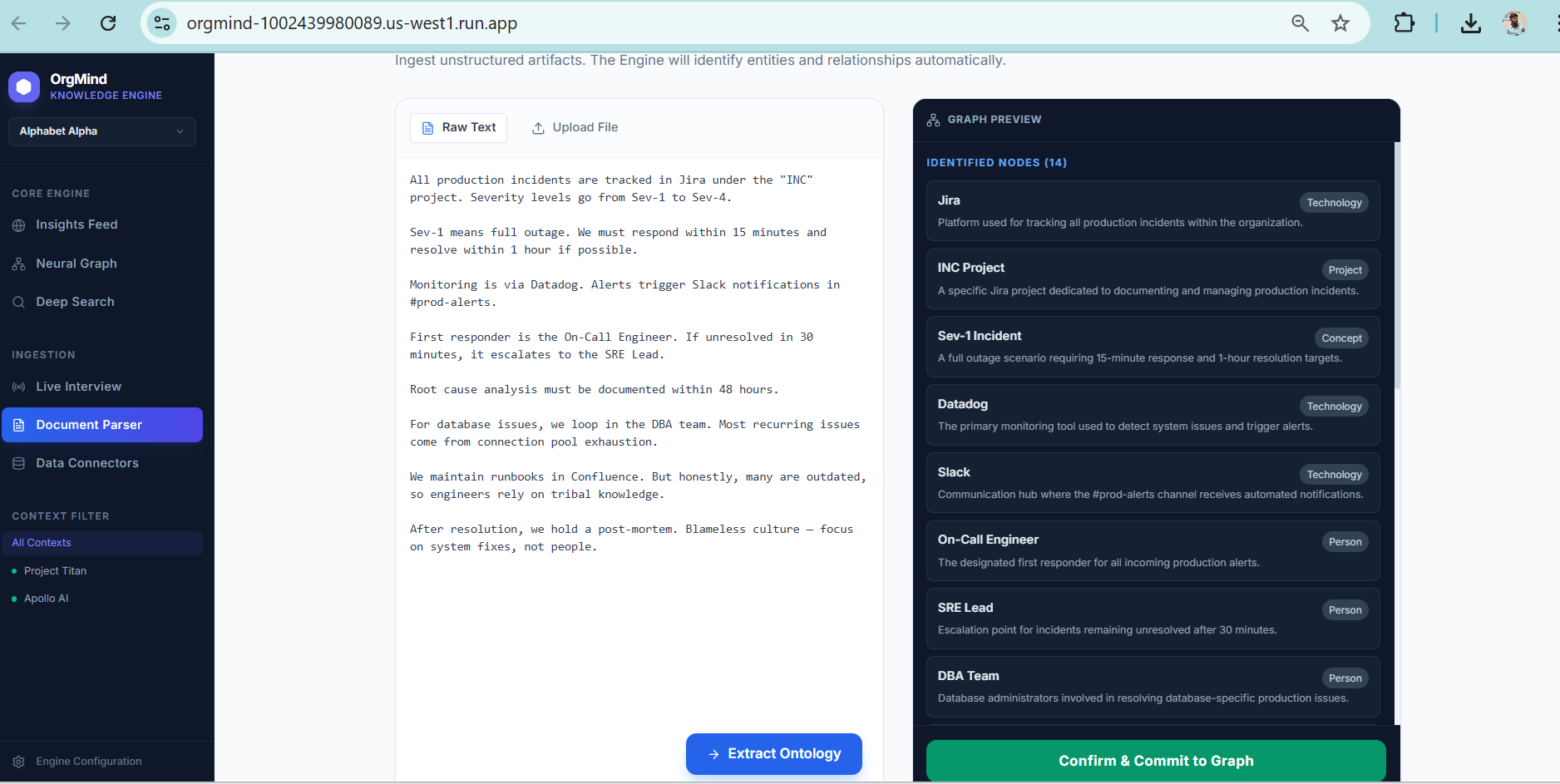
Document Parser
Inspiration
In large enterprises, Knowledge Transfer (KT) is often manual, incomplete, and risky. When senior engineers leave, critical institutional memory disappears. Compliance violations remain hidden in logs, incident patterns are undocumented, and teams repeatedly rediscover the same production failures.
We were inspired to build a system that treats Knowledge Transfer not as documentation, but as a governance problem — one that requires search, analytics, reasoning, and reliable action.
What it does
OrgMind is a multi-agent Knowledge Continuity system built with Elastic Agent Builder and Elasticsearch.
It autonomously: Indexes project artifacts (Jira, Git, docs, logs) Uses hybrid and vector search to retrieve context Applies ES|QL to detect patterns and anomalies Identifies compliance risks (PCI-DSS, GDPR) Computes a Knowledge Continuity Risk Score Generates structured KT plans Triggers workflow approvals Unlike a chatbot, OrgMind is tool-driven and multi-step. Agents retrieve, reason, correlate, and execute actions.
How we built it
Architecture
Data Sources → Elastic Ingestion → Elasticsearch (Hybrid + Vector + Time-Series) → Agent Builder Swarm → Workflow Execution
We implemented a multi-agent architecture:
Log Analyst – Uses ES|QL for time-series pattern mining
Compliance Officer – Detects regulatory risks
Solutions Architect – Synthesizes KT documentation
Workflow Executor – Creates Jira tickets & notifications
Verifier Agent – Calculates risk confidence
Risk Model
We define Knowledge Risk as: $$ Risk=αI+βC+γD+δO $$ Where: I = Incident frequency C = Code churn D = Documentation coverage gap O = Ownership volatility ES|QL enables real-time computation of these variables directly from indexed artifacts.
Challenges we ran into
Designing multi-agent orchestration with clear role separation Ensuring Elasticsearch was central — not just a vector store Writing ES|QL queries that meaningfully quantified KT risk Balancing reasoning depth with reliable workflow execution
Accomplishments that we're proud of
Built a true multi-agent system, not just a chatbot. OrgMind orchestrates specialized agents (Log Analyst, Compliance Officer, Solutions Architect, Workflow Executor, Verifier) using Elastic Agent Builder to perform structured, multi-step reasoning and tool-driven execution.
Made Elasticsearch the intelligence backbone. We leveraged: Hybrid search (vector + keyword) for high-recall enterprise retrieval ES|QL for real-time pattern mining and time-series analysis Structured indices for logs, commits, tickets, and documentation Elasticsearch is not just storage — it powers reasoning and analytics.
Designed a quantifiable Knowledge Continuity Risk Model. Instead of subjective KT quality, we formalized risk as: Risk=αI+βC+γD+δO Where incident frequency, code churn, documentation gaps, and ownership volatility are computed using ES|QL aggregations. Connected reasoning to reliable action. OrgMind doesn’t stop at analysis. It triggers workflow automation (e.g., Jira ticket creation) and enforces governance processes, demonstrating safe and explainable agent-driven execution. Turned a common enterprise pain point into an autonomous governance workflow. We transformed Knowledge Transfer from a manual meeting into a measurable, intelligent, and auditable process.
What we learned
Hybrid search significantly improves enterprise retrieval quality ES|QL is powerful for pattern detection beyond simple search Multi-agent verification improves trust in autonomous systems Tool-driven agents are fundamentally different from prompt-based bots
Impact
KT documentation time reduced from ~4 hours to ~5 minutes Compliance risks detected proactively Institutional memory preserved automatically Workflow governance embedded into enterprise processes
What's next for OrgMind: Elastic Knowledge Continuity System
Enterprise Knowledge Risk Dashboard Build a real-time Kibana dashboard that visualizes: Project-level risk heatmaps High-risk modules Ownership instability trends Compliance exposure indicators
Cross-Project Governance Layer Expand OrgMind to operate at organization scale, detecting systemic risks across multiple teams and identifying fragile knowledge clusters. M&A Knowledge Consolidation Mode Adapt OrgMind to assist during mergers and acquisitions by: Indexing legacy systems Detecting overlapping services Mapping dependency graphs Highlighting compliance conflicts
Continuous Knowledge Drift Detection Use time-series analytics in Elasticsearch to detect: Sudden documentation decay Spike in unresolved incidents Ownership churn impacting stability
Self-Improving Agents Introduce feedback loops where Verifier Agents adjust risk weight coefficients based on historical outcomes, improving prediction accuracy over time.
Embedded Enterprise Experience Deploy OrgMind natively inside: Slack Jira Internal DevOps dashboards CI/CD pipelines
Making knowledge governance ambient and continuous, not reactive.

Log in or sign up for Devpost to join the conversation.